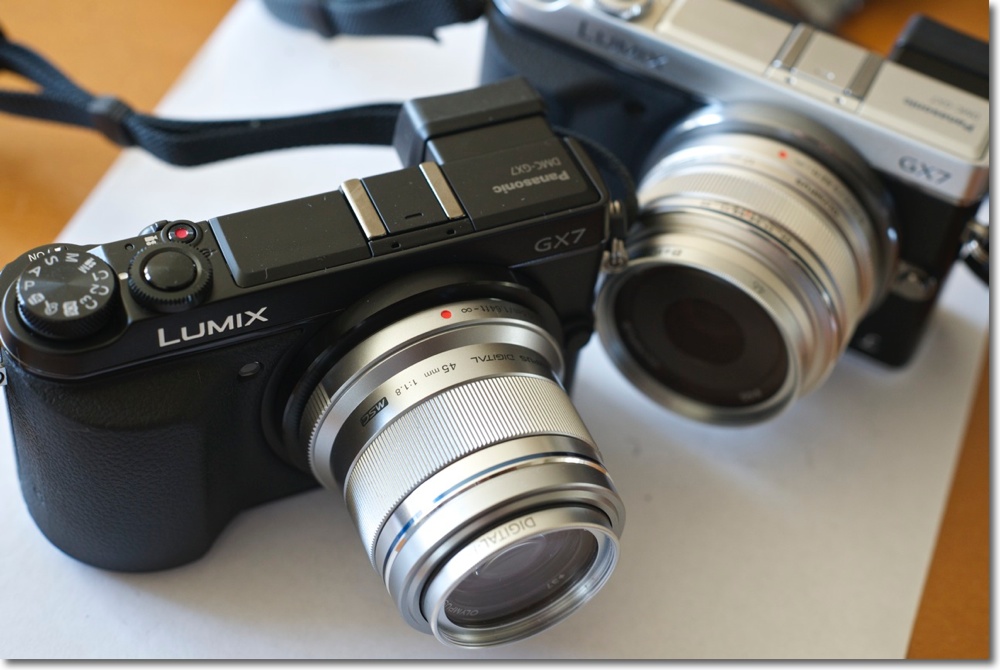
Panasonic Leica 15mm f/1.7 MFT lens

An interesting addition.

It’s not available in the US yet, though B&H already lists it:

The real comparison here for street snappers is the stellar Olympus 17mm f/1.8, which I have been using for a few months now. Regular readers will have noticed that the predominant gear byline for most of my recent street snaps published here is “Panny GX7, 17mm Zuiko” and the reasons are the same I noted in my original review. The fastest AF focus ever, unbelievable flare reistance into the sun, lovely color rendering and excellent optical quality at any aperture. The 17mm Zuiko is very much my “where have you been all my life?” lens.

So this new Panny-Leica optic has its work cut out in the competitive landscape. Fair, it’s a tad wider at 30mm FFE compared with 34mm FFE for the Oly and, truth be told, my brain is hard wired for 35mm after decades with a Leica M2 or M3 and a 35mm Summaron or Summicron attached.

But the point here is that it is heart warming to see so many lenses and makers in the MFT system – Panasonic, Olympus, Leica, Voigtländer with others like Bower/Rokinon joining the frey. And it’s ridiculous to argue that the $600 asked for the new 15mm optic is high. Have you priced Leica’s MF Summicron for the M body recently?

I was going to run a piece in late 2013 on the Panasonic GX7/Olympus Zuiko 17mm f/1.8 as the greatest street snapper combination yet, but decided to hold off until I had more experience with the outfit. Unless there is something very special indeed about the new Leica optic, expect to see that piece run in December, 2014.

Meanwhile, the hegemony enjoyed by Canon and Nikon in pro DSLR ‘flapping mirror/vast bulk and weight’ applications addresses an ever narrowing field of specialization. If you need very shallow depth of field and routinely print larger than 18″ x 24″, there’s still good reason to go with the big boys. But for everyone else, MFT solves. APS-C seems increasingly pointless to me – most of the bulk of FF and none of the pluses of MFT.

Conflicted advice? Hardly. I use a Nikon D3x/D2x and a host of legacy MF lenses, mainly because it’s fun and the investment is amortized. But light and jolly this gear is most certainly not.

Movies

Finally indexed.

Because they are so important a source of visual inspiration, I have indexed the articles here referring to movies.

You can access the index by clicking the drop down menu in the masthead, as illustrated below.


Or just click the image.

Walter Rosenblum

A man of the highest caliber.

Go to the web site of Walter Rosenblum and you will find this description in his bio:

“Walter Rosenblum has been a photographer for fifty years, as well as an important figure in the advancement of twentieth century photography. His early involvement with photography began when he was seventeen years old, when he joined the Photo League where he met Lewis Hine and studied with Paul Strand.

As a World War II U.S. Army combat photographer, Rosenblum landed in Normandy on D-Day morning. There, he joined the anti-tank battalion that drove through France, Germany and Austria; he took the first motion picture footage of the Dachau concentration camp. Rosenblum was one of the most decorated WWII photographers, receiving the Silver Star, Bronze Star, five battle stars, a Purple Heart and a Presidential Unit Citation. The Simon Weisenthal Center has honored him as a liberator of Dachau in WWII.”


Rosenblum’s street photography, frequently dealing with the poor, is exceptionally sensitive and introspective. As the son of immigrant parents brought up in a cold water apartment in the slums of the lower East side, it’s little wonder that he had empathy with the poor people whome he portrayed. The words ‘classical pictorial photojournalism’ come to mind as an apt description of his Å“uvre.

His book is available from Amazon – click the image below to go there:


Click for Amazon.

The images are well printed, with satisfying richness. The book includes a fine history of social conscience photography from Jacob Riis and Lewis Hine through the FSA and Rosenblum, written by the photographer’s wife, Naomi Rosenblum.

Recommended for all fans of quality street photojournalism.

While the book is out of print, used copies remain available. My mint copy cost $50.

For more in this genre see also the work of Helen Levitt.

The Computer History Museum – Part II

The modern era.

Part I is here.

Many of the rooms in the Museum address the modern era, which I think of as being anchored by the introduction of the two landmark home computers, the Apple ][ and the IBM Personal Computer. The Apple was more than I could afford so I bought the IBM PC in 1983 and it was modern in the sense that it used disk drives, albeit low capacity floppies, had a modem and could accept expansion cards.

But before that, in 1981 I splashed out $1,795 for the best computer I ever owned, the Osborne 1. Purportedly portable, it weighed 23 lbs.


My first computer. The Lee Felsenstein designed Osborne 1 of 1981.

The small CRT screen was supplemented with a $100 plug-in 10″ green on black one, the stock display being pretty much unreadable. Two things made this machine special. First, it was cheap by the standards of the day – the software alone came to the price of the machine if bought separately. Second, it came with a ton of said software. In addition to the lean and mean CP/M operating system, it included the Supercalc spreadsheet application (a clone of Visicalc, the first spreadsheet), Word Perfect for word processing, Basic and most importantly, Ashton Tate’s dBase II.

The Ozzy had 64KB (yes, 64KB) of memory, CP/M taking maybe 28KB of that, and as the applications were tightly written with much assembler code, things just zipped along. It never locked up – something Windows would fix for the ensuing decade of misery. If your spreadsheet or magnum opus was too large disk swapping would kick in, using the second of the two 360KB, one sided floppies. The other floppy drive was used to load the OS and app of choice, one at a time. This was before the days of graphics, so despite these limitations speed was not an issue. After a few months I added a 300 baud dial-up modem for the early days of the Internet. You can see one below the left hand floppy drive, above. It was slower than molasses.

Suffice it to say that after a few months use I was expert in word processing and spreadsheets, decent in Basic and a wiz in dBaseII. Disk swapping meant you could store pretty large databases on the floppies and the application was very competent indeed. It’s fair to say that I learned 75% of what I needed about computer use on the Ozzy, as things only got simpler down the road. The remaining 25% was Photoshop and related, a few years later. The practical knowledge gleaned from using the Ozzy was worth orders of magnitude what I paid for the machine.


The two floppy IBM PC – my second computer.

While the Ozzy was still pretty much a hobbyist machine, the IBM PC was polished and finished when first sold. Where the Ozzy had the feel of a garage build, the IBM PC was made to very high mechanical standards – over-engineered really and a bargain at $1,565. That’s $6-7,000 in today’s money. There was a costlier XT version with a 10MB hard drive, but that was more than I could afford. I added an orange on black 12″ display and a 9×9 pin Okidata dot matrix printer which jammed faster than a Catholic priest chasing an altar boy.

Working at Salomon Brothers on Wall Street at the time, a like machine arrived and sat gathering dust for several months before I pulled my finger out and wrote some handy Basic routines addressing security positions and valuations. The Ozzy had taught me well. Within a year there was one on every desk, all running Lotus 1-2-3.

It’s amazing to recall how slow the clock speed of the Intel 8088 CPU in the IBM PC was. Just 4.77 MHz, single core. I’m writing this on an upgraded 2009 Mac Pro whose twin CPUs run 24 virtual cores at 3.33GHz – some 700 times faster per core. But the modern machine, though it processes any sort of graphics and audio you can throw at it with aplomb, really is not much faster in real use. Back then, tight code was a requirement given the limited memory available. Now it’s an irrelevancy.

Moving on we came on the Game Room where Winston got absorbed in the many early consoles and game machines on display, not least the very capable Atari. There’s an early Pong machine on display and all it does is present two bats, one to each player, and a bouncing ball, which goes ‘pong’ when you hit it – not as easy as it seems. Many bars installed this at the time and many quarters were wasted by patrons playing this inane game.


Winston in the game room.

Finally, Google has a couple of fine displays, one for Google Earth on five large LEDs:


Finding home using Google Earth.

Another lets you sit in one of the Google StreetView cars, atop which is mounted a nine lens camera – eight around and one to the sky:


Google sees all, whether you like it or not.

The remaining displays, replete with PDAs (PalmPilot, anyone?), cellphones and modern PCs, leave me cold. How excited can you get about cell phones, the original iPhone apart?

What is missing?

A room devoted to the sheer hilarity of the many predictions made about technology would do well to discourage speculating about anything further than a week out. Here are some of my special favorites – obviously Doofus must take pride of place here:

  • “There’s no chance that the iPhone is going to get any significant market share”. Steve Ballmer, Microsoft CEO (April 2007)
  • “There is no reason anyone would want a computer in their home”. Ken Olson, president Digital Equipment Corp (1977)
  • “Remote shopping, while entirely feasible, will flop.” Time Magazine (1966)
  • “The ˜telephone” has too many shortcomings to be seriously considered as a means of communication.” Western Union internal memo, 1876.
  • “I think there is a world market for maybe five computers.” Thomas Watson, chairman of IBM, 1943.
  • “The world potential market for copying machines is 5,000 at most.” IBM executives to the eventual founders of Xerox, 1959.

Compared to those the daily pap you see in the MSM about the stock market is supremely credible and accurate.


Winnie 4 years ago with the iPad1 – not making any predictions..

Dining:

After visiting the Googleplex down the road we drove back across the freeway on Shoreline Boulevard into the town center on Castro Street in Mountain View, a city which was virtually unknown until Google came along just 15 years ago, somewhat defying the Luddites’ conviction that technology destroys jobs. Now Castro Street is lined with chic restaurants and stores, including three (!) bookstores. You know, hard covers, paper, numbered pages and so on.

We had lunch at CrepeVine, which offers a bewildering array of crepes. It’s directly opposite Books, Inc.:


A bewildering array of crepes.

I went for the Tuscany with chicken on a savory crepe, whereas Winnie opted for a truly disgusting looking toasted cheese kids’ sandwich with fries. Pure glop. $20 for the lot and we sat on the sidewalk under heat lamps. My son was the youngest person there, amidst an algorithm of Googlers, and I the oldest. The distinction we brought to the assembly is that neither of us has a boss, nor ever will.


Hustle and bustle at lunch.

Sated, we chatted about our Museum visit and Winnie gave it a “Totally awesome” rating, a modern adaptation and corruption of the language of Shakespeare which translates to ‘Bloody Good’ in the mother tongue.


Totally Awesome! Winnie at the Crepevine.

The Computer History Museum is unreservedly recommended, even for Luddites.

All snapped on the Panny GX7 with the 17mm Zuiko and typed on my Universal Turing Machine.