Everything that’s wrong with today.
Adding those mechanical era Nikon lenses for pennies to my arsenal makes me reflect how much computer technology has breathed new life into optics almost 50 years old. A CPU is easily added conferring proper EXIF data on every file. A tailored lens correction profile can be made in minutes and will recognize the lens in Lightroom using the newly found EXIF data. Searches on focal length are now made possible – it’s a common search field for me when I ‘lose’ an image despite fairly decent keywording. I often find that I can easily recall which focal length was used to make an image in the catalog. Superb new processing technologies, such as the enhanced Clarity slider in LR4, add microcontrast where there was none. Sharpening technologies make the mushy pop, and you can even add lens blur easily in Photoshop. All of these technologies make something very old, in photographic terms, new again and lenses long ago forgotten are resurrected to once more work their magic.
That appeals mightily to the engineer’s soul in me.
No one would deny that the latest Nikon AF D and G series lenses are masterpieces of the optical designer’s art. Or maybe one should say masterpieces of the computer programmer’s code. We have optics like the 14-24mm ultrawide zoom whose performance, by all accounts, improves on its prime competitors from the same maker. And while not cheap, try buying the constituent primes for less. But the problem with these new lenses is that their settings are awful. Plastic this, resin that. The controls grind rather than rotate, nylon gears abound and the whole thing feels like the kit lens off lower end budget models. And while the materials used appear not to lessen performance – indeed, lightning fast autofocus is a modern miracle which only ever helps matters – I believe that a well made lens can improve a photographer’s output in much the way a Porsche makes everyone a better driver. Eventually.
And nowhere can you find a more succinct summary of what ails modern designs than in the humble lens cap.
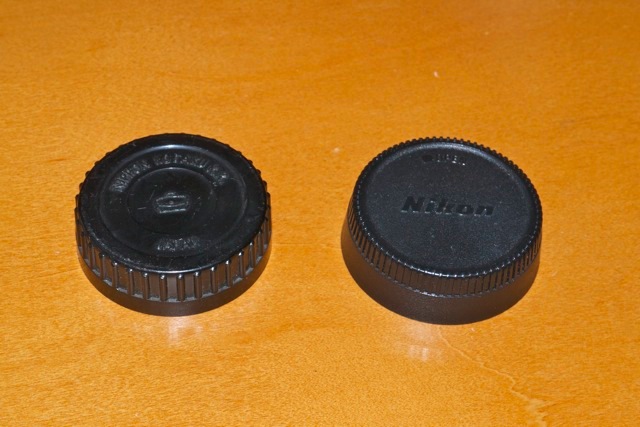
1965 and 2012 Nikon rear caps.
With three real oldies in my collection, all from around 1970, I thought it only appropriate to track down period rear caps. Those three lenses – the 50mm f/2 Nikkor-H, the 105mm f/2.5 Nikkor-P and the early four element 200mm f/4 Nikkor-Q – have an aggregate age approaching 130 years. The last, incidentally, though a simple four element Sonnar design, is probably the standout of the three, which is saying something given the prowess and renown of the first two designs. It’s only fair to grace them with period caps. And just look at those caps – the 1965 model is bakelite and has large, deep and long ridges which makes one-handed removal easy, because it is correctly shaped. The 2012 variant makes no such concessions to function and proves that if you can get everything wrong in something so simple, modern designers will find a way. The milling is pathetic, pure decoration without function. Then, to make absolutely sure that the thing is as slippery as a snake, the milled surface is inclined, making it almost impossible to remove the cap with one hand. Finally, well, there’s no other way to say it, it looks like the crap it is.
Here are those three Nikkors with which I am gradually getting acquainted, each superb in its own right and optically equal to the latest resin mounted horrors. Sure you have to turn the focus collar and, yes, I have installed CPUs in all three, as you can see, but the sheer pleasure these confer on this photographer’s snapping makes for better pictures. And $200 gets you the lot.
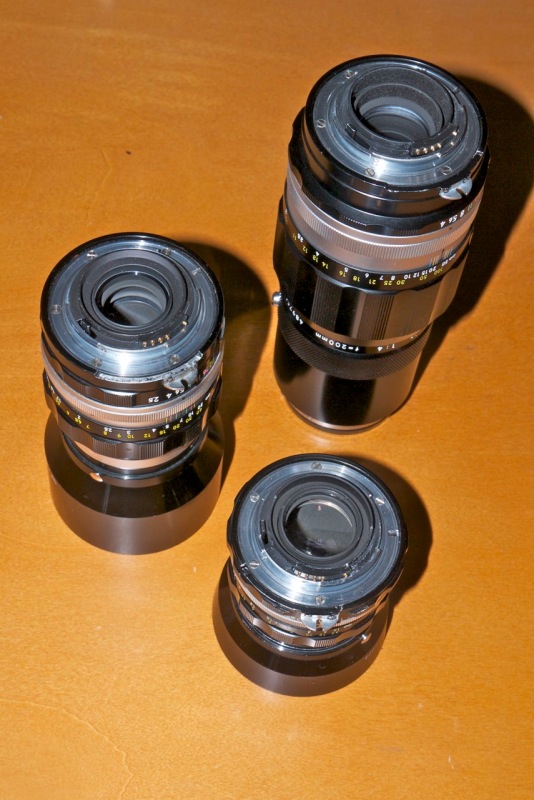
50, 105 and 200mm Nikkors from the last great era of lens making.
All have been Ai converted and have CPUs installed.
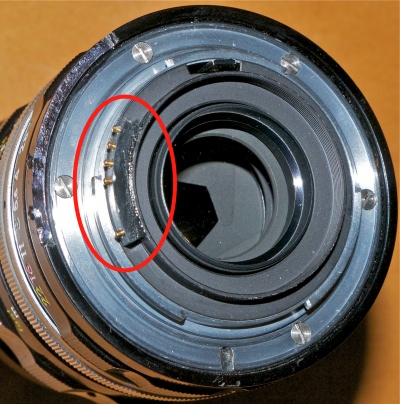
Bringing an old lens back to life. CPU installed on the 105mm Nikkor.
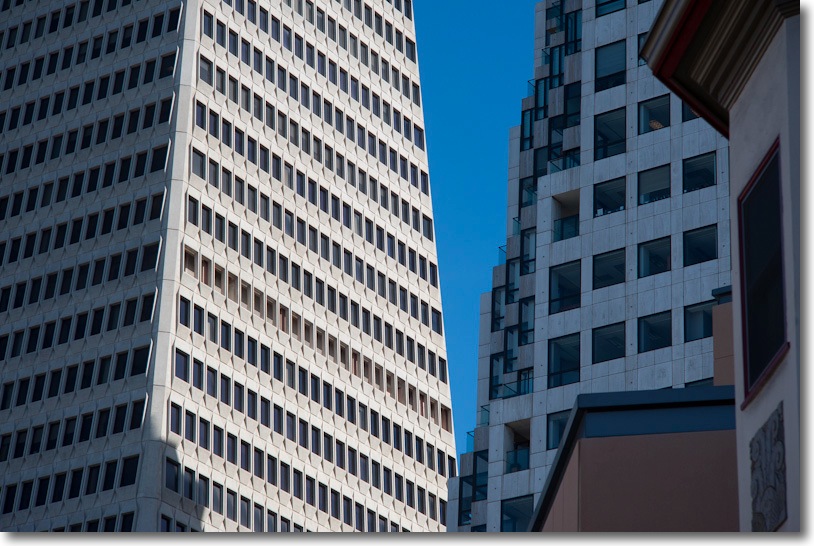
Transamerica from Columbus Avenue – 50 years old this year! 105mm Nikkor-P – a spring chicken at 42.
Sometimes old can be better.