From the ongoing Roach Coach series.
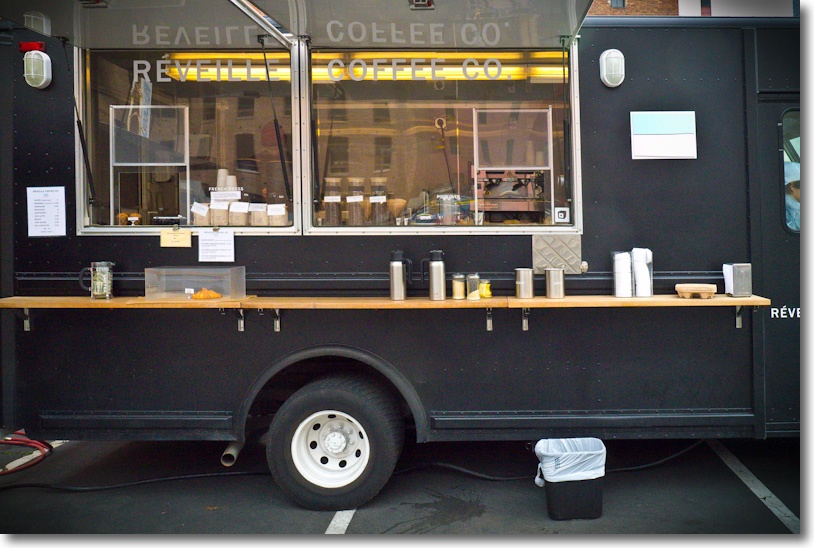
Near Jackson Square, SF. G3, kit zoom @14mm.
From the ongoing Roach Coach series.
Near Jackson Square, SF. G3, kit zoom @14mm.
A spot of timing.
I reckoned that if I pressed the button just so, the legs would mimic the Transamerica pyramid. In the event, I lucked out, with the parking meter adding a surreal touch.
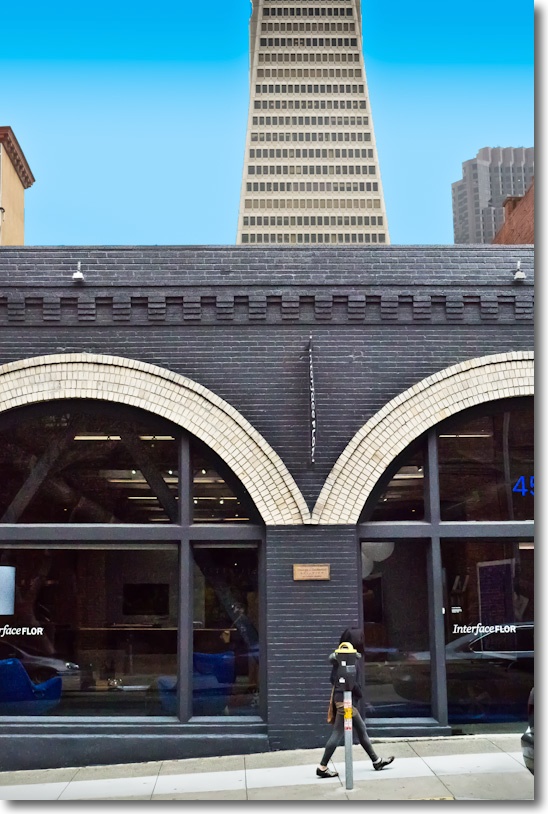
Click the picture for the video. On Pacific Avenue, San Francisco. G3, kit lens.
InterfaceFLOR, in the interesting foreground building, makes carpet squares for industrial and office use – modular carpets for a modular world. What’s not to lke about that lovely brickwork?
Click the image above to watch a video explaining how I changed a bland, washed out sky to gorgeous cyan with a couple of quick adjustments in Photoshop.
Update: A reader kindly pointed out that my fairly aggressive brightening of the foreground had introduced noise, so a couple of tweaks on the noise sliders in LR3 put that to right. The revised picture appears above. Note to self: Have eyes checked.
Top class Italian.
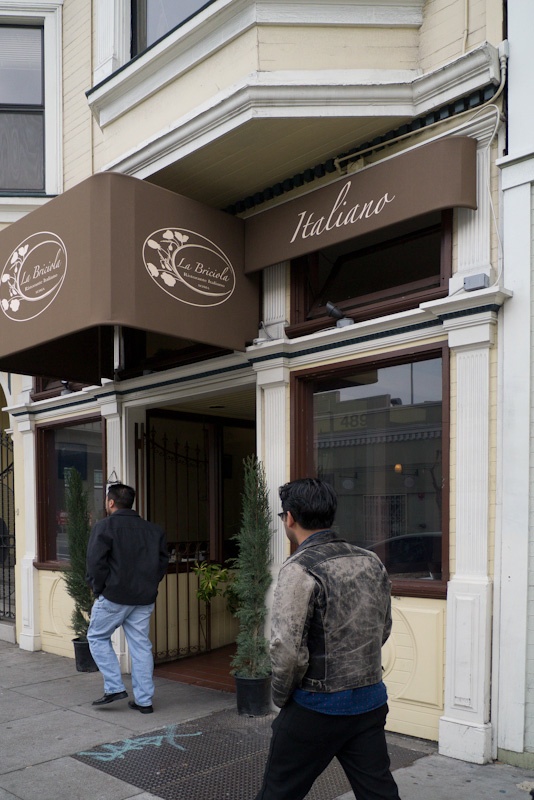
489 Third Street, San Francisco.
La Briciola makes its home at 489 Third Street in San Francisco, an unprepossessing exterior hiding an exquisite, high taste interior testifying to the best of northern Italian Tuscan food.
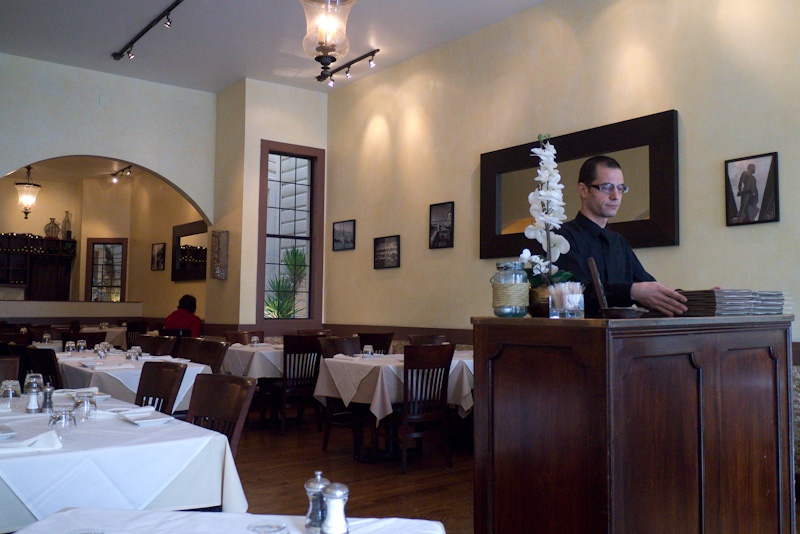
I feasted on the risotto with a fragrant Moretti Rosso and cannot speak highly enough of the service. The charming, and very Italian waiter, above, saw me taking a snap of the interior and before I knew it we were deep in discussion about the forthcoming Lytro light field camera!
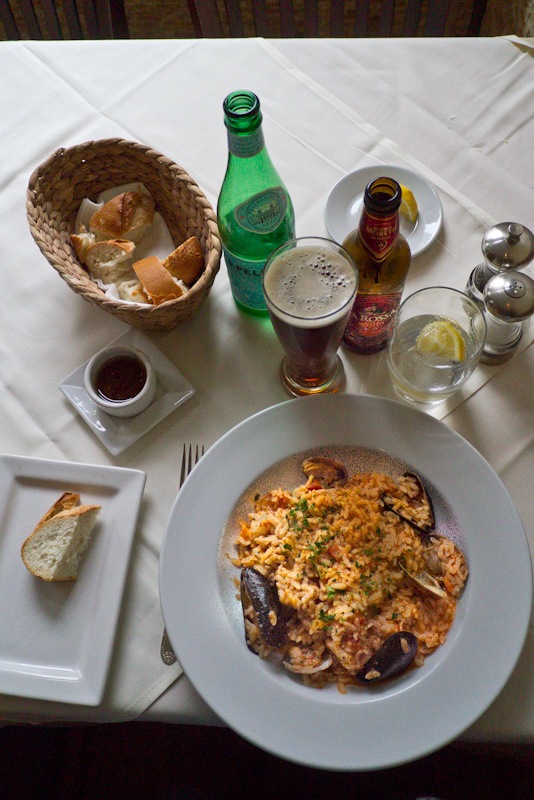
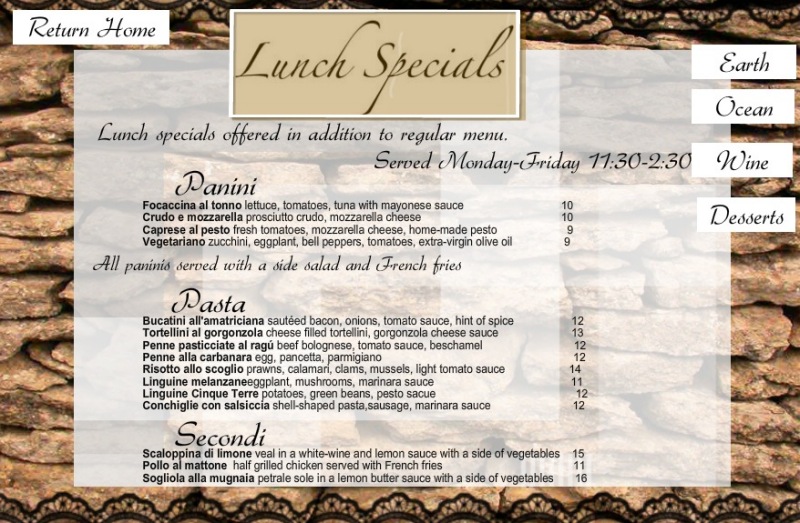
Risotto allo scoglio prawns, calamari, clams, mussels, light tomato sauce, Moretti Rosso.
This is very much a linen tablecloth sort of place yet one without any talking down to the customers. Highly recommended. The olive oil was the high point of the meal, with fragrance and flavor to die for. My tab for the risotto, beer and a Pellegrino came to $30 – spendy, and worth it.
A tragedy.
She remembered the chill running down her spine.
The man was tall. Tall and wide in that Mediterranean way. He blocked the light. The hair a touch too perfect, maybe on the verge of receding, the muscles well defined, the loose fitting black suit jacket sporting a bulge on one side.
But most of all she recalled the man’s smell. It was a strange mix of machismo and Old Spice, both sickening and alluring at the same time. She recalled the scent from her father and remembered how she had sworn to get away from that tedious middle class world of movies and dinner out once a week with her mum. So controlled, so cloying. She wanted so much more.
“Is Roger in?” he asked.
Instantly she knew he had asked that a thousand times. It was not a question he expected to be taken lightly or one to be denied. There was a mix of command, expectation and threat in the voice, lower pitched than she expected.
The eyes ran down her body, starting at her full, rouged lips, pausing at the single strand of pearls, resting that moment too long on her cleavage and then down past her slightly too tall body to her waist and legs, perfectly defined by the black Chanel evening dress. Too tall for Vogue, she had found her niche in the interior decorating line. The clients were men as often as not, frequently accompanying their trophy wives to that little place on Jackson Square that kept her amused during the week. Strictly high end furnishings, neatly extricated from China and England thanks to understanding customs officers, and commanding healthy mark-ups. Instant credibility for the hedge fund manager du jour who had hit it big before the SEC came calling. At least the male clients appreciated her for what she was, unlike the interior decorators who were the order of the day, and seemed to have eyes for one another only.
“Who shall I say is calling?” she asked, surprising herself at the slight quiver in her voice.
“Guido. He knows me.”
Roger visibly started when she announced their visitor. She recalled how his face turned the color of the Aubusson she had so lovingly secreted away on her last visit to Chartres. It was posited as a buying trip to her partner Nigel, but the reality was that she and Roger had devoted much of it to the first throes of new love, lost in one another’s arms most of the time. She recalled his long late night cell calls, all whispers and hidden glances, but made nothing of them. Roger was in money management of some sort, so she supposed that secrecy was part of the game. And that new 911 he had picked up in Zuffenhausen at the factory, a gorgeous antique silver Turbo which made a rude noise, testified to his success. A glance at the speedometer on the Autobahn had told her that this was as fast as she ever wanted to travel on the ground and she had closed her eyes and enjoyed the fragrance of the seven Schwabian bulls it had taken to line the interior.
The meeting took maybe twenty minutes. Even though the library doors were thick oak – she had personally seen to their import from that old castle in Berkshire – she could clearly hear the raised voices through them. When Roger finally came out his color had changed from Aubusson green to something more reminiscent of China white. He had rushed to the living room and poured himself a generous tumblerfull of Aberfeldy 21 – he had it specially shipped from the distillery in the Highlands – downing it in two great gulps. As the color came back to his cheeks, she gently inquired.
“Roger, darling” she knew that he loved the ‘darling’ part, “is anything wrong?”
“No, nothing honey. Nothing for you to worry about”.
She knew better than to ask, but she recalled how Roger had shouted out in his sleep that night “No, no, not that!”
She had always smoked too much, and during periods of stress she only smoked more, castigating herself for the habit. How her mother had upbraided her for that. What was Raleigh thinking of when he brought those early tobacco leaves back to the West? The only calming influence on such occasions was her first love, from her days immersed in English Lit at Vassar. Fyodor Dostoyevsky. So it was ‘The Brothers Karamazov’ that she had taken with her to work that fateful day.
It all happened so quickly. She has been waiting too long outside the store, had smoked too many cigarettes. Nigel had asked if she needed a ride, and she had brushed him off. And when it happened, where she was expecting Roger there was a hulking Guido emerging from the long, black limousine. His scent had a new taint. She recalled it from her chemistry lessons at school. Suddenly, one of her Blahniks had fallen off as she struggled hopelessly against Guido’s powerful biceps, the red Dior wrap ripped off, her Prada eyeglasses hurting her then falling with a sickening crunch to the sidewalk, and as the handkerchief came up to her mouth, all she could recall was a mix of man odor, Old Spice and chloroform. Her book dropped to the ground and she felt herself falling, falling, falling ….
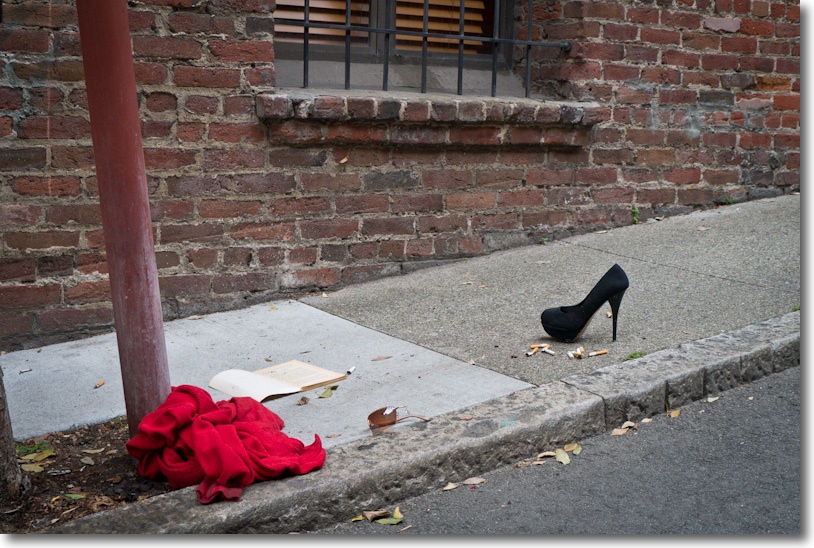
Osgood Place, Jackson Square, SF. Yesterday.
Harold Mac knew it.
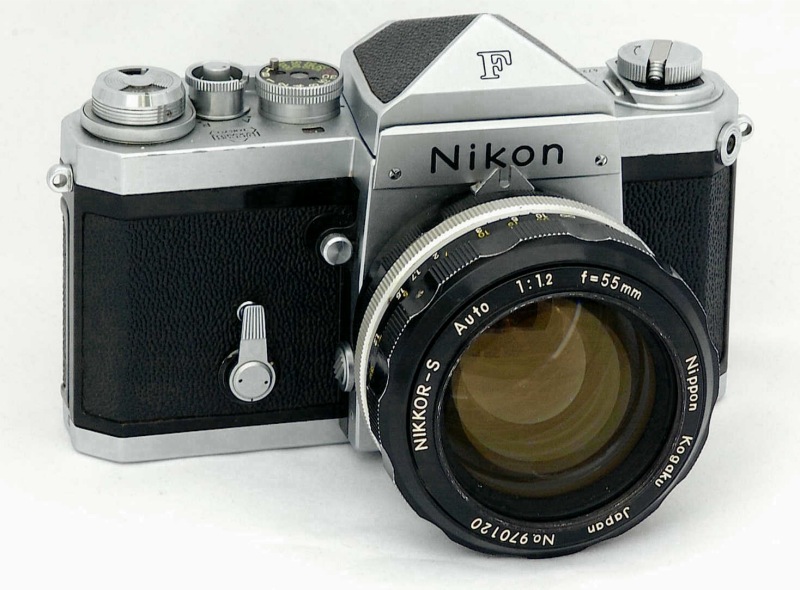
The state of the art around Harold Mac’s time.
A British Prime Minister and the wealthy scion of a famous publishing company once told the British that “they have never had it so good”. That was Harold Macmillan in 1957. This applies equally to photographers today. And while Harold Mac was addressing one of those rare periods of prosperity that England only enjoyed once since (unless you were a bankster), for photographers it continues to get better, and at an accelerating pace.
Sure, we can grumble that full frame DSLRs are behemoths which deny the original full frame concept introduced by the Leica almost a century ago. And why don’t most cameras have proper viewfinders? But if you are prepared to give up a little flexibility, and make a compromise or two, the raft of expected features today is breathtaking. Consider:
Of that long list, the 1925 Leica offered but the first three …. and the Leica or Nikon of Harold Mac’s time offered no more, though either now weighed twice as much!
These thoughts ran through my mind after seeing the David Bailey movie I wrote of the other day. Every time he raises that Pentax to his eye I think of the horrendous amount of back-end work needed to realize the artist’s vision. And that assumes he focused and exposed the image correctly in the first place.
Technology obsoletes labor and expertise. For many economies that’s not a good thing but for all photographers it’s a dream come true. So what if “anyone can take a picture”? Kodak said “You take the picture, we do the rest” over a century ago. Kodak is gone but that jingle is finally true. The “we” is largely microprocessors/telcos/computers/cell phones, and the amount YOU have to do has never been less. All you need is a forefinger and an eye. The latter is in as scarce supply today as it has ever been. But the technical obstacles to the realization of vision have never been lower.
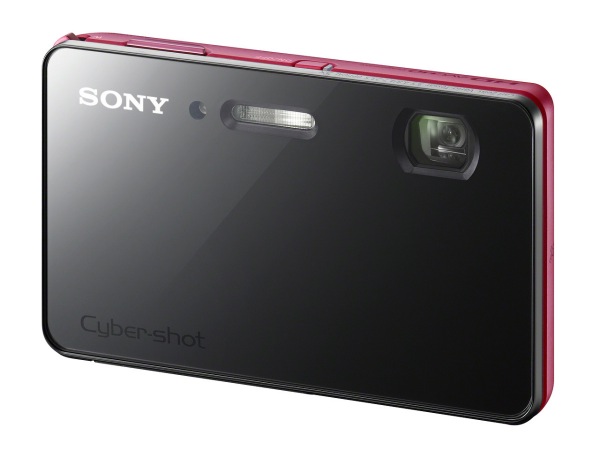
The state of the art today. Weight? <5 ounces.
Bailey would have killed for that little Sony in 1962 as much as Cartier-Bresson would have in 1932. And Roger Fenton would have killed for either the Sony or that Leica of yore:
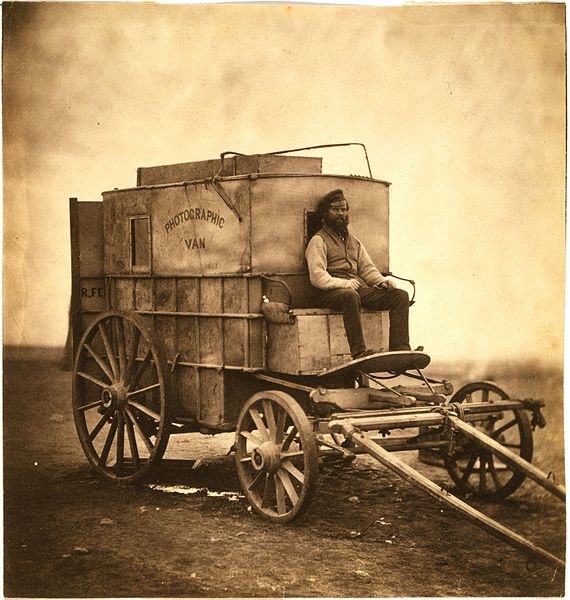
Roger Fenton’s gear wagon, Crimean War, 1855. Weight? 500 pounds + horse to feed and water.
And you thought your kit bag was large?