An inspired creation.
This column has nothing to do with photography. Rather it addresses a truly impressive creation from a company which is a stranger to innovation and reliability.
Microsoft.
Yes. Microsoft.
I have long ago realized that for my demanding computing needs, whether for business or photography, the optimal combination when performance and reliability are key is PC hardware married with Apple’s OS X operating system and related applications. No surprise that my workhorse is a Hackintosh. No breakdowns, no overheating, no lock-ups, it just runs 7-by-24 and never shows any signs of stress. The design has massive redundancy in case of component failure and all parts are readily available and inexpensive. The displays I use are made by Dell (LG LCDs) because it’s simply impossible to properly profile any Apple display for photography. But after spending 18 of my first 20 years with computers running Microsoft’s OS, I know that nothing will get me there again. Windows 7 is, by all accounts, robust and reliable, but when you have been kicked in the crotch dozens of times by its predecessors your desire for more of the same is zero. So the last ten years have seen this happy user depending on OS X and the recent years finally saw Apple’s pretty but poorly engineered iMacs shown the door, replaced with robust, reliable, well engineered PC hardware.
Thus, when Microsoft released Xbox a few years back I took no notice, and took even less when they debuted the strangely named Kinect add-on accessory in late 2010. “Designed to fail” I recall thinking, after reading the hype. Plus it said ‘Microsoft’ on the box. No thanks.
Then a strange thing happened. Our son, a Nintendo Wii man when it comes to motion games, came home bubbling from a friend’s home, replete with tales of a soccer game he had just played …. in the living room. Turns out the friend has an Xbox360 with Kinect and, as Winston related it, there is no controller. “You just move your body”.
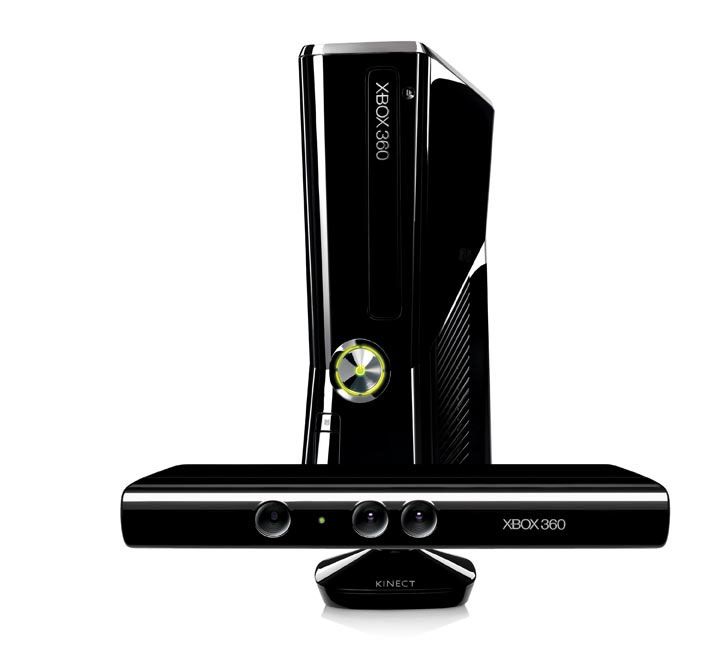
The Microsoft Kinect. Pure genius.
Naturally, I applied the old Socratic process to the boy, grilling him mercilessly on the device and on its performance. He had all the answers. Simple setup, never locked-up, no lag in replicating your movements, doesn’t need special lighting, and so on. “And it’s a lot of fun, dad”.
Well, he’s been doing well at math recently (can’t think where he gets that!) so, holding my nose, I ordered an Xbox360 + Kinect from Amazon.
The word ‘Microsoft’ is nowhere to be found on the box in which the device ships. That’s a good start. We set it up together, Dad suffering from extreme Blue Screen Of Death fear while Winnie merrily looked forward to playing. Not only did nothing go wrong, the device recognized the 802-11n wifi in the home immediately, automatically downloaded a bunch of software updates and maybe 15 minutes later, after a bit of calibration for his 4′ 2″ and my 6′ 0″, we were up and running with the included ‘Adventures’ disc. We mounted the Kinect sensor on the TV using a cheap PS3 mounting clip and some heavy duty Scotch Velcro-like material – the sensor weighs a few ounces.
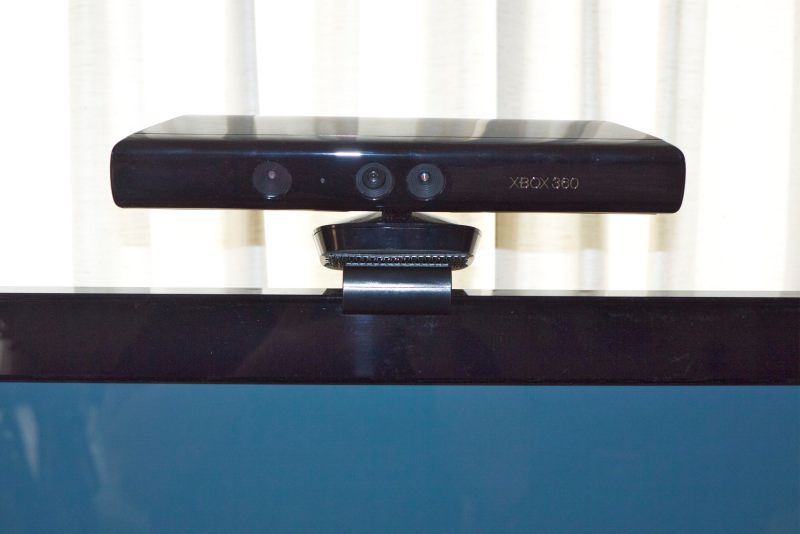
The Kinect sensor mounted on top of the TV.
The technology is simply jaw-dropping good. The sensor measures you using infra red beams and thereafter replicates your movements on screen. Bright or poor light, it makes no difference. You need an area maybe 6′ x 6′ without obstacles in front of your TV. Then you insert a DVD game of choice in the separate Xbox360 console and follow the instructions. Absent some programming (avatar names and the like) which requires use of the included wireless Xbox controller, all you need is a hand to motion your choices. After many hours of play we have not had a single lock-up, blue screen or related panic.
On completing some of the games on the Adventure disk the Kinect plays back pictures it has snapped of the players, to great amusement of the subjects. Brilliant.
After being roundly thrashed by our nine-year old in the Olympics, using the (extra $) Sports disc, I determined to get my own back and bought the exercise game, one of whose options is a personal trainer. You know, one of those disgustingly fit babes who does 20 miles before breakfast and drinks carrot juice.
So I get into it, mimicking her movements on screen. You get told off if you get out of sync. The whole thing is controller-less. The device scans your body, asks your age and weight, how often you exercise (ahem!) then gets down to it – squats, kicks, you name it. Screen response to your motions is instantaneous.
Well, after a bit of this, following the babe on the screen and trying to keep my concentration up (and my eyes off her tushie), I am breathing heavily, my right knee may just have exploded, and the resident Border Terrier is raising a troubled eyebrow. My scores are falling and my temperature is rising. I tell Bertie to get on with the program as I have to rest, but he says he’s fit and too short anyway, thanks, so we are sit in the garden to recover having burned 20 of my 100 assigned calories ….
Gee, but it’s a real work out. And you don’t have to drive to the gym. Next time I’m telling it I’m 90. Man has to have a chance.
So here’s the $64,000 question. How can a company which is led by a buffoon, which doesn’t ‘get’ computing trends and which has failed at pretty much everything it has tried in the past two decades, a company which is a stranger to innovation, a company which wastes shareholders’ money on foolish acquisitions, do something so brilliant? And when will they close it down? This is simply too good for the likes of Microsoft.
Whatever your age, whatever you think of computer games (not much, in my case), you owe it to yourself to check out Kinect.