The streets speaks.

Bicycle by Microsoft.

21st Amendment.
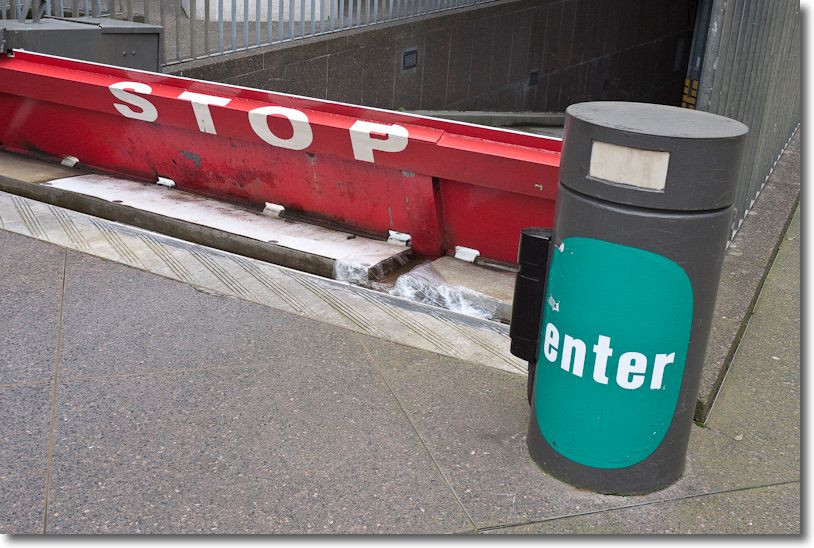
US foreign policy.
All snapped in San Francisco on the G1 and kit zoom.
The streets speaks.
Bicycle by Microsoft.
21st Amendment.
US foreign policy.
All snapped in San Francisco on the G1 and kit zoom.
Things I noticed.
The Fuji X100 brochure is now available from Fuji and as these things have a way of disappearing like all those test shots in early reviews, I have placed it on my file server and you can download it by clicking below:

Click to download the X100 brochure.
I’ll put aside any comments on the sheer vacuity of the puffery, which is at least written by an English speaker not by Google Translate, but there is some gold among the dross, and here’s what I spotted (page references are to pages as numbered using Apple’s Preview PDF viewer and 2-page display – the page numbering in the original is poor and incomplete):
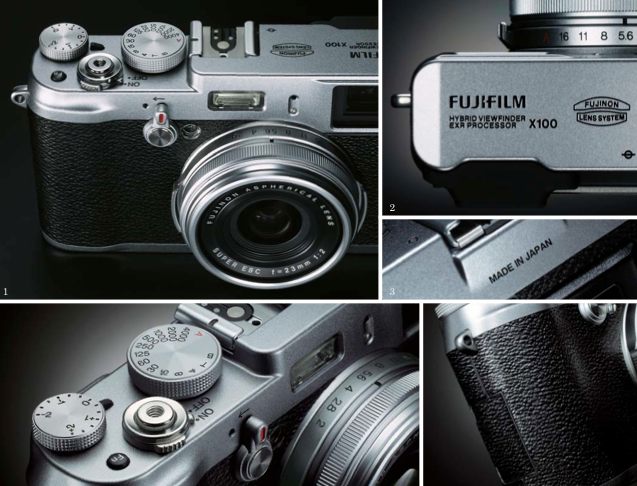
My comments are aimed at the primary target for this camera – street snappers. If you are into landscapes or bugs, I recommend you read elsewhere and buy something else.
[column width=45% padding=5%]
Page 4 – The user is clueless how to hold a camera with an optical finder. The lens should be supported from below with the left hand, not obscuring the finder.
Page 6 – The top plate engraving quality is a whole lot better than on my Leica M2 and M3.
Page 8 – The OVF displays vary between pictures confirming that you can tailor these extensively. The finder magnification is only 0.5x, a bit disappointing. The Leica M2’s 0.72x would have been better. The 1.44 mp definition of the eye-level EVF is identical to that of the Panasonic G1. That’s excellent. Diopter adjustment is -2 to +1 and the finder has a long eye point of 15mm meaning that eyeglass wearers like me will not struggle to see the full frame. One key aspect of the OVF is being able to see outside the frame lines, anticipating objects coming into the field of view.
Page 9 – The OVF can show under/exposure compensation, set on the top dial. Nice. It will also show DOF – useless, in my opinion. The AF target mark is a nice size compromise between spot and overall. The brightness of the displayed data varies with scene brightness. Really nice. There’s a proximity sensor, like in the iPhone, which switches off the LCD when the camera is brought to eye level. There’s also reference to a ‘Power Control System’ which suggests that you can switch off the dumb-as-it-gets LCD screen to conserve power. Any street snapper will immediately do this, not to conserve power, but to turn off the single device which has made nearly every point-and-shoot useless until now. An LCD screen is incapable of being a useful viewfinder in daylight. There’s a reference to ‘Page 25’ for more details, but that page is missing, their numbering jumping from 24 to 26 in the original document. Anyway, anything around 300-500 is fine and spare batteries are dirt cheap.
Page 10 – The lens charts show the lens peaks at f/4-5.6, just like Leica’s 35mm Summicron. The built in ND filter reduces sensor sensitivity by 3 stops. Handy when you want to use a slow shutter speed or large aperture but the light is otherwise too bright. For those who think they should be wasting their money on an X100 to take pictures of flowers, the LCD finder will allow framing down to 4″ (10cm).
Page 11 – Like on the Leica M8/9, peripheral photosite lenses on the sensor are inclined inward to minimize edge optical aberrations. There is some sort of dynamic range enhancement built in to reduce highlight burn out.
Page 12 – The top and bottom casings are die-cast magnesium. That beats a cheap pressing though I would have preferred plastic, owing to its greater shock resistance and flexibility when struck. They claim the lens engravings are hand-filled with enamel. Whatever. The reference to “Made in Japan” is so duplicitous you can bet the thing is made in China. The body covering is plastic. The smooth rubber from the G1 would have been better, if less sexy. The clear intent here is to mimic early Leica M bodies, though those used vulcanite which cracks and peels with age. There’s a dumb-as-it-gets male thread on the front of the lens with a decorative cover ring. You have to remove this and fit an adapter for a protective 49mm filter. As most 49mm filters have a front thread, it may be possible to simply screw one on reversed, but that would require the thread pitch on the lens to be identical to that used in filters. I don’t know if that is the case. There’s an optional leather case which no sane snapper will come within 100 miles of. There’s also an optional lens hood for those with more money than sense. Also an optional TTL flash for the same set.
[/column]
[column width=45% padding=5%]
Page 13 – The rear thumb wheel allows 1/3rd stop adjustments compared with 1 stop for the shutter dial on the top and aperture ring on the lens. Not sure how this interacts with what the mechanical dials show. The AE/AF button can be set to lock just AE or just AF. I cannot figure out whether a first pressure on the shutter release locks focus (which I like) and if so, that means I’ll be setting the AE/AF button to AE only, like on my G1. I have no comments on manual focus as I cannot see any use for it in street shots where time is of the essence. Those who like manual gearshifts in cars can get off on the options here. There’s a RAW button if you want to shoot in RAW and the camera is set to JPG. Who cares? Set the camera to RAW. There’s a bunch of stuff on white balance but as that’s all in Lightroom I don’t care. You can use sRGB or AdobeRGB gamuts. 5 shots per second bursts are limited to 2 seconds, 10 shots. Lots of bracketing options – AE, ISO setting, and film simulation (footnoted on p.14) – between Provia (natural), Velvia (garish) and Astia (flat). These purportedly emulate Fuji’s film emulsions. Nothing you can’t so in Lightroom or Photoshop.
Metering is selectable between multi metering (meaning you are clueless what is being measured), spot (2%) and average. The latter, used with RAW, is just what the doctor ordered for street snaps.
There’s an AF assist lamp for slow scenes as in “Hey! I’m over here! Can you see me now?”.
ISO top speed can be pushed to 12,800 from 6,400, a choice which can be assigned to the Fn button. Smart. Auto ISO works between 200 and 3200.
The reference to 0.01 second Shutter Time Lag is pure BS. They are trying to mislead by referring to VF display response not shutter lag. Every consumer camera on earth has a shutter lag dozens of times slower and the X100 will be no exception.
Here’s a show stopper. The included (and crappy) Silkypix software works with Winblows only! Wouldn’t do to realize that 99% of all creative people use Macs now, would it? This means that if you shoot RAW, like I do, you will have to use Windows with an emulator (I use the free VirtualBox from Sun and Wincrap XP) to process the images using SilkyPix until Adobe and Apple come up with RAW converters for Photoshop, Elements, Lightroom, iPhoto and Aperture. Ugh!
Page 14 – Built in Yellow, Red and Green filters for those who like to shoot in monochrome and don’t know how to use color or Lightroom. Beyond pretentious. The illustrations are so poor it’s hard to make out any difference. There’s some sort of dynamic range control for high contrast situations. If you like to get hosed down and buy the lens hood, it comes with the filter adapter ring.
No mention of movie mode anywhere which spares me additional vituperation. This is emphatically not a movie camera, having just two uses. One is for street snaps. The other is for the insecure – the types who put stickers in their rear windows saying which university they attended – to show their wealth. Those are the ones who will happily buy the silly leather case.
But, overall, this looks promising.
[/column]
[end_columns]
A tonic.
Planned obsolescence could only have been invented in America, the Land of the New. Long a staple of Detroit (which in turn has tried hard to obsolete itself) it has been perfected by the likes of Apple, each generation of whose computers makes sure it uses a new set of connectors guaranteed to make your peripherals obsolete or, at best, needing costly adapters to sort-of -work. (“It just works” should really be “It just sort-of works”).
For years Nikon, with its superb Nikon F film SLR, could rightly claim that planned obsolescence was notable for its absence from Nikon interchangeable lens bodies. Yes, the little AI hook came along to tell metering prisms what the aperture range of a lens was (you had to twist the aperture ring to minimum and maximum after fitting the lens!) but that hook could be fitted in minutes by a half-decent technician with a drill, tap and two screws. Later, when electronics came along the Nikon mount soldiered on and you can still fit most early Nikon film SLR lenses to your latest DSLR, even if most or all of the automation is missing. Leica was even better with its M rangefinders. Introduced to howls from the screw thread set in 1954 on the M3, the Leica bayonet mount soldiers on unchanged to this day, save for a few electronic contacts on lens and mount to tell the modern digital M8 or M9 things like aperture and the need for peripheral optical sensor-level corrections, notably with very wide angle lenses. Without these, the sensor has no way of recording lens data or correcting for aberrations. But, overall, you can get away with not using these or simply painting on your own ‘contacts’ as black blobs with a felt tip on older lenses to fool the body into doing the right thing. The fact that you need a few oil wells to afford that M9 need not trouble this discussion.
But if you have to give the prize for lack of planned obsolescence to any camera maker it has to be to Fuji (er, Hasselblad). Fuji may have bought Hasselblad years ago (and wisely kept silent about it to keep the premium price tag for its premium brand equity), and may also have seen the light of day that the huge installed V camera base (500C through 503CW variants) really should upgrade to the completely redesigned and super expensive H range with its electronics-loaded optics and superior ergonomics. But that didn’t stop someone at Fuji contracting with sensor makers to make one of the great anti-obsolescence hardware statements in photography.
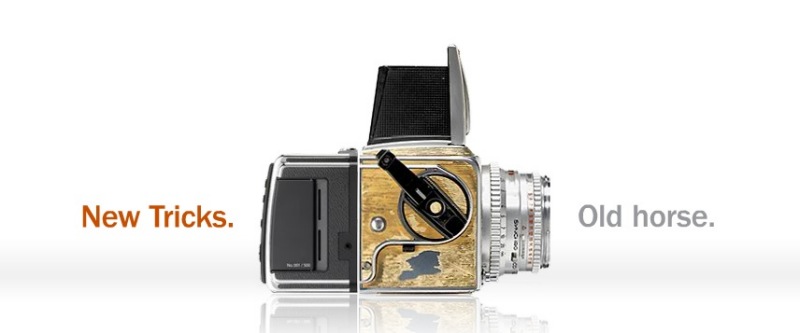
The digital back for the Hasselblad 500c.
It’s still not cheap – the current Hasselblad CFV digital back comes in 39 and 50 megapixel variants at $14-17,000, which is more than an entry level $14,000 H4D-31 with a new fangled standard lens – but if you have a major investment in 500-series lenses and really like that retro thing, it may make economic and emotional sense. Though before you get too emotional, you can procure an awful lot of film processing and scanning for that ….
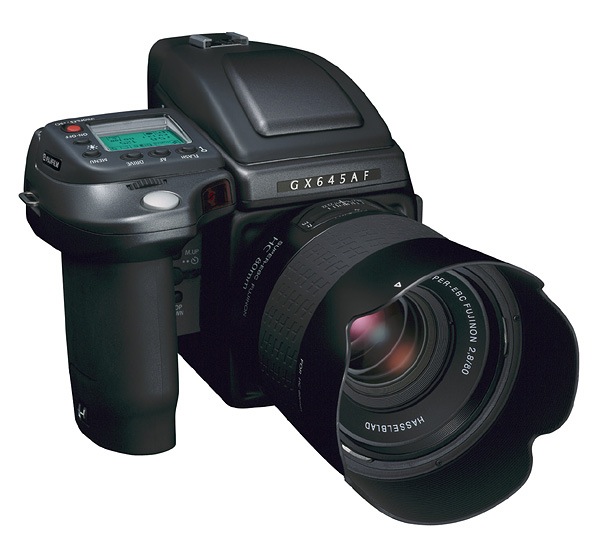
How they sell them in Japan.
And while I realize that a mindset that expects things to last forever in a world with high rates of change is silly, what Fuji has done here speaks deeply to the traditional engineer in my soul, even if it makes for a rather odd marriage of the mechanical and the digital.
By the way, apart from the original, rigid mount, chrome seven element 50mm Leitz Summicron, was there ever a more beautiful lens than the chrome Zeiss Planar 80mm f/2.8 in Synchro-Compur shutter, above? Its superb optical quality matched its looks. And you have the comfort of knowing that your gear, absent the digital back, is not all that different from that used to take what was then the costliest picture in the history of the human race.

1969. Real men use Hasselblads. Aldrin by Armstrong.
Book review

This collection of photographs from 1939 -1944 London is simply riveting.
If you look at the severity of Germany’s unprovoked aerial bombardment of London in WWII, using deaths as a yardstick, then the worst year was 1940 when the might of the Luftwaffe poured death and destruction from the skies. The combined efforts of I G Farben (now Bayer, BASF and Hoechst) for chemicals, Daimler Benz, BMW, AEG and Siemens for hardware and Deutsche Bank and Commerz Bank for finance, aided in no small part by massive conscription of slave labor, made all that insanity possible. Needless to add, all those firms survive and prosper to this day, along with the vermin offspring of their parents.
So it is impossible to write objectively about what this book of war time photographs from the Daily Mirror’s reporter George Greenwell portrays, other than to wonder at the miracle which gave England the English Channel, the greatest of all defenses, and a half-American named Winston Churchill. Our son Winston – a simple act of gratitude – will never know how close he came to not seeing this world.
While some of the pictures here are undoubtedly propagandistic in nature, the reality is that people did get married in bombed out churches, kids did play in the ruins and life went on as best as it could. ‘Muddling through’ may be a trait ascribed to the English but realistically what else were they going to do? I bow in admiration to their wonderful grace and stoicism in these hardest of times.
What many forget, and this book makes clear, is that death from the skies was not confined to 1940. Almost as many died in London in 1944. This time, with the Luftwaffe finished, it took the form of the V1 pulse jet and V2 rocket flying bombs, the first effective guided, pilotless missiles. The V1 could be put out of action by the faster Spitfires who would daringly tip it over with a delicate nudge from a wing tip and a 100 mph speed advantage. The V2 was altogether a different proposition. At 1,800 mph it flew at more than twice the speed of sound and no 400 mph piston-engined, propeller aircraft was about to catch it. That little number was created by a brilliant rocketeer who became a more than willing member of the SS in 1937 and managed to look resolutely the other way while Jews and Poles died on his production lines creating his evil weapon.
What became of him?
A few short years later he was to be seen in one of the last ticker tape parades down Manhattan’s Broadway, proudly waving a Stars and Stripes, testimony to his new citizenship and to the fact that his Saturn V rocket had just made it possible for Neil Armstrong to make his ‘Giant Leap for Mankind’.
That rocketeer was named Wernher von Braun.
An early review.
Spanish site Quesabesde has a review with picture samples of the Fuji X100. I was able to download the samples earlier and can report they are excellent – very fine grain even at the highest ISO settings, and sharp. Fuji has since instituted a blackout as the article states : ” Note: At the request of Fujifilm Japan has agreed to withdraw QUESABESDE.COM samples taken with a preproduction unit of the FinePix X100, with a view to publishing the short term a more extensive analysis from a final model of the camera.” The article also has RAW samples but as even SilkyPix has yet to process X100 RAW, they were unable to make any sense of them. These early samples were great so hopefully things will only get better.
Here’s a translation courtesy of the pidgins at Google Translate:
WANTED
Thursday, February 17, 2011
Fujifilm FinePix X100: first samples
Although it sounds like a worn cliché, the truth is that for some time that a model did not arouse the interest of the Fujifilm FinePix X100. Since it was seen at Photokina, there are few professional and amateur gourmets who have believed to see in the philosophy of this compact $ 1,000 responses to their requests. QUESABESDE.COM advantage that we have a working model of the X100 (do not ask how), it is time to stop philosophising and start answering questions with the camera in your hands.
Iker Morán .- Do not go on sale until March, but patience is not our forte. Faced with the prospect of waiting a little longer to get their hands on the FinePix X100-just that we were recommended from Fujifilm Spain-QUESABESDE.COM secret services have been launched to find a preproduction model of the compact.
Fujifilm FinePix X100
Have been 48 a few hours of living with a body that has installed the firmware version 0.69. Although it is early to draw conclusions (some camera functions were not operating at 100%), and we are working on a first test and a video that shows its performance and operation.
Anyway, thinking of the more impatient and in recent months who have asked for details of the expected camera, here are some early samples galleries and a fast response to an impromptu autocuestionario.SE SEARCH
Thursday, February 17, 2011
Although it sounds like a worn cliché, the truth is that for some time that a model did not arouse the interest of the Fujifilm FinePix X100. Since it was seen at Photokina, there are few professional and amateur gourmets who have believed to see in the philosophy of this compact $ 1,000 responses to their requests. QUESABESDE.COM advantage that we have a working model of the X100 (do not ask how), it is time to stop philosophising and start answering questions with the camera in your hands.
Iker Morán .- Do not go on sale until March, but patience is not our forte. Faced with the prospect of waiting a little longer to get their hands on the FinePix X100-just that we were recommended from Fujifilm Spain-QUESABESDE.COM secret services have been launched to find a preproduction model of the compact.
Fujifilm FinePix X100
Have been 48 a few hours of living with a body that has installed the firmware version 0.69. Although it is early to draw conclusions (some camera functions were not operating at 100%), and we are working on a first test and a video that shows its performance and operation.
Anyway, thinking of the more impatient and in recent months who have asked for details of the expected camera, here are some early samples galleries and a fast response to an impromptu autocuestionario.
“The ergonomics are as good as it seems at first sight?
The finish, the feel of the camera in your hands, the distribution of controls and, in general, the management allowed a few snags. Already discuss in more detail, but it’s nothing that we did not know for several months.
When you apply a good dose of common sense (almost everything is invented, you just have to reinterpret it in digital) is difficult for some to fail. But, as always, there are fringes that are not as well finished off (at least in pre-production model has fallen into our hands.)
Screen menus, for example, broadly follow the aesthetics of the compact Fujifilm. Not that they are very complex, but we expected something more special and personalized for a camera like this. Neither the rotary dial back-too deep in the body, not suppose to press it by mistake, is very comfortable to drive when changing any settings.
How does the viewer hybrid?
Located on the right side (the SLR used to have to retrain and learn to let the left eye wide open to see what happens out of frame), the X100 combines a direct optical viewfinder with an electronic 1.4-megapixel resolution . Simply activate the lever on the front of the camera to switch from optical to electronic form.
Although the viewfinder can boast excellent performance (only when the soda weakens a bit in low light remember his nature) is particularly interesting to the viewer directly. It not only shows the typical framing guides-with parallax correction, and the meter, but also information such as sensitivity, image size, or even an electronic level superimposed.
Is it fast?
It is one of the most recurrent questions of those interested in this camera. In this sense, they can rest assured that the startup and shutter response is very fast even in this model the end he has given us a headache in other ways.
Concerning the burst, the camera can reach speeds of up to 5 frames per second, but, attention, as follows: the blast was triggered in full to fill the buffer and then plays a few seconds to see the results.
Advertising
Less happy we are with the recording time on the card. At least in the final model is not proven (insist on this detail) and working with SD Card SanDisk Class 10, the simultaneous recording of a picture in two JPEG and RAW was delayed about 5 seconds, during which itself was possible to re-shoot but can not access or browse menus making.
And silent?
This is another of its strengths: the X100, like all cameras of this type, has a very stealthy shutter. Although the camera comes standard activated a sound that plays when you press the shutter-very well done, indeed, worth disconnect and go completely unnoticed.
How was your approach?
The autofocus of the X100 performs well in terms of speed and accuracy within the predictable in-focus by contrast. Even in poor lighting conditions and with the assist light turned off, your reaction is correct, but it takes a little worse in areas of low contrast and macro shots.
Fujifilm FinePix X100
However, the approach is one of the benefits that usually recorded improvements through new versions of firmware, so hopefully this model evolved from 0.69 to final chamber.
Besides the two automatic modes of approach (simple and continuous), also has a ring on the lens to manual mode. This is not a mechanical system, but this ring starts the electric motor approach, with small movements that are executed at every touch. When working with an optical viewfinder, no confirmation of an outbreak, but a guide to the distance that can be very useful.
And the results, what?
The images speak for themselves. Although this is a preproduction unit you must take the results with pliers and no definitive conclusions (white balance, for example, has room for improvement), obvious that Fujifilm has done its homework in terms optics (23 mm equivalent to 35 mm f2 in step universal) and CMOS (APS-C size with a resolution of 12 megapixels).
Hits: 12 MP © QUESABESDE.COM
Catches were made with a Fujifilm FinePix pre-X100 (firmware 0.69):
Note: At the request of Fujifilm Japan has agreed to withdraw QUESABESDE.COM samples taken with a preproduction unit of the FinePix X100, with a view to publishing the short term a more extensive analysis from a final model of the camera.
All outlets, of course, have been made with the default settings of color, sharpness and saturation, and using the optional lens hood for optics.
Does it EXR processor?
Although it is assumed that CMOS has not been manufactured by Fujifilm, from the company has insisted that it is a custom version for this camera, especially with her EXR processor.
Hits: 12 MP © QUESABESDE.COM
Catches were made with a Fujifilm FinePix pre-X100 (firmware 0.69):
Note: At the request of Fujifilm Japan has agreed to withdraw QUESABESDE.COM samples taken with a preproduction unit of the FinePix X100, with a view to publishing the short term a more extensive analysis from a final model of the camera.
In this sense, among the options menu provides a dynamic range control settings from 100% to 400%, although the latter value is only operational from 800 ISO. In short, we will post some samples to check the camera performance in this area.
What noise?
Another of the greatest fears of those interested in this camera was what that will endure when the light touches is complicated and increase the sensitivity. Again, the samples are the best answer.
Samples: high sensitivity © QUESABESDE.COM
Catches were made with a Fujifilm FinePix pre-X100 (firmware 0.69) with sensitivity settings from 640 to ISO 12800:
ISO 640
ISO 800
ISO 1600
ISO 3200
ISO 6400
ISO 12,800
Note: At the request of Fujifilm Japan has agreed to withdraw QUESABESDE.COM samples taken with a preproduction unit of the FinePix X100, with a view to publishing the short term a more extensive analysis from a final model of the camera.
Adjustments between 100 and 12,800 ISO-the latter not available in RAW-format, the camera supports up to 3,200 ISO smooth and even further if the conditions are not very critical. In all cases, the system has remained active noise reduction in standard mode.
What to do with the RAW?
That’s what we ask ourselves after filling out a card with dozens of images in RAW format and verify that there is not any software capable of reading them. Even tried a beta version (and in Japanese!) Of SILKYPIX 5, but no luck. Anyway, there we three files in original format in case anyone is encouraged to investigate.
Samples: RAW © QUESABESDE.COM
Catches were made with a Fujifilm FinePix pre-X100 (firmware 0.69). Photographs taken in RAW format and processed using the function included in the camera menus.
Note: At the request of Fujifilm Japan has agreed to withdraw QUESABESDE.COM samples taken with a preproduction unit of the FinePix X100, with a view to publishing the short term a more extensive analysis from a final model of the camera.
For now, what we can do (more to satisfy curiosity, to see the real potential of RAW) is to try to process them and export them to JPEG using the camera function that includes among its menus. That is precisely what we have done with these three images.
“I can leave the charger at home or autonomy is a fair bit?
With all the quotes that requires a non-final model in our quick test battery has supported more than 250 shots (JPEG and RAW formats) and about 20 clips from 10 to 20 seconds each.
Exactly the video recording (although nobody seems to remember, is an option there) seems to be the major consumer of battery, as it was to start experimenting with this feature when the camera started to show signs of exhaustion.
We believe that dosing the use of the screen and restricting the recording of sequences, we can stretch well over the autonomy of this battery of 1,700 mAh.
Is that all?
No. This is just an appetizer for the more impatient. Although circumstances have forced a stay of the X100 among us has been very short, we are working in a field test a little more detail and a video that shows the most interesting features of this camera in action.
Everything is to brighten the wait until we get a final chamber as those hit stores next month’s deck.
Note: Memory cards are pictured in this article have been released by SanDisk as part of an advertising agreement reached between the company and QUESABESDE.COM.
End of translation.
Here’s what I got out of that mess:
By the way, how much longer is Fuji going to keep calling itself Fujifilm? It’s even emblazoned on the X100’s top plate. Time to wake up, boys.
I’ll be writing about mine as soon as I get one, strictly in the context of real world use on the street. If you want pictures of test charts you can go to DPreview.com. Just don’t expect to find any photography there.