Keywords in Lightroom

A useful discipline.

No matter how well you catalog your images in Lightroom, adding keywords always helps. That snap at the beach may belong under ‘Beach and Sea’ in your catalog or, equally well, under ‘Abstracts’. But if you add the name of the beach as a keyword, or the words ‘beach’ if it’s cataloged in abstracts, the chances of finding it at some later date when you have many thousands of images added will increase through the use of keyword search.

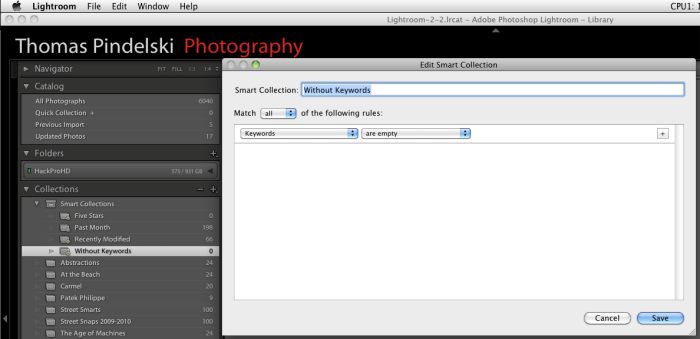
To find which of your images are missing keywords, set up a Smart Collection (Library->New Smart Collection) as follows:

Then when you click on the Smart Collection named ‘Without Keywords’ you can see all the images that need keywords added. I frequently forget to add keywords before cataloging my images after import and processing, so this is a useful discipline. And if you are way behind on your keywording, simly do a few images each time before quitting Lightroom. The payback down the road in image retrieval and time saved is immense – it takes less time to enter a keyword than to search for an image without one.

And while you are setting up this Smart Collection, take a look at some of the other filters that Smart Collections support. It’s a powerful tool.

Lens profile correction in practice

A dream to use.

Having explained how to create your own lens profiles for use with Lightroom3 yesterday, here’s that experience being put to use.

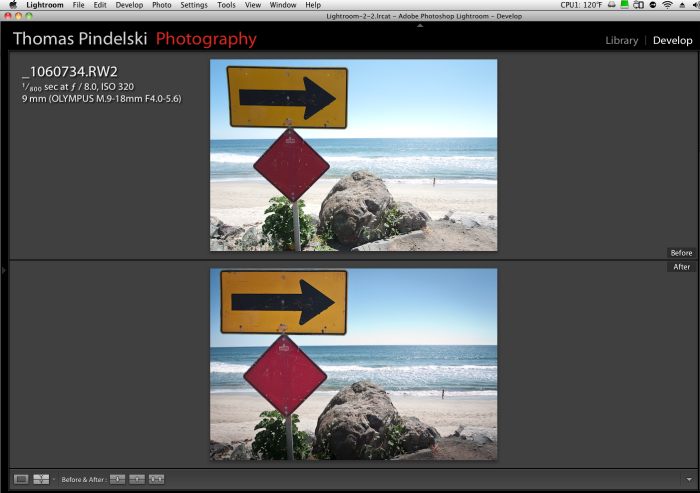
In this snap I wanted to emphasize the foreground sign to heighten the impact of the lone child on the beach. As you can see the original is rather blah as I was trying to moderate exposure between the poorly lit sign (the sun was shining into the lens – note how flare free the image is, especially as I do not use a lens hood) and the brightly lit beach. A separate attempt using fill-in flash looked too artificial for my taste, like one of those over-lit 1950s outdoor Hollywood musicals.

Original on the top. G1, Olympus 9-19mm MFT lens at 9mm.

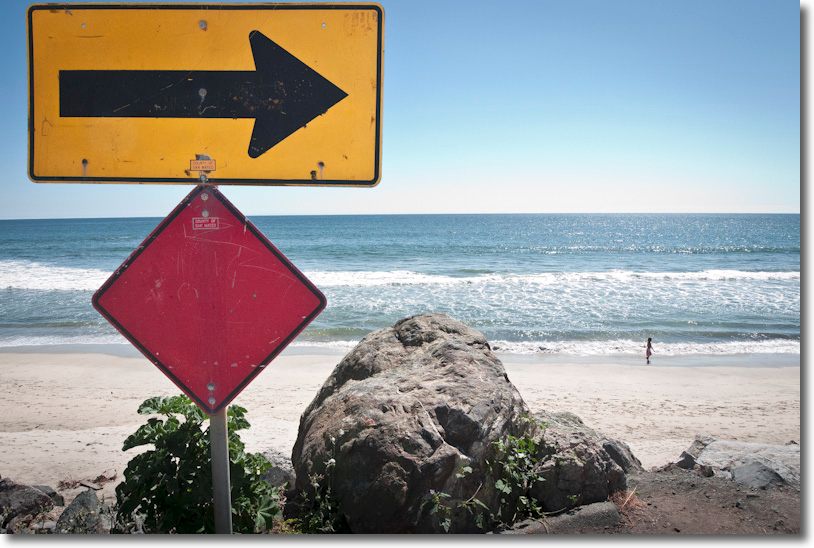
A quick tap on the lens correction profile for the lens in LR3, two minutes work with the adjustment brush on the signs using AutoMask and zero feather to faithfully define the edges, a local exposure adjustment of plus one stop on the masked signs, a minus one stop exposure adjustment to the whole image, a touch on the vibrance slider, a little post-crop vignetting (the Olympus lens is totally free from optical vignetting even at 9mm, as you can see from the original, above), some selective darkening of the foreground and a blah original becomes a picture, and exactly what I visualized when pressing the button. The sheer idiocy of the sign testifies to the fact that the least able in any society work for government.

Stop! Turn right! G1, 9-18mm Olympus at 9mm, 1/800, f/8, ISO 320

With images where you expect to use lens distortion correction or perspective correction at the processing stage, it makes sense to compose with a little space around objects close to the edge of the frame, as that space will be lost when corrections are added – as in this example. Things are made a lot easier by the fact that the Panasonic G1 has one of the very few viewfinders which shows 100% of the image – most crop 3-5% making it impossible to exactly preview the saved file.

Lightroom3 is a powerful, efficient photography tool. The enhancements in Lightroom3 have now almost totally obsoleted my use of Photoshop for which feature, alone, I am immensely grateful.

Thank you, Adobe. Now maybe you can convince that jerk Steve Jobs to allow Flash to work on the iPad before I resort to jailbreaking mine.

Lightroom 3 Lens Profile Creator

DIY lens profiles.

Adobe has not left Panasonic MFT camera users out in the cold when it comes to automation of corrections to remove distortion, chromatic aberration and vignetting in Lightroom 3. They provide a fine tool to create your own lens profiles, for example when using non-Panasonic lenses on a G-digital body, like my newly acquired Olympus 9-18mm MFT. In my third column reviewing that outstanding optic, I stated:

Well, it turns out that Adobe provides a free application named Lens Profile Creator which allows you to create your own lens profiles for just about any lens on any camera, film or digital, from iPhone to Leica S2 or scanning 4×5 back on a field camera. The download includes not only the charts (you must print one so that you can photograph it) but also instructions for use of both the application and details of how to set up your camera and lighting.

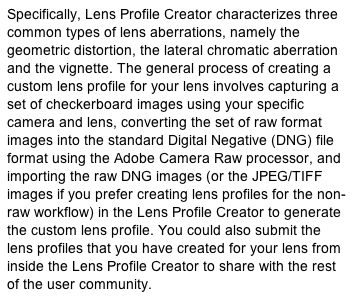
With the G1 it’s only necessary to do this for non-Panasonic MFT lenses like the Olympus 9-18mm ultra-wide zoom. Panasonic lens’ distortions are corrected by the software in the G1/G2/G10/GH1/GF1 range of bodies. Here is what Adobe says of their application:

The PDF instruction guide for Lens Profile Creator can be found here and the instructions for printing the calibration charts are here.

Creation of a lens profile is easy. You take nine pictures of the chart – I used RAW as that is all I use – convert them to DNG format by importing to LR3 then exporting in DNG format, and then you load the nine DNG images into Lens Profile Creator to create the lens profile for a specific focal length. As chromatic and barrel distortion in the Olympus 9-18mm lens vary with focal length, I did this at the four marked focal lengths – 9, 11, 14 and 18mm – a total of 36 pictures. It doesn’t take but a few minutes to take the pictures (alignment, per Adobe, is not critical) and, on my nuclear powered Mac, Adobe Lens Profile Creator took some 2 minutes to generate each of the four profiles from the nine constituent pictures I took for each. For the criminally insane, you could generate multiple profiles for each focal length at varying apertures, (chromatic aberration varies with aperture) but I would rather be taking pictures. Please yourself. I focused (!) on creating profiles at disparate focal lengths as it’s barrel distortion that is the most sensitive variable for my use and it varies significantly with focal length.

Once done you place the profiles in the /Library/Application Support/Adobe/CameraRaw/LensProfiles/1.0 directory on your Mac where they will be available to all users of that Mac. (There are also instructions for those poor, unfortunate Windows users who place little value on their time and have yet to get a life). Finally, the Adobe application allows you to submit the profile to Adobe’s user forum though for some bizarre reason the submitted profiles are only currently available for download to Photoshop CS5 users, not Lightroom 3 users. Hey! Adobe! Can you say ‘Duh!’?.

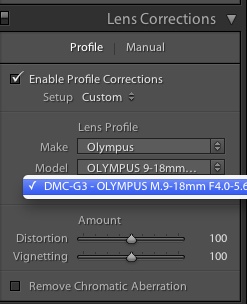
Here’s how your Lightroom 3 options will look if you named your profiles correctly:

The drop down focal length selection panel in LR3.

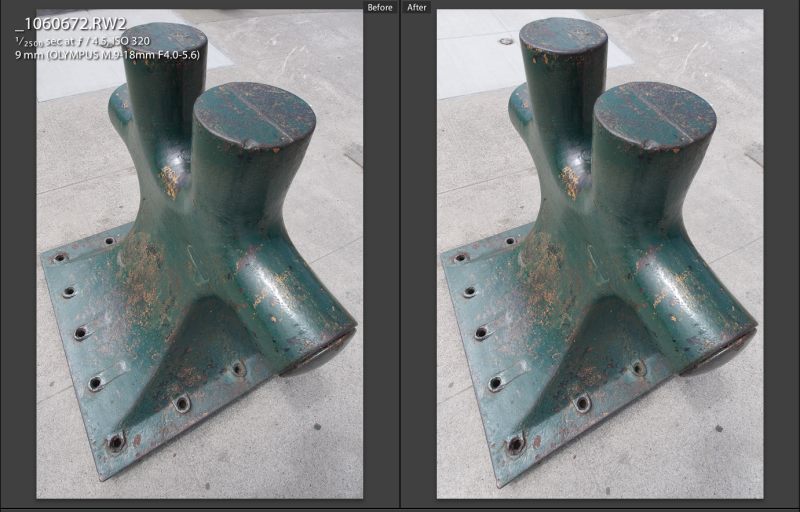
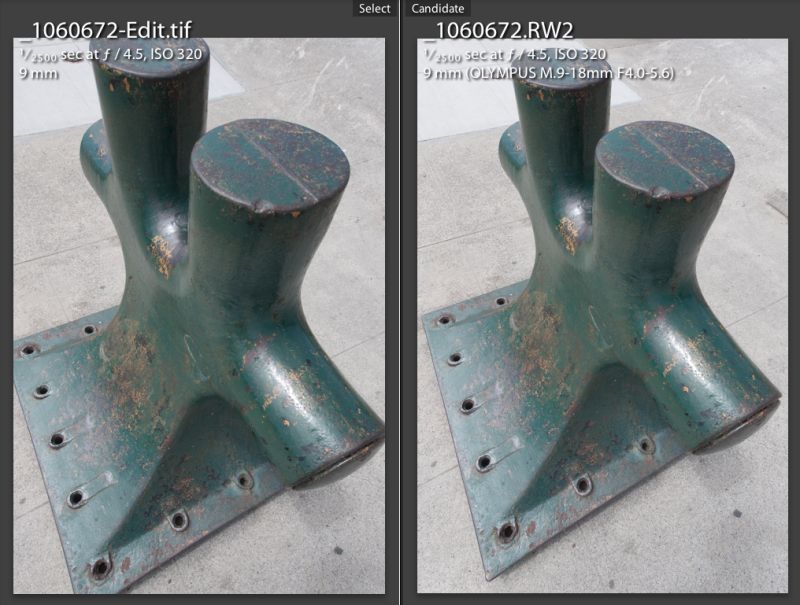
And here’s a ‘before’ (no profile) and ‘after’ (9mm profile) comparison of a profile being applied:

Henry Moore’s bollard. Before and after with the 9mm profile.

The profile file contains no fewer than 8 profiles, created at 9mm (f/4, f/5.6), 11mm (f/4.3, f/5.6), 14mm (f/4.9, f/7.1) and 18mm (f/5.6, f/11) at the apertures shown. Lightroom will automatically chose the profile nearest in focal length and aperture to your photograph’s EXIF data.

If you would like to download the profiles I created, for your own use, you can do so by clicking below. Please note that these are for use with RAW or DNG originals only. They will not appear if your file is in JPG or TIFF. Feel free to share them with anyone. Unzip the downloaded file then place the four individual profile files (not the enclosing folder) in the /Library/Application Support/Adobe/CameraRaw/LensProfiles/1.0 directory. Next time you start LR3 they will be available. Please note that these are solely for the Olympus 9-18mm MFT lens used on a Panasonic G-series digital body taking RAW images.

Click to download Olympus 9-18mm MFT lens profile for the Panasonic G-series body. For RAW and TIFF originals only.

So if you really must have automated corrections for that 65mm Super Angulon on your 1964 Linhof 4×5, Adobe Lens Profile Creator is the tool you need.

Indeed, I see no reason why this software tool should not be used to create profiles for your film and flat bed scanners – instead of photographing Adobe’s target, simply scan it and run the scans through the program, so now you can profile your scanner (or, heavens forbid, a darkroom enlarger) in much the same way you can profile your 21st century lens on the latest in digital bodies.

Alternative #1- DxO Optics Pro Elite:

DxO makes the fancifully named DxO Optics Pro Elite for correction of lens aberrations at the equally fancy price of $300. It’s bog slow even on my hyper-speed Mac, must be loaded separately from your regular processing application and at the price asked compares poorly with the free Adobe Lens Profile Creator. I reviewed it here. And there is no version for Snow Leopard. These people need a loud wake-up call.

Alternative #2 – PTLens:

I wrote in glowing terms of PTLens here. It’s a $15 app which can be used as either a stand-alone or as a PS or LR plugin, and has a large and constantly updated lens database. The latest version includes the Olympus 9-18mm MFT lens for both RAW and JPG on a Panny G body but I cannot recommend it. Simply stated, the RAW profile is awful, way overdoing the correction and turning barrel distortion into severe pincushion distortion instead. Further, as you have to round trip the file from LR that means that a TIFF file (lossless) is first generated, meaning that your 12mB RAW file will be 80gB by the time you save it back into LR. Not a big deal but with its current RAW profile I cannot recommend the product. My profiles, above, are way superior.

By way of illustration, here are the PTLens (left) and my custom profile (right) versions of an original which shows pronounced barrel distortion of the horizon. In the PTLens version a lot of the image is lost and the figure is way too elongated. If you could see the horizon which PTLens chops out you would see severe pincushion distortion, not to mention chopping out much of the ultra-wide effect you just paid good money for:

PTLens vs. my custom profile at 9mm

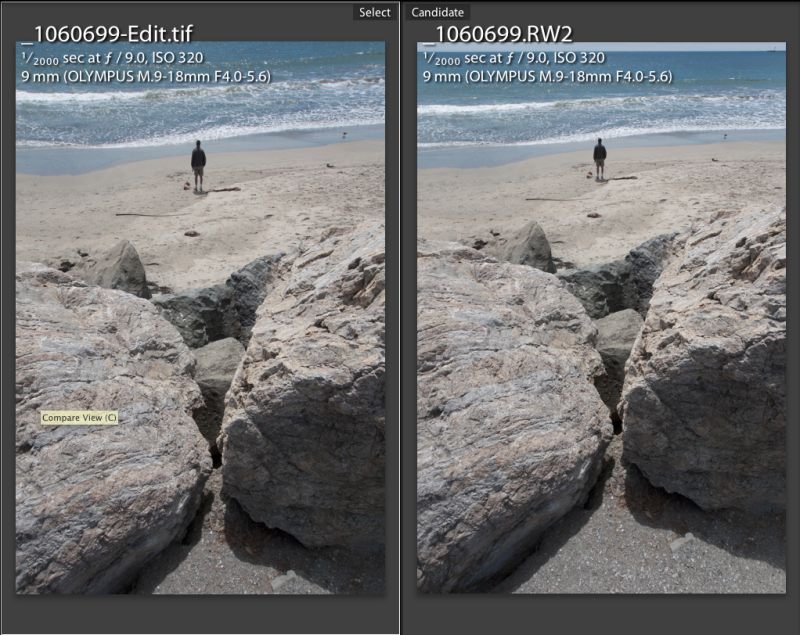
Here’s another example showing what a poor job PTLens does with this camera/lens combination – PTLens on the left cuts out lots of image information; my profile on the right does it correctly:

Moore’s bollard again – see above for the ‘as shot’ original. PTLens version on the left.

Alternative 3 – use LR3:

If you don’t mind having to manually correct distortions for every picture then manually adjusting for chromatic aberration, LR3’s controls are just fine when used with the Olympus 9-18mm. However, if your ultra-wide lens displays the ‘bow wave’ type of distortion where the barreling changes to pincushioning at different spots on the horizon then the built in LR3 control, which can correct plain spherical distortion only, is of no use and a tailored lens profile is the only option.

Conclusion:

“If you want a job done well, do it yourself” is one of the most asinine homespun philosophies in the Western world. If you want a job done well, delegate it to a professional and maximize your time value by applying your skill set to what you do best. This may just be an honorable exception to that dumb ‘rule’. If you want a good lens profile, do it yourself or if you use the Olympus 9-18 MFT on a G-body, use mine.

A great Lightroom 3 book

Martin Evening scores again.

It’s been almost a year since I wrote about Martin Evening’s outstanding Lightroom 2 reference book and the Lightroom 3 version is now available.

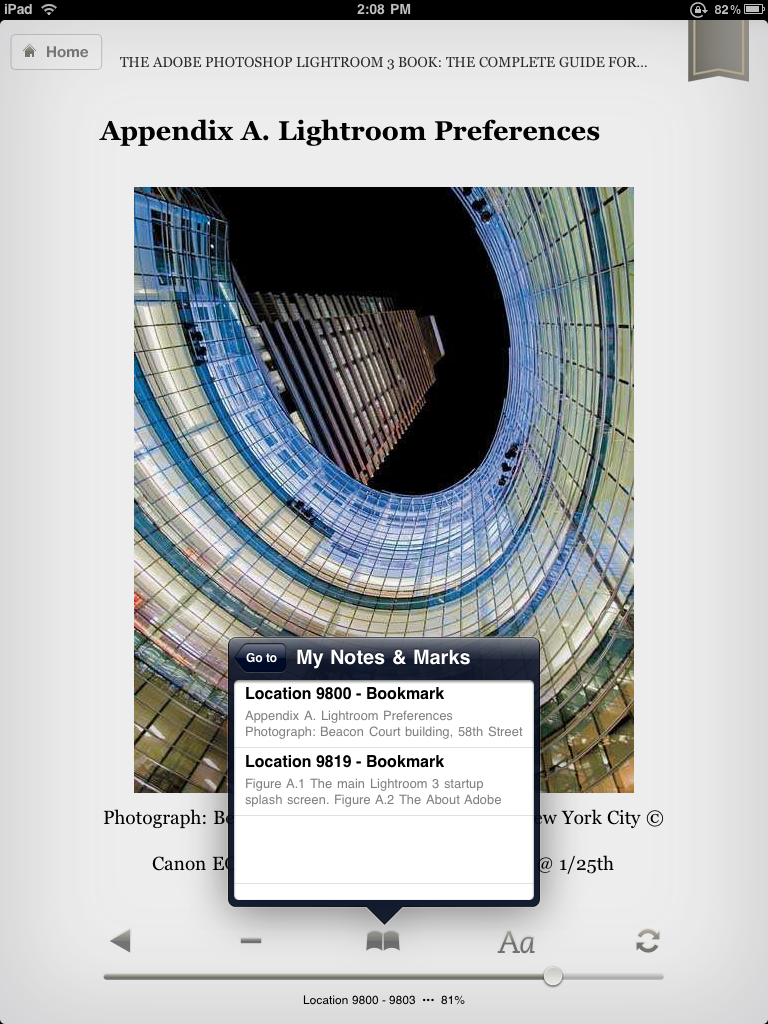
Best of all, you can get it in a Kindle eBook version which will play on up to five devices – I have mine on the iPad and on my desktop Mac.

What distinguishes Evening’s writing is not only clarity and practical experience, he is also a very good photographer. Too often these so called software experts turn out to be truly awful photographers which makes you wonder what you could possibly learn from them. It’s still impossible to make a silk purse out of a sow’s ear, last I checked. The beauty of an eBook is that you can look up the index then just touch the page to jump to it; it’s also weightless, not something that can be said of the 600 page paperback predecessor, which I refer to constantly. Further, you can bookmark as many locations as you like as well as change the font sizes to suit your eyesight. The Table of Contents is instantly available if you touch the bookmark logo at the base of the screen.

Bookmarking in the Kindle edition on the iPad.

Finally, the Kindle version meets with my goal of getting rid of every last physical book in my home, freeing the wall space covered with bookshelves for better use – like displaying photographs.

I use mine on the iPad where it works really well, as both my big Dell monitors are full when using Lightroom, making the desktop Mac unavailable unless I want to switch apps. You can also read the book on a Kindle but without color it’s not the same. It is very handy to peruse on the iPad in idle moments – rare is the occasion when I do not learn something new. And thanks to Kindle’s sync technology, the page you left at on the iPad will be the page the book opens at on the Mac, and so on.

There’s a good reason to buy the latest version – the new features of LR3 offer substantial processing enhancements and it really helps to have a working photographer show how to get the last ounce out of these.

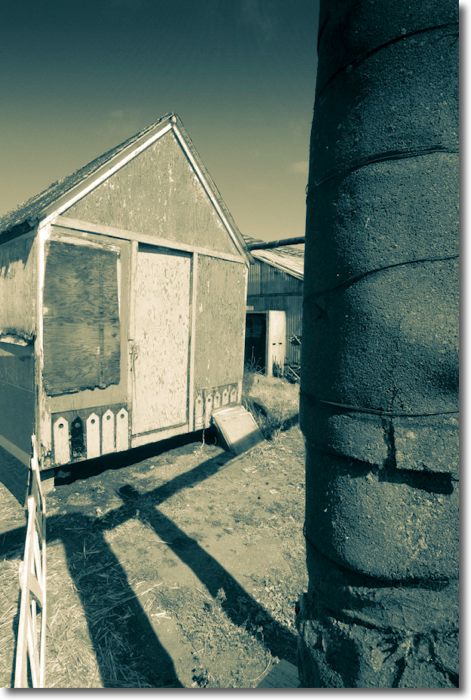
I continue to learn daily about Lightroom – yesterday, for example, I did my first split toning effort. I never did understand what those sliders were for until I checked Martin Evening’s book.

Hut. Split toning – my first attempt! G1, 9-18mm Olympus @ 9mm, ISO 320

Update as of July 30, 2010: Amazon just released an updated version of the Kindle app which allows free text search! Want to look for ‘noise’? Just touch the magnifying glass, type the word and there you are. Wonderful!

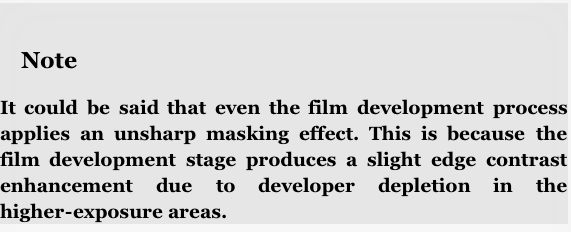
Some of Evening’s insights are tremendous. Take this one on film of days past:

Any old timer worth his salt knows well that if you agitated your film less when it was in developer that you would increase sharpness, owing to the exact effect he describes. It was a pre-digital age ‘sharpening’ process, albeit with near-zero control! The book is full of this sort of thing though rarely as quirky as this.

Olympus 9-18mm MFT lens – Part III

Finally, some pictures.

In Part I, I looked at some of the design aspects of the Olympus 9-18mm MFT lens for the Panasonic G1 and in Part II set forth some thoughts on how it handles.

This article addresses results. How good is this lens in practice?

So what qualifies me to pontificate on wide lenses?

I have always been a ‘wide’ rather than a ‘telephoto’ guy, liking to get close to the action. That’s my street snapper thing. In that context the widest lens I have used, and still own, is the Canon full frame f/2.8 8 mm fisheye for my 5D which, with de-fishing software, yields an effective Full Frame Equivalent (FFE) of 12mm. That’s insanely wide. That Canon lens is no slouch but the micro contrast is simply not there in big prints and definition is not that great at the corners until you stop it down to f/8.

The next widest lens I have used is the very costly 14mm f/2.8 Canon L for the 5D, a loaner. At thrice the cost of the fisheye it underperforms in every way with heavy chromatic aberration at most apertures and poor edge detail. A real dog. Apparently improved in the Mk II version but at $2,100 you can forget it. And it’s an absolute monster in your bag or on your camera.

The next widest was a sweet and minuscule 20mm f/2.8 Takumar which I used for years on my Pentax ME Super 35mm film camera. Small, fast, no bulbous front element and sharp all over. Everything was right about this optic which explains why it is much sought after on the used market.

My worst experience with ultra-wides was with the Canon 20mm f/2.8. No fewer than two of these soiled the rug and I was glad to see the last of them. Poor corner definition at most apertures, horrible vignetting, there’s really little good to be said about this excuse passing for a lens. Canon should be ashamed.

Then came two really heavy hitters. The unsurpassed 21mm f/2.8 Leica Aspherical Elmarit for my Leica M bodies (really a bit too large to equate well with the compact Leica M’s ethos) and the huge 21mm f/4 Super Angulon for my Leicaflex SL (a nice pairing) and Leica R4 (which it overpowered from a balance perspective). The former cost me $1,000 lightly used, I sold it for $2,000 and it now costs $4,200. The latter, actually a Joseph Schneider design licensed to Leitz, moved on with my Leica SLR gear when digital came along. It was almost as good as the Aspherical but sported a huge front element and was immensely heavy. Over-engineered in the way only Leitz knew how back then.

In use:

To check things out I set out for Half Moon Bay, a rather down-at-heels coastal town a few miles south of San Francisco. That is a good feature. Have you ever taken a good snap in the pristine, manicured sterility of Beverly Hills?

Half Moon Bay has some funky beach streets and an interesting boat marina and commercial fishery on the wharf.

Using the lens, absent the reverse rotation of the zoom ring compared with the two Panny lenses in my G1 kit, is unexceptional. The size, once extended, is similar to that of the 14-45mm kit lens and operation is much the same except, of course, that the 9-18mm Olympus is really wide at 9mm.

Loading the pictures into Lightroom 3, three considerations arise:

1 – Orientation sensor: In common with other Olympus MFT lenses, this optic has no orientation sensor to automatically rotate pictures in Lightroom 3. (Olympus does this in their MFT bodies). All pictures load in landscape orientation so it’s necessary to Command-click all the portrait images and turn them through a right angle using LR3’s controls. A minor irritant.

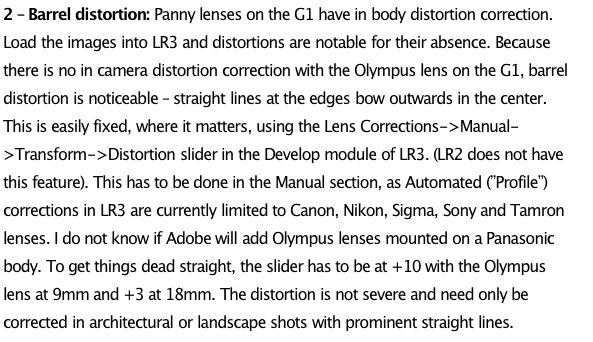
2 – Barrel distortion: Panny lenses on the G1 have in body distortion correction. Load the images into LR3 and distortions are notable for their absence. Because there is no in camera distortion correction with the Olympus lens on the G1, barrel distortion is noticeable – straight lines at the edges bow outwards in the center. This is easily fixed, where it matters, using the Lens Corrections->Manual->Transform->Distortion slider in the Develop module of LR3. (LR2 does not have this feature). This has to be done in the Manual section, as Automated (“Profile”) corrections in LR3 are currently limited to Canon, Nikon, Sigma, Sony and Tamron lenses. I do not know if Adobe will add Olympus lenses mounted on a Panasonic body. To get things dead straight, the slider has to be at +10 with the Olympus lens at 9mm and +3 at 18mm. The distortion is not severe and need only be corrected in architectural or landscape shots with prominent straight lines. You can also automate distortion correction by clicking here.

3 – Chromatic aberration (color fringing): As with barrel distortion, this has to be corrected manually. It’s mostly noticeable as a red fringe when pixel peeping at 9-10mm focal length and a setting of -15 to -20 on the Lens Corrections->Manual->Transform->Chromatic Aberration->Red/Cyan slider in LR3 does the trick.

It makes no sense to incorporate these settings into an import profile as that assumes that all pictures imported are taken on this lens at a specific, wide, focal length. Simply add the settings on the ‘keepers’ – it takes seconds to do.

None of these are disabling issues as the pictures from the lens are in every way as detailed and sharp as from its Panny stablemates, which means superb. There is a total absence of vignetting at any focal length or aperture and if you see any in the pictures here it’s because I added it in LR3 to heighten the impact of an image. Rather funny that designers go to all that effort to eradicate vignetting and photographers then proceed to add it when processing their pictures.

Examples:

Barrel distortion:
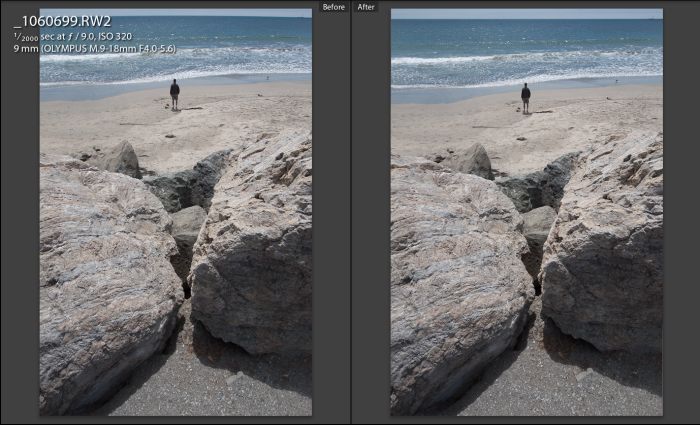
Barrel distortion at 9mm – look at the horizon.
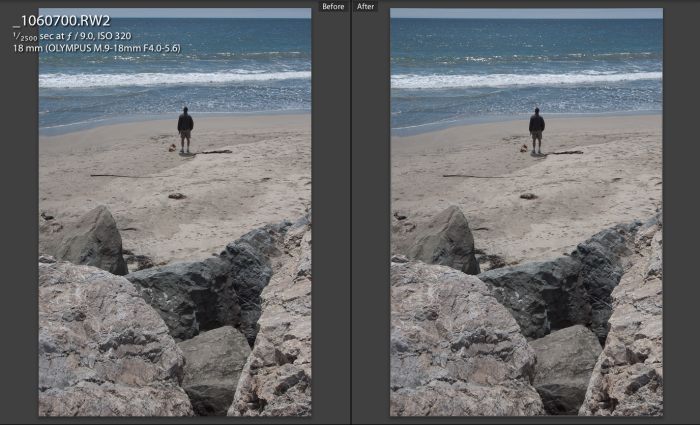
Barrel distortion at 18mm – less pronounced, but still there.

Chromatic aberration:

Not illustrated as it’s only visible to pixel peepers.

How wide is 9mm (=18mm FFE)?

18mm FFE is incredibly wide and if you are new to something this wide be prepared for disappointment with your first few snaps. Take a look at the two pairs of pictures above – one is at 18mm FFE, the other at 36mm. The increased amount of foreground is immense – I have kept the horizon at the top of the frame for comparison purposes. If you think you need this lens to ‘get more in’ forget it. Unless your back is against a wall or unless you have strong foreground interest, your pictures will be awful, your subject a tiny blob in the distance. And if you are afraid of getting in close, stick with your longer lenses and save your money; an ultra-wide is not for you.

Here’s another case in point – I was but a couple of steps away from this surfer dude throwing the ball to his retriever:
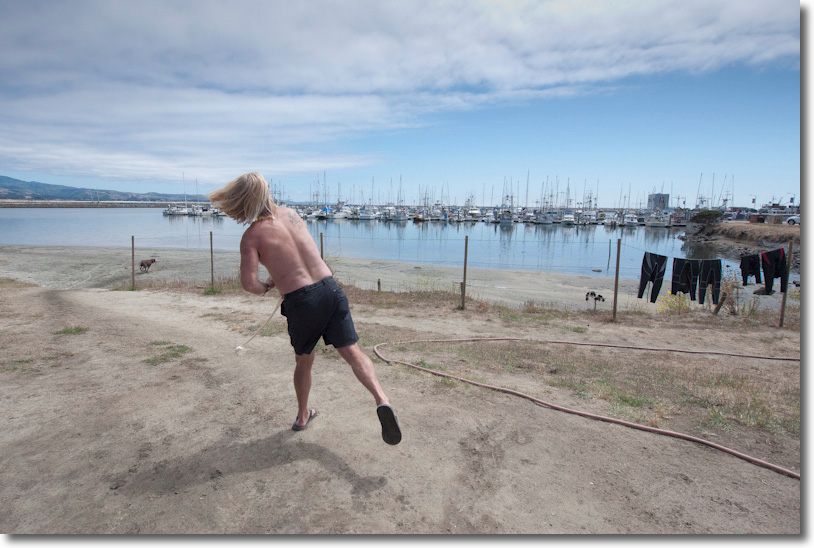
At 9mm, f/4.5 – the chocolate lab gets ready to retrieve.

An 18mm FFE lens is a surrealist’s delight. Sure you can take the proverbial interiors of cathedrals with it, and that’s fine, but I prefer to buy picture postcards of those as they are far better done than anything I want to spend time on.
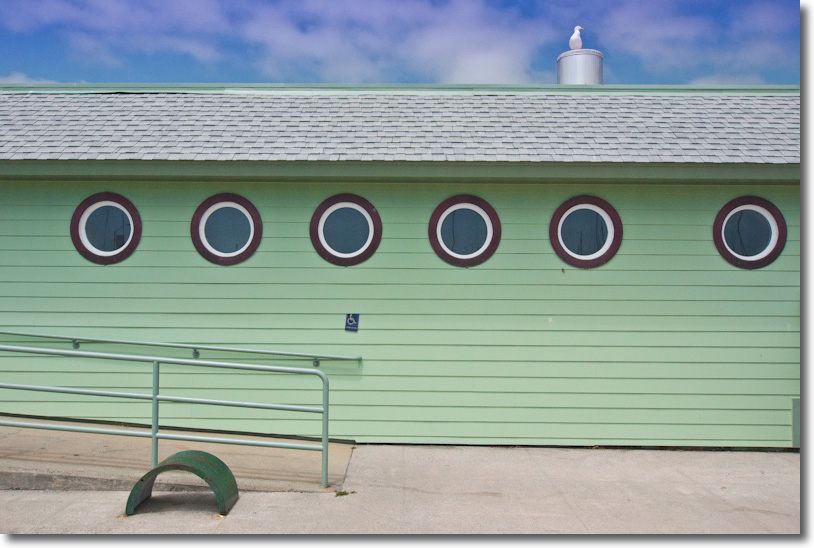
At 9mm. Portholes and gull. Lovely architecture for a building in a fishing village.

How about flare?

The wider a lens gets the higher the likelihood that strong light sources will be in the frame. This is an extreme example – the dynamic range between the interior of the bar and the strong sun outside is some 10 stops.
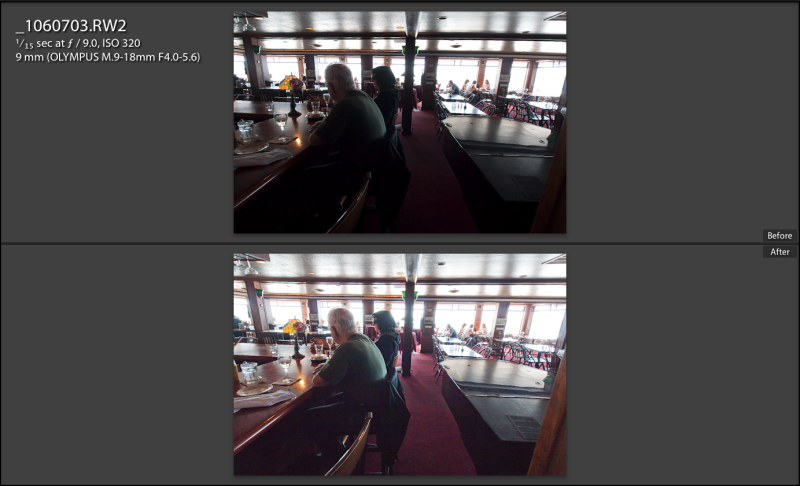
At 9mm, f/4.6. Lower picture shows the effect of using the Fill Light slider in LR3.

Flare is very well controlled, even in this extreme case. There are only minimal light source haloes to be seen in either interior or exterior pictures at 9mm. I do not, and will not, use a lens hood. Here’s a larger image:
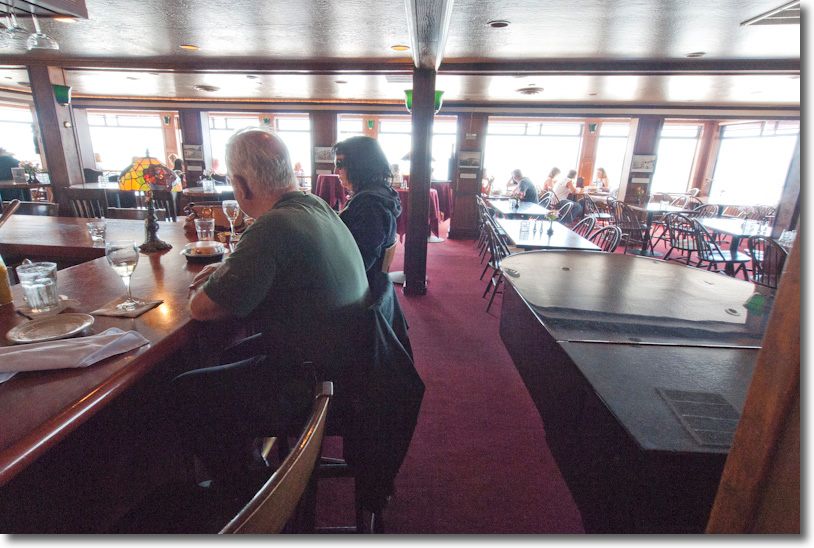
At 9mm, f/4.6. Flare is well controlled.

What’s the depth of field like?

It’s extreme at 9mm no matter what aperture you use. 9mm is 9mm. No matter whether it’s on an MFT body or something larger – depth of field is a function solely of focal length and aperture and has nothing to do with the size of the film or sensor used. While in the picture below I stopped down to f/22 to be safe (the rusted beams were inches from the lens) this also shows that, DP Review’s charts notwithstanding, where they show definition falling as the lens is stopped down, f/22 is as sharp in practice as is f/4.

At 9mm, f/22. A few inches to infinity ….

Finally, when your back really is against the wall, this sort of thing becomes easy:
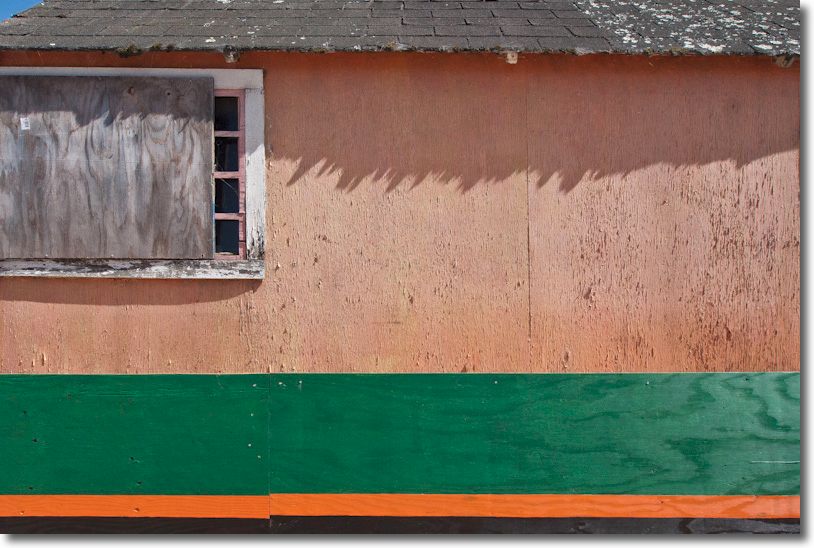
At 10mm, f/9. Colors on a wall. Taken in a narrow alleyway.

For more snaps over the next few days check my photoblog, Snap! While I have emphasized pictures taken at the wide end of the lens (a primary reason to buy it) performance at longer focal lengths is every bit as good.

Be honest – Micro Four-Thirds is lousy for big prints!

OK – here’s a full frame image:

At 18mm, f/8. Sunflowers.

Now here’s a magnified section which, if the whole thing was printed, would make a 30″ x 45″ print:

Magnified section of above – screenshot.

And your point is?

Conclusion: Despite a few quirks – a contra-rotating zoom ring, a non-existent image orientation sensor on import to LR3 and the need to manually correct chromatic aberration and barrel distortion if needed when used on a Panasonic rather than an Olympus body, the performance of the Olympus 9-18mm MFT ultra-wide zoom is as good as anything I have used at this focal length range. Color rendition is identical to that of the 14-45mm and 45-200mm Panasonic MFT lenses for the G1 camera range. At $600 it is an outstanding bargain.
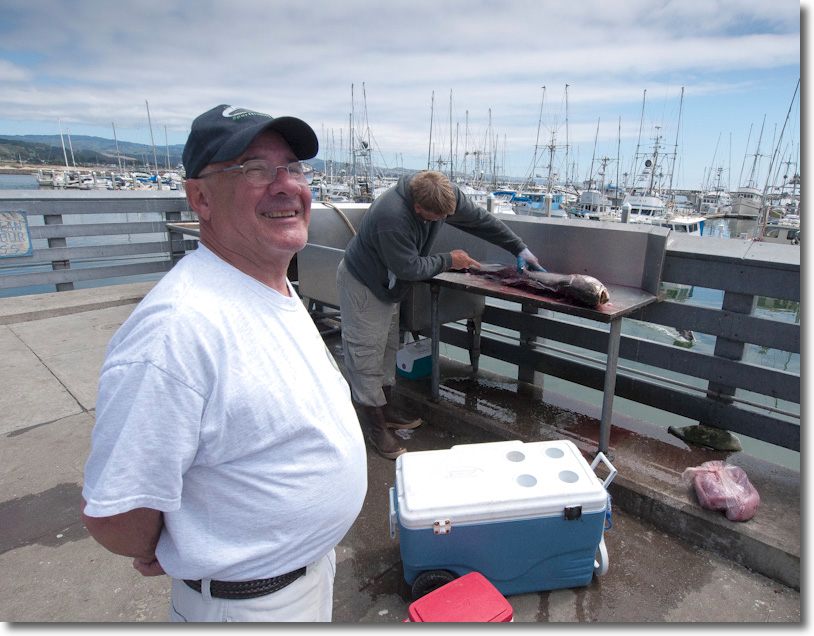
42 lbs. The fish and the amount of fat this fisherman needs to lose. At 9mm, f/4.5

As the above shows, one huge advantage of an ultra-wide is that your subjects have no reason to believe they are in the frame!

Automating aberration corrections: If you want to learn how to create profiles for this lens which will correct aberrations automatically in Lightroom 3 – or if you simply wish to download the ones I have already created – please click here.