A great LIFE photographer.
By 1965 television had replaced LIFE as the primary source of news for households. LIFE folded soon after. Yet the weekly, created by Henry Luce in 1936, once enjoyed a circulation of over 13 million, and it was during those years that John Phillips worked for the magazine.
I confess that when I first saw this massive tome, all 572 pages, I was immediately reminded of the great American novel – something seemingly devoid of any editing and consequently tedious and boring. Nothing could be further from the truth in the case of Phillips’s illustrated autobiography where the writing simply sparkles.
Phillips (1914-1996) worked for LIFE during the years 1936-1959, where his career included publication in the very first issue. As a child at school, when asked what he wanted to be, the unquestioning answer was “I want to be a photographer when I grow up” and that is what he became. With a Welsh father and American mother, born in French occupied Algeria, it’s no wonder he had wanderlust. His travels took him to most of the trouble spots of WWII and, as he worked in the days when photographers did the words and the pictures, the standard of writing in his book is exceptional. You are always left wanting more and the book is a real page turner.
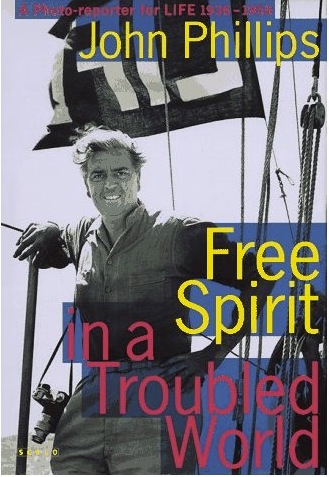
Some extracts:
Four days later we put into Port Taufiq. The authorities there were surprised to see us. We had been reported sunk by the Germans. Leaning over the side of the ship waiting to disembark, I reflected there was no satisfaction in photographing a munitions ship. If nothing happened, you had no story. If something did, you had no photographs.
Taking advantage of our conversation, I asked Mr. Kram (Churchill’s aide) about the Prime Minister’s drinking habits. “He never has a drop of whisky before 9 am” Mr. Kram said. “And before that?” I inquired, half-seriously. “Vermouth”
The King (Farouk of Egypt) and Queen’s private apartments were crammed with Louis XIV and Louis XV furniture. Seen ‘en masse’ it went a long way to explaining why the French Revolution came with Louis XVI.
Curious about the novelist (Evelyn Waugh), I joined him on his constitutional. He talked about education. “My father was better educated than I am, and I am better educated than my son.” This he put down to the decline in Greek studies. “What about engineering?” I asked. “Do you expect my son to be a taxi driver?”
Well, now you know why the British Empire collapsed.
While out of print, the book is readily available on the used and remaindered market and if you like good writing by a photographer who was there when history unfolded, you should pick up a copy. Some of the pictures are pretty hard to take – especially the ones of German atrocities in WWII – but Phillips never pulls his punches.