Winston is seven

A few thoughts on color balance

If accurate sound reproduction is your goal, then listening to the human voice (no, not some drug addled rock star; try German lieder or opera) or the piano (the one made by Steinway, not Roland – no electronics are involved) is the most critical test.

Humans know how a piano or human voice should sound. There is no such capability when it comes to electronic instruments as there is no ‘standard’ to refer to. This whole concept of a known reference is as valid for judging pictures as it is for determining accurate sound reproduction. With human subjects the equivalent of the piano or voice is the color of the subject’s flesh. We know what accurate flesh tones are. That is a known reference point.

Each year we take a studio portrait of our boy to document his early years. Inevitably, color balance is all over the place and adjustments need to be made.

No one has ever accused the Canon 5D of accurate color balance with artificial light sources, but a small investment in a white balance card easily fixes that.


Winston at seven. 5D, f/5.6, three Novatron flash heads, ISO 50

It takes seconds to do.


With the white balance card

The subject holds the card and a test snap is made. Later, in Lightroom, the eye dropper in the Develop module is simply placed over the white card and clicked.
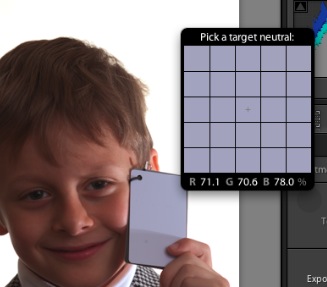

Before

This renders the card neutral in shade, and all other colors are adjusted accordingly.
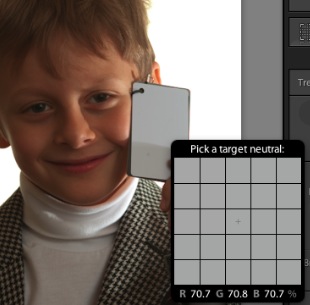

After

And the result, true skin tones and all, is at the beginning of this piece. Note the substantial drop in the Blue component in the ‘After’ picture.

There’s no need to restrict this approach to the studio. Place the card in a landscape, for example, and the result is the same. Add proper screen and printer profiling and true colors are a snap – no more messing about with sliders and suspect visual memory.

If you routinely take pictures in identical lighting, it’s easy to save a preset for the color balance adjustment in Lightroom, obviating any future need to use the white balance card in like lighting. Useful for studio work where lighting can be replicated exactly.

You can buy white balance cards for a few dollars or make your own from a nice piece of white card. There’s no cheaper way of getting true colors and when it comes to flesh tones the issue is binary – they are either right or wrong. My white balance card includes an 18% reflectance grey card which is also useful for exposure measurement.
Barry Lyndon

A must see

Like the great English film maker David Lean, the American Stanley Kubrick made but a handful of movies. As with Lean’s oeuvre, there’s not a dud to be found. Indeed, I recall many years ago buying my first DVD player and the first movie I bought to see on it was, of course, 2001: A Space Odyssey.

But if it’s visual richness you crave, then the Kubrick movie you will like most is the little played Barry Lyndon. In addition to a superb performance by Ryan O’Neal (when did you last use those words about O’Neal?) there is the sublime beauty of Marisa Berenson. Kubrick was nothing if not technically competent, having started life as a stills journalist photographer, and I recall at the time of its release stories circulating of Kubrick’s use of special Zeiss still camera lenses on his Mitchell movie camera.

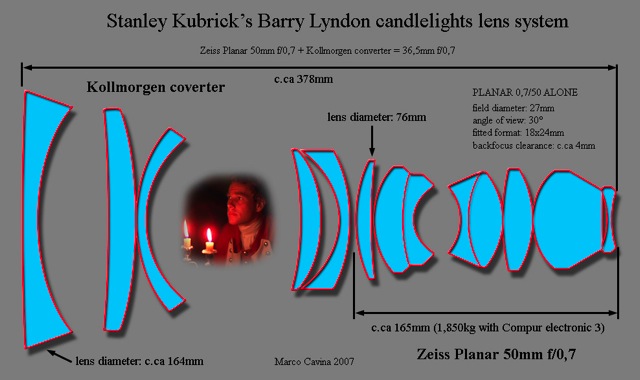
Well, here’s the scoop from Ed DiGiulio, the expert who adapted the Zeiss f/0.7 (f/0.7!) 50mm lens for Kubrick’s camera, which Kubrick proceeded to use for the candlelight scenes in the movie. The effect is magic. The lens – like the fabulous Leitz 180mm f/3.4 Apo-Telyt-R which I used for many years on my Leicaflex SL – was commissioned by NASA.

This is a very long, slow paced film and one which is essential viewing for those with non-American attention spans – meaning you can sit still without popcorn and colored, sugared water for 3 hours – and a love of visual beauty. It’s the sort of movie that makes you go out and buy a 100″ screen for your home theater. I did.

Here’s a schematic of the Zeiss Planar lens together with the enormous (over 5″ diameter) Kollmorgen wide angle adapter which DiGiulio refers to:

Marisa Berenson? None other than the great-grand-niece of that art plunderer and self-appointed Renaissance expert, Bernard Berenson, but a whole lot nicer to look at.


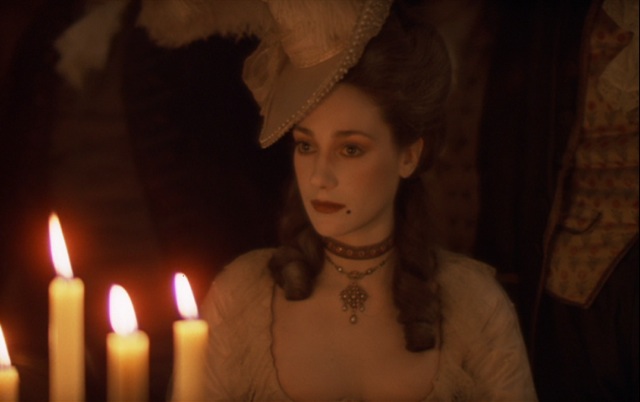
Marisa Berenson by candlelight in Barry Lyndon. Staney Kubrick, Zeiss Planar 50mm f/0.7 lens

Kubrick’s last movie was Eyes Wide Shut, released in 1999, the year he died. Another visual masterpiece, it is also distinguished by another actor who couldn’t act before he crossed Kubrick’s path, Tom Cruise. Watch it for a radiant Nicole Kidman.

Update June 2013:

Watching Barry Lyndon in the newly remastered Blu-Ray version is a revelation. Maybe the best art film ever, with luscious cinematography by Joe Alcott whose credits include three other Kubrick masterpieces – ‘A Clockwork Orange’, ‘The Shining’ and the unsurpassed ‘2001: A Space Odyssey’.

Update July 2015:

There’s a fine 6 minute documentary on the Mitchell cameras, the Zeiss f/0.7 lens and the costumes here.

The March 1976 issue of American Cinematographer with details about the cinematography can be downloaded here.

The curse of black

I never could fathom this one.

When I was a kid, cameras and stereo gear came in chrome. The engravings were in black and everything could be made out from a distance. Especially useful when trying to make out the settings on your amplifier or what have you.

Then, some time in the 1970s, black was declared cool (that seems to be a renewed trend now, with as little substance as last time) and the sad result for users was that their coolness was accompanied by a general inability to tell what anything was set to without a lot of squinting and eyeglasses on the head.

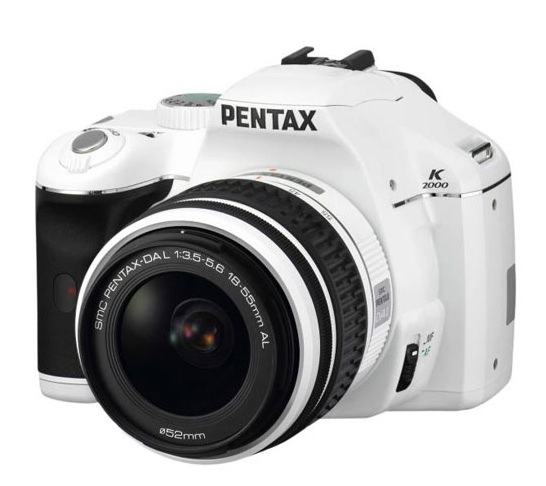
In their mass market models, some manufacturers bucked the trend and you see all sorts of jolly colors in digital point-and-shoots today and I, for one, love the trend. But there’s little color available in the better gear, a recent exception being the Panasonic G1 which comes in a couple of jolly colors. Now Pentax has joined the movement:

I’ve always liked saddle leather brown. Maybe Canon could be persuaded to do a custom 5D Mark II? Nah!

It was 25 years ago today ….

…. and it’s still the only Superbowl ad anyone remembers.

To this day, this inspired piece of anti-Big Brother propaganda convinces consumers that their PC maker of choice is a struggling start-up fighting the forces of evil, when in reality the company has $28bn in cash, 50% operating margins, a $100bn market capitalization and a presence in just about every country and seemingly on every Main Street on earth. Heck, IBM is smaller than the eponymous fruit company now.

You can fool all of the people all of the time and, no, I will emphatically not be watching the Superbowl with its hopped up, hyper-thyroid, cortisone injected ‘athletes’ any more this year than I did 25 years ago. I will, however, be watching the ads, as usual, to see how consumer trends can benefit investing strategy.