We all need it.
Faster lenses. Faster films. Faster sensors. Faster CPUs. Faster prints. Faster publishing. Faster access. Faster retrieval.
In all areas of human effort, speed is seen as a good thing. Time is money. The exception, of course, is government which is not playing with its own money. But we are talking of good things here, so let’s move on.
In most areas of my life I very consciously focus on doing mundane tasks – those which confer no great added value to my world but must be done – as speedily as possible.
In the world of photography that means using digital, not film (plus the results are far superior in any case). Delegating printing of all but the largest photographs to professional labs that do this sort of thing all day. And using snappy processing and data management software like Lightroom to keep all those pictures in easily accessible form. For the most part I see little purpose in spending time at a screen processing images and aim for the best in-camera original to keep back-end efforts at a minimum. Anyone can process and print. These are purely mechanical tasks, despite what those, seeking to protect what little knowledge they have, would tell you. Face it. The ‘great printers’ were, as often as not, lousy photographers. Can you say Ansel Adams?
One of the nicest things about modern computers is that most come with built-in webcams allowing you to make video calls to like-equipped colleagues anywhere in the world. I suppose I should make that “…. Mac-equipped colleagues….” because, for the life of me, I have never succeeded in getting a webcam to work reliably with Windows for any sustainable period and do not know anyone who has. Mine, in various Macs, has yet to fail in four years of solid use. What else is new?
The other day, enjoying one of these calls, I began to grow increasingly irate at the latency and image smearing I was getting on the video side of the call. Now it’s no great secret that America has some of the world’s worst broadband capabilities and, yes, you can blame a government which would rather regulate than free technology. As a result our internet connections are generally 10-25% the speed of those enjoyed by Europeans and Asians. Criminal. This from a country which claims a lead in all things technological.
Living in a rural area – to put this in perspective, most of my neighbors use dial-up – I didn’t hold out much hope of significantly increasing my internet connection speed but decided to call the cable company on a whim and learned that I could double my speed by simply upgrading to a newer modem (which they supplied at no up front cost) and paying an additional $10 monthly. So two hours later I had the new modem on line and could measure the difference. The standard for this is Speedtest.net and here are my before and after readings:
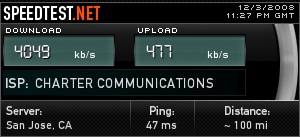
Before
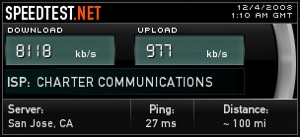
After
Exactly in line with the cable provider’s sales pitch. Amazing. Best money I have spent this year.
Now before you start thinking that 8 mbps/1 mbps download/upload is fast, take a look at the statistics available at Speedtest.net. These are averages for the cities concerned:
Tokyo: 25/15
Sydney: 30/20
London: 35/30
Paris: 21/13
In other words, the best I can get here is still far slower than the worst in these great cities. And these places are run by foreigners, for goodness’ sake!
Nonetheless, the next time I go to upload snaps to any one of my web sites, I am at least consoled that the time wasted will be half of what it was yesterday.
You think it was easy getting broadband here in the boonies? How about a 405 foot ditch and like amounts of broadband coaxial cable and PVC piping? We did this 5 years ago when buying the place and, despite many teething troubles, the whole thing is now very reliable. And newly fast!
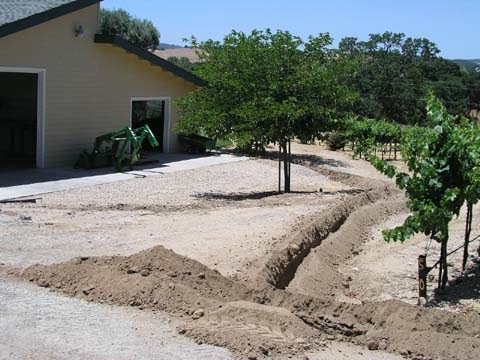
Getting broadband in the boonies is no simple thing
Have you checked your connection speed? Do so. My carrier makes contractual promises about speeds and I hold their feet to the fire on those. Too bad no such speed guarantee is offered by the ISPs I use, whose service and speed vary from poor to execrable.
For the record, this site is hosted at BlueHost.com, whose owner is forever blogging on how great his crappy service is. My photo web site (click on the right) is at Readyhosting.com (I like to spread the pain) and all you need know is that they use Windows server technology. The less said the better.
Too bad it’s so difficult to change ISPs. If you are looking for an ISP, avoid these two stinkers who have the bedside manner of the IRS and the efficiency of General Motors. Remember that 99% up time means an ISP is down over 3 days a year. Just say no to such poor statistics and keep shopping until you find 99.999%.