Frans Lanting – Good Advice

From the July 21 issue of the Wall Street Journal.

These extracts from the article in the July 21 issue of the Wall Street Journal include some excellent advice from the greatest living nature photographer:

“Slow down.”

“Don’t try to photograph everything in a scene.”

“Don’t get held back by technology.” Details like digital resolution and shutter speeds, as well as the plethora of different cameras and lenses available, can be daunting to the amateur photographer. To start, apply yourself to one main camera, and learn it and its accessories inside and out, Mr. Lanting says.

“Think of the story you want to convey.” Think of the three or four main photographs that would illustrate this story. Always have these four images in mind before you set out on the photography expedition. Take hundreds of shots, but always be looking for those four images, he says.

“Watch for light.” This is one part of the photographic process you can manage minutely, he says. Wait for the right light, add a flash or learn to say no to a shot if the light isn’t optimal. Mr. Lanting travels with a large selection of flash equipment, and uses a flash to light details like a tiny horseshoe crab on a beach at sunset, or even a high-powered strobe light to illuminate a flying puffin.

“Think first, shoot later. Photography is methodical.” Think first of the image you want to capture, then go about getting it. If you shoot first, then think later, that is a snapshot, not a photo, says Mr. Lanting.

“Go digital.” Mr. Lanting resisted switching to digital photography for years — he gave up film for good just one year ago. Finally, he says, digital technology can deliver the same quality images as film. He travels with several external hard drives and a Macbook Pro laptop, so he can shoot hundreds or even thousands of photos on each shoot, and upload them directly to his computer.

“Get up early. The best light is often at dawn, and animals and people are often at their best early in the morning.” Mr. Lanting often rises at daybreak to wander around his own backyard, snapping photos of birds and hoping to spot a bobcat or two.

You can read the whole thing by subscribing on line to WSJ.com.

Senility is a nasty thing

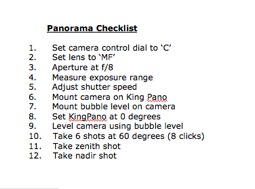
It’s tough to remember everything when doing those panoramas!

So I made a small check list which I embossed and which now happilly resides in my camera bag:

You may like to do something similar. In my early attempts I kept messing up exposure for some reason …. not good for a guy who grew up without an exposure meter.

By the way, as taking 360 degree panoramas dictates a new way of seeing – you think of the whole scene around you rather than just one straight ahead view – my limited mental powers suggest that a photography expedition in search of QTVR panoramas should be limited to just that. Meaning only a tripod, the KingPano and the 5D/fisheye come along.

So a trip to the local Target store found me splashing out on a small shoulder bag that accomodates the 5D mounted on the KingPano, all set up and ready to go. A somewhat unwieldy mass. This avoids the need to collapse or dismantle the KingPano which greatly reduces setup time. My genuine-Eddie-Bauer-original-Made-in-China shoulder bag ran all of $22. You can always buy a camera bag for four times that if you are so inclined.

Test your Photo IQ

This is only a test. Answer Yes or No.

1 – I believe cameras are objects of beauty to be collected and should only be kept in climate controlled display cases.

2 – I like the strap lugs on my Leica M like on the early models where they are too far up and back, ensuring the camera tilts forward on my waist.

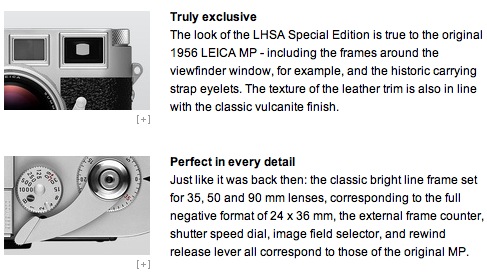
3 – I like the whole retro look thing because it means I am so cool and you cannot get it at the Apple Store. Would you just check these great features out:

4 – I get a real buzz from knowing that I paid $2,000 more than you did for your new rangefinder Leica, because I could. And you couldn’t. And it’s a nicely engraved, anyway. That’s German craftmsmanship for you.

5 – I like being a member of a group whose average profile is: Rich, semi-retired white male, wheeze when I walk, couldn’t take a picture to save my life, really wish my wife would slim down a hundred pounds or so, receding or no hair, last exercised when raising a glass of vintage French champagne to my lips.

6 – Having a collector’s Leica means I must be a great photographer.

7 – I think waiting a couple of days for my pictures to come back from my $5,000 camera is the height of chic. What do those digital guys know anyway? A passing fad.

8 – I think blowing $5,000 on an imitation of a camera first made over fifty years ago really validates my success in life.

9 – My dad got his in WWII when he liberated Berlin and this one’s nicer. The old man should see me now.

10 – Like my Harley it’s only 50% foreign content and who’s telling?

How did you do? If you answered ‘Yes’ to one or more of the above, do I have the thing for you:

A (QTVR) brush with the law

Your intrepid photographer gets grilled by the law.

Now I’m not the sort of person to flout the law. Except that I speed, now and then, just like you do, the better to avoid being rear-ended by some poorly endowed guy in the Hummer behind me, I have always believed that doing things the legal way beats the prospect of a stay in the local pokey. Which is why the request that I submit to interrogation, the other day, rather took me aback.

There I was in Morro Bay, a charming little seaside village in central California, wandering among the fishing boats with 5D, KingPano head and tripod poised for action. In as much, that is, that this combination can be poised for anything, tending to the clunky end of the ergonomic spectrum. It’s the nature of the beast. The local Coastguard had raised one of their rubber dinghies out of the water for maintenance and its bright colors and interesting shapes naturally drew me like a magnet. Thanks to the QR heads I have fitted to this kit I was set up and ready to rock in seconds. Until, that is, the long hand of the law intervened.

Now you must understand that the Coastguard exists to prevent Mexicans, seeking to work in the US, from swimming twenty miles up the coast in frigid Pacific waters, in search of $5/hour. True, two million of them elect the land route annually, and if you have ever dipped a toe in the Pacific, you will know why. These fellows are not dumb. Still, should any one of them so much as try the Mark Spitz thing, be assured that the Coastguard and its huge annual budget will be there to protect our women and drive up the price of our vegetables.

“Our captain would like to know why you are photographing one of our boats” the voice intoned.

“Well, I’m not exactly photographing your boat” says I.

“Sir, you are photographing a military vessel. Please report to the office with your camera”.

Let’s step back a moment. We are not talking about the US aircraft carrier The Ronald Reagan here, equipped with a crew of 5,000 and fifty F-14 Tomcats primed with nuclear weapons, ready to destroy any country of choice at a moment’s notice. No, sir. We are talking about a thirty foot rubber dinghy.

En route to the captain’s office I quickly swap the CF card in the 5D with a spare. It’s not that I have any snaps of the dinghy on it, I don’t, but I sure as hell am not having my Limekiln redwoods snaps from earlier in the day confiscated by someone with more authority than the Commissioner of the IRS.

Anyway, after keeping me waiting for what seemed like ages while he finalized the pleasure cruise they were putting on for a local reporter in another Coastguard craft (your taxpayer dollars at work) I am suitably grilled by El Capitano.

After first reassuring him that my tan was acquired in the local vineyard and not in the Middle East, I chose the Obfuscation Route. After explaining that I am an amateur photographer with no thought of gain, I give him five minutes on Virtual Reality and how his boat is but a small part, great grand vessel that it is, of the larger design. He begins to glaze half way through this and lets me go, not before reminding me that “….you can’t be too careful after nine-eleven” you know and “You are dealing with the Office of Homeland Security, here. After all, sir, you are taking pictures which include a military vessel”.

I leave trying hard not to laugh while thinking of that 19 year old German air ace Mathias Rust who landed his Cessna in Moscow’s Red Square in 1986, at the height of the Cold War. Yeah, we won that one, too. One particularly apposite cartoon the next day showed a technical drawing of the plane captioned “Stealth Bomber”. So now I think of the dinghy as the “Stealth Destroyer”.

Wandering back to the dinghy, excuse me, military vessel, I tell the chap who apprehended me that “I have security clearance, you know” (always wanted to use that line) and set up the tripod et al. I take my pictures, after promising the Captain a copy (he says he has QuickTime on the Coastguard’s PCs so that’s something, I suppose), and go on my way, thoughts of hot lights and pentathol still in my head, and deeply reassured that, were we to be invaded by sea, all would be well.

Here it is – The Stealth Destroyer.

Too bad it wasn’t sunny. You can see the Coastguard Office, where I was brutally interrogated, in the distance, half way around the circle. What I’ll do for a picture. Now about that army base nearby….
Finally, a QTVR HDR real life panorama

The whole megillah.

There are times of the year you really do not want to be driving on Highway One in central California. This is one of them. Make it a weekend and you would probably have more fun doing your taxes. You see, for reasons known only to the drafters of the Constitution, RVs and SUVs are allowed on this narrow winding road. As the selfish idiots who drive these vehicles (imagine doing 2 mpg in an RV and having to carry your waste with you) are also incapable of reading, ‘Turnout’ means nothing to them, leaving but three or four legal (and semi-suicidal) passing areas in the 40 miles between Hearst Castle and Limekiln State Park, a trip I took yesterday. This was not helped by the fact that the road was well and truly socked in, fog being par for the course at this time of the year. The only person having fun on this road was the guy who passed me on the double yellow on his Ducati. More power to him.

So my first words to the Forest Ranger on arriving at Limekiln and handing over my $6 were “Boy, there are some bad drivers out there”. “No kidding”, he replied, “two went off the road at night just north of here last night and fell 700 feet to the ocean floor. Both died.” Let’s hope they were driving an RV – nature’s little fix for the gene pool.

Having been to Limekiln many times, the fog left me untroubled, for I knew that some 500 yards from the Pacific all would be sweetness and light. A few seconds in the warming sun and a whiff or two of scented air, and the frustrations of the trip were forgotten.

The goal was simple. I have always been mightily frustrated with my pictures here, for two reasons. First, the insane dynamic range makes preserving of detail in both highlights and shadows very difficult. Second, there is simply no way a static picture can convey the sheer magnificence of a giant redwood forest.

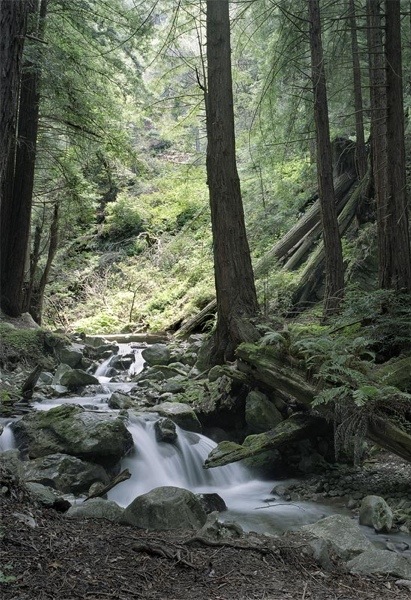
Here’s the sort of thing you get on 4″ x 5″ – at least the dynamic range is OK:

Limekiln. Crown Graphic 4×5, 210mm Sironar, Kodak Portra VC160

But, let’s face it, you are not there.

So after all that work to learn QTVR photography, and tons more to learn HDR, I put the whole thing together after all those tedious tests in the home I have documented here over the past few days.

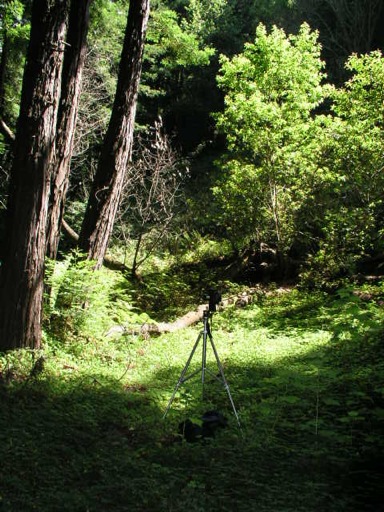
Canon EOS 5D and KingPano at Limekiln State Park, CA, July 17, 2006

I took no fewer than 24 pictures per image. 6 ‘circle’ views with the vertically mounted 5D + Canon fisheye rotated about a vertical axis on the KingPano head, each ‘view’ comprised of three pictures, properly exposed, + 2 stops (actually shutter speeds) and -2 stops. Two more views, each of three images, added the zenith and nadir images.

Back home (I had much fun on the drive back trying to run a pig on a Harley with open pipes – blasting his foul noise into unspoiled nature – off the road) each set of three images was merged in Photomatix into one HDR image which was then tone mapped in the same application. All eight resulting images were then dropped into PTMac, the previously determined lens parameters applied and auto control point generation was commenced. I didn’t even bother to delete the ‘bad’ (meaning big) control points. Saved the TIFF file, into Photoshop for final Levels and Curves fine tuning, a quick check of stitching using the Panagea plug-in, and then on to CubicConverter to save the panorama with the right starting point and zoom settings. This time I used the ‘M (high)’ JPG quality setting on the 5D, meaning each source image was between 3.4 mB and 5.1 mB. For some reason the underexposed ones are larger. Whatever. No need to use RAW – the files are too large for my purposes and I get better tone mapping through HDR than RAW can provide.

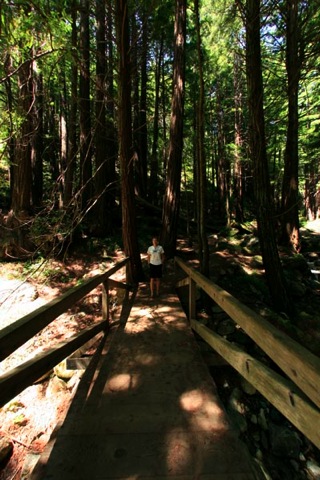
You can judge how much HDR adds to dynamic range from this non-HDR extract:

And here is the QTVR HDR result of the 24 constituent images:

Click Here

The young girl actually arrived on the scene when I had just finished the ‘circle’ images, so I asked her to stand as still as she could while I took three more to replace the original. As you can see, she moved slightly, but the effect is there. Photographer’s luck. You can’t have it if you don’t take pictures.

The file is some 2.5 mB in size, owing to the high quality of the JPGs used, and I have constrained the zoom range to the point where quality is not compromised on zooming in.

While taking 24 pictures to make one result sounds daunting, once you get the hang of it, assisted by auto over/under exposures and motor drive, and the click stops on the King Pano, things move along very fast. I didn’t even bother re-levelling the rig between shots, the subject being far less demanding for stitching purposes than the indoor scenes used to calibrate the equipment. A check of the time stamps on the files shows that the whole thing was done in two minutes. And do get QR heads for camera->King Pano and KingPano->tripod – the thought of all that screwing (I get enough from the IRS, thank you) in their absence is …. not good.

I hope you have enjoyed this learning exercise in QTVR HDR photography as much as I have.