Photographs, Photographers and Photography

February 21, 2010

Any day now ….

Filed under: Cameras — Thomas Pindelski @ 4:00 am

…. someone will get it right.

Another interesting product announcement from Samsung, the TL500, following on from their new APS-C DSLR:

The lens is fast at f/1.8, it does RAW and the zoom range is an incredibly useful 24-72mm. Just about perfect for street photography.

But, but, but …. there’s still no eye level viewfinder. I doubt it’s lost on the likes of Samsung and Panasonic, etc. that there’s a profitable and prestigious market segment waiting for a small, fast camera like this with a proper finder, not some dumb ass LCD screen, at $8,000 less than the crazy-priced Leica M9.

I doubt the day when we will see something like this is far away. F/1.8, 24-70mm or so with a manual zoom ring, a bigger sensor than the 0.6″ one in the TL500, low shutter lag and no earthly need for interchangeable lenses. All that’s needed in addition is an eye level EVF. Panny has most of this in the G1/GH1 and just needs to redesign the container, but if someone else beats them to it, so much the better. And forget the poncy built-in flash, for heaven’s sake. The technology is out there, it’s robust and my money is waiting. I would even settle for a smaller sensor than the one in the G1 – who is going to make huge prints from street snaps anyway?

February 4, 2010

The Olympus E-PL1 and new lenses

Filed under: Cameras — Thomas Pindelski @ 9:25 am

A strange idea.

Let me preface my comments by saying that I have yet to handle the newly announced micro four-thirds Olympus E-PL1. Only journalists who will say nice things about it get advance copies and I am neither journalist nor toady.

The Olympus E-PL1

The camera will likely retail for $500 compared to the $660 asked for the E-P1 and the outrageous $1,100 for the E-P2, even if the latter comes with a clunky clip on EVF. Cost savings are accomplished by dropping the turn wheel and replacing it with slower buttons, more use of plastics and mounting the kit lens in a plastic rather than a metal body. Conferring value added, the E-PL1 has a built in electronic flash, like the E-P2, whereas the E-P1 has none.

So for $160 less than the E-P1 you get more plastic in the body and lens and a flash gun. Not bad. As none of these cameras is intended for use in war zones, I see no problem with the use of plastics and for many the flash is worth having. Stated differently, Olympus has just cannibalized the E-P1 into obsolescence, especially when you realize that the E-PL1 accepts the clip-on EVF denied to E-P1 users. The lack of the thumb wheel for street snappers is no big deal – there’s no time to adjust anything in the urban jungle so it would not be missed by this user. And with any other subject you have all the time on earth to mess with the buttons.

The lens remains interchangeable and there’s still no built-in viewfinder. The clip-on EVF destroys the compactness concept of the design by adding bulk and weight. So, in summary, I see the E-PL1 as a replacement for the E-P1 at lower cost but still a very expensive point-and-shoot restricted by its adherence to an LCD screen for composition, with all the attendant problems those bring. I would guess that E-P1 users are none too happy about Oly’s confused marketing move here.

Olympus 9-18mm wide zoom

At the same time Olympus announced two micro four-thirds lenses of interest. One is a $600 9-18mm wide zoom (18-36mm full frame equivalent) which depends on the camera’s in body image stabilizer, meaning that Panasonic G1/GH1/GF1 users have no IS as those bodies depend on in-lens IS. No big deal with such a short and useful focal length range, and the price is more appealing than the $1,100 asked by Panny for its wider 7-14mm super-wide zoom. But where the Olympus design completely blows it is in the use of an extensible lens barrel, requiring the user to extend the lens before use – just like with certain Leica and Zeiss designs from the film days. While this idea makes for a more compact unit when collapsed, having to remember to extend the lens is simply a no-no for street snappers. Further, the higher wear rates of such designs which become wobbly with use and scratched up by dirt and grit on the trombone part, argues against longevity. I know. I used a collapsible 50mm Leitz Elmar for years and it was well and truly shot when I finally sold it. So nothing here for the Panasonic micro four-thirds user.

Olympus 14-150

The other newly announced Olympus zoom is the 14-150mm (28-300 FFE). At $525 it offers an appealing value but, once again, comes with a big negative. Without in-lens IS, use at the long end with the Panasonic bodies will require firm support to avoid shake. Olympus body owners benefit from in-body IS but have you ever tried to use an LCD for composition with long lenses, holding the camera two feet from your eyes like a real dork? Another dud, I’m afraid, especially for Panny micro four-thirds aficionados.

From a personal perspective with over 5,000 exposures on my G1, I remain delighted with the crackerjack 14-45mm kit lens (rough zoom ring apart) and find that I pocket the 45-200 IS for those few occasions where I need the reach. And what a reach it is at the long end! All I need to round things out is a pancake 10mm f/2.8 or so for really wide views and I will be a happy man. No sign of such a lens in Panny’s currently announced lens plans. There’s a 14mm f/2.8 coming but the very small kit zoom starts at 14mm and f/3.5 so I simply don’t understand Panny’s thinking here which seems about as clear as Oly’s mistake with the E-P1. The current 20mm Panny adds a fast aperture, true, but it duplicates what I have with the kit zoom and I do not need fast lenses for my kind of work.

January 16, 2010

Epson’s EVF

Filed under: Cameras — Thomas Pindelski @ 7:41 am

Now in quantity production.

A reader sent me a link to Epson’s press release with details of their new Electronic View Finder. What’s significant about this is that smaller camera makers like Ricoh and Pentax who lack the capital to develop something similar will be able to buy the part at reasonable cost.

Click the picture for more.

January 4, 2010

Another EVF SLR

Filed under: Cameras — Thomas Pindelski @ 9:00 am

From Samsung, unsurprisingly.

Samsung is rolling out its NX10 mirrorless DSLR any day now – much the same concept as the Panasonic G1/GH1 but with the larger APS-C sensor and using superior rear LCD screen technology. Boy, if anyone knows about LCDs it’s Samsung as they are one of the largest manufacturers of these in all sizes.

Sadly it’s still modeled, like the Panny twins, after the conventional DSLR silhouette, with that silly prism hump, but that will not last long, I am sure. Overall it seems about as small as the G1.

I can only applaud. It’s another nail in the coffin of the flapping mirror/pentaprism design which has seen its day in the sun. The user gains compactness and a quieter tool with less weight. So the tool gets used more as a result.

Can a full size sensor variant with no prism hump be far behind?

Now Sammy, where’s the British Racing Green version, please?

December 27, 2009

Falling lives

Filed under: Cameras — Thomas Pindelski @ 3:00 am

Shorter and shorter.

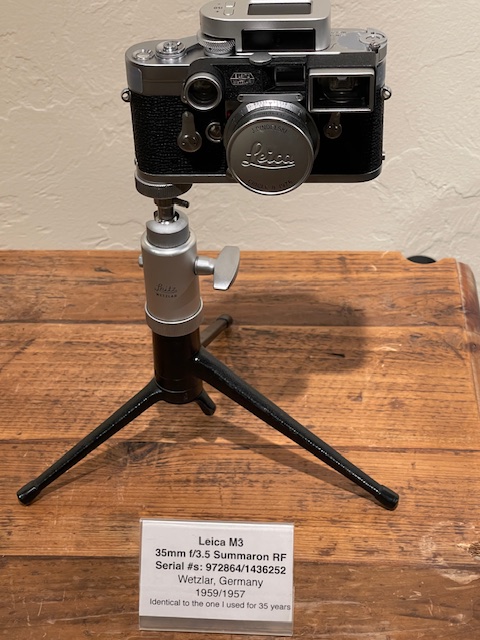
I used my Leica M3 for some 35 years. It had everything I needed in a street snapper, being small, quiet, sharp and fast. Add a lens or two and you had enough to travel the world. I mostly used it with the 35mm Summaron with those ghastly viewfinder ’spectacles’.

My M3

My Rollei 3.5F made it through 10 years. Truth be told, I seldom did it justice, never getting comfortable with the reversed waist level image (you were always looking up at people’s chins) but the large negative was nice and the camera even quieter than the Leica.

My Rollei 3.5F

It’s successor was possibly the most accomplished medium format film camera ever, the Rollei 6003 Pro. The designers obviously took pictures and the choice of shutter or aperture priority automation was better executed than anything before or since. The lenses were to die for and the controls near perfect. Too bad it weighed several tons. Five years.

My Rollei 6003 Pro

One other attempt at medium format came and went in a year. The Pentax 6×7 was so loud that there was basically no environment in which I cared to use it.

It made the sound of a gun when the button was pressed

By contrast, the diminutive Pentax ME Super with its sweet 40mm Pancake lens was a dream and served me well on the streets of a tough New York during most of the decade of the 1980s when I lived there. It started as a ’steal me, I don’t care’ substitute for the Leica and ended up my daily snapper. I left it behind in New York when I moved to Los Angeles. Street snappers were safe there as no one walked.

ME Super with pancake in place – as good as 35mm SLRs got

But my all time favorite of the film years was my Leica M2, which I bought in very sad shape in 1993. I got a dozen very hard years out of it and it always made me regret having bought the M3 back in 1971 when I really should have got the M2. The 35/50/90mm viewfinder was just what the doctor ordered and no bespectacled bulky 35mm lenses were needed, just the wonderful 35mm and 90mm Asph Summicrons. Parting with that one really hurt when I sold it.

My Leica M2 with the 35mm Asph Summicron

My general drift here, however, is that there are no more 5, 10 or 15 year cameras. The rate of change in technology is so startlingly high right now that if you were to tell me that I would be using my Panasonic G1 as my “go to” tool of choice five years hence I would laugh myself silly.

No sooner do I write that, though, than I am given pause by the superb Canon 5D. I see no earthly reason to upgrade to the Mark II as the images seem every bit as perfect as anything from medium format film and maybe it will just enjoy a double digit anniversary here. Provided it doesn’t blow and die for lack of digispares. I have recycled a couple of the poorer lenses made by Canon for this body but the rest soldier on as sharp as the day I bought them and newer arrivals preserve backward compatibility so far.

Life’s too short for brand loyalty. I wonder what the Panasonic G2 will bring? Or the Samsung XYZ3? If it works for me you will find it around my neck or, more likely, in my pocket.

“Rich sod” I hear you thinking. Nothing could be further from the truth. My M3, bought in 1971, was the results of My years in retail. The Rollei 3.5F was a real beater which cost very little. Now, film Leicas and Rolleis are super collectible, of course. Pretty much everything else was from trading gear, and I never bought new until digital came along. The reasons are simple. ‘Used’ and ‘digital’ equals ‘obsolete’, as in parts are not available no matter how competent the camera, and repairing them makes little economic sense. Further, digital gear is so much cheaper than the machines of old that it has become very affordable. That $650 G1 would have cost some $100 in 1971 currency when I got that Leica M3. It never ceases to amuse me that the proceeds of my M2, M3 and a small handful of lenses paid for everything I use today. Like with investing, timing the exit right makes a big difference. And loyalty is for dog lovers.

December 25, 2009

Like the old days – not!

Filed under: Cameras — Thomas Pindelski @ 3:00 am

A body and two lenses.

You would sling the camera over your neck with the short lens on the body. The other lens, the medium length one, went in the shoulder bag. And that little outfit would be all you needed to go around the world.

Back in 1973 it consisted of a Leica, 35mm and 90mm lenses. Changing from one to the other was second nature and you never messed with the silliness of lens caps – just another impediment to a swift lens change.

And I found myself reliving that experience the other day only this time everything was automatic, the lenses were zooms covering 28mm through 400mm (!) and my camera could take 600+ RAW images at a sitting at a level of quality and capability which leaves that lovely Leica in the museum where it belongs.

Lost in thought.

Lonely guy.

Copper sunset.

All pictures on the Panasonic G1 with the 14-45mm and 45-200mm lenses.

In a year or two it will all be in an even smaller package and the results even less dependent on technical skill. That seems right to me. Anything that gets in the way of the picture is a bad thing. Which means automation is a good thing – for what I want to accomplish.

December 23, 2009

A handy bag

Filed under: Cameras — Thomas Pindelski @ 3:00 am

Thanks to the US military

The US military may last have checked the ‘win’ column some 60-plus years ago, but not all is bad. This taxpayer got a bit of his own back by picking up a handy ex-military bag from the local Army & Navy surplus store. Have you ever wondered what happens to Air Force surplus, by the way?

The problem with most camera gear bags is that they scream ‘camera’, invariably being emblazoned ‘Tenba’, ‘Domke’, ‘Lowepro’ and the like – all brand labels beloved of the light fingered set. They are also invariably obscenely expensive – $75-150 for, let’s face it, some canvas and stitching, made in China. Neither issue arises here for this is an ex-Army canvas map bag, has no markings and costs …. wait for it, all of $12.

The three compartments hold the Panasonic G1 with either the kit lens or the 45-200mm, the other lens goes in the center divider and my mobile back-up drive goes in the front. If needed, the rear compartment will accommodate my netbook computer. In that case the camera with one lens goes in the middle and the other lens moves to a jacket pocket – the G1’s lenses are so small this is simply not an issue. The ‘ears’ keep the rain out and there’s even room for a sandwich and a bottle of water.

Check your local surplus store for any number of similar choices. I like that it looks so shabby and amateur (unlike our military), the last thing a thief would be interested in. It is also superbly effective (also unlike our military). Probably not made in China, which may well turn your crank, to boot. And you can always console yourself with the near certainty that the thing cost the US Army hundreds of dollars when originally procured from our patriotic military contractors.

December 22, 2009

Kevin and Tiger

Filed under: Cameras — Thomas Pindelski @ 3:00 am

Celebrity endorsement trash.

Why would anyone think that celebrity endorsements make sense?

Will I be able to drive like Schumacher by buying a Ferrari? Ride like Lance on a Trek? Play like Tiger with those clubs?

So I weep when I see a truly great actor like Kevin Spacey touting a camera in one of the most condescending ads made in recent memory.

Spacey touts the EP1

The one thing we do not see is Spacey’s pictures. Why not? I mean, he is advertising a camera, no?

The inverted snobbery (”Don’t be a tourist”), the denigration, the put downs – it’s all about as wrong as you can get. Tell me that the camera is sweet and elegant like almost everything Olympus makes, fits in your purse or pocket, encourages you to take it anywhere, makes for glorious pictures, and I am there. Tell me I have a shot at being the next Doisneau or Cartier-Bresson with it and my check book comes out. Tell me it’s what Bailey uses before making out with his latest discovery and I’ll buy two.

But where, pray, Mr. Spacey, are your pictures?

Frank Rich of the NYT writes eloquently about the credibility of another celebrity endorser:

“What’s striking instead is the exceptional, Enron-sized gap between this golfer’s public image as a paragon of businesslike discipline and focus and the maniacally reckless life we now know he led. What’s equally striking, if not shocking, is that the American establishment and news media — all of it, not just golf writers or celebrity tabloids — fell for the Woods myth as hard as any fan and actively helped sustain and enhance it.”

Why, then, should I buy a camera from you, Mr. Spacey? At least Tiger can play golf, but I haven’t the foggiest idea if you can take a photograph.

Olympus, you can do better. Start by paying someone who can take pictures. I don’t much care if he sleeps around – that’s his business, not mine.

September 15, 2009

Experts and pictures

Filed under: Cameras — Thomas Pindelski @ 5:16 am

Trust your eyes, not charts.

Frequently one sees performance of digital cameras compared using JPG images. This could not be more useless. Different sharpening algorithms in the cameras being compared render such comparisons meaningless, compounded by the poor dynamic range of the JPG file format. JPG is the fastest way of making a fifty dollar camera out of a thousand dollar one. Add to this technical ‘analysis’ the fact that different lenses at different price points are being used and what you end up is so much noise.

Some try to counter these issues by comparing unprocessed RAW image output. Even worse.

All digital images require anti-aliasing – the process of removing ‘jaggies’ from image details. For example, when the Leica M8 was first ‘tested’ reviewers gushed over the native definition of the RAW images produced by the camera, comparing these favorably with Canon, Pentax and Nikon DSLRs’ output. Chalk and cheese. The Japanese cameras use a strong anti-aliasing filter, placed in front of the sensor. The Leica M8 (and M9) uses none, preferring in-camera software to do the same thing to images rendered with its previous generation Kodak sensor. To get the best out of the Japanese cameras’ RAW images substantial sharpening must be applied in Lightroom (or whatever you use) to get the best from the original file and make a proper comparison.

Reviewers would have it that this makes the Leica image superior as no sharpening is needed, conveniently disregarding the fact that sharpening has been done in camera. They will then compound this misinformation by comparing a fixed focus lens on the Leica (because that’s what they were given to test and are too lazy/ignorant/conflicted to do it right) to a lower quality zoom on the Japanese competitor.

As I have pointed out many times here, the 5D I use – depending on the lens used – mostly needs a sharpening setting of 40-60 in LR. This works fine for the 24-105, 85/1.8, 100 macro and 400/5.6. The 200 f/2.8 ‘L’ is so sharp that it needs a setting of 20 at most. The 20.8 and 50/1.4 I owned (both sold) needed 70 or more at wide apertures. The Panasonic G1 uses so little in-camera RAW processing that it needs even more sharpening – my default import setting for the G1 with the kit lens in LR is 90.

So what’s the right answer to the question : “Is this camera capable of delivering the resolution/speed/handling/whatever that I need?” I’m afraid that, with the host of variables in the digital process, and the broad range of skill sets and needs among users, the only right answer is “Try it and see”.

After all, would you trust a surgeon who never operated before to work on you? Because that’s what these reviewers are – hardly a one of them can take a picture to save his life and what works for you will differ from what works for the guy working for ‘click-through’ advertising dollars using free gear from the manufacturer. He’s not about to bite the hand that feeds him.

So for the reader who asked here the other day “Should I sell my LX-3 and get a G1?” there’s no right answer to that question. How can the needs of, say, a street snapper, compare with those of a macro or sports enthusiast? Depends what you want to use the camera for – there are no Swiss Army Knife solutions.

By all means read the technical reviews to get a sense of the gear but don’t waste your time on comparisons with other makers’ equipment by those unqualified to pontificate. Try it yourself.


Expert camera reviewers. G1, 14mm, f/4, 1/2000, ISO 100

An online camera review reader having just finished yet another mind numbing twenty page special:

September 11, 2009

The Leica M9 and the Viewfinder Revolution

Filed under: Cameras — Thomas Pindelski @ 8:36 am

The last face lift.

I wish Leica well with its new M9. There’s always a market, however small, for the dowager on her third face lift and no shortage of insecure, wealthy buyers with weak egos craving fame by association. I think of the M9 as the Joan Collins of cameras. Neither is cheap.


The Joan Collins of cameras – the Leica M9.

The best thing to be learned from the M9’s tired makeover of a design that peaked in 1959 with the M2 is that the viewfinder is key. It is the window to the soul of the photographer’s subject, and the less it imposes itself between subject and snap, the better it serves its purpose.

The first twenty years or so of digital camera design will, I believe, go down as the period during which manufacturers’ disregard of the needs of consumers was at an all time high. So enamored did they become of digital this, and LCD that, their design results were some of the slowest, least responsive and unusable cameras ever made. You hardly need me to tell you that. Go to any crowded place on a sunny day and enjoy watching their owners squinting at silly little screens held two feet away from their eyes while taking pictures far worse than their parents managed on the Brownies and Instamatics of yore. Those at least were properly framed and action shots were the order of the day.

At the other extreme from the point-and-shoot set were the ‘professional’ DSLRs which made matters even worse. Like the Leica M9 these depended on fifty year old technology, this time in the guise of flapping mirrors and bulky glass prisms to get the image to the snapper’s eye. But as this is the digital age, these cameras started to sprout dozens of excrescences in the guise of control buttons and yet more ergonomic noise on their miserable LCD screens and ever more cluttered viewfinders. The only significant change in appearance was that the shapes became more organic and free flowing as modern plastics and manufacturing technologies took the sharp edges off. Just look at the original Nikon F for comparison, if you want to see what I’m talking about.

But the innovators in camera design, the Japanese, have woken up. First, they need a new idea to sell more gear to all those current digital owners, be they amateurs or pros. Second, some of them actually use the gear they make and grew up adulating the Leica M as the touchstone of camera and industrial design for, in 1959 when Mr. Yamamoto was knee high to a grasshopper, the Leica M2 was the unique blend of form and function. Small, fast and with decent lenses, it was the traveling companion of choice not just for well heeled amateurs but for pros wanting the best there was. And Yamamoto san, when he finally migrated to longer pants, found that the M2 was his snapper of choice, surrounded as he was by flashing LEDs and beeping buzzers galore.

To cut a long story short, the example set by the Leica M has placed camera design on the cusp of the next revolution. The changes that will bring will be nowhere near as earth shaking as the invention of digital sensors but they will finally make the digital camera the practical tool it has so far largely failed to be. And the most significant of those changes will, simply stated, be in the area where the Leica M once excelled. The viewfinder. The window to the subject’s soul.

I doubt it matters what the sensor size or format will be, for the new crop of digital cameras will come in any size you want. Medium format, full frame 35mm, APS-C, Micro four thirds, microdot – whatever. But what all of these designs will boast will be an absence of the ridiculous pentaprism, flapping mirror and LCD screen, all obsoleted by the growing availability of fast, noise free, bright-in-any-light and superbly compact electronic viewfinders. And they will focus fast with no shutter lag. A whole new selling proposition, rediscovered from those halcyon Leica days.

The maker at the cusp of what I call the Viewfinder Revolution is, of course, Panasonic, with their ground breaking G1/GH1 designs. That will not last long and you can bet that the basements of Nikon, Canon, Sony, Pentax/Samsung, Olympus et alia are a beehive of activity, filled with engineers and lawyers finding workarounds to Panny’s patents.

And their new designs will boldly drop the faux pentaprism hump that Panny felt was needed to introduce users to a new design ethic, will delete all the silly little buttons and will relegate the LCD screen to its rightful place as nothing more than a rarely used configuration display for favored settings. The EVF, whether eye level, waist level or both, will move modern camera design to a place where the wonderful digital sensors of today and tomorrow will finally be wrapped in a body with a viewfinder which can do them justice.

So thanks, Leica, for pointing the way. It’s just too bad that, like our heroine in the first paragraph, you refuse to age gracefully and pass to the museum which is your well deserved resting place.


The Leica M of women – Joan in 1960 and in 2007

Note: The writer used Leica M2/3/6 cameras and lenses almost exclusively in the period 1973-2008 (doubtless all now owned by Yamamoto san) and can assure the reader that the only ‘Leica glow’ he ever felt from all those wonderful lenses was from the red ink on his bank statement. Only those who have paid the asking price of the M9 and its glass will feel that glow, and will they spare no effort telling you about it.

September 9, 2009

The Leica X1 and street snaps

Filed under: Cameras — Thomas Pindelski @ 9:13 am

Some thoughts.

It’s 9/9/09 and Leica finally introduced its full frame digital M9. I won’t be dwelling on it here as I doubt there’s much need for, or interest in, a $10,000 camera (with lens) which comes with almost no automation, bulky lenses and a near total lack of weatherproofing. For that sort of money there are several rugged and capable DSLRs available from other makers and the specific situations in which a rangefinder camera excels are few and far between. Street snapping is probably the main genre where the r/f is most at home. A good reality check may be found here.

Leica has also introduced the X1, a fixed lens (35mm equivalent) APS-C body with a very appealing design. They deserve hearty congratulations on this as it’s not yet another rebadged Panasonic, though the premium price of $2,000 is hard to swallow. Plus you will need to add an optical viewfinder to make the thing workable in street situations which adds more cost. With v/f and with its non-detachable lens extended it’s much the same size as the G1 or GF1:


Leica X1

Note the full manual operation afforded by separate shutter and aperture dials.

So who needs this? Well, my perspective has altered significantly in the two short months during which I have owned the Panasonic G1. Having been a street snapper since childhood and having given up on film when the Canon 5D came along, I have been waiting for the ‘digital Leica’ a long time. And the G1 has changed how I think about street cameras.

In days of yore you would load up your little shoulder bag with a 35 and 90mm Leica lens, leave the 50mm on the M2 or M3 slung over your shoulder, and cram in a few rolls of film wherever you could stash them. After decades of use all the manual adjustments required became second nature – aperture, shutter speed, focus and the endless tedious changing of film in fair weather or foul (mostly foul in my London days). The results of those early efforts can be seen in all their monochrome splendor here. You didn’t complain because there not only was no alternative, no one saw digital coming. And SLRs were too loud and bulky and noisy to be an alternative for the truly unobtrusive and relatively quiet Leica M. You just learned to pre-visualize the image and would change lenses on the run to make sure the right one was in place by the time you pressed the button. And it made sense to have the right lens in place as film could only handle so much enlarging.

When the 5D came along you suddenly had medium format film quality at an affordable price with full automation thrown in. The bulk seemed modest compared to my Rollei 6003 and the ergonomics superior, but no one could accuse the 5D of being a street snapper. Landscapes, macro still lifes, portraits, QTVRs, HDR, all well and good, but unobtrusiveness is not that camera’s strong point.

So along came the Panasonic LX-1 with its host of compromises. Shutter lag, slow autofocus, an awful LCD screen replaced with a glued-on optical finder and too small to handle easily in a hurry, yet it was the best this street snapper could find at the time.

But the digital Leica did finally come along and the logo said ‘Lumix G1′.

After the first few hundred street exposures you realized that the craving for the rumored 20mm f/1.7 (now available) pancake lens was gone. I don’t need f/1.7 but I do need 35, 50 and 90mm focal lengths, much as I did in the M2/M3 film days. And the G1 went one better at the wide end, stretching to 28mm.

But it’s the total automation and that revolutionary Electronic View Finder which make the G1 the digital Leica. No need to change lenses. No need to excuse the quality of the kit lens or sensor, both small and superb. No need to wait for autofocus – in 1,200 exposures I have ‘beaten’ the AF just once. It’s that good. And as for the sensor, you may not want to make 30″ prints (who any longer makes these regularly?) but 13″ x 19″ is par for the course. And no need to set anything other than the aperture or squint into a dark finder trying to figure out what the camera is doing. The automation is outstanding and the EVF even better. In fact it’s pretty close to my wish list. Best of all, you can set the frame aspect ratio to 3:2, just like in that Leica of yore, and that’s how I use my G1.

So while Leica has done a fine aesthetic job (let’s just hope the shutter and focus delays are low) in designing the X1, I really question who needs a fixed focal length camera at such a price when you can have a more versatile tool with the same bulk for under one third of the cost? The only thing the G1 has which I have realized that I do not need is the interchangeable lens. The kit lens is this street snapper’s ideal.


Distraught. G1, kit lens, 14mm, f/5.6, 1/400, ISO100.

So yes, the digital Leica is here. It just happens to be made by someone else.

July 29, 2009

Olympus EP-1 …. woof!

Filed under: Cameras — Thomas Pindelski @ 4:02 pm

A real dog

Coming from David Pogue, the New York Times’s technology writer with a knack for making the technical understandable, is a review of the new Olympus EP-1.


Click the picture for the review

Well, sorry to say, the camera is an awful disappointment, and an expensive one at that. No viewfinder, horribly slow focusing (Panasonic refused to share its superbly fast focus technology from the G1 with Olympus) and, yes, you guessed it, miserable shutter lag. Hard to understand why anyone would waste the development budget on a camera which, while adding interchangeable lenses to a small body, otherwise does absolutely nothing to conquer the three bugbears of compact point-and-shoots.

An LCD screen passing as a ‘viewfinder’, slow focus and shutter lag.

And, at $800, considerably more than the G1 which, for a little more bulk, has none of these problems.

A real dog.

And thank you, Mr. Pogue, for pulling no punches.

Where is the genius of the company that gave us the stunningly original Pen F half frame SLR or the ‘better mousetrap’ of the Olympus OM1 full frame film SLR under designer Maitani?

June 5, 2009

Elitism

Filed under: Cameras — Thomas Pindelski @ 8:59 am

Guilty as charged!

I am an unashamed elitist, a status too often mistaken for snobbery. The two are unrelated. To misquote Wilde, the snob knows the price of everything and the value of nothing. The elitist, by contrast, focuses solely on value. Scratch an elitist and you will find an engineer.

I was struck by this realization when thinking of the choices I have made in machines over the years. Before we get to cameras, let’s look at some other daily possessions and the brands involved.

In the kitchen you simply cannot beat GE appliances. Not some fancy marque name, just your basic GE (and still made by GE as their disaster passing for a CEO failed to sell the home appliance division). Bog reliable, no instruction book needed and parts easily available when they do eventually break. But let’s face it, they rarely do. The GE fridge is the very touchstone of reliability.

With the mundane behind us, let’s focus on the essential. Motorcycles. For as long as I can remember I have ridden BMW motorcycles. Air cooled twins, water cooled flat threes and fours, oil cooled twins, faired, naked (the bike, not me), carburetted, injected, with or without sidecar, fast, slow, I loved them all, but only my first – a 1975 R90/6 air cooled boxer – remains, and is much loved. It had style where the others had function. Riding that old BMW reminds me that it’s the journey, not the destination, which matters.

In watches, I would love to tell you that I have always worn a Patek, but that would require that I had done a far better job of choosing my parents. Let’s face it, Polish refugees who had the poor sense to choose England over America as the land of the future – we are talking 1947 here – for their kids aren’t going to be troubling the Nobel Committee any time soon. Econ. 101 was plainly not on my parents’ curriculum. Add a curious predisposition for keeping their wealth in a Polish bank despite six – 1933-1939 – years’ warning that maybe moving the lot to Switzerland might make sense, their belief in the League of Nations and in the power and goodness of America saw them lose the lot to the invading hordes. So, to cut a long story short, I can claim to have worn nothing but a Patek since 1996. For nigh on twenty years, every time I was about to get one, the price had risen that bit faster than my disposable income. Well, it inspired me to try harder, I suppose.

I was a long time woodworker. Relaxing like nothing else, very challenging (metalwork is child’s play by comparison) and a perennial source of dissatisfaction. You can always do better. And I say ‘was’ because the onset of tendonitis – meaning my wrists hurt like hell when stressed – dictated disposal of my tools and conversion of the woodshop to a home theater. But I did keep one or two for the odd occasion and they all say Makita or Panasonic on the body. The Japanese make lovely, well adjusted and light tools which take an incredible beating and remain in perfect order. By contrast American tools – they used to be made here – try to impress with weight and the heck with the fit and finish. De Walt and Porter Cable have a lot to answer for when you look at just how shoddily the average American home is put together. As for the cheap and cheerful Chinese imports, whether from Taiwan or PRC, well you get a kit which has to be repaired and tuned before it works. Not a great use of valuable time.

Though I’m lousy at it, I do enjoy cooking and the pots and pans have always said All Clad. You can bury me with those. Good weapons too, in the event of a burglary. The chef’s knife is a Sabattier because if you want to cut well, use what the world’s most food obsessed nation swears by. Leave the guns to the Germans.

And speaking of Germans, when it comes to cars, few would disagree that the best cars made from 1975 through 1990 came from Stuttgart. Mercedes had the market cornered in execution, quality, longevity, resale value and safety, and Americans – me included – were happy to pay a premium for the three pointed star. Sure, the budding Andrettis swore by Porsche, the gold chain set by BMWs and techies by Audis, but Mercedes was the car for the rest of us. Masocists, by the way, opted for Jaguars. Then, two momentous events changed everything in 1990. The accountants took over Mercedes Benz and dictated that cars need only last two years. Greedy, over-leveraged Americans no longer bought cars, they leased them for two years then traded in for the latest variant. So, as leases were only 2 years long, no one cared if the knobs, dials and button failed on Day 731. It was someone else’s problem. The other event, which the dumb Germans made light of, was Toyota’s entry with a new luxury brand aimed directly at Mercedes. The Lexus LS400 introduce in 1990 cost 25% less than the top of the line Mercedes and outperformed it in every regard. My last Mercedes was the 560SEL, maybe their most glorious sedan creation and my first Lexus which I drive to this day is a 2000 LS400. MPG? How about 14 vs. 27 on the freeway. Horsepower? 238/290. Comfort? Identical. Noise? Lots/none. Repairs: Constant/none. So Lexus was this elitist’s choice.

Computers? Apple. If you have to ask, you just don’t get it.

Home electronics? It really doesn’t matter. Nearly everything made is dead reliable and dirt cheap – premium prices generally add never-used features. So brand no longer matters. No one buys a Sony because it’s a Sony any more, as Sony is finally learning. This is the Era of Price.

Furniture? Unless you are into antiques, see ‘Home electronics’ above. I despair at how good cheap imported furniture is (as do the last two remaining US manufacturers in North Carolina) and how much better than even my best woodworking efforts.

Long time readers will experience no surprises when it (finally!) comes to photography.

Cameras :

Ultra small: Then nothing, now Panasonic LX1
Small: Then – Leica M, now Panasonic G1
Medium: Then Rollei, now Canon 5D
Large: Then Crown Graphic 4×5, now fughedaboutit

Printers:

Then Epson, now HP – because it does big prints using dyes, which I love and they don’t fade like the old Epson’s dyes.

Tripods:

Then Gandolfi, now Linhof

Lenses:

Then Leica and Zeiss, now Canon (how I wish Leica would fully automate their wides in a Canon DSLR mount!)

Studio light: Then Novatron, now Novatron (proudly and very well made in Dallas, Texas – at least mine was)

So, there you have one elitist’s choices. Notice how the photographic ones need no explaining, telling their own story. It’s when you get to kitchen tools that you are forced to expound at length, it seems.

March 27, 2009

Tomorrow’s viewfinder

Filed under: Cameras — Thomas Pindelski @ 7:51 am

Well overdue

Take any consumer or better DSLR and you will find it comes with a more than decent lens. Computer design and mass manufacture has made these multi-element wonders but distant relatives of their generally awful forbears.

So worrying about the lens is not the primary matter of concern for the buyer of a good camera.

Ease of use is the decider, I suspect.

And as Apple testifies with its ghastly glossy monitors, first impressions are key to a sale, be it of computers, cars or cameras. No matter that the thing appalls you after a week of ownership. Like that over bright AV system, it looked good in the store.

With cameras, as with people, the eyes are the mirror of the soul, and for a photographer that means the first real feel he gets for a camera is by peering through the viewfinder. Mercifully, with full frame DSLRs, the view is every bit as big and bright as it was through your Nikon F of yore. However, the tradeoff for the (D)SLRs excellent viewfinding is greatly increased bulk, weight and noise, the latter due to the flapping mirror mandated by the design.

This user is cursed with mediocre eyesight. Thus it’s hardly any wonder that some 30 years of my life were spent pressing the button on a Leica M. All it took was one look through the magnificent finder of the M3, or even better, the M2, and you were sold. And the only place you can enjoy a like experience in today’s world is with the M8, at egregious cost. Even if you are Bill Gates, the thought of dropping a $7k camera+lens is going to inhibit your use. It’s the same reason no one drives his Ferrari in anger. So these jewels get little use in the real world.

That’s why I think whoever gets the viewfinder right – the sharp end of the user’s decision process – will be on to a good thing. It will not be Leica – they lack both the electronic skills and the necessary money.

I do think that company will be Panasonic. Recall the press release I referenced here. You have to realize that the Japanese, those masters of modern design, adulate the Leica rangefinder camera. They are leading collectors of the marque and it’s no wonder that a nation with such a refined sense of style and design would find the Leica M as something to look up to. And the Japanese are too smart to deny that imitation is the sincerest form of flattery. As much is obvious to a between-the-lines reading of that Panasonic spokesman’s quote.

So, Panasonic, make that electronic viewfinder bright, blur free and with that fabulous suspended frame defining the field of view floating freely in space. And leave a bit of room around the frame so that the user can literally see what’s coming. Then we will have the best of all worlds. A zoom EVF with suspended brightlines, a slim and small mirror-free body, an offset eyepiece for added stability, no viewfinder hump and nothing more than a whisper when the button is pressed. Then the M2’s sublime design will have come full circle, though its replacement will be a mere fraction of the cost. Heck, give the thing a manual wind-on lever. That will stop gratuitous snapping if nothing else will.


The Leica M2 finder – Panasonic’s design brief. The best yet

February 4, 2009

The curse of black

Filed under: Cameras — Thomas Pindelski @ 8:54 am

I never could fathom this one.

When I was a kid, cameras and stereo gear came in chrome. The engravings were in black and everything could be made out from a distance. Especially useful when trying to make out the settings on your amplifier or what have you.

Then, some time in the 1970s, black was declared cool (that seems to be a renewed trend now, with as little substance as last time) and the sad result for users was that their coolness was accompanied by a general inability to tell what anything was set to without a lot of squinting and eyeglasses on the head.

In their mass market models, some manufacturers bucked the trend and you see all sorts of jolly colors in digital point-and-shoots today and I, for one, love the trend. But there’s little color available in the better gear, a recent exception being the Panasonic G1 which comes in a couple of jolly colors. Now Pentax has joined the movement:

I’ve always liked saddle leather brown. Maybe Canon could be persuaded to do a custom 5D Mark II? Nah!

January 20, 2009

The cult of Leica

Filed under: Cameras — Thomas Pindelski @ 10:44 am

Amusing writing.

There’s an amusing piece by Anthony Lane on the cult of Leica in the September 2007 issue of The New Yorker, a magazine renowned for using three words where one would do.

Click the picture to read.

January 19, 2009

Something’s afoot at Panasonic

Filed under: Cameras — Thomas Pindelski @ 7:32 pm

The new Leica M?

Call me dated. Say I am out of touch. Ridicule my love of the mechanical age.

I have no problem with any of those accusations as all are true.

So when I wrote a while back, not a little intrigued, of the Panasonic G1, it was for no other reason than that this photographer’s schnozzer sensed a possibility in the making.

Revolution? Why, yes. A modern Leica M for the digital set because, whether you like it or not, we are all members. Meaning small, fast, quiet and with large aperture lenses for low light work.

And we all know who designs the lenses for the best Panny designs, don’t we? Can you say Leica?

These thoughts were brought to the fore when DP Review published its analysis of the Panasonic G1. To cut to the chase, it’s not ready for prime time any more than the L1 (which at least looked like a Leica M) was. But you have to respect where Panny is going with this.

Meaning they are inching closer to the Leica ideal – small, quiet, fast, unobtrusive.

Now all they need to do is throw the design book out of the window and …. take a hard look at the form factor of the Leica M – but 33% smaller this time. And it wouldn’t hurt to have a viewfinder that works in something less than California sunshine.

December 4, 2008

Camera of the Year

Filed under: Cameras — Thomas Pindelski @ 9:43 am

Still waiting.

Modern DSLRs are superbly competent, have great lens choices, come in a variety of sensor formats and enjoy minimal shutter and focus lag. They come from any number of manufacturers and share two bad features – they are bulky and noisy. The Mark II and Mark III variants do nothing to fix this and are very much in the land of diminishing returns, but it’s nice to see that Canon now has two full frame manufacturers to compete with – Nikon and Sony/Minolta. Best of all, by introducing the 5D Mark II, Canon has done a real number on the resale value of the Mark I and I expect you will be able to find lightly used Mark I bodies in 2009 for under $1,000.

Street and advanced casual snappers want something small, fast and quiet in their pocket when not hauling around the DSLR and they want a decent sized sensor, not one of those ridiculous fingernail sized things found in nearly every compact digital. They want instant on, couldn’t care less about the LCD screen, want an optical viewfinder and auto focus. They want a proper buffer so that snap-to-snap times are very short and they want a semi-wide angle non-zoom lens which suffices for most of the work the camera will be expected to do.

In other words, they want a digital Leica without the antiquated feature set, bulk, dated manual focusing and overpriced lenses of the Leica M8.

Well, we are not much closer to getting that in 2008 than we were in 2007.

Sure, the Sigma DP-1 is a compact with a large APS-C sensor capable of big, noise free enlargements. But everything else about it is wrong. The fixed focus length lens extends and retracts (why, for goodness sake?) making start-up times ridiculous and the whole thing sports what must be one of the worst user interfaces ever. The lens is also ridiculously slow for what you get.

The Panasonic G1 has some promise, dropping the SLR mirror, adding a competent electronic viewfinder for through-the-lens viewing, but pointlessly retaining the SLR form.

And that’s about it. The Panasonic LX-1, now in its third iteration, does some things right (so-so shutter lag, quiet, small, Leica optics) but has a lousy, small sensor and the lens extends and retracts. At least they now include an accessory shoe in the LX-3, meaning you no longer have to glue on your viewfinder the way I did.

Here’s what mystifies me. Given the sheer number of DSLR users, each wanting something small, simple and fast for fun use, why can none of the world’s camera makers get it right and put out a minimally featured digital point-and-shot with a fast 35mm f/2 non-retractable fixed focus lens, a big sensor and no shutter lag. How hard is that? They could sell these for $500 all day long.

So the Camera of the Year award goes to …. no one. The big manufacturers continue to refine their DSLRs to ridiculous extremes and continue to miss a vast, unserved sector – the very users of those DSLRs who no longer need to upgrade to 10 frames per second or 600mm f/2.8 lenses with IS.


The ideal digital snapper has to borrow the best features of these.

Take the lens and lack of shutter lag from the Leica, the electronic viewfinder and mirrorless/prismless design of the G1 and add the Sigma’s big sensor and you have a winner. Come to think of it, make two versions – one with a 35mm f/2 and the other with a 75mm f/2 lens. The size should be somewhere between the Leica M (too bulky) and the LX-1 (too small). Forget about Live View, face detection, wifi, interchangeable lenses, IS and all that other nonsense, sell them stripped and bare and photographers will make a line at your door.

November 25, 2008

Exciting times for medium format digital

Filed under: Cameras — Thomas Pindelski @ 9:30 am

Bigger sensors and cheaper cameras coming.

Right now if you want a step up in sensor size (and dynamic range, resolution, color fidelity, etc.) your choices have been limited to the established Hasselblad (made by Fuji) H3D range which tops out at 50 megapixels from a 48mm x 36mm Kodak sensor and costs more than most new cars. There’s a coming offering from Mamiya, the DL28 at $15,000 and Pentax is rumored to have filed patent papers for a medium format DSLR. The latter makes especial sense given that Pentax already has fine medium format lenses available for both 6×7cm and 6×4.5cm film formats.

Now rumors abound of a medium format offering from Nikon which may be 48×48mm or 48×36mm (like the Leica S2 at $40,000 and counting) and may be a DSLR or a rangefinder along the lines of the great Mamiya 6 and 7. I used a 6 for many years and just loved the compromise of negative size and reasonable bulk in a near-silent rangefinder body.

The significance of these rumors is that Nikon is more than likely to make a working proposition of a medium format digital than most. The Hasselblad relies on the traditional waist level format at a ridiculous price. I haven’t used one but reviews suggest the camera is clunky in the extreme with slow operating controls, a lousy LCD display and limited in-camera adjustments, not to mention seriously compromised metering. So the rumors about Nikon are especially appealing. If Nikon can confer its trade mark ease of use on a medium format body with a 50 megapixel low noise sensor at a price of, say, $10,000, I do believe the floodgates will open. Any number of pros and advanced amateurs will hold their breath at the price, much as they did when Canon started asking $7,000 for its pro full frame 1Ds bodies, but will nevertheless bite the bullet. With so relatively few pixels on such a large sensor the image quality should easily match 4 x 5 film cameras at a fraction of the weight and inconvenience, not to mention an increase of an order of magnitude in productivity. Have you ever tried scanning 4×5 film? I have. Not fun and not fast.

Whatever the rumors, this all spells good news for image quality mavens. More sensors by more manufacturers will mean lower prices and we can expect to see better ergonomics as manufacturers learn from smaller format DSLRs which have largely got the user interface right.

Finally, there’s the Phase One 645 body (looking for all the world like the Mamiya DL28 but with a Phase One back rather than a Leaf), rumored to take all sorts of different lenses from Hasselblad and Pentax. These are exciting times.

Probably costly, but this is all pointing in the right direction.

November 22, 2008

20 snaps = 1 gigabyte

Filed under: Cameras — Thomas Pindelski @ 7:59 am

This is getting ridiculous.

The soon-to-be-available Canon 5D/II consumes some 22 megabytes per image. Child’s play. How about 50 mb a pop?


The Hasselblad H3D50 medium format digital camera

So twenty snaps on this baby (made by Fuji, by the way, not by flaxen haired Swedish maidens) dictate one gigabyte of storage. Or, stated differently, your one terabyte hard drive where you store these will hold a mere 20,000 pictures.

And before you stock up on hard drives, what sort of processing power are you going to need to manipulate those huge images? Presumably a top-of-the-line MacPro with multiple CPUs. And, of course, a couple of 30″ Cinema Displays to do justice to the $30k you just blew on the camera. Add another $10k for computer hardware.

My, digital is expensive. Guess I’ll be sticking with the 12 mb images from my 5D/I a while longer. The body and seven lenses ran me under $9k, but really cost nothing in cash outlay as I sold all my Leica and Rollei gear to finance the Canon. Chump change, eh? I suppose I should add another $900 for the MacBook and $300 for more memory and disk storage, but I use that for lots of other things, too. At least my HP DJ90 wide carriage printer should work with the Hassy, no?

Older Posts »

Powered by WordPress