Yearly Archives: 2006

Joe’s NYC

A Photoblog to satisfy your need for a daily fix

When I left Manhattan’s West Side in 1987 for Los Angeles, the two closest friends I had in the world were the limo driver who would take me home from the southern tip of the island at ridiculous hours and my doorman. The driver was a whole lot more fun than the methadone case who held the door open, palm expertly proferred, once a year at Christmas. You see, Dimitri was a Russian emigre and we used to argue about Tchaikovsky and Chopin and Mussorgsky during the 30 minute trip home. Music and dance, whether in the streets or in more formal settings, were the artistic highlights of my many years in New York, but it was time to go.

Fulfilling the American business belief that motion beats action any day, I found myself revisiting the city on many needless cross country trips over the next few years and gradually fell out of love with it. Too dirty, too crooked, too everything.

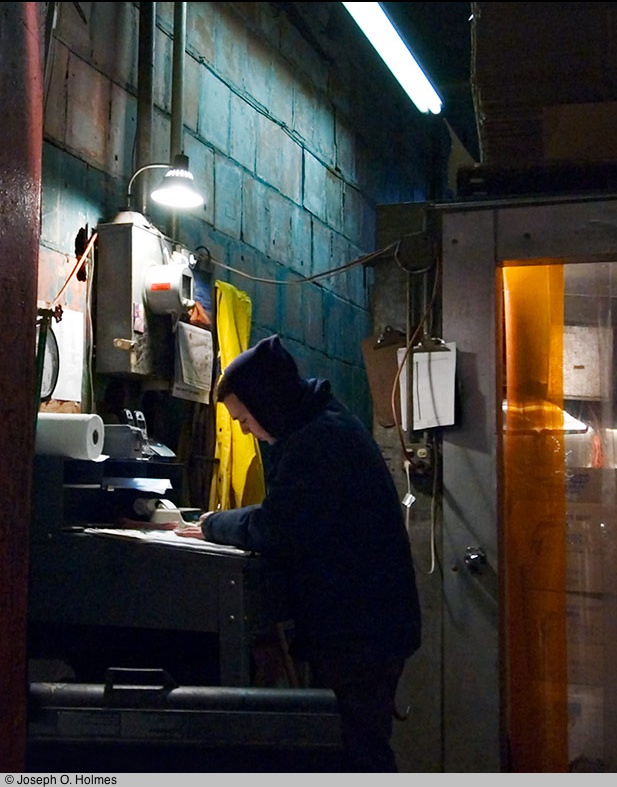
However, every now and then I need a quick fix. Whether to confirm the wisdom of my decision or to see how wrong I was, I’m not exactly sure. And the best way to do this is to visit Joe Holmes’s photoblog Joe’s NYC where, without fail, you will find a new picture every day taken, as often as not, in Brooklyn or Manhattan. The work is fresh and vital, clearly done by one who loves his environment and captures the best and worst of the city I recall so well. Some of Holmes’s best work was done in early 2005 when he and some friends set about documenting Fulton Fish Market on the lower East Side before some developer converted it to high rises.

Click the picture to see Joe’s fabulous documentary photography. Ten months after he took these, the market was relocated to the Bronx, a victim of rising real estate values in lower Manhattan.

Click the picture for the slideshow.

Take a peek. It beats flying to New York and getting ripped off on the cab fare into town any day.

Digital Dust

Or I’ll be blowed!

Mooching around some of the Canon digital fora out there one recurring complaint seeems to be how much dust the EOS 5D attracts to its viewfinder.

Now while most of my pictures over the years have been snapped on rangefinder 35mm film cameras, with few dust bearing surfaces between subject and film, every SLR I have used has been plagued with the occasional speck of dust or a hair in the viewfinder. The 5D is no different. I suspect the increased use of plastics in modern cameras makes matters worse as they seem to retain static charges more, but when I did get some dust in the 5D’s viewfinder the last thing I was going to do was blow it away.

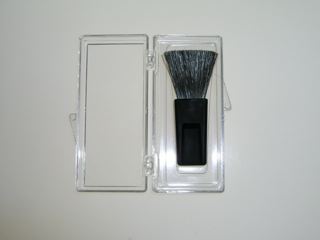
When the maid vacuums the carpet she does just that – she vacuums. She does not blow. Blowing on dust in your camera seems the exactly wrong thing to do. You are a) Hoping to dislodge it, and b) Praying it magically exits the camera rather than getting embedded or relocated elsewhere inside. Ideally what is called for is something like those suction gadgets dentists use to remove waste water from the patient’s mouth. Until something smart like that comes along – and imagine the liability issues in a country whose residents have long ago ceased taking responsibility for their actions – you can blow (!) your money on one of the Digital Camera Cleaning Kits. For your eighty dollars you get a small bottle of Miracle Solution, probably 2 cents worth of isopropyl alcohol, a 5 cent rubber tipped blower and a Digital Brush. The latter, you should understand, grows on Digital Camels only, hence it’s price.

Me? I’ll continue using the $5 anti-static film cleaning brush I have used for years when scanning film, holding the camera just so to let gravity do its thing with the dust, and I’ll continue to avoid changing lenses in the middle of the Sahara in a sandstorm. I hate to admit it but the dust in my 5D didn’t know any better and exited stage left after I gave it a gentle shove. Oh! yes, and I’ll keep the change.

For some new thoughts on the causes of sensor dust, please click here.

Cartier-Bresson: The Man, The Image and The World

Henri Cartier-Bresson – Book review
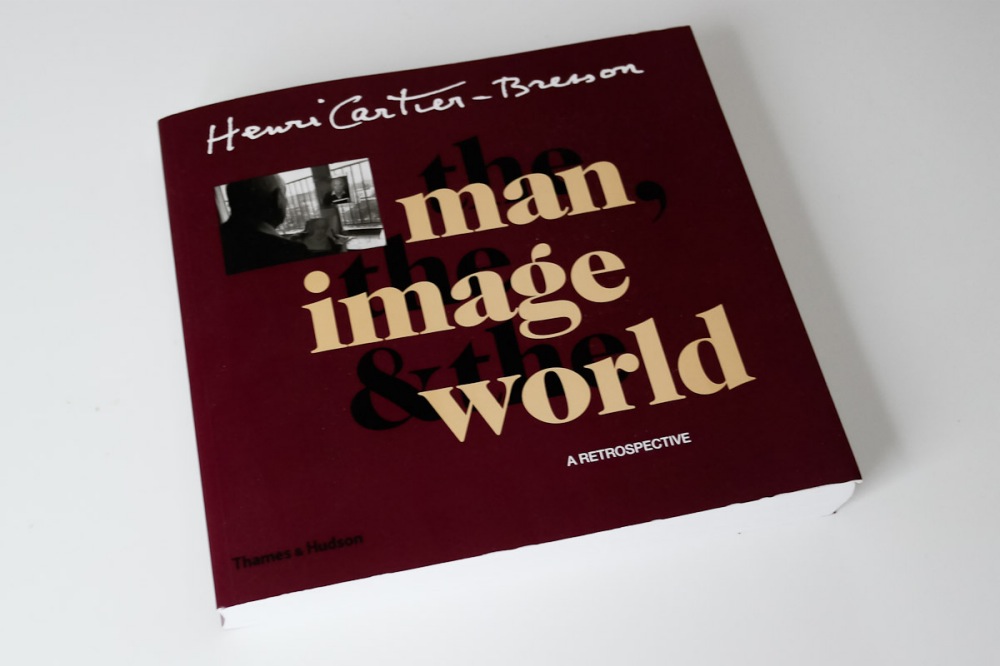
The man couldn’t take a good color picture. His portrait pictures are, for the most part, eminently forgettable. His street pictures invariably use maximum depth of field and are without exception, humorless. He claimed to be a revolutionary while spending the last thirty years of his life in a multi-million dollar apartment on the Rue de Rivoli overlooking the Tuileries Gardens. He was a rabid self-publicist with over a dozen picture books to his name. And he did his best work over 70 years ago, mostly before 1934, though living into the 21st century.

But wait a minute.

The man jumping the puddle.

The blind boy feeling his way along the wall.

The kid on crutches.

The Gestapo informer.

The monocled man at the bull fight ring.

The Chinese eating from a rice bowl.

The eunuch.

The near-naked man at the wall in Russia.

The couple on the train.

The gored bull.

The French lunch on the banks of the Marne.

The behatted Orson Welles character in Spain against that wild wall of windows.

The beautiful couple in Los Angeles.

Giacometti on the Rue d’Alema in the pelting rain.

And on and on.

Anyone with even a passing familiarity with the work of Henri Cartier-Bresson will easily call to mind the images conjured up by these brief descriptions and it is just that which makes him such a great photographer. His work is memorable. Name another photographer where you can recall so many photographs.

Maybe what makes his very early work the best is the still fresh teachings of the cubist Andre Lhote. Maybe it was a clearer vision in a less cluttered world. Yet what is so amazing about these early pictures is that they were all taken on assignments during his years as a photojournalist. Amazing, because he chose to make beautifully composed and timed images where mere photographic records would have sufficed.

Traveling in then exotic lands like China and India, pretty much anything would have satisfied his editors. But he wanted to do better. Years later, famous and revered, he disclaimed his photojournalist roots and posed as an artist. Later still, he disavowed photography (an interesting negative marketing tactic which cleverly served to make his work all the more famous) while making some of the most banal sketches since the crayon was invented. None of that matters. His life’s work was done.

There is so much we can learn from him. In a digital age where photographers think nothing of banging off hundreds of pictures in the hope one comes out (interestingly a criticism George Bernard-Shaw leveled at early 35mm photographers, when likening them to the fish which lays many eggs trusting one would hatch) it gives you pause when you realize that his picture rate during the 1968 Paris riots, for example, was no more than four per hour. And you can bet his success rate was high.

What made it possible for him to make so many well timed and composed pictures? The invisibility of this gangly, raincoated man is well known. His visage beyond bland, it would be difficult to take note of this faceless man in the street. Recalling that he came to his medium with a well trained eye, what remains a wonder is the timing. Lhote may have taught him to see, but the skill of pre-visualization, knowing the precise moment when all those building blocks would fit just so, that was born not bred. Thus was the Decisive Moment created.

And if there is any quibble to be had with this magnificent book, whose reproductions are beyond reproach, it’s that none of Cartier-Bresson’s contact sheets are included. These bear out just how often he got it dead right, without any need to machine gun his Leica emulating the fish model.

So what of the post-war work? Well, he didn’t “get” America any more than Robert Frank ever did. The images from the New World are replete with overfed Texans, gun toting kids and put-upon blacks. Nowhere is the beauty of America and the boundless generosity of its people on view. But what do you expect? Cartier-Bresson was, after all, French and his great inherited wealth had passed from bourgeois to royal status once he became its inheritor. This gave him license, of course, to mock the nouveau riches, whence he came. Further, the more recent work had lost its edge. With occasional exceptions the acidity of vision is gone. The architectural, nay cubist, compositional sense is no more. Maybe he got bored. Maybe he was no longer hungry. Or maybe fame had done its damage.

No matter. He transformed photography as we know it and is the spiritual father to all photographers. And you can forget all the rot about printing the whole negative and nothing but the whole negative. First I don’t believe it. Second, who cares if the result is good?

As a one volume reprise of his seventy plus years of photography it would be hard to improve on this book, as long as you are prepared to discount the silly, uncritical, gushing essays and HCB’s frightful pencil and charcoal sketches. I use this book as an interesting litmus test at home. Leaving it open on the bar for all to see, I know immediately a guest’s sensibilities when he pauses and turns the pages. Now that is someone with a shared passion.

And just for laughs, depending on whether he got his first Leica in 1932 or 1933 (the text is confused on this) it may just be that that man jumping the puddle wasn’t even taken on a Leica at all. Ha! ha! ha!
Monochrome flashback

Still taking the occasional black and white picture

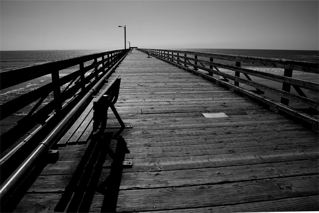
While I may have largely given up on black and white pictures, sometimes things just look better without color.

This was taken almost directly into the sun and the color original is already pretty desaturated. One click using the TLR Black and White Conversion action for Photoshop and a satisfying monochrome rendition results. I find the TLR plug-in gives a better monochrome tonal range than Photoshop’s native ‘Desaturate’ command. There are lots of other interesting actions on that site, too.

Note the slight vignetting in the sky from the Canon 24-105mm L lens at 24mm. I left it in as it heightens the mood.

Hearst’s Castle

The only good thing to come out of yellow journalism

If the state of American journalism was headed solidly downwards in the 1930s, publisher William Randolph Hearst made sure that the pace to the bottom of the cess pit was accelerated. His populist, sensationalist brand of reporting bequeathed to the modern consumer prime time television news that focuses exclusively on the latest murder/rape/divorce, or the tribulations of some famous sports figure who has taken one steroid too many. Bread and circuses.

However, you can glean more useful information from one page of any American newspaper than from one hour of the so called prime time ‘news’ on television. Unless, that is, you read the New York Times or Washington Post, whose reporting sources tend to be Hollywood stars, supremely qualified to report on geopolitics and the fiscal state of the nation.

Thank you, Mr. Hearst.

However, Hearst’s millions did leave us with one fine attraction, namely Hearst Castle on Highway One in central California, some 20 miles from my home. Taken as a whole it’s something of an abomination, the ultimate in ‘check book collecting’, but digested in smaller pieces each of the many rooms packed with antiquities is a fine thing to behold. The Castle was Hearst’s lifetime hobby, and his architect Julia Morgan was adding to it throughout his life. Hearst would buy a medieval ceiling on one of his European jaunts (he probably wanted to read the British press to see what was really going on), bring it home and tell Morgan to build a room around it. Now that’s thinking big!

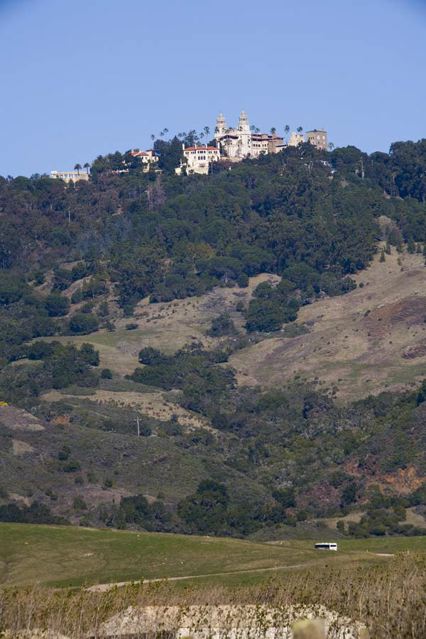
Driving by the other day on the way to see the elephant seal pups a few miles north on the beach, I took a picture from Highway One with the castle rising magnificently in the distance on top of the hill some mile and a half away. I had despaired of ever getting this right on film, as the long lens required only emphasized the atmospheric haze, but as I had my 400mm Leitz Telyt with me I gave it a shot anyway. I finally get to try RAW, I thought.

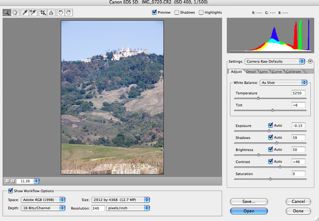
So I set the EOS 5D on RAW, the film speed at ISO 400 and the f/8 setting on the lens yielded a 1/500th second shutter speed. The result, after dropping the snap into Adobe’s Photoshop CS2, which automatically opens Adobe Camera Raw (ACR), was disappointing. The haze had washed out the picture, and the Telyt lens, I know, does not lack for contrast.

However, a few tweaks of the sliders in ACR made things look better so I saved the file in PSD format and added the usual unsharp masking and a small tweak to the levels control and look what emerged:

Now I must confess that, so far, I have not found the Canon EOS 5D’s Fine JPG images lacking in any way. The quality is outstanding, large prints a breeze and whatever JPG processing the camera does appears unobtrusive. Digital artifacts are invisible. Best of all, the file size is relatively small – some 4 mB or so. By contrast the 5D’s RAW file is 14 mB and the processed PSD version balloons to a ridiculous 73 mB. Now that is large. So RAW appears to have a place for challenging subjects that need a lot of manipulation, but the extra processing time is not justified, for this user, on the average photograph. JPG Fine quality equals or exceeds anything from medium format and processing is fast and easy.

Still, it’s nice to know RAW is available in the overall tool kit. Now I want to retake this picture early in the morning with the castle rising from the mist as California’s sun gradually makes it visible.