Yearly Archives: 2011

Panasonic 20mm f/1.7 MFT lens – Part II

A massive disappointment.

I captioned Part I of this review with the words “State of the art”. I have had to go back and revise that to read “State of the art?”. There are several issues with my sample of the 20mm Panny and one is so fundamentally beyond correction that I can only say I am massively disappointed.

No, this is not an April Fool’s Day joke.

The variables not at issue here are the camera body, the technique or the subject matter. All are the same. I took the lens for a spin on the Panny G1, on which I now have over 10,000 exposures. I used the same settings as usual, though I mostly snapped at ISO100 rather than ISO320 to allow the use of a larger aperture in my preferred aperture-priority mode. The lens is f/1.7 fully open and I want to see how that works. I mostly used f/1.7 to f/2.8 and even at ISO100 I was over-exposing in the bright sun that favored my street excursion to San Francisco. That’s frustrating, but hardly the fault of the lens.

Some tests had disclosed that the 20mm is natively quite a bit sharper than my other three lenses for the G1 – the 9-18mm Olympus MFT, the Panny kit lens and the Panny 45-200 zoom. While those all need a sharpening setting of 100 in Lightroom on import to get the image just so, the 20mm only needs 55 for like results. So I set up an import preset with that sharpness setting and imported the snaps taken yesterday.

I’m using the lens with a stock B+W UV filter for protection and no lens hood. I have yet to see one scintilla of evidence that a hood makes any difference with modern multi-coated lenses and refuse to be bamboozled by purported ‘experts’ in the matter. The filter is not multi-coated and, in fairness, presents a far larger glass surface to the world than the front element of the 20mm which is minuscule by comparison.

I mention this because, on importing the pictures into LR3, the following were immediately obvious:

  • Flare is everywhere, even in modestly bright into-the-sun pictures. With the possible exception of a 1950 50mm Leitz f/1.5 Summarit with primitive coatings which I used when the dinosaurs still walked the earth, I have never used a lens which flares more. Not even close. A veil over the whole picture, and light spots everywhere. A catastrophe. See also ‘Flare update’ below.
  • The lens is disappointingly low in contrast. I have to increase LR3’s Contrast slider to 50 from the default 25 to equal the kit zoom.
  • All my pictures are one stop over exposed except for those taken indoors in very low light. Those tend to under-exposure of 1/2 stop.
  • The orientation sensor does not work. All vertical snaps (40% of my total) have to be manually rotated in LR3 after import. What? I can forgive Oly this fault in their excellent 9-18 ultra-wide MFT zoom as their lens was not designed for Panny bodies, but a Panny lens on the Panny G1? Inexcusable and a real time waster at the processing stage. Not one single review I have read has mentioned this. Does any of these reviewers actually take and process photographs?
  • But, worst of all, for someone who needs fast autofocus for his preferred subject matter, fully 30% (yes, 30%) of my pictures showed that I had depressed the shutter button before the lens had established proper focus and the result was garbage. This really got my goat as there was some great stuff lost forever. I mentioned yesterday that the lens takes twice as long to focus as the kit lens and it seems that the difference crosses my critical point of need. My focus failure rate with the kit lens? Just 3%. Max. Why not set the camera to only allow shutter release when focus is established? That’s about as rational as insisting the US Government manages your retirement monies. Have you seen the returns on Social Security? Please. The problem is that the 20mm defaults to infinity focus after every snap so it has just too much work to do with its slow focus motor for what I do – meaning a typical subject distance of 5-7 feet.

Definition? The lens just sparkles when it isn’t flaring or getting the focus and exposure wrong. No issues there. It’s as sharp and aberration-free, after Panasonic does its in-camera magic, as anything I have used. And that’s all the good news I have to report.

So what are my exit strategies?

Well, maybe I could discard the UV filter and the lens would stop catching flare rays. Or I could get a multi-coated variant. OK. Happy to learn I’m at fault here.

I suppose I could set the camera to underexpose by one stop when the 20mm is fitted but, honestly, it’s one more thing to remember for a guy who is happy just to recall his name in the morning. Contrast? More of the same. Bottom line is that every time you change lenses you are going to screw up and with the Panny’s smallish sensor, proper exposure and contrast are critical if you want to make large prints. I make a lot of those.

The need to turn every vertical image 90 degrees in LR3 does not make me happy but at least it has nothing to do with image quality and I’m prepared to live with that.

But the one thing I do not think has anything to do with sample variation, which cannot be excused with that old chestnut beloved of owners of British cars – “I got a bad one” – is the focus speed. It does not cut it for street snaps. Not even close.

The 20mm is going back to B&H today, where it can make a less demanding user happy. I am so not looking forward to explaining the above to the good people at B&H.

Fuji had better make more X100s really soon. I remain on Amazon’s waiting list, for what that is worth.

I include below some snaps I like from yesterday’s foray and remain bitterly dismayed that so many good images are forever lost. I mean, I was having a really good day, seeing fast, clearly and on point. The Panny 14-45mm kit lens, crappy feeling zoom ring and all, has it all over the Panny 20mm. It just shines by comparison. I can always blur backgrounds using Photoshop CS5. Had you told me that all in one week I would be praising Photoshop and simultaneously trashing Panasonic, I would have pointed you to the local shrink, and I would have been wrong.

The last time I felt this disappointed was when a date told me she didn’t like opera …. with the same result. I dumped her. And like Panny’s 20mm she was lovely to behold. Life is too short for women with poor taste …. and bad lenses.
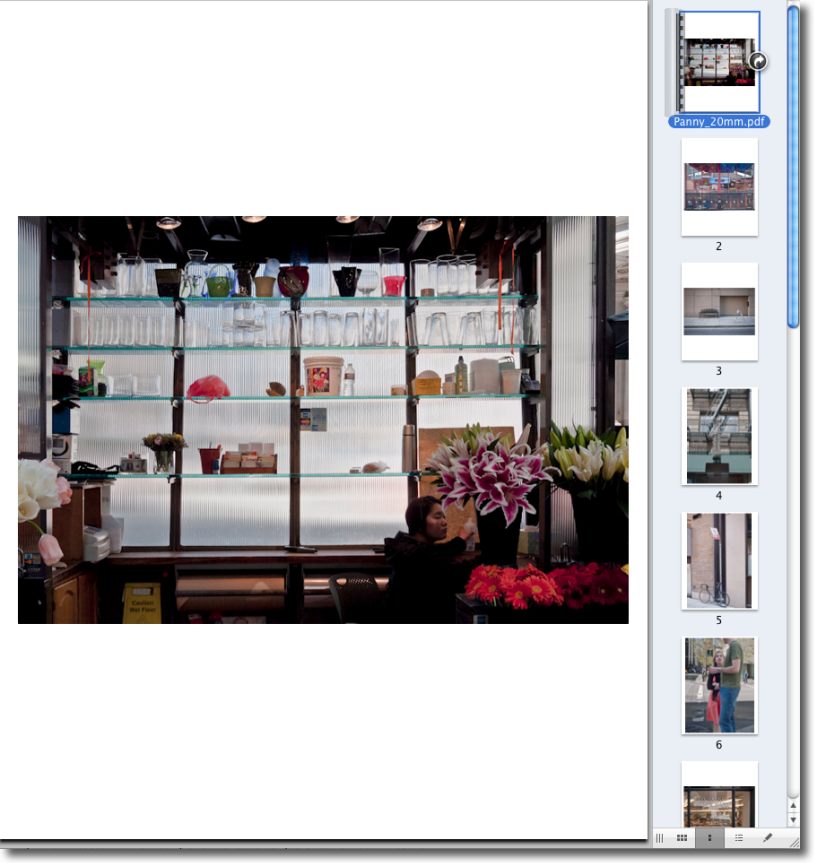
Click the picture to view the PDF.

Flare update: I tried the lens into the sun with and without the filter, just before returning it. No difference – meaning it flares just horribly. There is clearly something very wrong with this aspect of the design of the Panny 20mm. As another test, I compared two screens of unprocessed RAW imports in LR3, the one taken on the 14-45mm kit lens, the other with the 20mm. The flatness and poor native contrast of those taken on the 20mm are startlingly obvious. This is just as noticeable with pictures taken in the shade as with those in the sun, where flare makes matters even worse. So this optic does not just have a problem with flare; its inherent contrast is poor – almost like an uncoated lens made over 60 years ago. It’s not subtle or something that only a critical eye can detect – it’s obvious. The images it produces are flat.

After buying gear from them for over 25 years, this is only the second item I have ever had to return to B&H. The first was the first example of my Canon 20mm EF lens which, like this Panny, drank from a bowl. Its replacement was marginally better. Replacing the Panny is simply not on the cards, as I don’t fancy another kick in the groin. By the way, I eventually gave up on the mediocre Canon 20mm and sold it. Canon makes some great lenses (85EF, 200L, L zooms, 400L) but has a well earned reputation for making some real stinkers at the wide end.
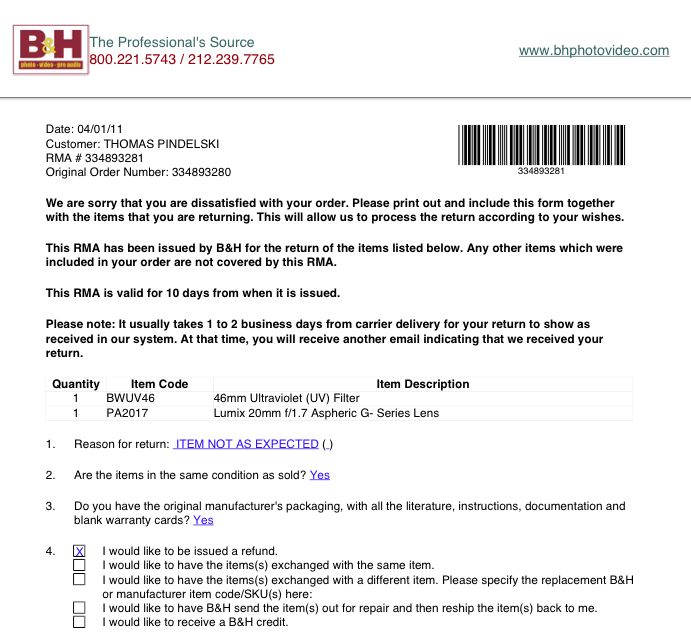
Second return ever to B&H.

Independent ‘reviews’: This piece might as well have been named “Never trust what you read”. It’s unconscionable that not one review of the many I have read focuses on the shortcomings of this lens, especially the critical one of its slow focus. All they go on about is distortion, aberration and vignetting. Charts this, resolving power that.

What, after all, is a pancake, semi-wide’s primary purpose in life? It is to take snapshots.

It’s not for studio portraits.

It’s not for landscapes.

It’s not for cathedral interiors.

It’s for snapshots.

And snapshots mean it has to be fast, not fast as in large aperture but fast as in speed of focus. The modern camera-aware subject does not permit manual focus for the street snapper. It has to be auto everything – focus and exposure. And because the street snapper cannot order up the light, it has to be highly flare resistant because 50% of the time when it’s sunny the sun will be shining into the lens, not on the photographer’s rear end.

In that context, all the reviews I have seen of the Panasonic 20mm lens have been a waste of time to read, written as they are in some laboratory by non-photographers.
Panasonic 20mm f/1.7 MFT lens – Part I

State of the art?

Those in the prediction business usually have a hefty supply of egg at their keyboard, newly removed from their face. Egg-on-face is a common affliction for those who claim to see the future.

Some examples:

‘No one will need more than 637Kb of memory for a personal computer’ – Bill Gates

‘There is no reason anyone would want a computer in their home.’ – Ken Olson, 1977, Digital Equipment Corporation

‘Radio has no future.’ – Lord Kelvin, 1897

And, my favorite, given the nature of my day job, which is managing money:

‘Stocks have reached what looks like a permanently high plateau.’ – Irving Fisher (1929)

So when I try to play at the prediction game in these pages, caution tends to be the order of the day. Heck, no one saw the internet coming so who am I to dust off the crystal ball?

But, sometimes, you luck out, and when I wrote the following five years ago in a piece titled ‘It’s the Software, Stupid”, even my sternest critics might agree that the closing to that piece was on the mark:

“And who will be the genius designing these new ‘lenses’? It won’t be a god the likes of Max Berek or Walter Mandler in Wetzlar. It will be some kid who is really sharp at coding who happens to like a superb picture from the one ounce piece of plastic passing for a lens attached to his camera. The great days of optics are yet to come and their designs will emanate from the keyboard of some unknown master even now getting his lips around the teat on that plastic milk bottle.”

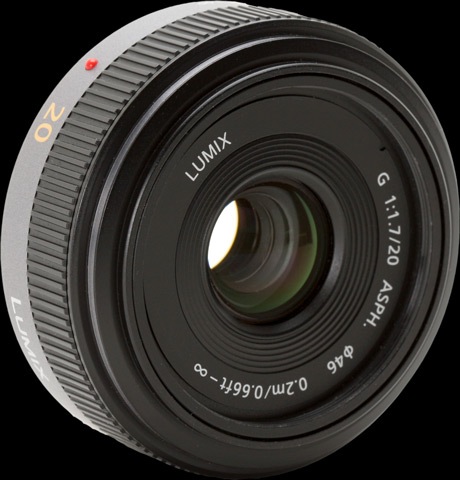
Well, the 20mm Panasonic MFT lens is not quite a ‘one ounce piece of plastic’, but it’s close. And while Panny was still making toasters and LP players when the design geniuses at Leitz were creating some of the greatest optics in the Old World (before computers) they now find themselves using Panny’s brains in a quixotic effort to sell jewelry at prices only collectors can afford. Because the state of the art in optical design has shifted a few thousand miles east and is now in Tokyo, not in Wetzlar.

I first wrote about the Panasonic 20mm MFT lens six months ago, and proving my own dictum about egg-on-face concluded:

“So why am I not rushing out to buy one? Well, I very much intended to when it was first announced but, frankly, I have become so enamored of the kit lens with its exceptionally useful 14-45mm (28-90mm on full frame) zoom range in a very small package that I no longer want to be burdened with the task of swapping lenses when snapping on the street.

The little Panny now resides on my G1 and I’m busy cleaning the egg up.

Why did I buy it? Well, I like small and unobtrusive. I like cheap – the Panny is under $400. I like sharp – the Panny is that in droves. And I don’t like the prospect of waiting another year until the Fuji X100 becomes available at non-black market prices. Why, if Panny wakes up, it will make a small MFT body with a proper, built-in finder, like Fuji’s, and allow me to use my Panny and Olympus lenses on it. And I’m not the only one to notice that Fuji has a huge winner on its hands. Users want small, simple and fast and they are beginning to realize that clunky, loud, heavy DSLRs may not quite be what the doctor ordered. The iPhone is a whole lot easier to take with you than that DSLR outfit, which increasingly remains at home ….

Some historical context is also relevant. Since I started seriously street snapping in 1971, you would have found but one camera and lens slung around my neck – a Leica M and a 35mm Summaron or Summicron – for 35 of those 40 years. I did not need a zoom, (not like it was an option, in any case), I had no issues about getting in close and the gear delivered. Well, it delivered most of the time, except when I got the focus or exposure wrong because I was in a hurry. So a fixed focal length lens, modestly wide, is pretty much in my genes by now. Zooms are nice, although they come with lots of compromises, like bulky mediocre optics and smaller apertures, though Panny has done such a superb job with their 14-45mm kit zoom that there was little room for grumbling, even if the maximum aperture range of f/3.5 to f/5.6 was nothing to write home about. The lens focuses fast, it’s very small and the optical quality is outstanding at any aperture.

That kid programmer at Panasonic knew that the optimal design compromise was not the Wetzlar way, where you struggle mightily to make a bunch of lenses cast a flat picture. That’s costly, takes a lot of fancy glass and it’s just plain wrong. Better, make a half-decent optic loaded with aberrations, then have the camera’s computer fix what ails it. By the time your Panny original file hits Lightroom or Photoshop, all those nasty spherical and chromatic aberrations have been well and truly removed by a few chips and a bunch of code in the camera’s body. Purists aver that this is wrong. They say there should be no software correction as it simply means the lens is bad. Then again, these are the same people who get off on critiquing the out of focus areas in a picture (I kid you not – these twits go on about ‘bokeh’ like it has something to do with a good photograph). Let’s move on and leave them to their mental masturbation.

Tomorrow I’ll publish some snaps from this little wonder but meanwhile, a few quick words:

  • It’s very sharp at all apertures.
  • It’s slower to focus on my G1 than the kit zoom – 1/2 second compared to 1/4, but still five times faster than your Leica M
  • Unlike the kit zoom, it’s not silent. You can hear it in a quiet room. Not an issue for non-movie snappers.
  • It comes without a hood which is great. Hoods are a waste of money and space with modern glass.
  • It will not make your G1 pocketable, but it gets close. It’s that small.
  • Construction quality is outstanding.
  • Used correctly the manual focus ring gets you critical focus in any light condition, thanks to the auto-magnification in the EVF. There is simply no way any RF camera can compare, and those who tell you otherwise have simply not tried a G-bodied EVF or do not know how to use it.
  • And take it with you you will, as camera and lens weigh little more than your crappy point-and-shoot. And the only good camera is the one you have around your neck.

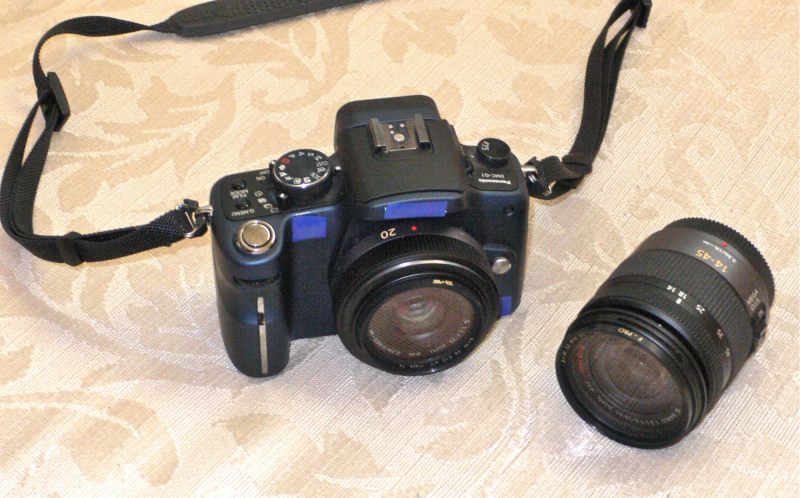
The Panasonic 20mm on the G1, with the kit lens. Did I say ‘small’?

Now, without furter ado, I’m putting my money where my mouth is, my shoe leather on the sidewalk, and will return with some snaps tomorrow.

Before I go, here’s one from the Old World:

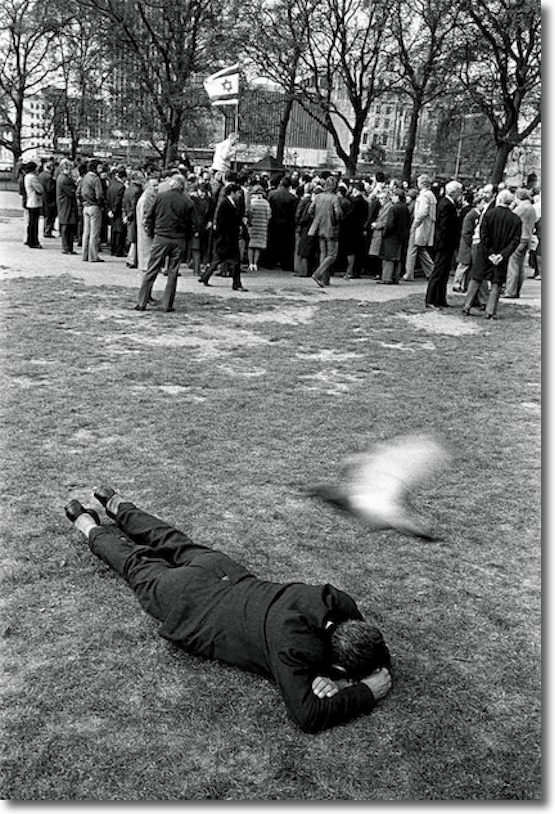
Speakers’ Corner, Hyde Park, London. Leica M3, 35mm Summaron, TriX. Taken in 1976.

Part II is here.

Street hype

There’s one born every minute.

I came across a ridiculous piece of advertising the other day. It claims to teach class participants how to take street photographs. For the best part of two grand you get to meet a self-proclaimed ‘famous photographer’ who then pats you on the ass, sends you out to record your theme of the day in a big city and then graciously spends 30 minutes of his precious time with you ‘critiquing’ your snaps. Well, at $2000+ per hour, which is what his rate for a medium sized class comes to, I would be spending my even more valuable time with you too, and my trashing of your work – guaranteeing that you would have to sign up for a refresher course – would be at no extra charge.

I will never understand the concept of tuition which purports to teach you to see. Seeing is like musical or business talent. It’s a right brain function. You either have it or you do not. Technique, like any left brain function, can be learned, seeing cannot. You may, perhaps, sharpen your visual sense by using it more, but it’s still binary. It’s either there or it’s missing. It cannot be bought.

Thankfully for the world’s gear makers, the total disconnect between gear and vision allows them to sell tons of equipment to people most of whom really should be taking up other hobbies more suited to their skills. Like Morris Dancing or crochet. Just check any of the more popular chat boards to see what I’m talking about. The average participant there changes gear more frequently than a politician changes his mind yet cannot take a picture to save his life.

Anyway, here are a few recent street snaps and, whether you like them or not, this most ephemeral of art forms most certainly did not cost me the big bucks demanded by that ‘famous photographer’. Actually, my cost was a train ticket and a sandwich for lunch, plus some shoe leather.

Click the picture for the PDF download.

All snapped on the Panny G1 with the kit lens, the first in Monterey, the remainder in San Francisco.

Now please excuse me while I rattle up some business at $2,000+ per hour. There truly is one born every minute, and he really needs to have his wallet lightened.

Intel improves its SSD

Change continues at a hectic pace.

No sooner do I install a 120gB solid state boot/app Intel X25-M drive (SSD) in the HackPro than Intel announces many improvements and a price reduction. This message will likely be repeated often over the next few quarters and Intel is to be commended.

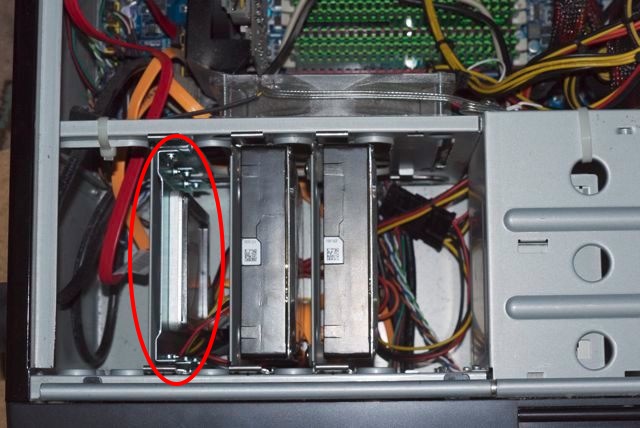
Intel SSD in the HackPro. Two 1 tB Samsung HDDs to the right.

Here’s what I got from Macworld’s lengthy piece on Intel’s latest:

  • 30% price drop
  • Sequential write speed more than doubled – holy moly!
  • Redundant chips included in case any of the main ones fail
  • Capacitors added so the write operation can be concluded if the power fails – wow!
  • Capacities up to 600gB – but at a price – $1,069
  • Despite the lowest industry failure rate of 1.4% in the current model, the new one aims to improve on that statistic, which is already far lower than for conventional HDDs.
  • Intel is putting its mouth where its money is and using these in its servers.

My advice? Wait for these to hit Amazon and rush out and get one. There’s simply no going back once you have used one, be it in your laptop or desktop computer. The new model is the ‘320M’. HDDs are to storage what film was to photography 10 years ago.

The iPad as drawing tablet

Move over, Wacom.

Photographers who do much outlining work with the Lasso tool in Photoshop often end up using a Wacom tablet. This is an electrostatic tablet with a pen; the pen is dragged along the surface and activates the on-screen pointer in Photoshop.

I never found much use for my small wired Wacom and gave it away a few years back. As I find I’m using the Lasso tool now and then to blur backgrounds, I find I have a hankering for a pen tablet again.

iPad to the rescue! A combination of the Pogo Stylus and Mobile Mouse is all you need. And the iPad is wireless. Mostly I use my finger for outlining, controlling the Lasso tool in PS from my iPad, but if more accuracy is called for the Pogo Stylus can be useful. With the enhanced outlining in Photoshop CS5 I find my finger suffices nearly every time. If you already have an iPad, Mobile Mouse is about the lowest incremental cost of entry to to a tablet outlining tool there is and outlining with an iPad is far smoother than with a mouse.

Rollover the image (use Safari or Chrome to render – does not work on an iPad):

Cyclists after and before using the Lasso tool in PS CS2 and Mobile Mouse.

I also livened up the processed image, as a rollover discloses. Take a careful look at the hair of the beauty on the right ….