Yearly Archives: 2011

North Beach

A slice of civilization.

Grant Avenue in San Francisco starts life at O’Farrell and Market Streets and, once it crosses California Street, enters the frenetic world and nicotine laden air of Chinatown. A few blocks of stores full of strange foods, garbage goods and neon signs later it crosses Columbus Avenue and enters Little Italy. The contrast could scarcely be greater. No crowds, no chintz, neighborhood restaurants and some fine high end stores.

I was strolling up this civilized stretch of Grant the other day and came across two chaps working the parking meters, one on either side of the road. I caught up with one and chatted with him while he worked his magic. It was quite something to behold. In one smooth motion he would open the locking door, remove the green coin cylinder, pop it into the coin box on his heavy dolly, empty it and replace and lock. So practiced was this routine that I had to speed up from stroll to walk, just to keep up!

He told me that on a street like Grant Avenue, totally parked out all the time, they have to empty the meters every other day, with an average yield of $40 per meter. Wow! “But these meters also take credit cards, don’t they?” I asked. “Yes, but coins will never die. People like to use coins.” I’m not sure whether that’s job protection speaking or reality, but it was sort of reassuring in a nation where all manual labor is being either obsoleted by technology or exported to China.

I tried a couple of snaps and this one catches his intensity, the coin cylinder and all.
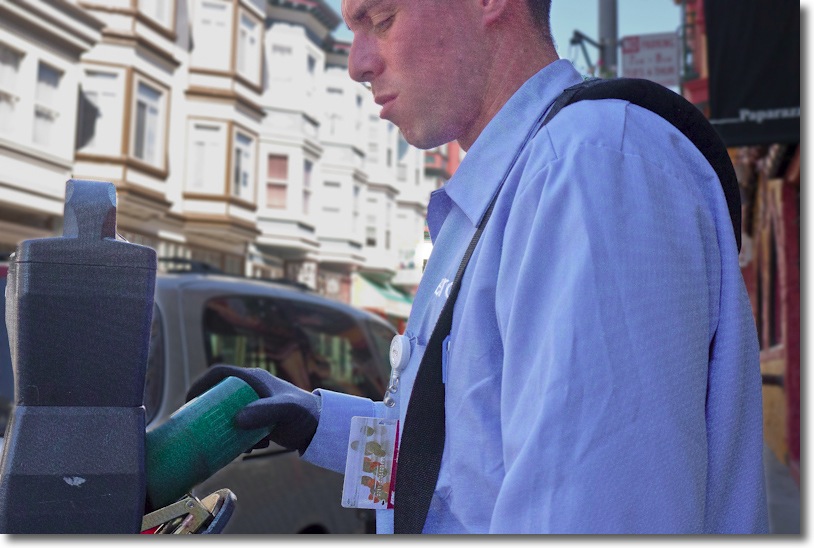
Meter Man.

Another block north, at Vallejo Street, is Al’s Attire, a cavernous store whose enticing window displays pulled me inside. Modeled on the British bespoke tradition, Al’s makes shoes, hats and jackets. One window has a display of cobbler’s lasts which the owner assured me are not for show. They are all in use.

Lasts at Al’s.

Some of the exquisite ladies’ shoes on display here could be straight of of Vanity Fair (Thackeray’s not SI Newhouse’s). Viewed from inside the store the light is to die for.

Large expanses of leather are lying around, waiting to be crafted into shoes.
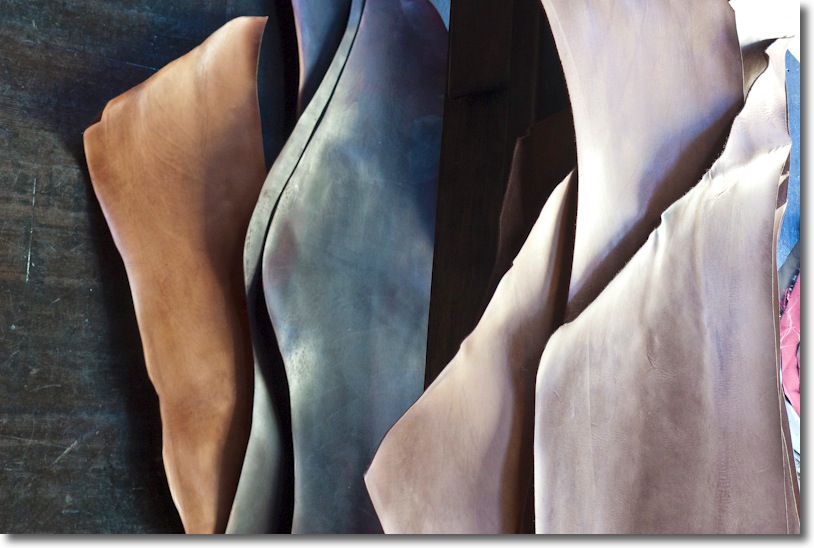
Sheets of leather waiting to be crafted into fine footwear.

The other window display is no less impressive:
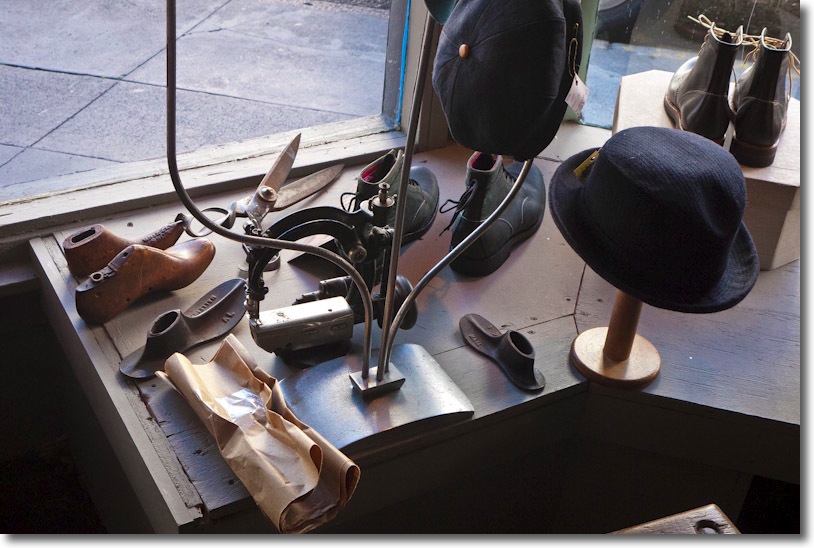
Hats and tools.

Crossing the road the Live Worms Gallery has yet to open and has a spare window display with a little model Ford truck. I snap it merrily and only notice that I have included my hand and camera when in Lightroom later. Still, it seems to work.
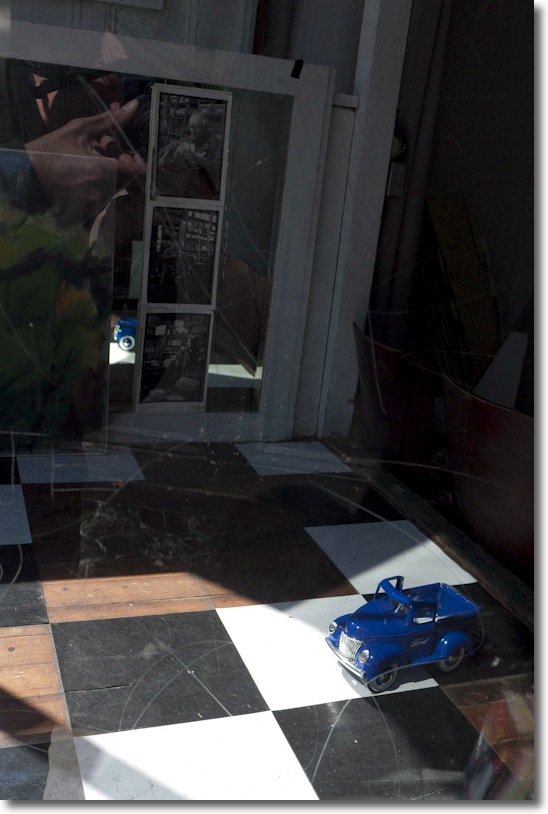
Ford at Live Worms.

A few yards further down and a soccer game from Italy is enthralling the lunchtime crowd. I quickly crank the G1 up from ISO320 to ISO1600, knowing that it’s going to be dark inside there. It takes seconds to do as I have the two options stored in the first two of the three available Custom settings. As luck would have it my timing coincides with that rarest of events in world class soccer, a goal!
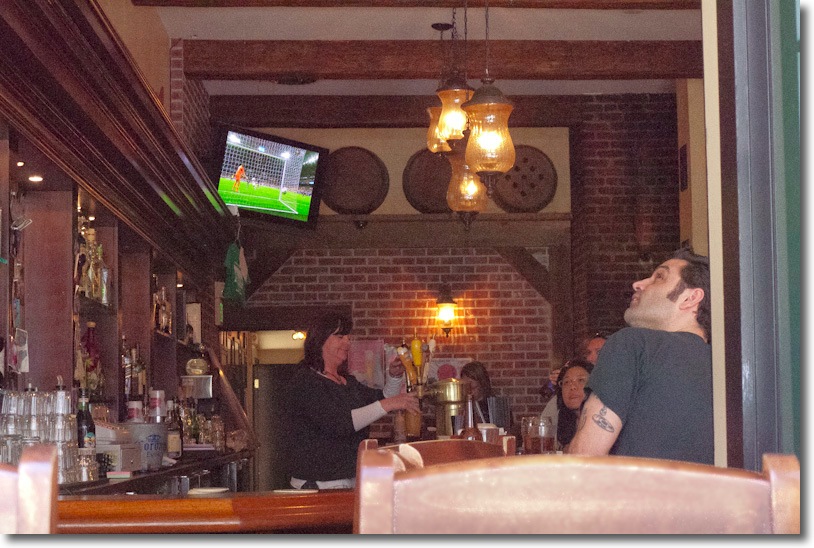
Goal!

Before heading down to Washington Square my eye is caught by a gorgeous race bike at Cykel. Just as I approach a fellow bicyclist gives the machine a longing glance. The owner of the store tells me it’s a carbon fibre and aluminum frame, and the tires are glued to the rims. This is a board track racer so there are no brakes, one gear, and the whole thing weighs just 15 lbs! No, I don’t ask the price.
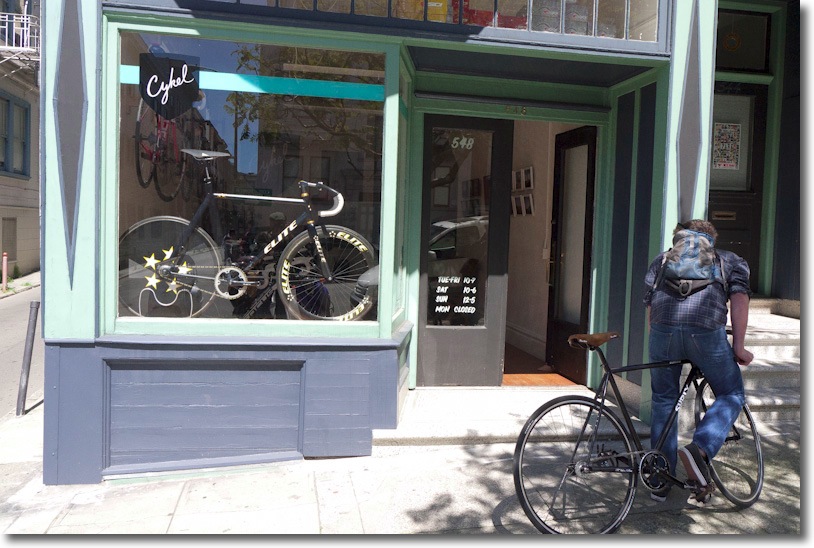
Board track racer at Cykel.

Heading west to Washington Square I thank my lucky stars that I am carrying that little charmer, the 45-200mm Panny in my shoulder bag. To describe a lens with a maximum reach equivalent to a 400mm on a full frame body as a ‘charmer’ may sound like a bit of a stretch, but it’s true in this case. It’s the first super telephoto you don’t think twice about taking with you. Weight is not an issue, the optics are tremendous and the built-in OIS means the tripod stays at home. The reason I’m glad I have it with me is that there’s a chap, down to his skivvies, doing all sort of bizarre calisthenics in the center of the park and I’m not about to poke my camera in the face of one who, for all I know, has a black belt in martial arts. The Panny’s at full chat, extended to 400mm for this one:
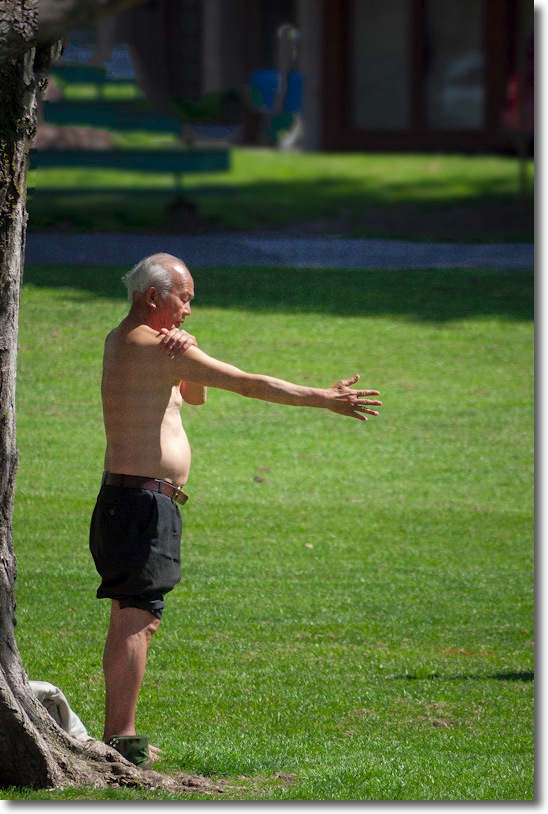
Skivvy man.

Exiting Washington Park there’s a mural celebrating the SF Giants’ World Championship victory in baseball. Quite how you become a world champion in a sport largely played only on these shores I’m not sure, but even someone as disinterested in baseball as I can assure you that the City will not let you forget the Giants’ championship status. I still have the 45-200mm on the Panny so wait lazily on the little traffic island in the middle of Columbus until the scene is just so.
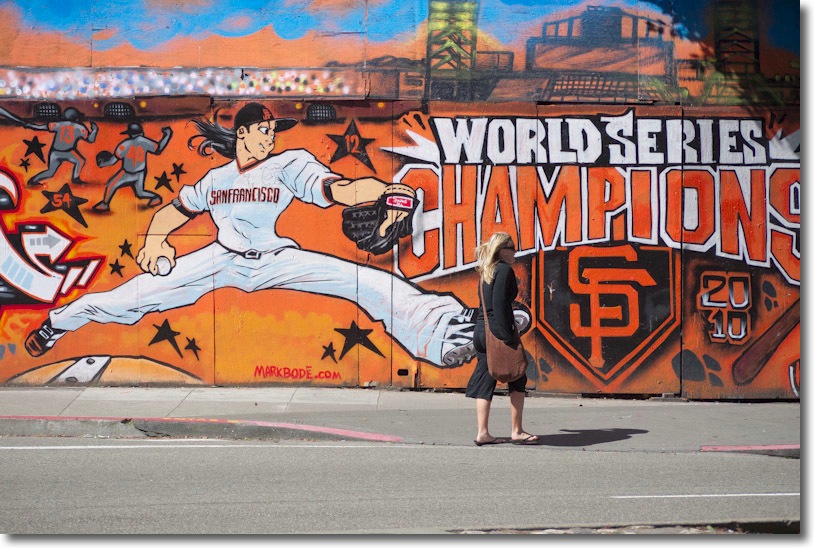
World Champions.

Turn the corner onto the main artery of Little Italy, Columbus Avenue, and there’s a local enjoying a cappuccino and some reading. Yes, not everyone uses an iPad:
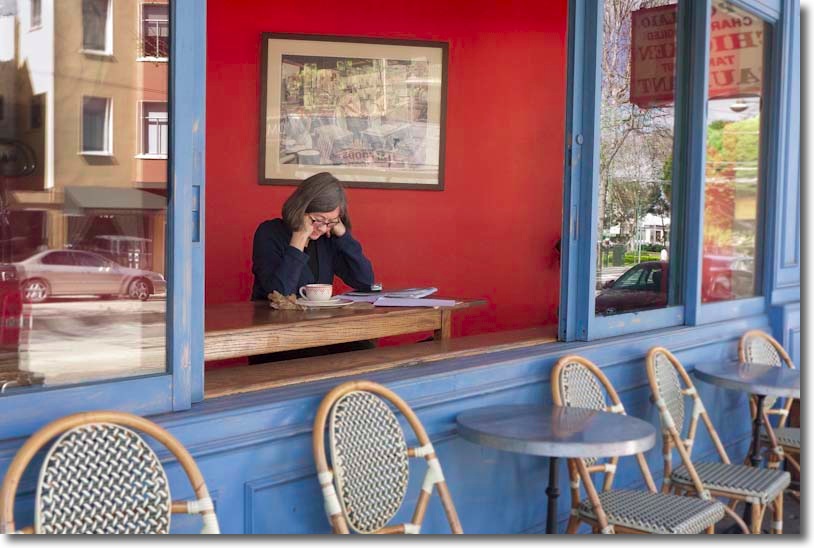
No iPad.

These are the sort of scenes which typify that fine corner of San Francisco known as Little Italy. And now it’s time for lunch.
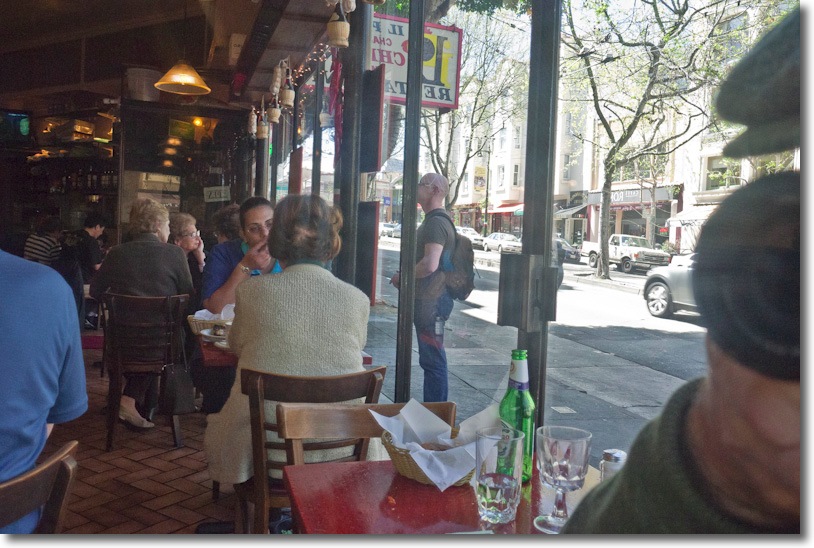
Lunch in the mirror in Little Italy.

All snaps on the Panasonic G1 with the kit lens at ISO320, except as noted.
The alleyway habit

Always something unexpected.

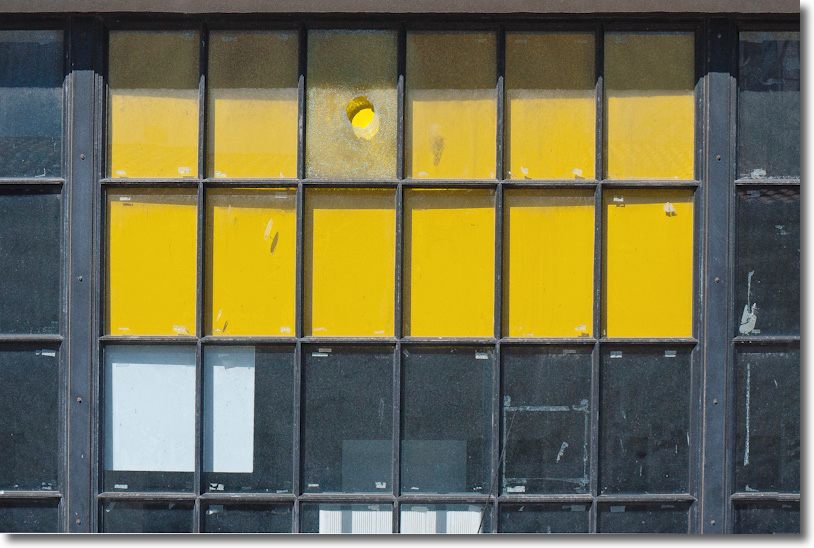
When traipsing around any big, old city, taking the alleyway in preference to Main Street is something I can never resist. There’s rarely an instance where it does not deliver a surprise, like here:

Baseball window. G1, kit lens @28mm, 1/2000, f/6.3, ISO320.

This one was in a drab back alley off Fisherman’s Wharf in San Francisco. The blast of yellow was like nectar to a bee and, lo and behold, someone had made a hole in one of the panes.

A few seconds in PS straightened the leaning verticals.

Always take the road less travelled.

Milk

A lovely mural.

Panny G1, Olympus 9-18mm at 10mm, ISO320.

This lovely mural makes its home in Burlingame in the Bay Area and has been recently restored to its former glory. Unfortunately it’s in the back of a crowded car dealer’s lot so the only way to snap it was with the ultra-wide Olympus zoom on the G1 and then fix perspective in Photoshop. Taken directly into the sun, the original is rather flat but a few seconds work with the Clarity and Vibrance sliders in Lightroom3 and all is well. The Olympus lens shows a total freedom from internal reflection highlights, even in so demanding a case.

A lovely reminder of times past when milk was still delivered to your front door. When I was a kid in London, this was still the case and we would give an apple to the Express Dairy milkman’s horse (!) which was always gratefully accepted. He had two – a sweet brown one and a not so sweet black one, so you were really careful with your fingers in the latter’s case!

The cost of gear

Never lower.

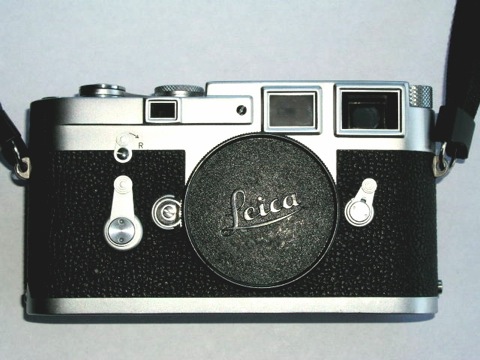
Selling off my Canon 5D outfit gave me pause to reflect on the cost of photography gear. While it’s not something I pay much attention to, my ‘investment’ in hardware has, for many years, been less than zero. That is largely attributable to selling off my Leica equipment a few years back, most of it bought before the lunatic increases in second hand values seen in the late 1990s. Most items sold for at least twice what I had paid, some of the older ones for five times my cost. So even after splashing out on my 5D, a bunch of lenses and the HP DJ90 printer, I was well ahead of the game. While I denigrate the collector mentality which saw my Leica gear rise so greatly in value, living free is not so bad either.

My Leica M3. That was then ….

In 1971, when I got serious about street snapping and bought my first Leica, a used M3, a new M4 could be had for some $940, complete with the greatest 50mm lens ever made, the f/2 Summicron. If film is your thing you cannot improve on this combination forty years later. Today a new digital M9 with a similar optic will run you $9,000, or $10,000 with the even more street-suitable 35mm lens. That’s an annual compounded inflation rate of almost 6%. By contrast, the US CPI has an annualized increase of 4.5% over the same period, which makes Leica’s price inflation look reasonable. Stated differently, that M4 + lens, inflated at the US CPI rate, would cost you $5,200 today. Yet, when someone tells you that a modern M9 + lens runs you the price of a good used car you blanch and look elsewhere.

The M9 is a far more capable body than any of its predecessors and for the over-and-above-inflation price increase you get a full frame digital sensor, a ‘motor drive’ as there’s no film to advance, aperture-priority exposure automation, extremely high ISO capability, a thousand shots a roll and instant gratification. All missing from that M4 of yesteryear. That’s a lot of value added for the incremental $4,000 or so over an M4 at today’s prices. And you still get that dumb-as-it-gets removable baseplate.

Yet why do so few serious photographers buy it? The reason is simple. It’s not that the M9, in some abstracted sense, ‘seems’ expensive. It’s that everything else is so much cheaper. And if you take function and flexibility into account, the single-use Leica (street snaps only, please) pales when compared to like priced modern megacomputers in the guise of the big Canons and Nikons. Indeed, for just a few hundred dollars you have a choice of any number of DSLRs from the likes of Nikon, Canon, Pentax, Samsung, Olympus, Sony and Panasonic which will outperform that M9 in every respect – speed, automation, flexibility and so on – while yielding results indistinguishable in quality from the Leica’s to all except those who have shelled out the price of entry for the latter. The Leica has migrated from tool to fetish.

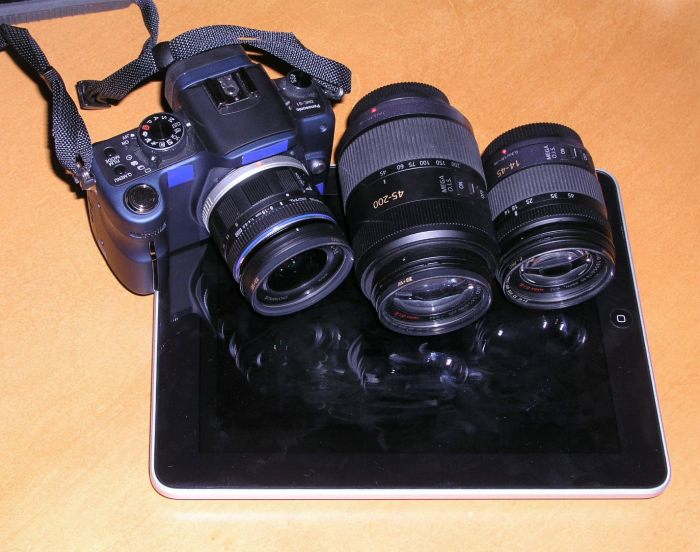
I’m thinking about this as I contemplate what to do with all the excess proceeds from my 5D sales. My little G1 outfit with 9-18, 14-45 and 45-200mm lenses, which ran me all of $1,650, can deliver 13″ x 19″ prints with ease, 18″ x 24″ if I try a little harder. I tried the 20mm f/1.7 pancake and returned this poor optic one day after purchase. It was, arguably, a luxury purchase, meaning I really did not need it, but I had all that cash burning a hole in my pocket, so blowing $400 of it on a toy seemed the thing to do.

Panny lists a 45mm Macro with Leica branding (right, pull the other leg) which helps them justify $800 for the lens. But my macro days are over. Been there, done that.

…. this is now. G1 and friends.

There’s also a tempting Panny fisheye lens which may entice me should I get the hankering to do QTVRs again, but the 9-18mm Oly satisfies my ultrawide needs for now.

On the software front simplification has also been the order of the day. Lightroom and Photoshop CS5 are a powerful team for just about everything I need, absent QTVRs. Panoramas, perspective correction, selective blurring, you name it. Plus LR’s superb cataloging and keywording. So no way to blow some cash there.

And when it comes to heat mounting my big prints, the old Seal press has about a thousand years left on it and the last I checked, they do still make them like that.

I guess I’ll just invest the excess, setting $1100 aside for the Fuji X100. Now that is one piece of gear I very much do not want to have to return for credit.

Meanwhile, there’s nothing to it. I simply have to take my dirt cheap gear and go make some more pictures.

Panasonic 14-45mm f/3.5-5.6 OIS MFT Lens

Staring me in the face.

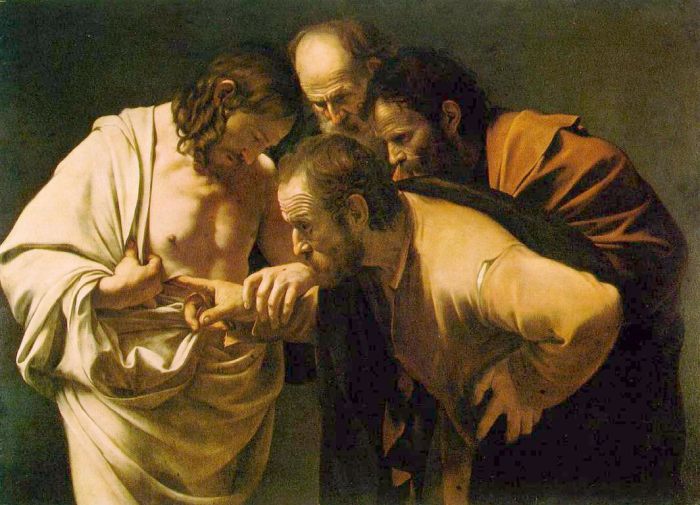
It’s not for nothing that my mother gave birth to me on St. Thomas’s day and duly named me Thomas. For those into Christianity, Thomas was the ultimate skeptic. Judas, unlike his fellow scum in the banking sector today, at least had the courage to off himself. All but one of the remaining eleven apostles took Christ’s wounds for granted, but Thomas was having none of it. He had to check it out. I like that guy, and it took Caravaggio to truly do him justice and, as usual, he pulls no punches.

St. Thomas, that greatest of skeptics, checks for himself.

In a world where everything on the internet is taken as gospel, we could do with more like him.

So, having been duly skeptical about the hype surrounding Panny’s 20mm lens yesterday, and after returning the lens to B&H in disgust after one day and 434 exposures, I think it’s only fair to set the record straight. The good thing about being a skeptic is that you rarely get ripped off; the bad thing is that when something really good stares you in the face you tend to take it for granted. And that ‘something good’ has been staring me in the face for some 18 months now. I admit it. When it comes to the expression ‘kit lens’ I am prejudiced. Prejudiced as in ‘It’s a piece of plastic junk used to keep the price of a basic DSLR low’.

So my ghastly experience with the Panny 20mm f/1.7 MFT lens is a salutary lesson, one which taught me that the Panny ‘kit’ zoom is one of the great optics of our time. It’s appropriate, therefore, to devote a journal entry to that kit lens, the Panasonic 14-45mm f/3.5-5.6 OIS MFT Lens. I have been taking it for granted for far too long.

With some 9,500 exposures using this lens under my belt I can lay some claim to living in the real world of results, not in the theoretical one of chart and laboratory measurements.

Almost everything about this lens is right. It is small, it focuses very quickly, it’s sharp at any aperture and subject distance and it delivers every time. Let’s get the complaints out of the way first. It’s not a large aperture lens, meaning everything will be pretty much in focus at every aperture and most subject distances. You will not be adjusting the zoom ring with one finger because it binds and jerks. And, yes, there’s a lot of plastic in it, if that bothers you, though how that is relevant to the quality of your images beats me. Ever tried dropping your brass and steel (brassy steal?) $3,000 Leica Summicron on the sidewalk to see how well malleable, deformable metal survives gravity compared to plastic?

And, my word, this lens delivers.

You want blurred backgrounds? Hop into Photoshop CS5, use the lasso and ‘refine edges’ tools with Filter->Blur->Lens Blur and you have all the background blurring you need. Takes seconds to do on those special images. For a quicker, less nuanced result, you can just use the localised adjustment brush in LR3 and turn down the sharpness, using the slider, for the highlighted area. Don’t forget to hit Command-Option-O (it’s a toggle) to show the outlining mask as you do your outlining.

Point this lens into the sun, as in ‘the sun is in the picture’, and you will get an occasional flare spot, easily removed in Photoshop. Does the result lose contrast as a result? No.

Use this lens in poor light and you will be struggling with a compromise between noisy high ISO and movement blur. But compromise you can, and you will still get the photograph. At ISO1600 noise from the G1’s sensor is not nice, but a bit of post-processing and you can get a decent 13″ x 19″ print. One that works fine unless you like sticking your nose in the canvas.

So, Panny, thanks for one of the truly great optical masterpieces of our time. I don’t care how you got there, I don’t mind if you used plastic ‘glass’ and polycarbonate this and that, because I have an incredible hit rate with your optic on my G1. And I much prefer to cull images for poor timing/composition/realization than I do for wrong focus or flare. Further, the built in shake reduction (OIS) gets me the equivalent of two stops of sharpness (if not two stops less depth of field) so the f/3.5-5.6 becomes an effective f/1.7-2.8. Where I might use a 1/30th shutter with a non-OIS lens, here I can use 1/8th with the same result. What’s not to like? The 13″ x 19″ prints on my wall tell a story no LCD monitor can. This lens is superb.

When Panny went to the G2 and later models the 14-45 morphed into a 14-42, which sells for $150 less. Whether that’s because it’s a poorer optic or not, I cannot say as I have yet to try one, but I do know that my 14-45 is very much a keeper.

Until the recent Panasonic GH2 camera came along all Panny and Olympus MFT bodies (which is the same as saying ‘all interchangeable lens MFT cameras’) used the same sensor. The GH2 claims to improve on that sensor and, if they are to be believed, the 14-45 kit zoom will only move to strength with the additional benefits of an improved ‘back end’.

The kit zoom is highly recommended if it’s the only lens for your G-body and street snaps are your preferred genre. And I promise never to use the words ‘kit zoom’ as pejoratives again.

Pictures speak louder than words, so I took the kit lens out for a spin yesterday, just to heal the wounds left by the 20mm, and here are a few results:

Click the picture to see the PDF.

All taken at ISO320 on the G1 body with minimal post processing.