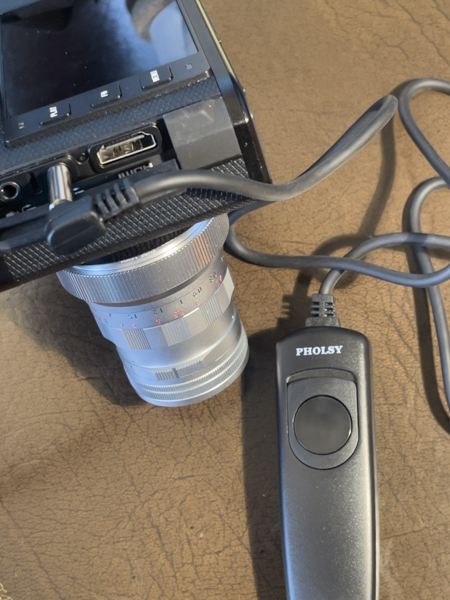
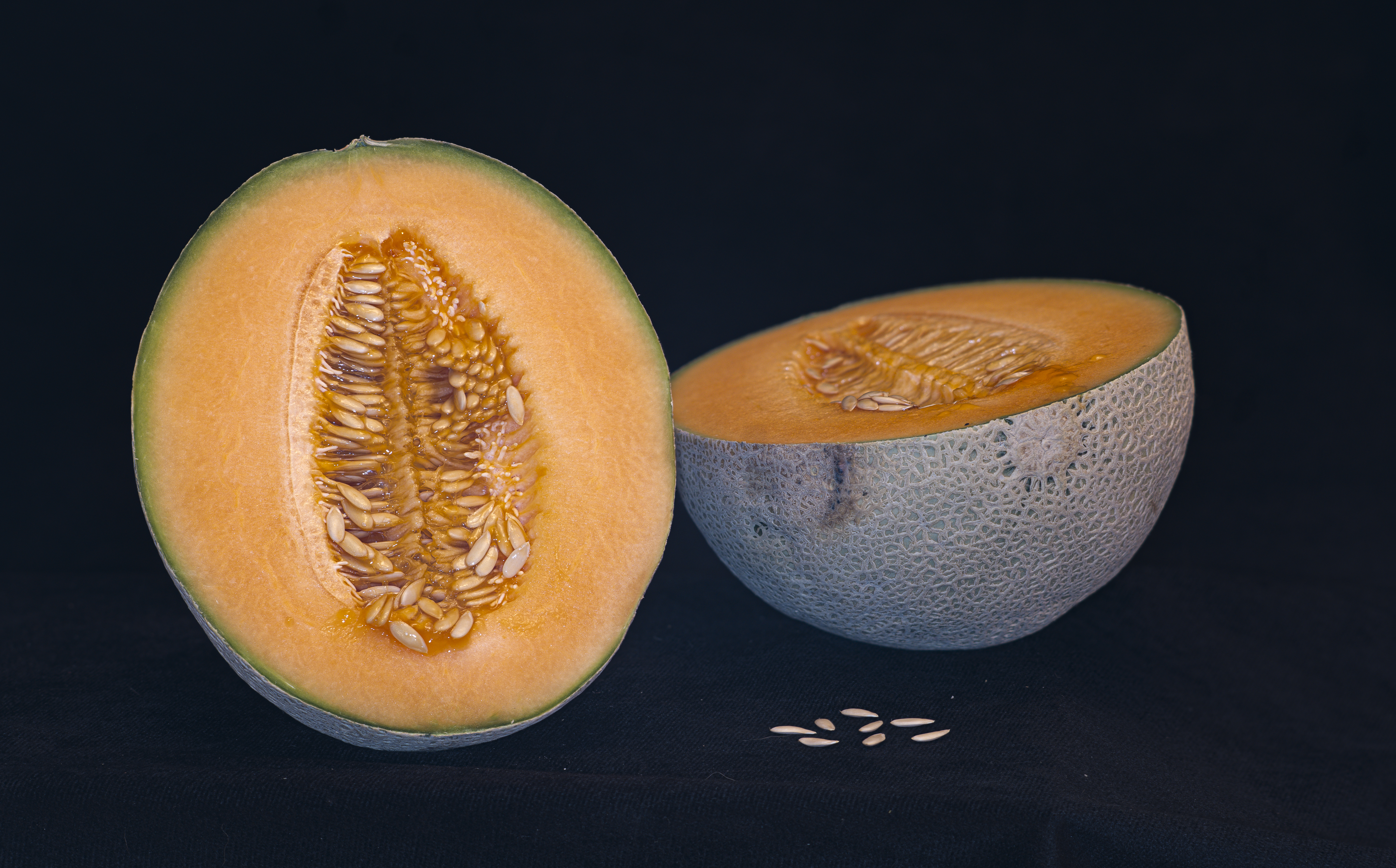
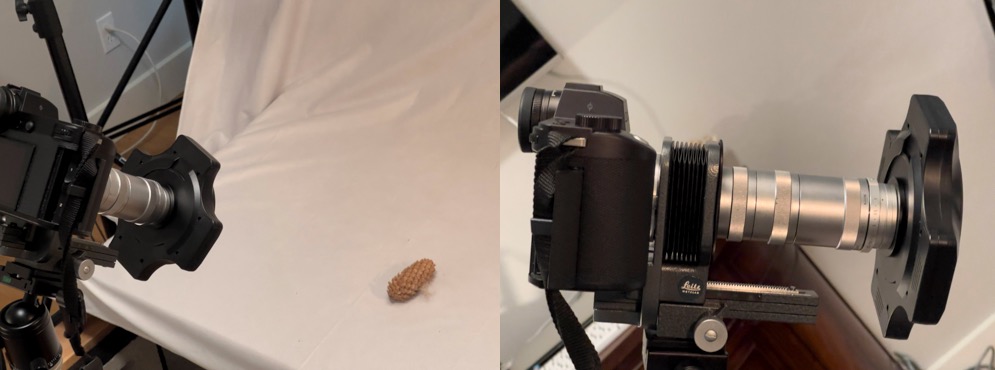
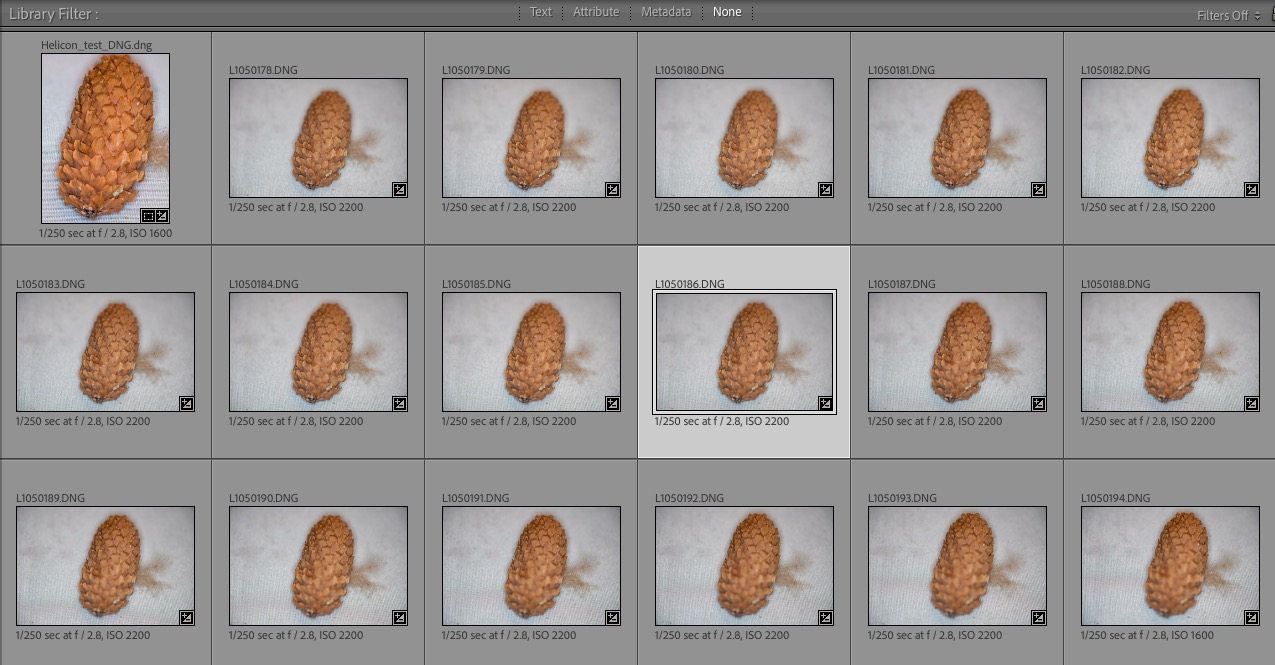
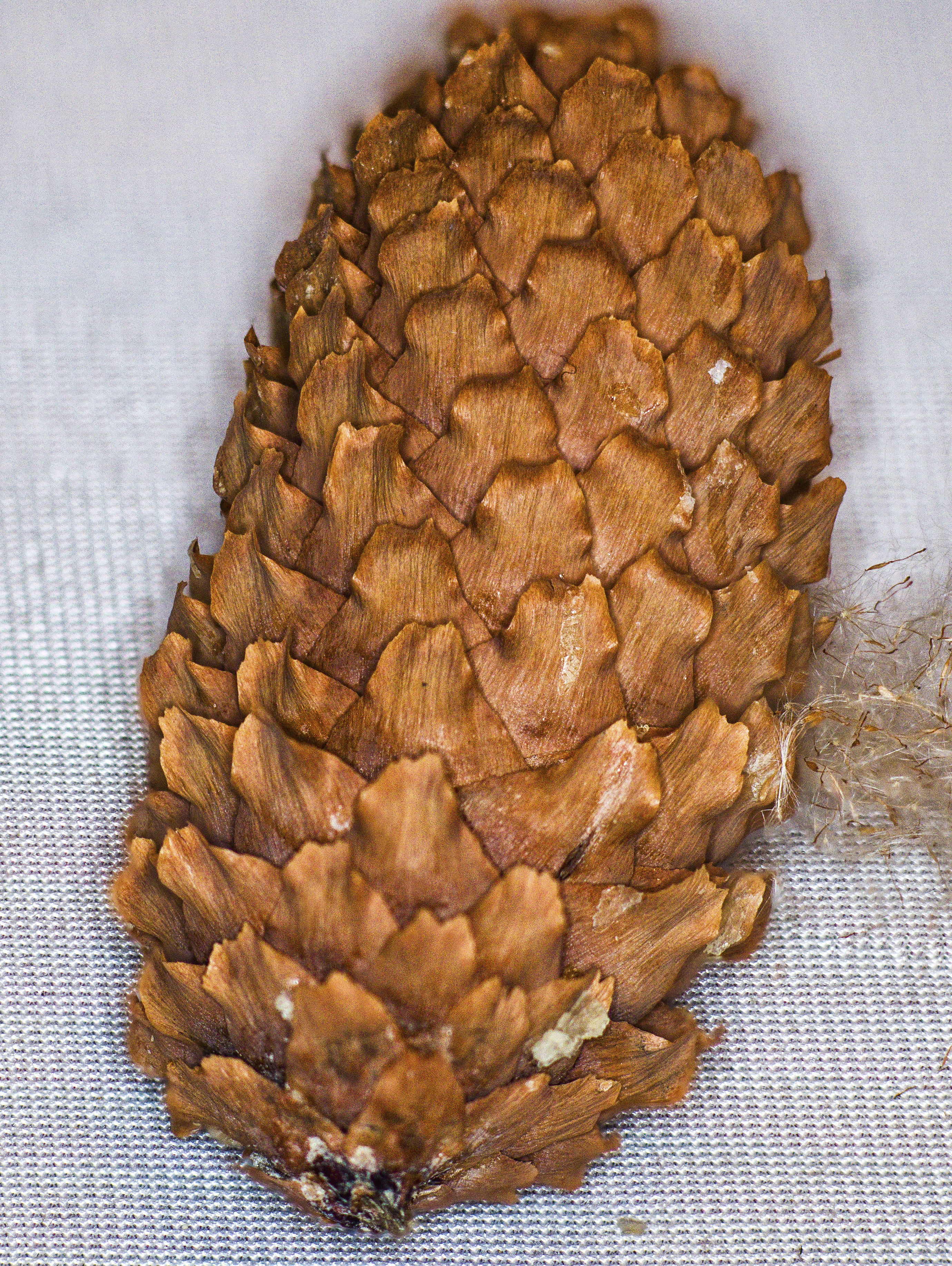
The ancient and the new.
For an index of all Leica-related articles click here.
The goal:
Having resolved to do some serious macro work in the studio, I ruminated on how to effectively use my hardware resources. The idea of going with an AF L mount macro lens was discarded as being too costly for a few snaps. An alternative approach using either a Leica 100mm f/4 Macro-R lens, either in a focusing mount or in the lens head version + bellows was also too costly, with a likely investment of $500 and up, including a R-to-L adapter.
The hardware:
Then it struck me that my Leitz 135mm f/4 Elmar from the mid-1960s has a removable lens head which can be easily installed on a focusing bellows and the bellows, with a Leica M bayonet on the rear, will fit into Leica M-to-L adapter. I don’t need AF or auto-aperture in this application as the magnification capability of the SL2-S’s EVF is very accurate for manual focusing and the EVF screen’s brightness automatically adjusts regardless of the aperture dialed in. Further, the simple 4-element design of the Elmar is known to be a sound choice for macro work, performing well in the close-up range.
Leitz made a large range of close up and reflex box tools for both the screw and bayonet mount Leica bodies, as best illustrated in this Visoflex III table of the period. The Visoflex was a simple, if rather clunky, mirror box, converting an M or Barnack body to single lens reflex use:
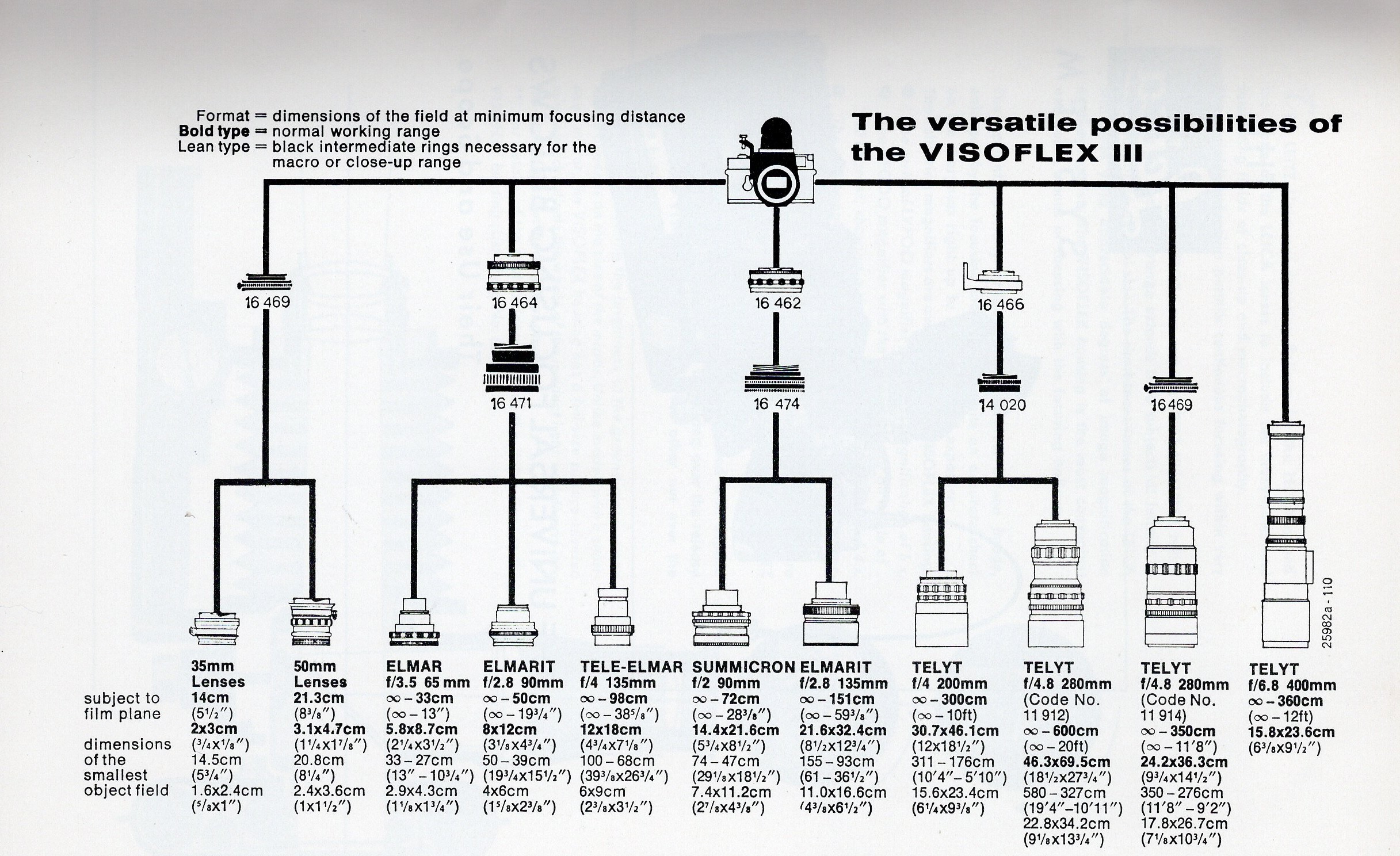
No shortage of options.
The 135mm Tele-Elmar lens head illustrated above has a slimmer optical unit barrel than the earlier 135mm Elmar, whereas the thicker barrel of the Elmar dictates use of an adapter, so I first procured the adapter #16472 ($25, not shown above) to fit the lens to the bellows, then added two extension tubes for really close work, numbered #16471 ($29). These can be stacked – the thread diameter is 33.8mm, smaller than the 39.0mm Leica Thread Mount. A pristine Bellows II was added, in mint condition, in its original box with instructions, no less, for $77. The bellows came with the 16558 front adapter.
The Leitz Focusing Bellows II assembly:
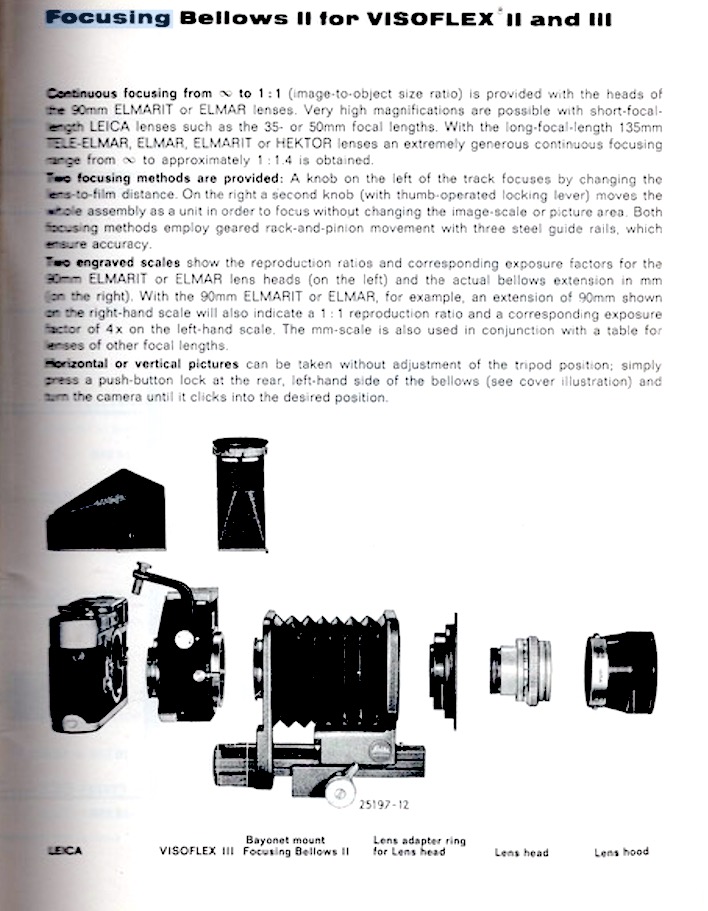
The Leitz Focusing Bellows II assembly.
This bellows is a standout because not only does it provide bellows focusing, with a maximum extension of 97.0mm, it has a separate rack and pinion drive to move the whole assembly back and forth. That drive travels up to 25mm. This is a feature missing from both the earlier Bellows I (though that model does extend to 135mm and a hard to find separate focusing rack was made). The separate rack means you can adjust focus without changing the reproduction ratio by moving the whole camera/bellows/lens/ring light assembly to and fro. Some Nikon bellows also had this killer feature (the PB-4 which added tilt and shift and the PB-6 are examples), making sizing and focusing a breeze. The Leica Bellows R also includes a lower rack.
With 97.0mm of bellows extension and 29.8mm more from the two 16471 extension tubes (they can be stacked and are very robust, as is the whole assembly) I have a total extension which can deliver life size images with the 135mm Elmar. The 135mm focal length is especially handy as it means a greater subject-to-lens distance making for ease of illumination. For illumination I bought this inexpensive LED ring light for all of $31 plus a 39-49mm filter thread adapter as the Leitz lens’s filter thread is 39mm in diameter and no such adapter comes with the ring light. This added $10 to the cost. The ring light is not as bright as a ring flash but much easier to work with, as it delivers continuous lighting, and the SL2-S’s IBIS will take care of any camera shake.
Adapters required:
(a) For the lens head on the Focusing Bellows:
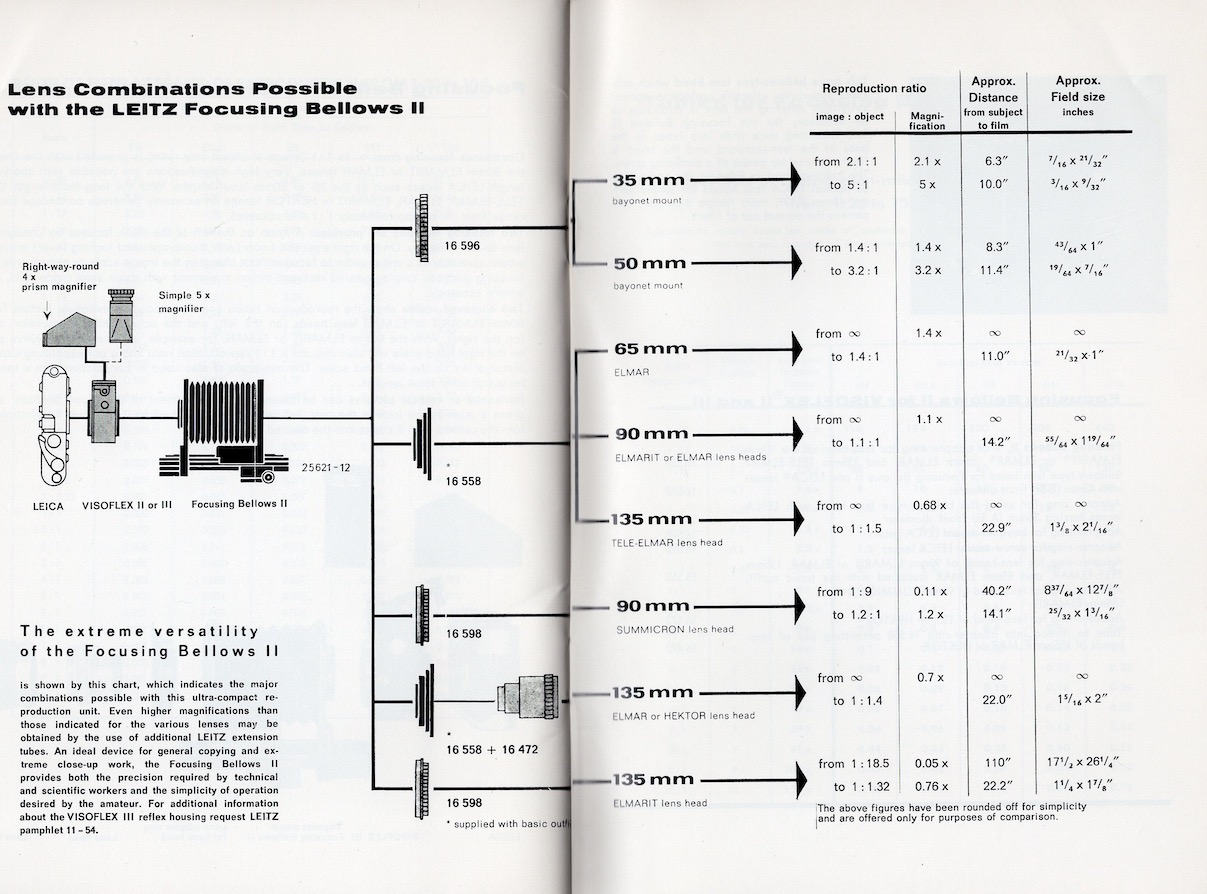
Lens adapters for use with the Focusing Bellows II, which comes with #16558.
(b) For the Focusing Bellows on the M-to-L adapter on the SL2-S body:
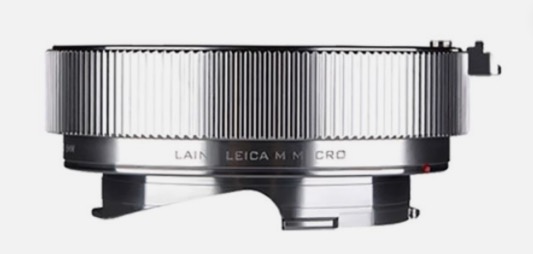
Laina 16mm Leica M-to-M extension tube.
This adapter cost $75 on eBay all the way from China and is required for one simple reason – the Focusing Bellows II will not mount directly on the Leica M-to-L adapter as the focusing rail protrudes too far back, interfering with the body. This 16mm extension tube permits mounting of the Focusing Bellows on the Leica M-to-L adapter mounted on the camera body. It’s not cheap but is made up to Leica quality standards.
To permit rotation of the camera body through 90 degrees:
An additional 10mm extension tube between the rear of the bellows and the SL2-S body is required if the camera 90 degree rotation function is to be enabled. Without this additional extension tube the rear of the rack interferes with the body, preventing rotation.
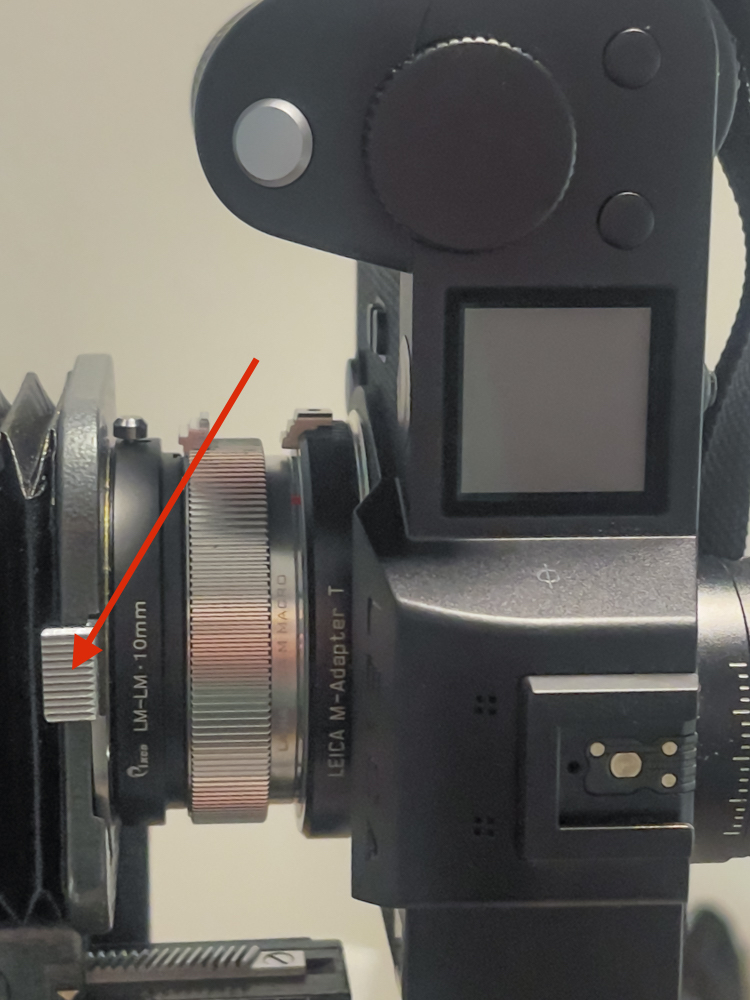
10mm extension tube, $26 from China.
The camera rotation release is arrowed,
and the SL2-S has been rotated 90 degrees.
Reproduction ranges:
These data will convey the exceptional flexibility of the combination(s) possible with the 135mm Elmar/16mm extension tube/Focusing Bellows/16471 extension tubes. Reproduction ratios are shown, so 1.0x is life size, 0.5x is half-life size and so on:
- 135mm Elmar in RF focusing mount + 16mm extension tube – 0.06x to 0.25x
- 135mm Elmar lens head + 16mm extension tube + Focusing Bellows – Infinity to 0.6x
- 135mm Elmar lens head + 16mm extension tube + one 16471 extension tube + Focusing Bellows – 0.17x to 0.8x
- 135mm Elmar lens head + 16mm extension tube + two 16471 extension tubes + Focusing Bellows – 0.4x to 1.0x
Stated differently these various combinations span a focus range from infinity to life size.
Lighting:
The LED light is made by JJC, the same company which made the excellent film scanning device I used with the Nikon D800 to make high quality scans of my films and slides:
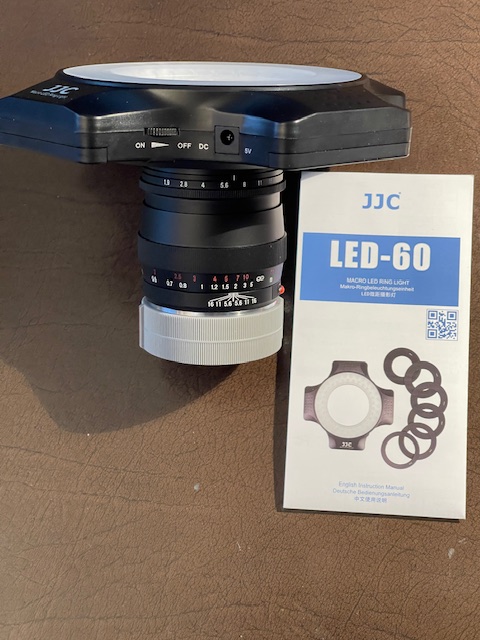
Attached to the 75mm Ultron using the 49mm adapter.
The ring light ($31) comes with a host of different filter thread diameter adapters (49/52/55/58/62/67mm – each slips into the rear of the unit with a tight and satisfying ‘click’) and uses four AA batteries, one in each ‘wing’. It has adjustable lighting power using the rotary On/Off switch. I note that there is also provision for a 9 volt DC power supply through the provided socket, but no transformer is included. In practice using disposable or rechargeable batteries means one fewer cable to trip on. The light is well made and with batteries inserted weighs in at just 7.95ozs/225grams, so it will not tax the lens and body. An additional 49mm to 39mm step up/down ring is attached to fit the LED light to the 39mm filter thread of the 135mm Elmar optical unit – $10.
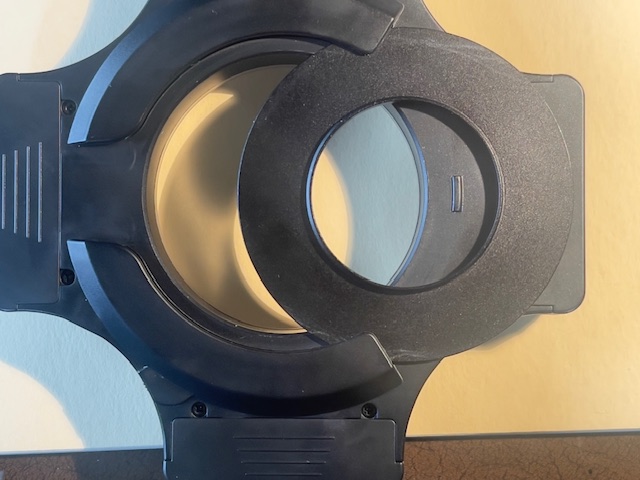
The adapters slide in and are held very securely.
The assembled outfit:
The number of adapters notwithstanding the whole assembly is exceptionally rigid with no play or wobble to be found.
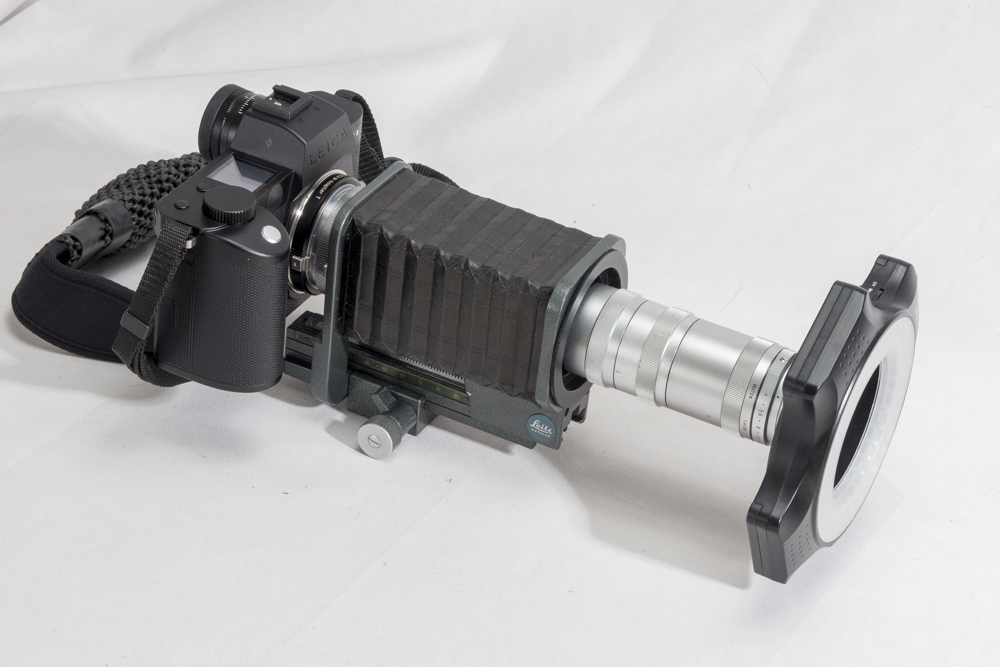
SL2-S body/M-to-L adapter/16mm M-to-M extension tube/Focusing Bellows II/16558 adapter ring/two 16471 extension tubes/16472 135mm Elmar adapter/135mm Elmar lens head/39-46mm step up ring/LED ring light.
The minimum bellows extension is 53mm, as shown below.
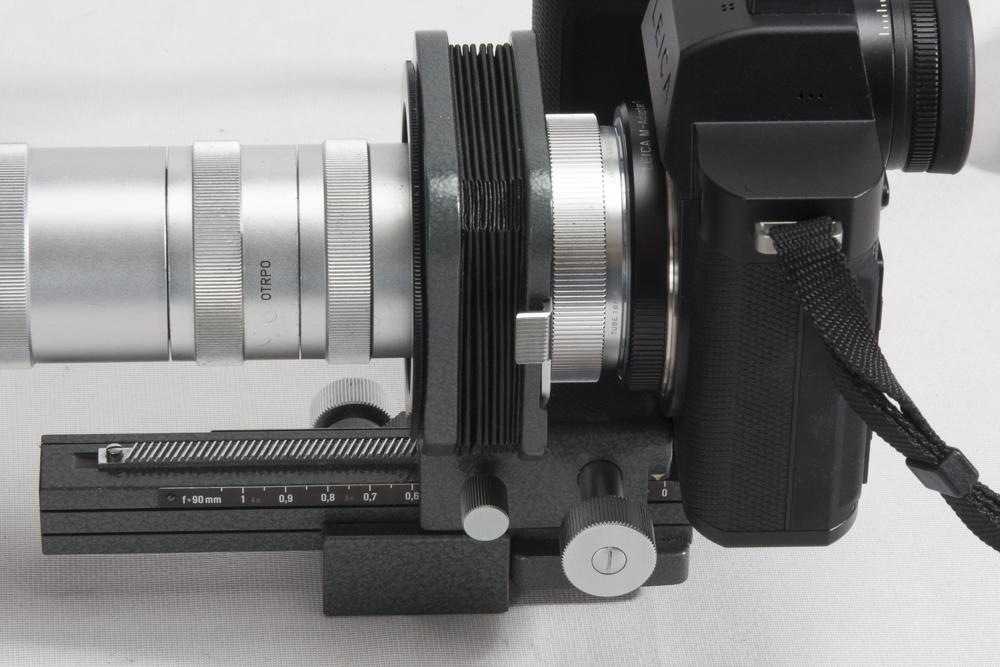
Showing the minimum permissible bellows extension.
Fully collapsed the bellows has a 48mm extension so only 5mm is sacrificed with this combination.
The 16mm M-to-M extension tube comes with engraved pits for 6-bit coding. I have coded it ‘001001’ for the 135mm Tele-Emarit which works well with the Elmar.
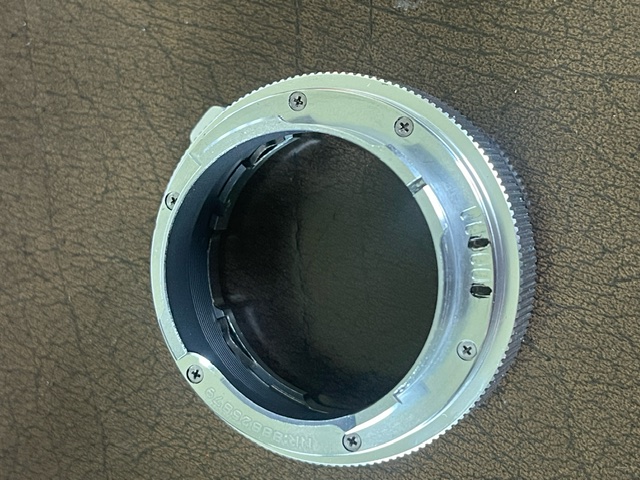
The 16mm extension tube 6-bit coded.
Cost:
My total investment is $255 and most of this hardware is easily resold at cost upon project completion. The Leitz bellows and adapter rings for the lens head are abundantly available on eBay, which offers a veritable cornucopia of choice despite the fact that the Leitz components are mostly 60 or so years old. All these parts are inexpensive and you will not find better mechanical engineering than existed in 1960s Leitz hardware.
The Bellows II in use:
It’s impossible to convey just how well engineered the Bellows II is. Both rack-and-pinion drives are beyond smooth with zero backlash and such is the rigidity of the design that nothing wobbles or shakes. German mechanical engineering at its finest.
Focus stacking:
Using the magnification feature of the SL2-S to focus the 135mm Elmar in macro mode is very simple and it’s child’s play to nail focus on a flat subject perpendicular to the camera. But most subjects are anything but flat and the very narrow depth-of-field in the macro range dictates the use of multiple exposures, differently focused, with the images combined in the excellent Helicon Focus application, which can be used as a plugin with Lightroom Classic. Since I wrote that piece in 2009 Helicon has adopted a subscription model (sigh!) but remains the breed standard and is recommended without reservations. The lower rack-and-pinion stage of the Bellows II makes changing focus/camera-to-subject distances very easy between shots. If you are using a regular macro lens then there is a large selection of focusing rails available at all price points.
Manual exposure is used to avoid density changes from image to image.
In Part II I will publish a ‘proof of concept’ result.
Note: Use on a digital Leica M body:
This kit can be fitted to a Leica M digital body and focused using Live View. However, you must use an M-to-M adapter ring between the rear of the Focusing Bellows II and the camera body. Fail to do so a the rear bellows plate will block the lens release button making removal of the bellows from the camera impossible without dismantling the bellows.
Leitz Bellows-R and the 100mm Macro-Elmar-R lens:
For use of this later hardware on the Leica SL2-S, click here.