My Sigma 35mm f/1.4 review.
I have generally stuck with lenses from the maker of the camera body – Leica, Canon, Panasonic/Olympus and Nikon – for the simple reason that I have the most awful memories of the aftermarket alternatives. When I worked in cameras stores during vacations as a kid, the most returned items were lenses from the likes of Tamron, Soligor and especially Sigma which, when not just downright awful optically would often fall apart mechanically. For the generally modest savings compared to the real thing and the massive attendant depreciation, the economics simply did not solve. My Sigma 35mm f/1.4 review follows.
But more recently old line designers, like Zeiss and Schneider, started making inroads into the super premium FF, APS-C and MFT lens markets, generally at prices substantially higher than the camera makers’ own lines. Cosina manufactures the Zeiss designs. I’m not sure who makes the Schneider ones. Maybe it’s Samsung, given how many of their cameras feature Schneider lenses. One thing is fairly sure and which is that neither is made in Germany.
Sigma, that maker of many of the worst clunkers in optical history, made some early progress under contract to Leica for Leicaflex lenses, the 28-70mm f/3.5-4.5 Vario Elmar being one example where Leica’s eagle-eyed inspectors claimed to have bestowed some QC discipline on a manufacturer alien to the concept. That was ages ago. More recently, Sigma came out with two well reviewed primes in the 50mm and 85mm optics, both AF and both f/1.4, though reports of autofocus issues with both abound. That’s pretty tough competition with the Canon and Nikon versions, especially at 85mm, but Sigma garnered a following for its lenses, suggesting that they were turning a new leaf.
It is very much in all photographers’ interests that independent lens makers succeed. Nikon and Canon have greatly increased the prices of their best primes, with their 35mm f/1.4 offerings selling for $1,500 and $1,600 respectively, with stellar reputations to match. That is a lot of money. Yet, had you told me that I would be trying a Sigma lens on my Nikon I would have laughed all the way to the boozer. But I am doing exactly that (trying the lens, that is, not laughing en route to the boozer), awed by the incredible critical reception for this optic. Either Sigma has very deep pockets to fill the shallow ones of the paid review set, or there’s something exciting going on here.
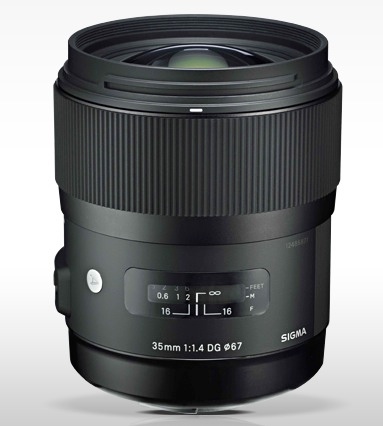
The Sigma 35mm f/1.4 DG HSM A1 is a non-VR AF full frame lens from Sigma which comes in a variety of mounts. Nikon versions remain back-ordered but I was able to rent one for the weekend and can report on it here. It will cost $900 with hood and case.
My rental, s/n 50004444, came from Borrowlenses.com for the simple reasons that they are down the road from my home and because they had just got the first ones in stock. I paid $60 for a weekend rental. After the foul stench left by my prior Sigma experiences I was not about to plonk down cash without a dry run first. The big appeal here, of course, is the auto focusing design and f/1.4 does not hurt either. That should mean optimal resolution by f/2.8 for really large prints, and 35mm is very much in my sweet spot for street snapping. I do not really need a zoom or anything much longer for that.

The cool dudes at BorrowLenses.com. D3x, 35mm Sigma at f/4.
Some of the best lens test data recently is coming from Roger Cicala at a competing lens rental place named LensRentals.com. What distinguishes his analyses is that he tests dozens of lenses of any one type on his optical bench, thus reporting not just on quality but also on manufacturing consistency. And that’s a must have for Sigma optics whose history of poor QC and inconsistency is legendary. Cicala only has one sample of the Sigma in Canon mount at the time of writing, and you can see his review here. Doubtless he will soon report on sample variability.
The lens is distinguished by its largely metal (there’s a thin rubber coating on the focus collar) finish, a marked departure from the plastics used by Nikon and Canon in even their costliest offerings and, uniquely, a rumored add-on device which will attach to the lens and permit updates to firmware and focus collimation through a PC (please, Sigma, make it work with Macs) with a USB connection. No details yet on the pricing of this innovative device. It really should come free with the lens, given Sigma’s reputation. The lens is all black, with none of the garish gold markings (Nikon) or ‘look at me’ red rings (Canon) which add zero value to the user experience. The gold and red stuff always reminds me of insecure Americans who emblazon their rear view windows with ‘Harvard’, ‘Yale’ or ‘Balls Pond Road’, the last for the degree-mill set.
The depth-of-field scale on the lens – visible in the image above – is useless and should be dropped. The gearing of the focus movement means that there’s insufficient space for a proper DOF scale. Further, these scales can only be meaningful at a specific enlargement ratio and really are a thing of the past. For that matter, the focus distance scale should also be dropped.
The chromed blob visible in the above picture is marked ‘A’, and is purportedly a statement that the optic is a member of the manufacturer’s ‘Art’ line of lenses. This is marketing BS of quite exceptional purity.
I do not understand weatherproofing issues. The Sigma has no rubber O ring – found with certain allegedly weatherproof Nikon and Canon optics – on the bayonet flange. My 16-35 Nikon AF-S has this ring and it strikes me as an exercise in futility. Quite how water could penetrate the very tight seal between lens and body beats me, O ring or no O ring. What ‘weatherproofing’ means to me is that there is a good seal between the moving parts of the lens – the focus collar and A-M switch – and there is no data I have seen which compares the Sigma with the Canon and Nikon offerings in this regard. So I am pretty clueless here. Suffice it to say that ‘reviews’ state the Sigma is not weatherproofed. Beats me what that means or how they know. In heavy rain I would simply encase the barrel in a plastic bag and have at it, using AF, as no external parts move when the lens is focused using AF.
Early reviews suggest that the lens not only outperforms the Canon and Nikon alternatives optically, it also is more than a match for the $1,840 Zeiss 35mm f/1.4 optic, which is MF only. I cannot comment, not having used any of the alternatives. The Sigma is AF with AF override or MF optional. The feel of the focus collar does not change between the A and M settings and is quite the best I have experienced in a lens with internal motors, and superior in smoothness and damping to the AF-S 16-35 Nikkor. You do not feel or hear any gears using AF override or MF. The AF mechanism is audible to the user in quiet surroundings, inaudible to everyone else. A tactile and aural delight.
The lens is very solid in the hand and no lightweight. Balance on the Nikon D3/D2 is a bit front heavy as there’s a lot of glass in this optic, but the combination handles well. My 16-35mm Nikon f/4 AF-S VR weighs 1.5 lbs and is 4.9″ long, taking 77mm filters. The Sigma, a non-VR prime, comes in at almost the same weight but is only 3.7″ long. It takes 67mm filters. Fit, feel and finish all harken back to the golden era of all metal lenses with brass helicoids. The plastic petal-type hood, included, clicks on nicely but adds a lot of bulk and length. My rental came with front (pinch type) and rear caps, the hood and a protective filter. I did not use the hood – it is silly-large for a street snapper, though it does clip on and reverse nicely, still permitting the use of the front cap. The rental lens appears new.
Because of Sigma’s poor reputation, the first thing I did was point the lens at a bookcase – tripod, MLU, remote release – to determine whether any fine focus adjustment was required. My Nikon D3x correctly reported the lens as a 35mm f/1.4 in the fine tuning menu and required absolutely no adjustment for optimum auto focusing. I wasn’t about to hit the street only to find that everything was out of focus. Further, infinity focus was just as accurate. Indeed, I simply could not reliably get sharp focus at any distance at f/1.4 and f/2.0 with manual focusing, using the LED focus confirmation light, whereas AF nailed it every time. Impressive, especially in light of all the grumbling on the web. Impossible to know if this is sample variation or user error.
The obvious comparison here is to my 1971 pre-Ai 35mm MF Nikkor f/2, a stellar performer from f/2.8 down, and clearly delivering better resolution than the current 16-35mm f/4 AF-S optic I also use. More on that in Part II.
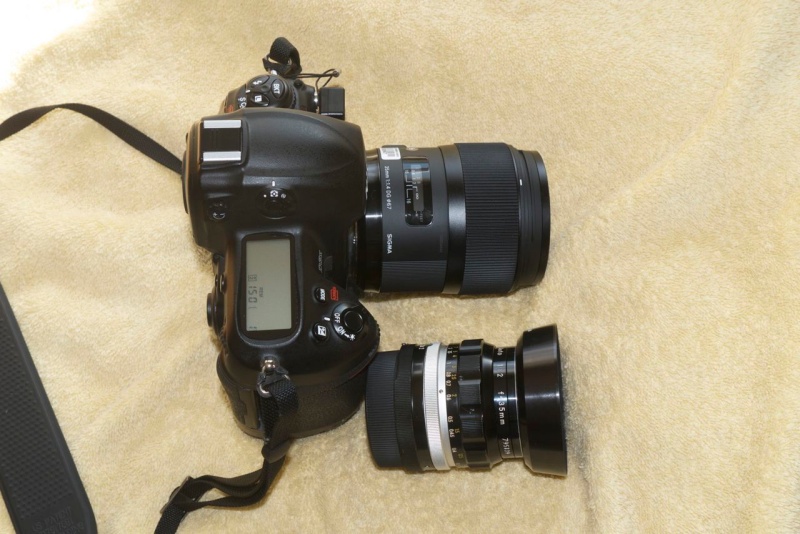
Sigma on the D3x compared to the much smaller 35mm f/2 MF pre-Ai Nikkor. Sigma’s hood removed.
The one anomaly compared to Nikkors is that the focus collar rotation is opposite to that of the Nikon optics. Still, with AF it’s not a big deal but may take some getting used to if you use AF override, done by simply manually rotating the focus collar in AF mode, like on current Nikkors.
The next task was to make a lens correction profile as the Sigma is known to exhibit fairly serious vignetting at f/1.4, and my profile corrects it. If you must have vignetting, that should be a user choice at the processing stage, not a lens default. Doubtless Adobe will publish one eventually. Mine is made at f/1.4, f/2, f/2.8 and f/4. Vignetting is gone by f/4 and Lightroom and Photoshop will automatically select the correct version defaulting to the last at any aperture smaller than f/4. This profile also removes the small amounts of lateral chromatic aberration the lens displays and also removes a small amount of barrel distortion. You can download the profile here. This profile works with RAW images only. That page includes OS X and Windows installation instructions.
If your import preset in Lightroom is checked to invoke the lens correction profile or if you check the box below, you will see this on import in the Develop module:
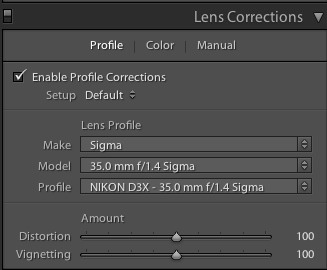
Lens correction profile in Lightroom 3 and 4.
While I have named the profile “Nikon D3X ….” it will be correctly invoked with any Nikon camera. The ‘Model’ field description is what LR uses to look up the matching lens profile; the name of the camera body is irrelevant. I have no other non-Nikon bodies or lenses with which to test this profile, but it should also work fine with Canon, Sony and Sigma bodies, though you may have to select it manually. The profile is fine with FF and APS-C, though less needed on the latter which cuts out much of the corner vignetting.
DPReview drooled all over their sample and you can read their findings here while I make off to take some snaps with it. Just don’t get too thrilled about their field snaps as one of the qualifications for being a DPReview tester, an otherwise worthy bunch, is a total inability to take a good photograph, a qualification shared by optical lab rats worldwide. No problem. They are not paid to take great pictures.
I’ll update this Sigma 35mm f/1.4 review in Part II.