Fools rush in ….
The recent history of OS X is as follows:
- 10.5 Leopard – the last to run on G3/4/5 PPC machines as well as on Intel Macs. 32 bit.
- 10.6 Snow Leopard – the last pre-‘dumb’ UI, 32 and 64 bit, Intel only, will run PPC apps using Rosetta
- 10.7 Lion – the current OS with many iOS influences, such as touch gestures and the AppStore. Intel apps only, no PPC, no Rosetta. 32- and 64-bit.
- 10.8 Mountain Lion – more dumbing down of the UI and 64 bit Intel only
On balance, I would have to say that OS X peaked with Snow Leopard. Robust, no nonsense, no frou frou. We are now in the land of chintz, bells and whistles. Faux chrome spokes will be next.
Before being a pioneer at the bleeding edge and upgrading your OS Lion Mac or Hack to OS Mountain Lion, due out any day now, stop and do this simple test first.
It’s the bold words above that should give you pause. If you recall losing the use of NikonScan or Quicken 2007 (both PPC apps requiring Rosetta in Snow Leopard) when you migrated to Lion, you run the same risk in migrating to Mountain Lion from Lion for all your non-64 bit apps. Indeed, as what follows shows, the risk is potentially far worse.
Apple continues to dumb down the UI of its desktop OS, making it more responsive to touch gestures, which sells more Magic TrackPads I suppose (Magic What? Gimme a break, Apple), while in reality the use of touch gestures with a desktop and traditional keyboard is simply poor design. It may work with a laptop but does not with a desktop, in my experience.
The quickest way to find out what will not run on Mountain Lion is to start up all the apps you use then go to Applications->Utilities->Activity Monitor and sort this screen by clicking on the ‘Kind’ column:
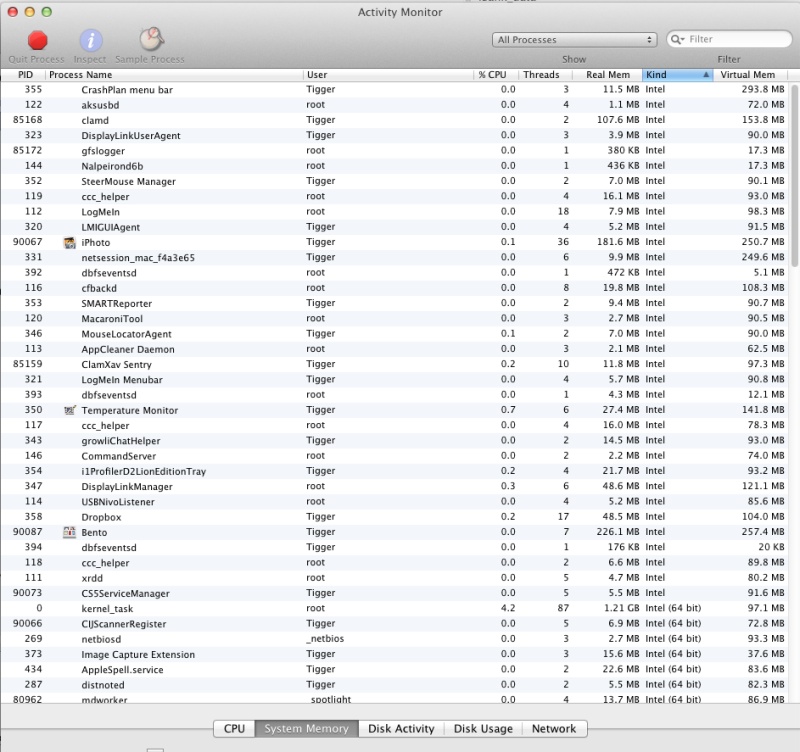
Activity Monitor sorted by 32- and 64-bit apps.
Anything that does not say ‘Intel (64 bit)’ in the ‘Kind’ column will not run with Mountain Lion until the application is updated by the maker. And, in my case, there are some real shockers here:
- CrashPlan menu bar – cloud back-up. I have emailed the maker who replied “We plan to fully support Mountain Lion by the time it is publicly available.”
- SteerMouse manager – confers enhanced functionality on my ancient Logitech mouse. I emailed the maker who responded: “ML supports 32 and 64 bit applications, but it does not support 32 bit kexts. SteerMouse consists of a 32 bit application and a 64 bit kext.” This means SteerMouse should work fine
- LogMeIn – permits remote access and control of any computer. I have emailed the maker and they replied that LogMeIn will work fine with Mountain Lion
- iPhoto – no problem – Apple has just updated to 10.6.3 which works with Mountain Lion
- SMARTReporter – menu bar utility which provides early warning of imminent drive failure. I have emailed the maker who replied: “SMARTReporter works fine in 64 bit, and mostly fine under Mountain Lion. There is one issue related to Mountain Lion, the I/O error check doesn’t work there. i’ll provide an update for this in the next days and unless the Mac App Store delays things too long, the update should be released before Mountain Lion is publicly available.”
- MacaroniTool – excellent UNIX utility which repairs permissions overnight with no attention. I have emailed the maker
- growliChat helper – pops up a window when something important happens
- i1ProfilerD2LionEditionTray – deal killer. App for running the i1Display2 colorimeter for profiling displays. I have emailed Xrite requesting an ETA. Don’t hold your breath on this one, as they just replied to me as follows: “We have not established final compatibility with Mountain Lion with any of our products. Apple reserves the right to change the OS up until the day of actual first customer shipment. Our software engineers are testing with pre-release copies of 10.8, but our final testing will only begin when the release version is available.” Meaning if you move to ML, be sure to profile your displays in Lion first as you will be waiting for the ML version for quite a while. Xrite did a similarly poor job of releasing the Lion version despite having 2 years notice that Apple was abandoning Rosetta and PPC CPUs. Bunch of amateurs who care little as they enjoy a monopoly in the colorimeter market – Huey, EyeOne, Spyder – yup, all Xrtite, unfortunately.
- Dropbox – another deal killer. Replaces MobileMe for me and provides an easily accessed cloud storage space for frequently used files. There’s an experimental Mountain Lion version here of unknown stability
- Bento – database app owned by Apple used for inventories
- ccc_helper – used by CarbonCopyCloner – though I believe CCC is on top of 64 bit migration. Used for drive copying
- Temperature Monitor – the maker has written in response to my question: “Yes, of course. There is no reason why Temperature Monitor should not work. The application also has 32 and 64 bit sensor drivers included to support monitoring of Intel’s “per core” temperature sensors.”
So several of these, once disabled, make my Macs and Hacks unusable. Mountain Lion will have to wait until apps are updated or alternatives become available. Running this simple check will warn you whether Mountain Lion is too early for prime time. I suspect that, for many photographers, the answer is a resounding ‘No thanks’ at this time. Better to stop and wait than to find you have just dropped the anchor through the keel of the boat and that you are out of lifejackets.
Some good news. PS CS5 and LR4 are fine – they have been 64-bit apps for quite a while. If you use three or more monitors with #3 and above powered from a USB2 port using a Newer Technology USB-DVI adapter (excellent) then I am glad to report that the maker has just updated the driver to 64-bit. I’m using the Moutain Lion version with Lion on my third display and it’s fine.
Will my Hackintosh or Mac run Mountain Lion?
You need to check if you are running in 64-bit mode. This is done in System profiler (‘About This Mac’) as follows:
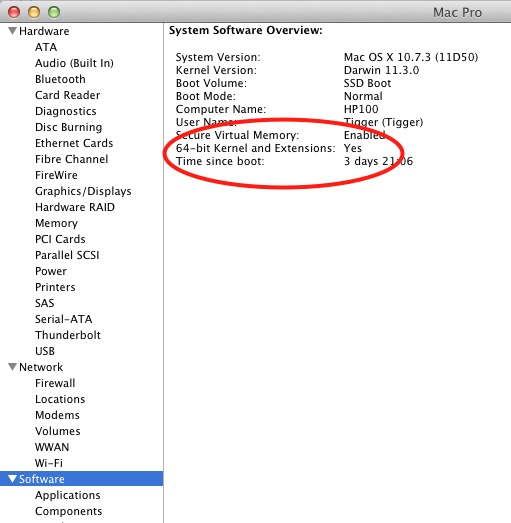
If yours says ’32-bit’ you are SOL with Mountain Lion, arguably no bad thing. Mostly it’s the graphics card that is to blame. Good luck upgrading a Mac, but Hacks are easily upgraded to later cards. The Nvidia 9800GTX+ GPU I use is a 64-bit card. It is discontinued, outstanding and easily found used for $50 or less. Apple has published a list of Macs which will not run Mountain Lion and this is probably the issue. Just about any Mac over 3-4 years old will not run Mountain Lion. The list is somewhere on their site and I’m damned if I care to look for it. If you have to, your next desktop should be a Hackintosh.
Disclosure: Lomg January 2013 AAPL call options.