A little bit of charm.

G3, kit lens.

A little bit of charm.
G3, kit lens.
A few hurdles first!
Adobe allows installation of Photoshop on two computers, and requires that if it is to be used on a third that one of the other two be deactivated. Fair enough. It’s premium priced software and shareholders of ADBE should rejoice at any and all attempts to control theft.
I’m on CS5, having started with CS2 ages ago and progressed through CS3 and CS4. CS5 is a fine product, it’s fast and I have never had it lock up on the Hackintosh it calls home. It is blisteringly fast on that machine, with its overclocked Sandy Bridge i7 CPU.
Given the very speedy technology in the latest 2012 MacBook Air, I determined to add CS5 to that laptop which already runs Lightroom 4.1 very capably. But how to get it on the MBA’s SSD?
Good luck finding CS5 for Mac at Adobe.com. There’s a Windows version but for the life of me I could not locate the Mac option, and all current Mac downloads point you to CS6, which I have not yet purchased. I found my original CS5 disc and cloned it to a flash drive using CarbonCopyCloner on the Hackintosh, some 1.2Gb. Inserting the USB flash drive in the MBA and starting the installation process failed. I was asked to insert the installation disk. So I copied over the installation files to the MBA and launched the installer from the MBA’s SSD. After inputting my bazillion digit serial number all ran smoothly.
But, firing up CS5 I got the ‘Activation limit exceeded – you have already installed this application on two computers. Deactivate one’ message. Well, the snag is that the other installation was on the predecessor MBA 2010 which I had wiped before sale, so there’s no way I could ‘deactivate it’. I called Adobe (866 772 3623, hit ‘3’) fearing the worst and got an exceptionally competent person to whom I explained that they needed to wipe one activation count off their registration database. After ten minutes on hold I was informed that one activation was erased and that I could proceed. I did so and all was sweetness and light! Thank you, Adobe.
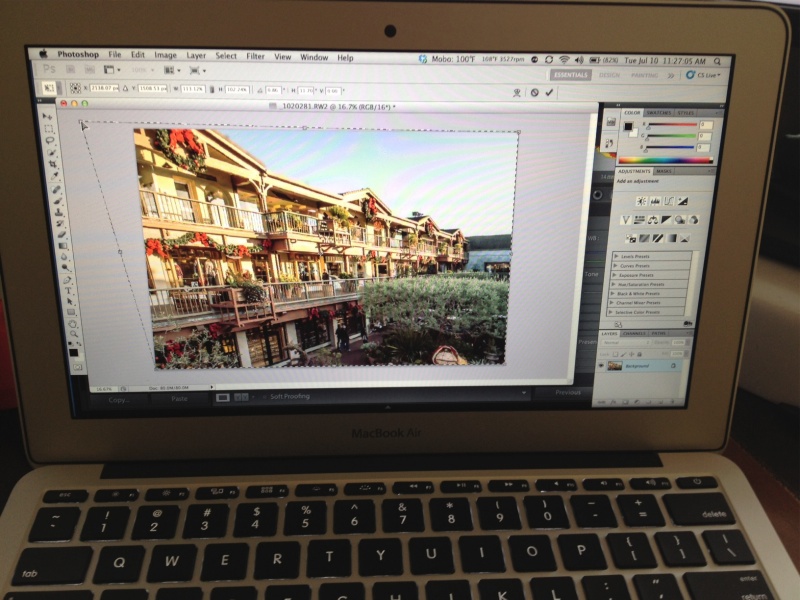
Photoshop CS5.1 running happily on the 2012 MBA.
Some usage notes on the 2012 MBA – mine has 4Gb RAM, twice that of the 2010 predecessor.
Start up takes a mere 3 seconds. Opening a RAW file (Panny G3) from Lightroom 4.1 in CS5.1 takes 9 seconds. Selective Lens Blur preview takes 2 seconds, applying the blur another 10. This is a processor intensive activity. It’s faster on the MBA than on my Core i7 Hackintosh. Applying routine distortions to correct verticals and the like is near instantaneous. The 8Gb RAM MBA would probably be even faster.
Bottom line? No excuses need be made for the 2012 MacBook Air as a Photoshop machine. It is perfectly capable of keeping up with the best.
Disclosure: Long AAPL January 2013 call options.
Time for tea.

My Fair Lady. Mayfair, 2000. Leica M6, 35mm Asph Summicron, Gold 100.
In Bernal Heights, SF.

Armchair. D700, 24mm.
The 24mm MF Nikkor may just be my favorite prime lens. My D700 is seldom far from it.
Not without a struggle.
Intel’s LightPeak is currently the fastest way of moving data to or from external storage, claiming 10 gigabits/sec, or 1.25Gbytes/s in regular English. This compares with a theoretical limit of 0.06Gbytes/s for USB2, so twenty times as fast on paper. LightPeak was rolled out in several Macs where it continues to enjoy near-zero market share, owing to a dearth of peripherals using the connector and insanely expensive connecting cables.
Meanwhile we have USB3 which claims 0.63Gbytes/s, is backward compatible with USB2 and USB1.1, and is available on most current Macs. The 2012 MacBook Air supports both USB3 and LightPeak (‘Thunderbolt’ in Apple Hypespeak).
For Hackintosh owners there are two ways of adding USB3. For those with older motherboards (LGA775, LGA 1156 typically) a PCIe internal card has to be added at a cost of $20-40. For more recent builds (LGA1155 and LGA1366 sockets) most come with USB3 connectors built into the motherboard. For Sandy Bridge and Ivy Bridge machines (LGA1155) current Gigabyte boards include USB3, so when ace computer builder FU Steve upgraded HP1 (LGA775 Core2Quad) to LGA1155 (Sandy Bridge i7-2600K) by fitting a Z68 Gigabyte motherboard, it came with two blue USB3 sockets on the back and a 19 pin USB3 connector inside.
And my HP100 has done nothing to use those USB3 sockets since the upgrade, as I have no USB3 peripherals. Until now. As we are getting into hardware, definitely not my forte, I’ll hand it over to ace Hackintosh builder FU Steve for what follows.
Thanks, Thomas.
When I upgraded Thomas’s HP1 to HP100 I intentionally chose the Z68X-UD3H-B3 motherboard from Gigabyte because it’s easily hacked, comes with two USB3 sockets (and many USB2), and has the 19 pin USB3 connector on the board itself. I envisaged upgrading the USB2 internal, front panel USB2 card reader to USB3 and had Thomas plonk down $33 for a Silverstone FP37B 3.5″ internal card reader. This was easily swapped with the older Sony 3.5″ reader, plugging into the 19 pin mobo socket.
And here the story gets complicated. After installing the appropriate USB3 driver (kext file) using TonyMac’s MultiBeast app, the two rear panel blue USB3 sockets were recognized:
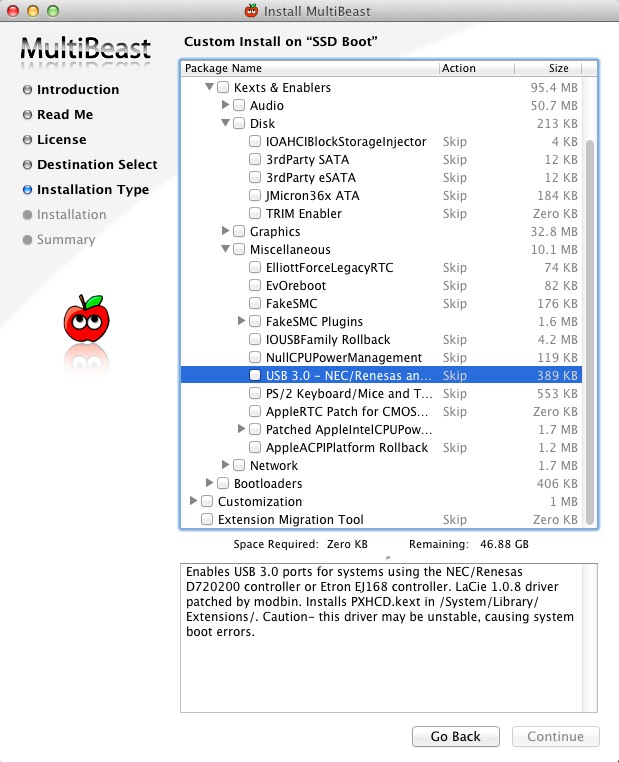
Installing the USB3 driver – check the box and restart after running this.
The Gigayte Z68X mobo uses an Etron EJ168 controller. No instability issues noted.
However, no matter how many different drivers I tried the card reader was MIA. Nada. Zilch. Back she goes to Amazon.
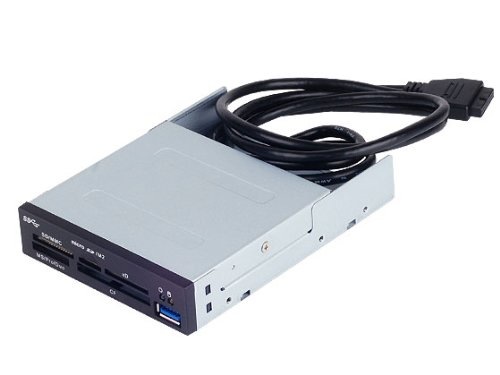
Failure. Not recognized by the Hackintosh.
Plan 2. I had Thomas buy an external USB3 card reader, confident it would be recognized once plugged into one of the rear sockets. $35 and nowhere near as elegant a solution, but having the advantage that it could also be used with Thomas’s 2012 MacBook Air, which has no built-in card reader.
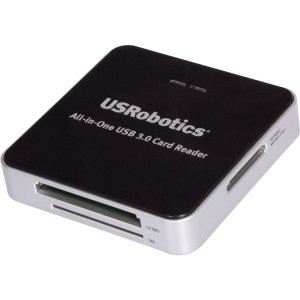
US Robotics USB3 card reader.
This comes with a ridiculous 6″ (yes, inch) USB3->micro-USB3 cable, so another $7 saw a 6′ extension cable arrive which is actually usable on the HP100. Having Thomas cuss me out because he cannot get at the card reader is more than life is worth. The stock, short cable is fine for use with the MBA. The reader is USB-powered, so no power brick is required.
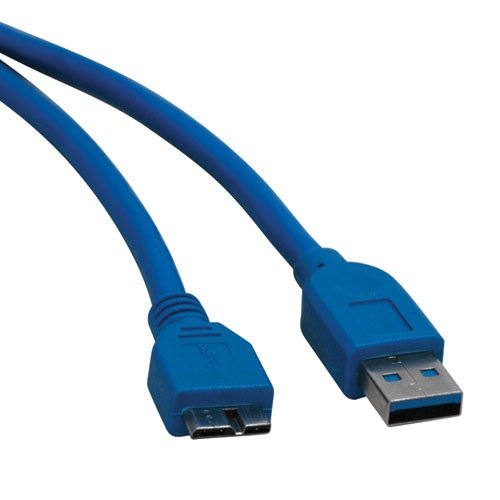
Micro-USB3 extension cable.
Don’t bother with that old male-female USB2 extension cable in the brown cardboard box under the stairs. It will fit but you will only get USB2 speed. A USB3 cable has more wires and contacts. There is no free lunch here.
The card reader was immediately recognized, and though System Profiler reports the maximum speed is the 480Mbits/s of USB2, rather than the 5000Mbits/s of USB3, the full USB speed is available. Here’s how it’s seen in System Profiler:
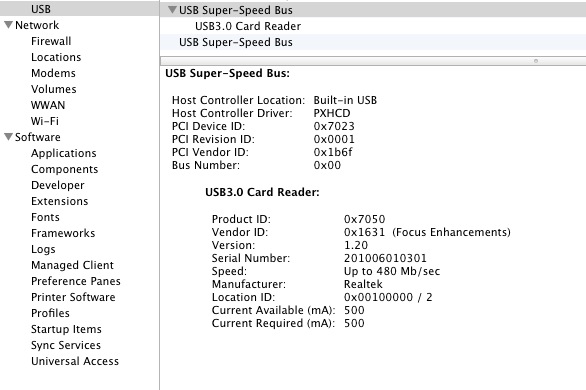
USB3 card reader with a Class 10 SDHC card inserted.
USB3 is reported as ‘USB Super-Speed Bus’, and you can see both sockets are recognized.
Confirmation of the transfer speed was easily done by running the Xbench disk test. Here’s USB2, which takes 10 minutes (!) to run:
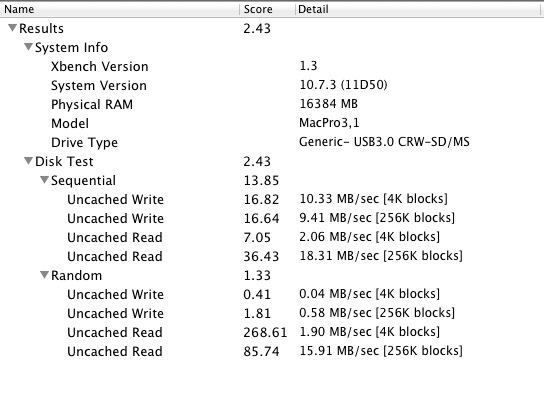
Xbench – USB2 (extension cable) with SDHC Class 10 card.
And here’s USB3 which takes a 75 seconds:
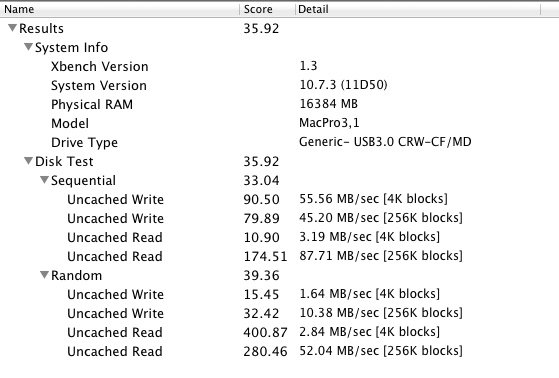
Xbench – USB3 cable with UDMA CF 400x card.
Like, whoa!
So USB3 is working properly on the HP100. I ran the same tests with the card reader connected to the 2012 MacBook Air, with identical results, except that the MBA reports the card reader’s speed correctly:
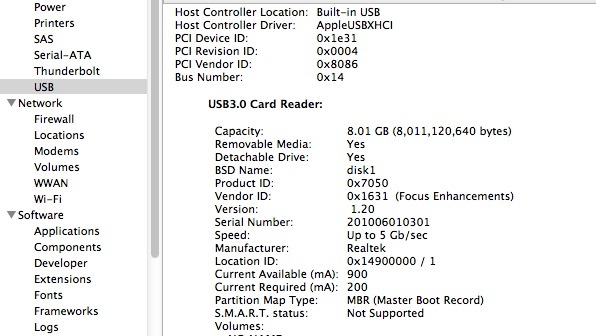
USB3 card reader as reported by the 2012 MacBook Air.
How about some real world tests?
Import and processing of 20 Panny G3 RAW files from the SDHC Class 10 card (not especially speedy as cards go) using USB3 compares with USB2 as follows, using Lightroom 4.1:
Hmmm. Not very impressive. Why is USB3 no faster?
The limiting factor here is the slow SDHC Class 10 card. Here are the speed specs for the various SDHC card classes:
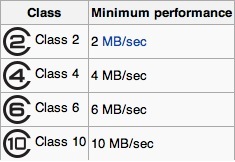
As you can see both USB2 and USB3 are working at maximum efficiency in HP100 – meaning one second per file, with files being around 10Mbytes in size. SDHC simply cannot go any faster, and is not helped by USB3 at all. More recent high-speed CF and SDXC cards however should benefit, as they support data transfer rates of 32Mbytes/s or more and here USB3 should realize the benefits. Thomas’s Panny G3 does support SDXC cards, his earlier G1 does not. He needs a faster card to realize the benefits of USB3 with the Panny G3.
Now repeating the same test using the Lexar 400x CF UDMA card from the Nikon D700:
Thanks, FU. So USB3 in the HP100 will work great with external USB3 drives, and with SD and CF cards. If the card is fast, USB3 is 7x as fast importing files with a 400x UDMA CF cards (and probably similar with recent SDXC cards), and all at a fraction of the cost of LightPeak/Thunderbolt. Processing time remains unchanged as that’s a function of the CPU and GPU, having nothing to do with the card. For users of the latest DSLRs like the Nikon D800 which generate 75Mb files USB3 is a cheap – and highly recommended – fix for fast import – the time will fall from 6 seconds a file to under 1 second.
And, of course, any USB3 external disk drives will be much faster, especially if SATA3 drives are used in preference to the older SATA2 designs.
As for the processing speed when importing to LR, that’s hardly a limitation. Once the files are imported, you can let LR grind through processing while you simultaneously start developing your picture. Processing occurs in background mode and only a faster CPU and GPU can speed that up.
So if you want the best transfer speed per dollar, USB3 is the way to go at very modest increased cost – $35 for the card reader plus $7 for an extension cable.
Update January 27, 2013:
I managed to bend two of the pins in the US Robotics USB3 card reader when inserting a CF card from my Nikon D3x. The pictures on the card were corrupted, but were easily recovered with the wonderful DiskDrill application. Mercifully, I have retained the original internal USB2 Sony card reader in my Hackintosh, so download could proceed. I dismantled the US Robotics device (you have to pull off the four rubber feet hiding the screws) and managed to straighten the bent pins and all is well again.
Moral: Be very careful to insert the card straight into this device. The guide channel is short – misalign your card and the suspect engineering design of the CF card which requires perfect alignment will trip you up, much as it did me. SD/SDHC/SDXC cards are a far more robust design, using broad contacts on the card, addressed by wipers – not pins – in the reader. Yes, you hear of CF cameras with bent pins too, but Nikons are fairly well made in this regard as they use a very long channel to ensure proper alignment of the card in the slot.