Category Archives: Cameras

Things that go ‘Click’

Shutter lag

It takes the Wall Street Journal to surface the issue

Not only is America afflicted with some of the world’s worst television – from situation comedy to news reporting, though it’s often difficult to distinguish the two – it can also lay claim to having the worst newspapers. As often as not, these mistake editorial opinion for news, so you end up reading some leftie’s opinion about put-upon losers as news reporting. Write enough of this sort of thing and you get a Pulitzer Prize.

In the digital photography world, the worst reporting involves avoidance of mention of a near universal problem in modern cameras. Shutter lag. The time it takes between pressing the button to recording the image. Read any number of reviews of digital cameras and chances are you will see no mention of this defect. I can only guess that this is either because of conflicts of interest (journalists accepting bribes in the form of free equipment or pushing advertising in their magazine) or because the reviewer hasn’t the faintest idea how to take a photograph.

So it was welcome news indeed to open the Wall Street Journal this morning – a fine newspaper which keeps its opinions on the editorial page – to see an article on shutter lag, of all things. They quoted some poor schnuck who blew big coin on a digital camera to record the whales on his Mexican vacation, but managed to record only sterile images of the sea, the leaping whale having just departed owing to shutter lag. What’s interesting about the piece is that it takes a business newspaper to disclose a design defect which makes most digital cameras worthless for all except maybe landscape photographers and realtors. Let’s face it, neither is exactly dealing with moving subjects. Earlier reporting by the Journal confirms that the primary use of digital cameras hasn’t changed from that for film cameras, meaning pictures of one’s family. Especially of the kids. Ever tried to catch that fleeting moment on your baby’s face with a modern digital point-and-shoot camera?

The Journal gets it wrong in saying this is a digital camera problem, citing the good old days of fast film cameras. As the latter developed more automation – focus, exposure and so on – shutter lag was already beginning to raise its ugly head. Simple cameras like rangefinder Leicas and better SLRs never had the problem, and it was one of the major causes for concern I had when waiting to go digital. With the Canon EOS 5D there is no shutter lag, but then you should expect no less from a camera that runs close to $5,000 with a decent lens attached. I was more than aware of the issue having used an Olympus C5050Z for three years or so, and learned early on not to use it to photograph anything that moved.
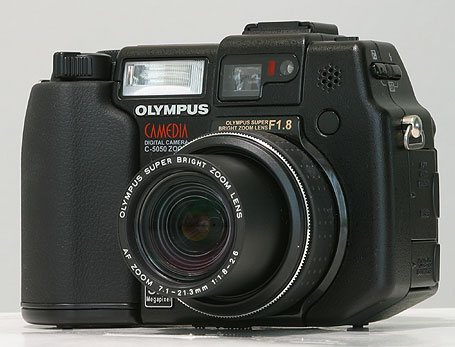
The Olympus C5050Z – a very competent camera for static recording, but useless for moving subjects because of horrid shutter lag

So it’s satisfying to report that Panasonic cured the issue in a point-and-shoot digital in the LX1. Unfortunately, they made two boo-boos. First, they never advertised this ‘feature’ which I discovered after much research. Second, they have just discontinued the camera. So if you want a fast, small digital point-and-shoot, now is the time to get an LX1. Read more by clicking on the ‘Leica DP’ entry on the left.

Meanwhile, kudos to the Wall Street Journal for good reporting.
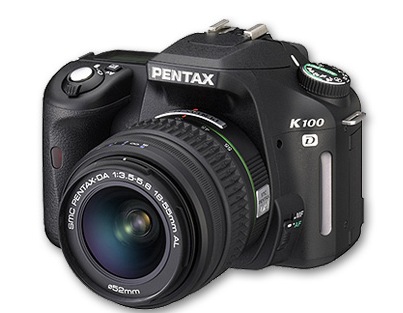
Pentax does it right

How vibration reduction should be done

I have made no secret of my admiration for the camera designers at Pentax, having owned a Pentax ME Super and a Pentax 6×7 over the years.

The ME Super was my New York street camera during the years 1980-1987, when I lived in what was then a pretty dangerous New York City. Not caring to lose my Leica M3 to a chain snatcher, I acquired an inexpensive ME Super and a couple of lenses – a very compact 20mm ultra-wide, a 28mm wide and that miniscule 40mm ‘Pancake’ standard. A sweet outfit, with the added benefit of exposure automation.

The 6×7 represented my first foray into landscape photography and while it went off like Dirty Harry’s Magnum when you pressed the button, there was no arguing with the quality of the negatives that resulted.

The other day I was thinking about changes in camera design which made things so much easier for today’s picture taker. Small 35mm cameras, greatly improved film emulsions, ever better lenses and that sort of thing. But clearly digital imaging was the watershed that made everything much faster yet, to my mind, vibration reduction has saved more snaps from the reject bin than any feature since automatic exposure and focus. If your goal in life is big prints, then the old saw that the slowest shutter speed should be no slower than the reciprocal of the focal length for hand held pictures is simply wrong. You think you can get shake free pictures with your standard lens at 1/50th second good enough for an 18” x 24” print? I don’t think so.

I don’t know who came up with the idea of vibration compensating mechanisms and circuitry in still cameras – the Steadicam for film makers, after all, has been around for some 25 years, famously used by Stanley Kubrick in ‘The Shining’ in 1980 – but I was very conscious of its availability in some Canon lenses when I sprung for the EOS 5D. Most importantly, the ‘standard’ lens I chose – the 24-105mm ‘L’ – has this feature and it adds wonderfully to definition. Canon says it’s good for three shutter speeds slower than normal, meaning that the modest f/4 maximum aperture of the lens is not as limiting as you might think.

Similarly, my Panasonic LX-1 comes with Panasonic’s version of vibration reduction in a very compact package and Nikon has offered the feature on some of its more exotic lenses for a while. However, with both Nikon and Canon, the execution is not well thought out when it comes to their interchangeable lens cameras. The problem is that the vibration reduction circuitry is part of the lens, not the camera, meaning only certain lenses have it.

It took a smart designer at Pentax to finally get this right. His answer? Simple. Build the circuitry into the body, not the lens, which they have just done with the newly announced K100D.

In this way, any lens, however adapted to the camera’s body, benefits from this wonderful feature, and you don’t have to double up on lens bulk as no lens contains any related mechanisms or circuitry. Now is that clever or what?

Fun with the B&H catalog

Everything under the sun in one big book

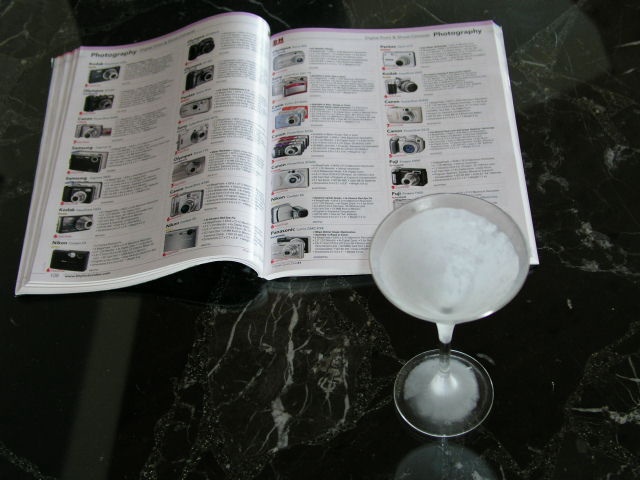
Say what you may, a notebook computer cannot hold a candle to a book when it comes to browsing. Spill your cocktail on the former and you have just had a $2,000 drink; spill it on the latter and you come back to read a slightly crinkled copy tomorrow. Make the cocktail a gin or vodka martini and your carpet will never know the difference.

So when B&H, that estimable New York City business, sent me their big book of photo and related equipment, it was rather fun to browse it in book form rather than searching for something on a computer. Best of all, with a book you come across things you would never think of browsing for at a keyboard, because it would simply never occur to you to look for them.

I suspect B&H sent me the book because I blew all that cash on the Canon EOS 5D a while back, and more power to them. I cannot think of another business with such integrity and client service, and I’m not even Jewish!

So what interesting items are of note browsing these 322 pages? Well first of all, kudos to the team that puts this monster together. With some 15-100 items a page you are talking a lot of work here.

There are sections on everything from Audio/Visual, Computers, Lighting, Photography of course, Podcasting(!), Portable Entertainment (meaning iPod mostly), Satellite radio (where you can get to listen to potty mouthed smut and pay for it), Hard Drive storage, Surveillance Video (honest!) and many more. Here, in no particular order, are some items that caught my eye:

Stupidest, most over-priced item: Easy – page 128. A company named Visible Dust is asking $90 for an ‘Econo Sensor Brush’. No kidding. $90 for a brush. And that’s for the ‘Econo’ model. The Real Thing is $135. Go to the local art store, get a nice camel hair brush, soak it in your vodka supply to clean up any grease, and you have the same thing for $5. A fool and his money…. If things go really badly at the old estate I think I might start selling these. Mine will be the Organic CCD Rendition Improver with French Vodka Enhancement for a mere $75, or a Special on three for $125. The Special would include a bottle of Grey Goose (“A lifetime supply of brush cleaner for you and everyone else in your county”).

The thing no one needs: Page 129. The Zeiss Ikon rangefinder body for film at all of $1,617. True, it makes the Sensor Brush look cheap.

The camera you thought they didn’t make any more: Page 135. A Linhof 6×9 view camera, no lens, for $7,964. Probably made in China, anyway. You can get two EOS 5Ds for that price and have money left for a couple of top notch Canon ‘L’ lenses. Plus your snaps will be sharper.

The truly funky: Page 172. The Sea & Sea marine housing for the EOS 5D, a tad pricey at $2,600. Keeps things dry, I suppose, but what do you do about flash?

The ‘I wish I had one’ item: Page 190. The QT Quick Truss system. No, not for hernia, rather an electric roller system to move your studio backgrounds into place. A bargain at $1,839 for the biggest size, some 11′ square. OK, so maybe it is for hernia after all.

The $300 a fyard tripod: Page 165. $900 gets you the Gitzo Giant which elevates to all of 91.3″. Now that’s tall.

A close runner-up to Visible Dust: Page 267. How about shelling out $290 for a Tecnec LED clock/timer, with 4″ high digits. Let’s see, you can get 20 of those at Target for that amount.

The greatest bargain: Page 286. $22 gets you 50 JVC blank DVD, or 235 gigabytes of storage.

The ‘What were they thinking of?’ award: Piece of cake. Page 305. A gorgeous pair of Leica binoculars, watertight to 16.4 feet (no, not 16.5). $1,795. Ok, not chump change, I grant you, but we are talking Leica glass and my much older Trinovids testify to the sheer pleasure of using such an instrument. But wait. The description goes on to say “Elegant Black Leather”. In a waterproof binocular? Please….

Biggest choice in one category: Well, there are no fewer than some 150 digital cameras listed, from a 3 mp P&S to the mighty Canon 1DS Mark II N with its 17 mp.

“The item I was happiest to sell” winner: Page 143 – the Nikon Super Coolscan 9000 ED film scanner, for $1,900. A horrible use of dollars and desk top space. Hasta la vista, baby.

The “Haven’t you heard of full frame digital, bozo?” award winner: Page 143. The grandly branded Hasselblad Imacon Flextight 848 Drum Scanner, for $14,995. Yes, $14,995. It’s not made by Hasselblad, it’s not a drum scanner, and what the hell is your time worth anyway?

The “No one told me the sixties were over” champ: Page 162. The Cokin #201 Multi-Image filter. Pass the bong.

The gooks only special: Page 213. The Sony Indoor Pendant Mount Housing with Power, the better to hide your spy camera in. $330 for a box and cover. Just don’t ask the CIA for installation instructions. They pay $5,000 for theirs, yet still manage to place them on the wrong continent.

The “What the heck does that do?” gadget: Page 246. The Electrosonics Digital Hybrid Diversity Receiver. Sinister. No price listed. Could this be the answer to getting all those losers off the street in the interests of diversity rather than survival of the fittest? Naah. Probably another CIA budget boondoggle. “Hey, Joe. Check this out. I can get dirty pictures on it even in this lead lined room”.

The “I wish I had one even though I have no earthly use for it” gadget: Page 258. The Sound Devices Portable Digital Recorder with Time Code for $2,375. Shades of John Travolta in ‘Blow Out’.

And I’m just getting started. Anyway, it beats watching some dope read the 6 o’clock teleprompter, laughably masquerading as ‘The News’, while making $15mm a year and being revered by all as an Influential Voice. Reading a Teleprompter….

The designer as star

It’s great to see the designers of innovative producets credited

Panasonic will soon release their L1 interchangeable lens SLR to market. The camera is notable for a couple of things. First, there’s the compact Leica M ‘look’, owing to the flat top, the result of using a mirror and prism design pioneered by Olympus in the brilliant Pen F half frame some thirty years ago. Second, the continuation of the Panasonic-Leica collaboration with the Panasonic vibration reduction system integrated into the ‘standard’ Leica zoom lens.

The last time I remember this sort of thing was when the inspired designer of the jewel-like Olympus Pen F and OM1 cameras, Yoshihisa Maitani, was featured prominently in advertisements, also some thirty years ago.


Maitani.

Noise

Shutters are all over the board

Over the years I have owned cameras from across the noise spectrum, by which I mean the noise the shutter makes when it’s tripped has varied from near silence to cacophonous. From a gentle whisper to a metalllic explosion.

For the most part, it’s fair to assume most photographers would agree that noise is not a good thing. Not only does it distract and cause vibration, there’s something just wrong about it. It’s in our genetic make-up. Why do you think the costliest real estate is invariably in the quietest locations, be it Fifth Avenue mansions with one foot thick stone walls or the sweeping estates of the Bel Air with the nearest neighbor hundreds of yards distant?

Silence, then, is a premium priced attribute, yet that fact seems to have escaped many camera manufacturers. Thinking back, the large Pentax 6×7 I owned years ago had the most wonderful lenses, yet the only truly sharp results I obtained from it were when it was used with a studio flash, with which it unfortunately synchronized at very low speeds. The problem was that tripping the shutter set off an explosion so loud, that people a hundred yards distant would duck for cover wondering which cowboy had come to town, guns blazing. So nice as that big negative was, and it fit 16″ x 20″ paper near perfectly, the camera had to go. The ten explosions a roll plus the onset of carpal tunnel from trying to hold this beast to eye level, not to mention hearing problems, were simply too much.

My large format gear is at the other end of the noise spectrum. In fact the lens shutters are so nearly totally silent, an illusion enhanced by the distance of the shutter from the operator and the huge space between lens and film which acts as a baffle, that sometimes I wish the shutters were a tad louder. Take the time I was photographing by a waterfall. Did that shutter trip or not? In other words, a crucial element essential in the design of all machines, feedback to the operator, is missing. It’s the same problem that makes using a silent keyboard so difficult.

Engineers will point out that noise is not just sound. Rather, it’s a collection of sounds of varying frequency, volume and duration all mixed together. So while I have no idea what the optimal mix is, I do know that higher frequencies are not a good thing as they tend to amplify the apparent noise too much. On the other hand, too much low frequency sound, is just as bad. As it takes far more energy to generate a loud low frequency sound than a loud one of high pitch – compare a cello or double bass to a violin – too much of the low stuff means something is moving hard and fast. Like a mirror thudding into a frame, protected only by a strip of neoprene. That spells vibration.

The second noisiest camera I ever owned was the Rollei 6003 medium format single lens reflex. What with the large instant return mirror, the electrical diaphragm and the motor yanking the film to the next frame, you could not be inconspicuous using one of these beasts. Rollei must have done something right with damping and vibration control, however, as even images at 1/15th or 1/8th second on a solid tripod showed no blurring from camera movement. And as a studio camera par excellence there’s an argument to be made in favor of noise as the subject knows that the picture has been taken. There’s that feedback thing again.

The Nikon F wasn’t bad. Like everything else about the camera, the noise was purposeful. No nonsense. “Built to last” was the thought that came to mind when operating this brute of a camera. The Leicaflex SL that succeeded it in my tool kit gave the exact opposite impression. Tinny, limp-wristed, you always wondered how long things would last before the next trip to the repair shop. Quite a contrast to the magnificent solidity of the lenses.

The screw thread Leicas rangefinder were always far noisier than you expected. While their “clack” was not that obtrusive, it hardly meshed with the Leica’s reputation as a stealth camera. The M3 and its successors were superior, though I always wished they were quieter, especially with that irritating shutter bounce on 1/15th and 1/30th, which every mechanical shutter M has had. The best in this regard was the M6 I used for several years which had a zinc top plate replacing the brass in the M2 and M3. Brass is ideal for chrome plating, but my M6 was black, so zinc was used as a cost saving. That camera had a beautiful shutter sound, sadly not matched by its build quality which was dramatically inferior to the M2 and M3. Plus the quick jam loading system was an absolute catastrophe – you had to crimp the film end to ensure it did not slip out of the stines meant to grasp it. So the M6 moved on, but not on account of its shutter sound. With any mechanical Leica M (I have not used the electronic M7) you get wonderful tactile feedback from the shutter release, to the extent that you know exactly how much pressure is needed to trip the shutter. Worth its weight in gold, whether on the street or in the studio.

The Canon EOS 5D is nothing to get excited about either way. The timbre of the noise is not objectionable, the volume is middle of the road, but you are going to be noticed when you press the button. For an electrical release, feedback is not bad. The first pressure to lock in focus and exposure is easily distinguished from the second which releases the shutter. There’s not that progressive feel of the Leica M’s shutter release, but it’s a worthy effort.

Setting aside the minority audience for large format cameras, the two quietest shutters I have used were from opposite camps. The one on the Rollei 3.5F was purely mechanical and wonderfully quiet. Feedback was not the greatest, not helped by the awkward location of the button, but it was a joy to use and hear.

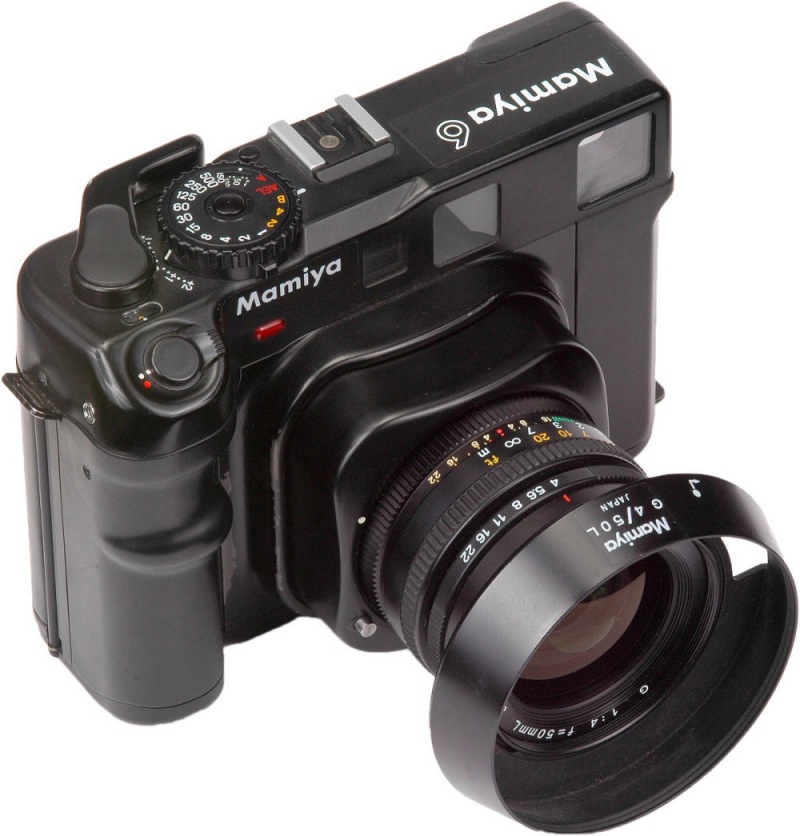
The other was in the Mamiya 6, also a medium format camera. This one is purely electronic, the shutter release is actually an electrical switch, with all the challenges that poses for feedback design. Owing to an absence of a flapping mirror and the use of between the lens shutters, the camera was simply wonderfully quiet and what you did hear was just right.


Mamiya 6. Noise? Just right.

Before closing, I have to say a word about the shutter in my Olympus 5050Z point and shoot. Near silent, Olympus felt obliged to add an option of an electronically generated shutter sound. This emanates from the camera’s speaker after the shutter is pressed. Unfortnately, it comes so late that it’s tomorrow by the time you hear it. Add the huge shutter lag and you have an example of how to get it dead wrong. Needless to add, the shutter release button has such poor resistance design that accidental exposures become the order of the day. At least you can switch off the electronic shutter noise.

So, camera designers, in my next camera I would like the sound of the Mamiya 6 with the tactile feedback of a Leica M2 or M3, with some of the overtones from the M6 for reassurance. The gun makers can use the Pentax 6×7 and Rollei 6003 as reference for their latest efforts. And the people at Olympus have some learning to do.