Category Archives: Cameras

Things that go ‘Click’

Choices

They will always be limited at the top.

Reading the other day that Konica/Minolta had given up making cameras I started getting worried that we are headed for a world with too few choices when it comes to manufacturers of photo gear. Competition improves the breed, after all. Then a few moments of reflection suggested that maybe there never has been more than a very small handful of choices when it comes to the best of the best. What the pros use.

At the start of the second World War, your choice was 35mm or medium format. Sure, large format has been around for a hundred or more years and soldiers on today, but it’s hardly a product with what you would call critical mass. In 35mm it was the world of the rangefinder – meaning Leica or Contax. The Contax had it all over the Leica, more sophisticated in every way, but damned by a fragile shutter mechanism. Leica countered with a great shutter and maybe the worst viewfinder/rangefinder yet invented. In medium format there was no choice. It was Rolleiflex or nothing. Now little about twin lens reflex design makes sense, but it worked, had great lenses and a negative big enough that even the average duffer could make a decent 8″ x 10″ print.

In film the choice was greater – Kodak, Agfa, Ilford, Perutz, Adox – all made great monochrome emulsions and Kodak, of course, was working on Kodachrome. Two violin players, the Leopolds – Mannes and Godowsky – were locked in a lab by the boys in Rochester and emerged a couple of years later with Kodachrome, rated at all of 12 ASA. Just in time for the film to be used by Nazi photographers to record Hitler as he set about destroying the great race whence these two geniuses of chemistry came. If the Leica was the greatest camera of the century, and it was, then Kodachrome owns a similar place in the world of film. Kodachrome was simply fabulous. Without it 35mm color photography would not have blossomed the way it did.

In the early fifties Leica finally made the single greatest 35mm camera of all time. The M3. Learning from the Zeiss Contax that integration of the viewfinder and rangefinder into one eyepiece might just be a good idea, and that making the thing bigger than a pinhole could be a selling feature, they added a wonderful, sharply delineated rangefinder rectangle and those projected, illuminated, nay, electric, field of view frames that left you in no doubt whatsoever as to what your lens was seeing. And you could use that viewfinder in almost non-existent light, focusing and framing with the utmost confidence, taking your picture with the near silent whisper of the Leica shutter. They didn’t stop there. They crafted what remains the greatest 35mm lens made. The 50mm Summicron which remains, to this day, the standard all Japanese manufacturers aspire to. This pairing was a high point in engineering aesthetics and optical design.

The M3 and its descendants lasted in the pro’s gadget bag through the mid-sixties when machismo dictated long lenses and brutal looks. The former to avoid the bullets, the latter to state unequivocally that your camera could double as a weapon in time of need. The smart people at Pentax may have invented the instant return mirror, but the Nikon F was the camera of the Viet Nam generation. Its brute good looks, augmented by the equally masculine finish of the lenses, said you were the Real Thing. Pentax was not to be outdone, however. They started painting their cameras black and had the smarts to give a few to a London fashion photographer par excellence named David Bailey. In stark contrast to the stodgy, patrician, epicene Beaton, wedded to his Rolleiflexes and his Royal sitters, Bailey rocked. He was a real man. Pentax pushed it. They ran one of the greatest camera ads ever. It showed a beaten up black Spotmatic, brass wear spots everywhere, with just three words. David Bailey’s Pentax. Wow! Here was a guy slogging it out in the studios of London with all those dolly birds and clearly having every bit as tough a time of it as the fellows in Nam with their Nikon Fs. Years later, Bailey admitted he had taken sandpaper to his Spotmatics and rubbed the paint off at strategic locations. It got him a lot of dates. Not bad for a few bob and a couple of minutes of elbow grease, huh? So in the ’60s your choice in 35mm was Nikon or Pentax.

David Hemmings played Bailey in Antonioni’s wonderful movie ˜Blow Up”, though his weapons of choice were a Nikon F and a Hasselblad. Change in the medium format world was slower than in the frenetic corner known as 35mm. At least you finally had a choice. It was no longer just a clunky twin lens reflex Rolleiflex. Why, the Hasselblad, scarcely more competent, said you had arrived. Because you could afford it. OK, so the viewfinder was lousy and the mirror did not return after you pressed the button, but good marketing saw to it that you did not notice.

Enter the seventies and eighties and Canon began to get noticed. They could not compete with Nikon or Pentax for charisma, those marques having earned their stripes in the hellish fields of Viet Nam and Carnaby Street. So they had to sell something else. And that something was technology, backed with abundant capital. Fast, small motors to move the film? Of course. Coreless linear motors to focus the lens? Naturally. Fast sensors to provide autofocus? Absoluement. Eye controlled focus? Well, we did it just to show that we could. Suddenly the competitors were rocked by this Japanese copier-making powerhouse with seemingly infinite resources, and they have been playing catch up ever since. But the old rule prevailed. In 35mm your choices were few at the top. Canon, Nikon, and maybe Pentax.

In medium format, the old guys were still at it. Rollei came out with a camera that four people bought, the SL66. Its huge mass and focal plane shutter which hated working with studio flash made sure that no one bought it. Zenza came out with something even worse, the Bronica, which jammed as soon as you looked at it. They had taken the worst of the Rollei and made it …. worse. Working photographers preferred proper flash synchronization and bought a Hasselblad. Rollei fixed that deficiency with their wonderful 6000 series of medium format SLRs, but it was too late. Traction had been ceded to Hasselblad. The Hasselblad may have been horribly unreliable but it was glamor personified. Plus it shared Rollei’s great German lens providers. An entry ticket to the world of Madison Avenue. So, like a Jaguar owner, you bought two hoping that one would survive while the other was in the shop.

Then in the ’90s, digital arrived. No matter that the first efforts were comical in the extreme. Digital was Now and the old protagonists, Canon and Nikon, were at it again, followed by a somewhat breathless Pentax. The latter had one thing the two others could never understand. The word ˜elegance” is part of Pentax’s genetic make up, a concept that never graced the worlds of Nikon and Canon. Olympus gave Pentax some competition when it came to chic design but let’s face it. What self respecting, red blooded American male was going to be seen with his wife’s camera? David Bailey’s Olympus? I don’t think so.

So, once again, choice was limited. Sure, you could have flirtations with minority brands like Minolta or Konica, but it was always rather comical to see the poor photographers using this gear. Like the people who were buying Saabs, hoping they would be sufficiently different that the downright horribleness of their choice would qualify them as eclectic, independent, thinkers. Wrong. They just didn’t get it.

Meanwhile, digital completely bypassed the medium format boys during this decade, and they will never recover the lead established by the big Japanese houses. When full frame digital beats medium format film, why would you blow $15k on a digital back for your Hassy when you could get a couple of Canon’s best bodies for the same coin and have something reliable to boot?

Leica? While issuing quarterly denials of impending bankruptcy their apparent goal is to sell only to Japanese collectors and tax exiles in Geneva. So you can’t have one. Settle for a Rolls or Bentley instead.

Film, meanwhile, had gone the way of Contax and Yashica and Konica and Minolta. The choices in color were now down to just two – Kodak and Fuji. The latter may have done a number on the former, taking away market share daily, but it’s all history now. Neither will be making color film by the end of the decade.

So there never have been that many choices at the top. Today it’s Canon or Nikon. Pentax for those willing to be different. And for medium format it’s Hasselblad digital, but who knows how long that will survive. And no one needs film.
Upstrap in action

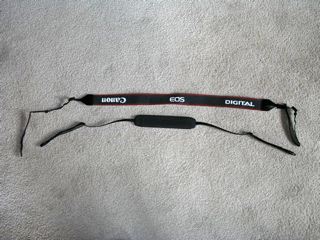
Goodbye to the garish, inept horror story that is the Canon strap.

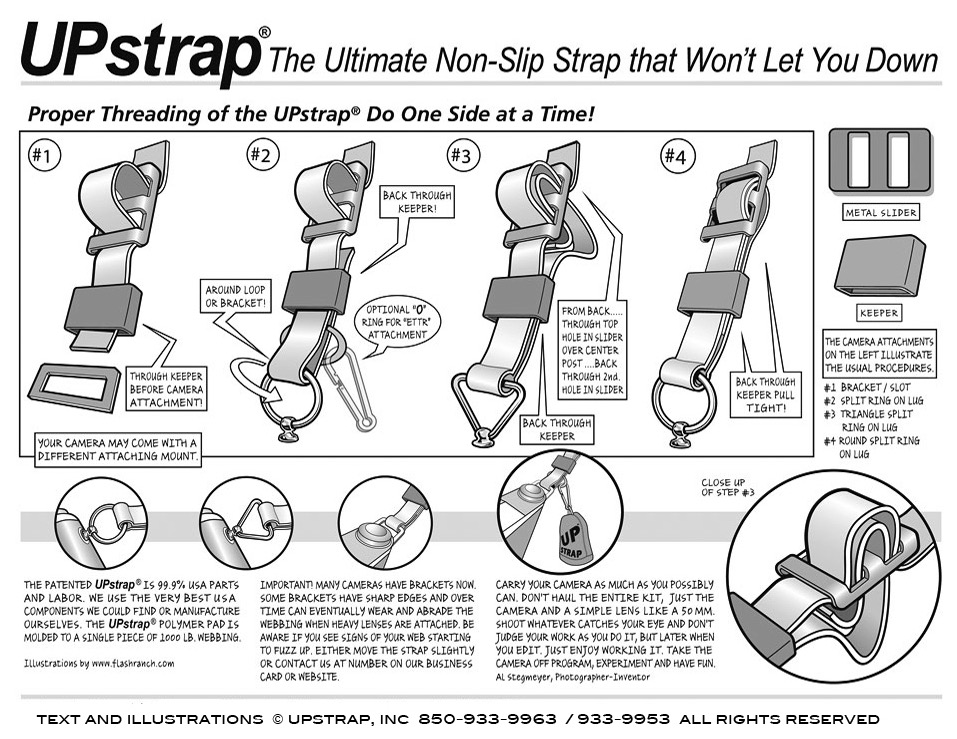
Here you can see what I am going on about – fancy being a walking billboard for Canon? Heck, I just paid them nearly $5k for the gear – if they want me to wear that, they need to pay me. Plus free repairs for when it slips off my shoulder. The Upstrap has a broad rubber pad with nipples on both sides. It is far more comfortable and simply does not slip. This is the SLR model for cameras over 2.25 lbs. I used to use the lighter RF/DC variant on my Leica M2 and M3.

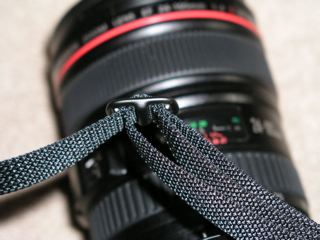
Here you can see how it is threaded so that the ‘tail’ can be folded in between the two sides and retained by the slider. Neat.

Recommended without reservation unless, that is, you prefer gold chains displayed on your chest.

Here are the detailed instructions – there are many incorrect ways to install one of these and one correct one. Follow these instructions and the strap cannot become detached from your eyelets:

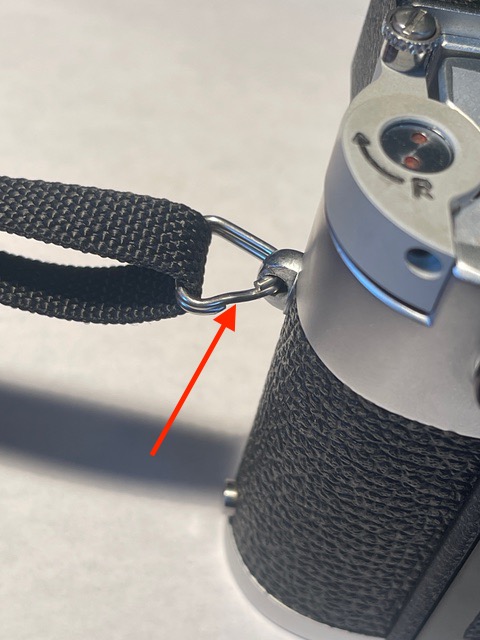
When threading the strap through triangular keepers be sure that its surface contacts one of the two non-opening sides, as the sharp ends of the latter can gradually wear through the strap material. Triangular split D-rings are far better than circular ones as you cannot prevent the opening area rubbing on the strap’s material with those.


You do not want the strap in contact with the arrowed side of the D-ring.

Hurry. It’s almost over.

Don’t emulate the Poles in 1939

I can claim some authority in writing about the ostrich-like behavior of my noble Polish ancestors in 1939. You see, my ancestry goes back for more centuries than I care to admit in that most conquered, yet most proud, of nations. When I was growing up, I looked around, and once old enough to appreciate these things, I realized we were poor. Why so?

That was in London. Back in 1939 when the Stukas threatened and the Panzers loomed and the Polish army prepared to charge on horseback, my parents placed all their valuables in a safe in Warsaw. You might well question this asset diversification strategy when the most powerful, aggressive nation known to man was massing on Poland’s borders. I hold no rancor for my parents’ behavior. Hindsight tends to be perfect and if I could only get the Wall Street Journal a day or two early, place just a couple of hot trades, I would be writing this from my Gulfstream private jet. It happened. Get over it.

My parents, of course, were in deep denial. After all, how do you move 15,000 acres of some of the most beautiful land man has seen? Deep denial. Like modern users of film.

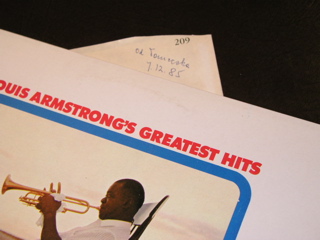
To get in the mood for this piece, I thought I would turn on an LP, for old times’ sake. They do sound good, we all know that. If you can disregard the scratches, the click and pops, the cleaning ritual and on and on. So I pulled an old Louis Armstrong number out and it’s playing as I write. There on the inner sleeve, forgotten, was a lovely note from my dear departed mother to herself. She wrote ‘od Tomeczka’, meaning it was from me. I had given her this LP on December 7, 1985.

So what has all this to do with photography?

Well, that little note on the inner sleeve of the 20 year old LP speaks to obsolescence every bit as much as film speaks to the sea change in photography. Like Proust’s madeleine dipped in tea, it brought thoughts of the need for change flooding back to my brain.

Like most of us, I have been forced to change. LPs gave way to CDs. CDs eventually moved to the iPod, 300 discs in the space of a shirt pocket, fidelity uncompromised. The cathode ray tube gave way to the flat screen. VHS tapes moved on as DVDs came in. They must be due for obsolescence any time soon. How else are the electronics manufacturers going to stay alive?

And, like the aggressive German masses congregated on the border of my parents’ estate in September, 1939, that change is now rolling over the serious photographic world faster than we can begin to realize.

It started with the mass consumer. Easy prey for innovation, digital cameras were sprung on him seemingly overnight and, even if he still struggles to get the picture while squinting at the barely visible screen in broad daylight, the digital camera has become as de rigeur as the SUV. A staple of American life, meaning the rest of the world will follow in short order.

The professional press photographer got the idea three or four years ago when up-market SLRs started sporting acceptable definition and the city desk editor wanted to beat the competition with the latest picture of the celebrity of the day behaving badly. The studio and wedding professionals followed suit and Apple recently jumped on the bandwagon with software aimed solely at enhancing digital workflow with RAW files. It’s called Aperture. Some one third of the content in the leading Macintosh monthly, Macworld, is now dedicated to digital capture. Capture. That’s hip talk, I have learned, for snapping pictures.

The Art Photography set, however, held out, clutching their platinum prints to their troubled chests. Nothing can equal the quality of a darkroom print. Deep denial.

One second – I have to attend to my 80 year old technology and flip the LP after all of 20 minutes of playing time.

Well, I think the Art Photography set, while not wanting to admit it, is getting the idea. The last ball to fall.

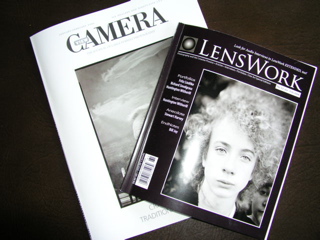
I subscribe to a couple of top quality photo magazines. Strictly minority material. LensWork and View Camera. They showcase fine work and offer a good reading of the pulse of the market.

LensWork has a very high opinion of itself, right down to its small size masquerading as Art. The magazine has very high production values. Printing is fabulous (as it should be for so small a format), writing is excellent, the whole thing reeks of quality. Until a couple of issues ago they refused to accept ink jet prints for publication! Suddenly, seemingly 50% of their content is all digital – camera and print – and the equipment, which they invariably mention, is pretty much at the consumer end of the spectrum, meaning mid-range SLRs and the like. Nothing like market forces. Needless to add, content is strictly monochrome. They say it’s for aesthetic reasons, which means they cannot afford color with their miniscule print run. No matter. It’s a fine magazine whose content always makes you think. It’s going digital fast.

View Camera, on the other hand must have either some of the most dyslexic, or most stoned, proof readers in the world. It reminds me of that old leftie standby of English newspapers, The Guardian, known to one and all as The Grauniad. Beloved reading of faded academics in tired tweeds who think fondly of Stalin as a great liberator. An issue of either VC or TG without typos is like a US Congress without crooks. But once you get past this slovenliness, you find a fine magazine with a balanced mix of the photographic and the technical. I just received the current issue and what do I find? Articles on digital backs for 4”x5” cameras! Reminiscent , it is true, of Lord Chesterfield’s thoughts on sex – “The pleasure, momentary. One’s position, ridiculous. And the cost …. damnable.” Now you not only have to lug the camera, lenses and tripod, you need a laptop computer, back-up hard disks, cables and a very, very costly digital back. We are talking the cost of a new car here. Of course you save the weight of all those film holders. Great. And if you use a scanning back every picture takes many minutes to expose. Go on line to one of the advertisers selling scanning digital backs and you find a comparison of full frame 35mm digital (meaning Canon) with scanning 4”x5” backs. Now is that defensive or what?

Another article in Veer Pamela, sorry, View Camera, speaks to ULF. That’s Ultra Large Format to the ignorant, meaning people silly or strong enough to lug around 8”x10” cameras so they can make contact prints from the negatives, allowing them to be printed smaller than actual size in photography magazines. No, I’m not kidding. These poor photographers pool their meagre resources (all that’s left after their chiropractors’ fees) to convince Kodak, Ilford et al to make just one more batch of 8”x10” or 16”x20” film. Please. Humor us. Just one more time. The fact that Kodak and Ilford even bother confirms that they both deserve to go out of business. You want to own stock in a company engaging in this sort of trivial pursuit?

Denial. My parents were graduates of the art. These fellows are post-grads. The only difference is they are not risking their lives.

Aargh! The needle on that LP is stuck again, right in the middle of Basin Street Blues.

Cameras and aesthetic design

Why are so few beautiful?

A friend kindly emailed me to alert me that a web chat board was offering a camera as a prize for the best picture taken in the style of Henri Cartier-Bresson. A worthy goal which will doubtless see some great work submitted.

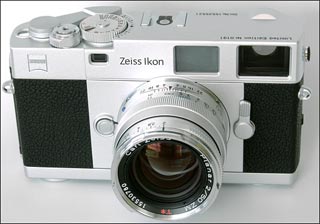
Then I got to looking at the prize and was struck by how inexcusably ugly it was. Going by the name of the Zeiss Ikon ZM, there is no other way to describe this brick than in one simple word whose meaning needs no explanation: Ugly. I was going to preface the U word with a vulgarity describing part of the anatomy, the bit you sit on, but good taste prevailed. You get the idea.

Equipment, it seems to me, is merely a tool to do the job, so dwelling on it to excess is not productive. But this kind gesture on my friend’s part, who suggested I should submit some of my street snaps to the contest, got me thinking about the aesthetics of equipment, or more specifically, why so little in the way of camera gear is remotely attractive to look at.

So, like most photographers, I thought about the equipment I have owned, have borrowed and have lusted after. And in the interests of keeping this piece upbeat, I will concentrate on the cameras my eye remembers as beautiful, a work of art to hold and use, rather than all the others. And that is important to me. The old saw that has it that a poor worker blames his tools has it all wrong. It should be that a good worker uses beautiful tools. You think Michelangelo and his buddies didn’t discuss paints, brushes and canvases? Sure they did.

So I won’t refer to the brutish ugliness of the Nikon F, nor the brick like facade of the Mamiya RB67, nor even the Leicaflex SL – a face only a parent could love – in this brief Statement of Preferences. And I will most certainly not refer to the Kodak Ektra.

The post-WWII list is, sadly, a short one.

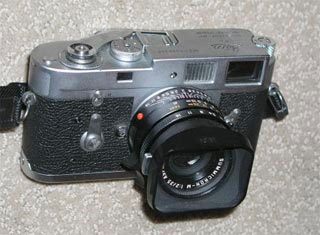
Headed, of course, by the chrome Leica M2. The most perfect blend of form and function ever designed. Color it black and you have nouveau riche – the young up-and-comer’s Porsche 911. Make it chrome and….aaahhh! Yes, this one is mine. With the wonderful 35mm Asph Summicron, no less.

But before that exemplar of taste and execution came along there was something equally fine to be had in the Zeiss Ikon Contax II and IIa. Forget the metered version with the ugly bump for the selenium cell meter. The un-metered camera was simply beautiful and aeons ahead of the cheesy looking screw thread Leicas of the time with their miserable viewfinders. A top hat compared to a cloth cap. Note the beautiful symmetry of the finder windows and the knobs, the gorgeous proportions of the body. You just must pick it up.

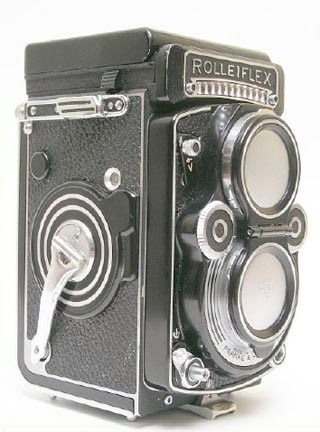
No Rolleiflex twin lens reflex can be left out of this reckoning with, perhaps the metered 3.5F at the pinnacle, the lens being just the right size for the body, something lost in the 2.8 variant. This one was mine until I gave it to a friend.

Whether it was because so many of the greats used it – Avedon, Penn, Beaton – or whether it had that secret something, call it balance, proportion, despite the rectangular shape, the Rollei is a beautiful camera.

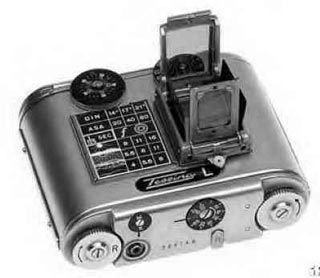
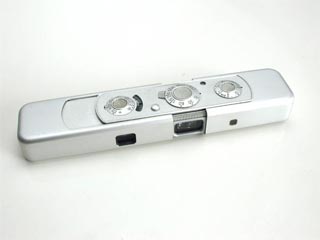
Some miniature format cameras had that something called beauty too. Two of the best were the Tessina and the Minox. Regardless of their clandestine Cold War role in life, these two, especially the watch like Minox, had the secret ingredient. Have you ever opened a Minox for action? Try it. Sensuality redefined.


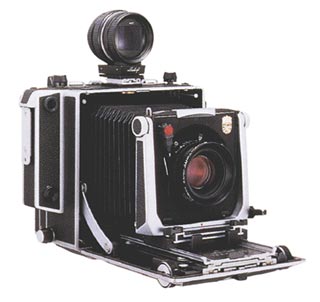
At the other end of the size spectrum, Linhof had what no American manufacturer could approach. A divine aesthetic sense. I won’t say anything about the Crown Graphic (heck! I own one) but just feast your eyes on this Super Technika.

Aaah!

Now that is a camera.

Now there’s a lot of German equipment permeating this piece. A nation that makes fine cameras and killing machines. But its eastern emulator, Japan, has had some pretty fine things to contribute to camera aesthetics too.

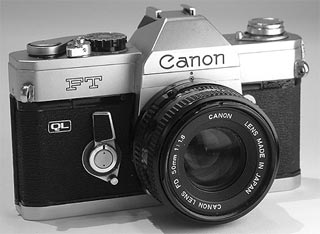
Take the fine line of early Canon SLRs. This is an FT. Note the finely sculpted controls and the general balance of the machine.

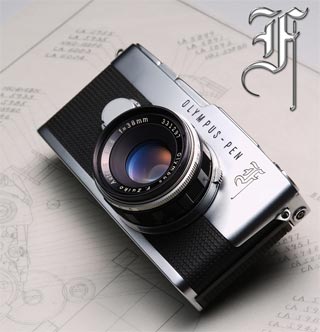
Olympus made a fine effort with the Pen F and even the bold gothic letter “F” seems to work well for this courageous, innovative design. A camera with a sweet, feminine grace, with a bold escutcheon. I loved mine. Wish I had never sold it.

They tried later to recapture the spirit of the Pen F with the OM1 but the magic spark was, alas, gone.

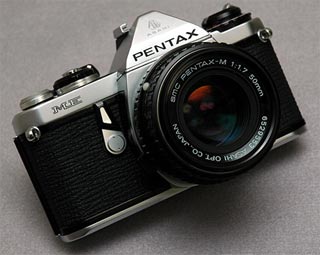
Then two really great Japanese designs come to mind. One very good – the Pentax MV/ME. Another camera with jeweled precision and an absolute joy to use. My ME Super fell apart but not before we had had the most wonderful relationship.

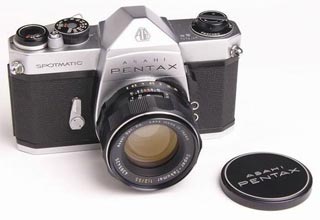
But their earlier Pentax Spotmatic was, after all, an impossible act to follow. Here was a camera that was a joy to behold. To hold. To use. Forget all that nonsense you read about the Japanese being imitators. Just take a glance at the raw sensuality of the advance lever. The most beautiful thing to ever grace a mass produced object. And note those angled “Zeiss” corners. The sincerest form of flattery is imitation. This was something that you would think should have set an example for the designers of the miserable looking Zeiss Ikon ZM, that execrable excresence passing for a camera. An example of which, sadly, they seem damnable unaware. As unaware as they are of their company’s glorious history of design.

The Photographer-Mule migrates up-market.

So you thought the nation with the largest contiguous border with the most successful, the most powerful, nation the world has ever seen, not to mention the most altruistic, had nothing to offer but cheap prescription drugs and cold winters?

Well, think again.

Dialing up the foul eBay the other day in search of a better price on a used LowePro Omni Trekker bag the better with which to carry my magnificent fifty year old Crown Graphic and its many film holders and accessories, I came across a Canadian vendor selling new versions at half the price of the ones available to those of us who count ourselves blessed to be Americans.

So I splashed out my $119 (US) and no less than five days later the new Omni-Trekker, or at least a very good rip off, tags and all, was on my doorstep.

My dog was happy, as it meant a cookie from the UPS man. I was happy as someone from Canada had actually shown some business acumen (we need all the friends we can get) and geopolitics was happy, reassured that maybe those neighbors of ours were not complete losers after all.

The point of this preamble, of course, is that humping the Crown over California’s magnificent landscape, rugged as the camera is, in an old LA Rams gym bag, the Linhof tripod carelessly slung in insouciant manner over the other shoulder, was not a prescription for longevity of either the equipment or the operator.

So on my 140 mile round trip trek to that Top Secret Highway One Location today, the casual observer would have spotted a rather well dressed gent, yes, Harris Tweed cap and all in deference to Her Majesty and our northern neighbors, sporting nothing less than a magnificent LowePro Omni-Trekker bag (or cheap imitation thereof – you decide) in backpack manner with Linhof tripod prominently displayed. Thank goodness for quick release straps.

It has to be said that this huge investment in carrying capacity and function paid dividends. First, in reducing the stress caused by its predecessor, the LowePro earned its keep right there. Second, in spreading the load over the body, sternum and waist, it made a damnable trek into something more resembling sheer bloody hell. A whole lot easier, in other words.

But. most importantly, this Canadian import made it possible to reach places heretofore unknown and that’s what makes for great photographs.

So if you don’t care how you carry your equipment, think again. Canada is not just a haven for those favoring socialized medicine. You can also get cheap camera bags there.