Category Archives: Book reviews

Photography books

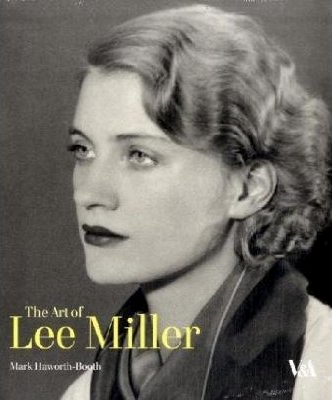
Lee Miller

A woman conquers a man’s world.

It’s hard to imagine being successful at any one of Lee Miller’s callings, let alone all three.

I don’t mean dilettante dabbling. I mean as good as it gets.

Famous model, surrealist artist, war photographer. Miller (1907-77) did all of these with aplomb and was at all times in the center of the action. Whether posing for Genthe and Stieglitz in her modeling days, making a career as a surrealist artist when married to Roland Penrose and living with Man Ray, or being the only woman war correspondent to set foot at the scene of the crime waged on mankind in Dachau, whence she reported and photographed for Vogue magazine, Miller was as good as they get.

This is a splendid book and highly recommended. When you read that Sir Roland’s son, Anthony, did not learn of his mother’s many accomplishments until shortly before she passed away – she didn’t care to speak of any of them – your sense of wonder and admiration for this very special woman only increases.

Her beauty needs no words. Her originality is there for all to see in her art works. And her heartbreaking reportage from the death camps is the sign of a supreme professional. After witnessing the SS torching Berchtesgaden, Hitler’s retreat in the mountains, she was among the very first to enter his Munich rooms and proceeded, in true surrealist fashion, to take a bath in his tub. As she explained – and there’s a picture of her in the act – she was washing away the evil which she had witnessed and photographed just hours earlier. Just ask, which of us would have had the courage to do that, given the chance?

All of this is expertly set forth by experienced art curator Mark Haworth-Booth in this simply splendid book. The extracts of her searing prose for Vogue are almost as powerful as her pictures, many of the latter so horrific that they never saw publication. Seldom have I read such a clear eyed exposition of the German people’s utter complicity in the crimes of their leaders.

A woman for the ages. Any photographer or historian with an interest in Miller’s era should read this.

Angus McBean

For Beaton fans.

For an index of all my book reviews click here.

An exact contemporary of Cecil Beaton, the great Welsh photographer Angus McBean chose to specialize in the theater whereas Beaton chose the more lucrative world of fashion and film. Yet a viewing of the less famous McBean’s work shows a level of sophistication and skill Beaton could never equal, whether it’s in the complex sets, creative posing or theatrical lighting.

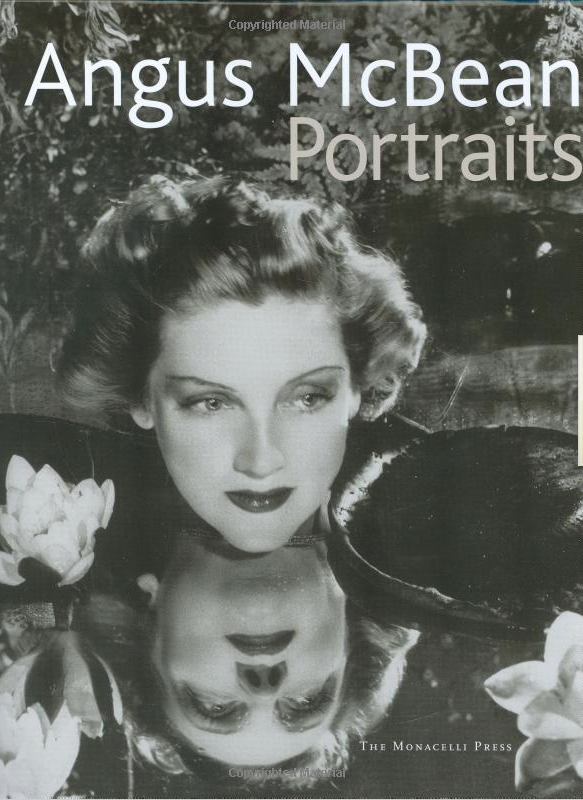
On the cover – Dorothy Dickson, 1938

This splendid book of McBean’s work shows not only his studio work but also includes an extensive collection of his self portraits which became his Christmas cards. It’s said that his picture of Vivien Leigh was the calling card that got her the role of Scarlett O’Hara and I can believe it. Adjusted for inflation, Gone With the Wind is still the top selling movie ever.

McBean died in 1990 and you can find a fine review of his life and work in the London Times here.

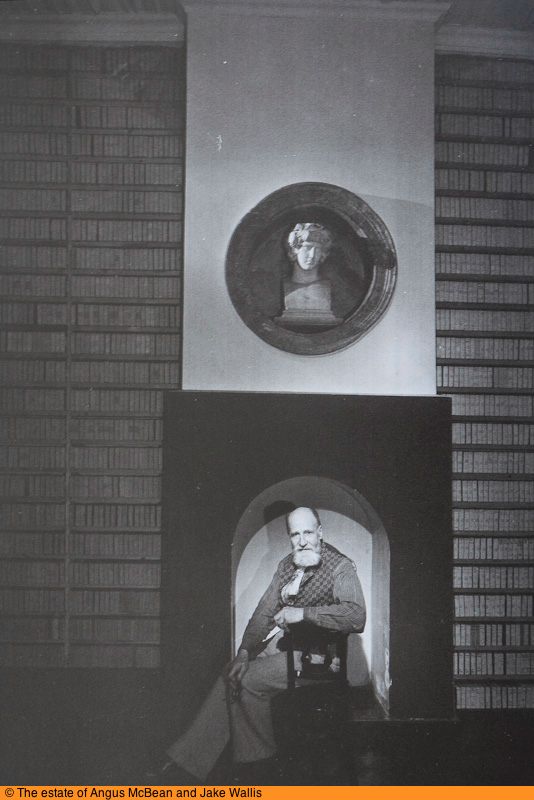
The book is splendidly illustrated; you can get a sense of the man from this Jake Wallis portrait of McBean in his very severe looking library, complete with some 40,000 glass plates of his life’s work:

Norman Parkinson: Sisters under the Skin

Another Parkinson for the library.

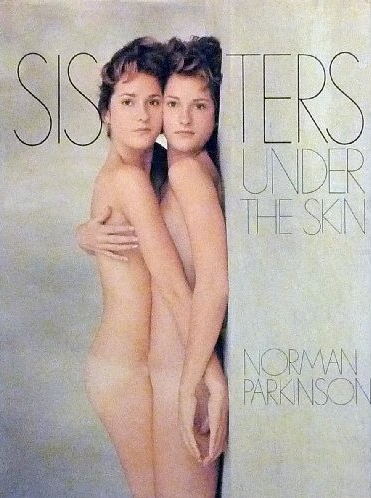
If I make mention of Norman Parkinson yet again it’s for the simple reason that a friend gave me her copy of Parkinson’s first book, Sisters under the Skin, for Christmas.

The sensationalist cover notwithstanding, the contents show Parkinson at his very best. Simply stated, Norman Parkinson is the Renoir of the camera and, mercifully, there is no recourse to black and white for its own sake. I increasingly think of black and white as an excuse sought out by photographers who are struggling with mediocre color material. When Parkinson uses monochrome it’s because it’s the right thing to do.

You see women in all their glory and infinite variety here. Iman with an impossibly long neck, a slutty/sultry Bianca Jagger, Elizabeth Taylor – never more beautiful, an equally lovely Lesley-Anne Down rendered in pastel tones, and a simply charming portrait of the Queen Mother, warm and tender. There’s Twiggy at the height of her fame, Princess Anne very much in charge of her (charging) steed, and that fabulous Van Dongen out-of-focus book cover you will see if you click the link above, from Parkinson’s book ‘Portraits in Fashion’.

This book is enhanced with short stories for most of the pictures, my favorite being the Marisa Berenson one where some crass git remarks “Goodness, your backside is collapsing like Mahtma Gandhi’s dhoti” to which the superb Marisa replies “Who’s she?”.

Wenda Rogerson (Mrs. Norman Parkinson) makes a spectacular appearance in perhaps the warmest photograph in a book suffused with warmth – you can also see her by clicking the link at the start of this piece and, yes, she hangs on my wall to this day. My, even Barbara Cartland looks half human in Parkinson’s hands, layers of make up or not. The only question which constantly comes to mind is how could an Englishman be, well, so Italian?

Very worthwhile searching out on the used market as it’s no longer available new.

Angel’s World

A driven man.

For an index of all my book reviews click here.

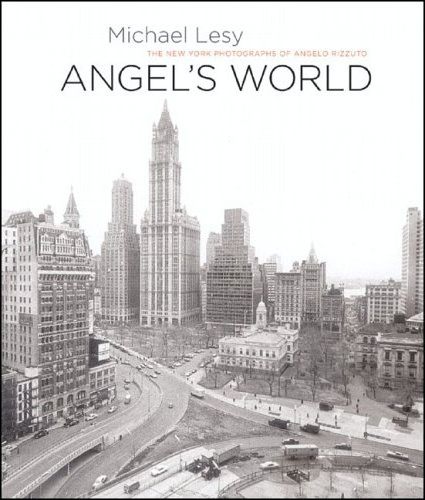
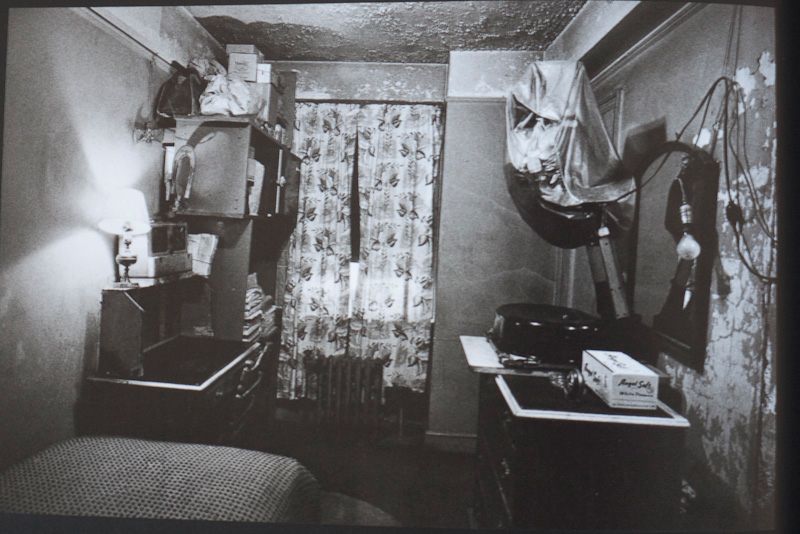
Angel Rizzuto lead a troubled life. Despite substantial wealth he spent the last years of his life in a seedy single room apartment in New York, whence, from 1952 through 1966, he emerged daily to record the city and its people. Returning, he would put up the window blind, get out his chemicals and process his pictures. Twelve pictures a day for fifteen years …. he had found his calling.

His legacy consisted of nearly 1,700 contact sheets, some 60,000 images in all, which he left to the Library of Congress along with $50,000. Michael Lesy has done an outstanding job reprising the life of this troubled man and his strange quest for immortality.

It’s hard to know how you decide which one hundred or so pictures to present from a lifetime’s output so huge, but the ones beautifully reproduced here are seldom happy. Troubled people on the street, mostly women, and recurring self portraits of the unsmiling photographer. There are occasional bursts of lyricism like the small girl with her poodle (p. 83) or the painter in Central Park (p. 63) but by and large this collection will make you frown rather than smile.

Imagine living and processing all your pictures in this:

Angel Rizzuto’s home and darkroom.

Simultaneously troubling and inspiring, a great tale of one photographer’s odyssey, this book is highly recommended. A related New York Times article appears here.

John Phillips

A great LIFE photographer.

By 1965 television had replaced LIFE as the primary source of news for households. LIFE folded soon after. Yet the weekly, created by Henry Luce in 1936, once enjoyed a circulation of over 13 million, and it was during those years that John Phillips worked for the magazine.

I confess that when I first saw this massive tome, all 572 pages, I was immediately reminded of the great American novel – something seemingly devoid of any editing and consequently tedious and boring. Nothing could be further from the truth in the case of Phillips’s illustrated autobiography where the writing simply sparkles.

Phillips (1914-1996) worked for LIFE during the years 1936-1959, where his career included publication in the very first issue. As a child at school, when asked what he wanted to be, the unquestioning answer was “I want to be a photographer when I grow up” and that is what he became. With a Welsh father and American mother, born in French occupied Algeria, it’s no wonder he had wanderlust. His travels took him to most of the trouble spots of WWII and, as he worked in the days when photographers did the words and the pictures, the standard of writing in his book is exceptional. You are always left wanting more and the book is a real page turner.

Some extracts:

Four days later we put into Port Taufiq. The authorities there were surprised to see us. We had been reported sunk by the Germans. Leaning over the side of the ship waiting to disembark, I reflected there was no satisfaction in photographing a munitions ship. If nothing happened, you had no story. If something did, you had no photographs.

* * * * *

Taking advantage of our conversation, I asked Mr. Kram (Churchill’s aide) about the Prime Minister’s drinking habits. “He never has a drop of whisky before 9 am” Mr. Kram said. “And before that?” I inquired, half-seriously. “Vermouth”

* * * * *

The King (Farouk of Egypt) and Queen’s private apartments were crammed with Louis XIV and Louis XV furniture. Seen ‘en masse’ it went a long way to explaining why the French Revolution came with Louis XVI.

* * * * *

Curious about the novelist (Evelyn Waugh), I joined him on his constitutional. He talked about education. “My father was better educated than I am, and I am better educated than my son.” This he put down to the decline in Greek studies. “What about engineering?” I asked. “Do you expect my son to be a taxi driver?”

* * * * *

Well, now you know why the British Empire collapsed.

While out of print, the book is readily available on the used and remaindered market and if you like good writing by a photographer who was there when history unfolded, you should pick up a copy. Some of the pictures are pretty hard to take – especially the ones of German atrocities in WWII – but Phillips never pulls his punches.