Category Archives: Photographers

Must quality pay?

The best succeed

Let me preface this piece with a childhood story. Mine.

Like you, the first music I recall was the result of my parents’ ancestry, upbringing and beliefs. That meant a strict diet of Beethoven and, as a true Pole, Chopin. There was no choice in the matter and, candidly, I had no clue that anyone else even wrote music. Modern beliefs would damn my parents for this exclusionary tactic but I think they are wrong. Consciously or otherwise, I was being exposed to the best of the best. That leaves an awful lot of grey matter free for the dull realities of making ends meet.

To close that little episode, let me just add that the very first music I remember from my childhood – maybe 5 at the time? – is the Eroica. Talk of starting at the top. No two chords in music anywhere rival the hammer blows at the start of the symphony, proclaiming simply that the future starts now. Bach, Handel, Scarlatti – none of that really matters any more. So yesterday. Western music is easily divisible into three eras. Before-Beethoven, after-Beethoven and Elvis. And it emboldens me not a little to add that I got my old mum to listen to The King when she reached 80, and she proceeded to tune him in for the last seven years of her life. That’s what I call an open mind!

So quality in composition – be it musical or photographic – makes for a very short list of ‘great’ composers. When did you last listen to Jean Baptiste Lully, the darling of his age? Exactly. Or adulate those bloody awful baby pictures Aunt Vi just snapped, with quantity and her waistline indistinguishable, on her new digital?

Which, somewhat circuitously, brings me to my point. If we listen to just a handful of composers and look at the work of just a few photographers, are we denying the existence of a broader reality, an undiscovered ocean of quality, or are we simply being smart in our selectivity?

I think it’s the latter. I look at the work of thousands of unknown photographers during the course of a year, yet I recollect the images of one or two. I will seek their work out as time passes. Without exception I am sure they will become famous, being beyond secure in my taste – which extends to sending rude notes to morons who email me with detritus passing for comment. If you don’t like what you are reading here, please take a dump elsewhere.

So.

You have to be famous to be good.

HCB was famous and we saw he was good. But had he not made efforts – strenuous efforts – to become famous, we would not know whether he was good. I cherish the work of very few other photographers. Not because I am being exclusionary, but because I have seen the work of most and I know quality when I see it. There is no need to go down market.

Horowitz played like a God. Maybe not the way Chopin played, but the way he would have been amazed at. I listen to very few other pianists. Not because I am being exclusionary, but because I have heard most and I know quality when I hear it. There is no need to go down market.

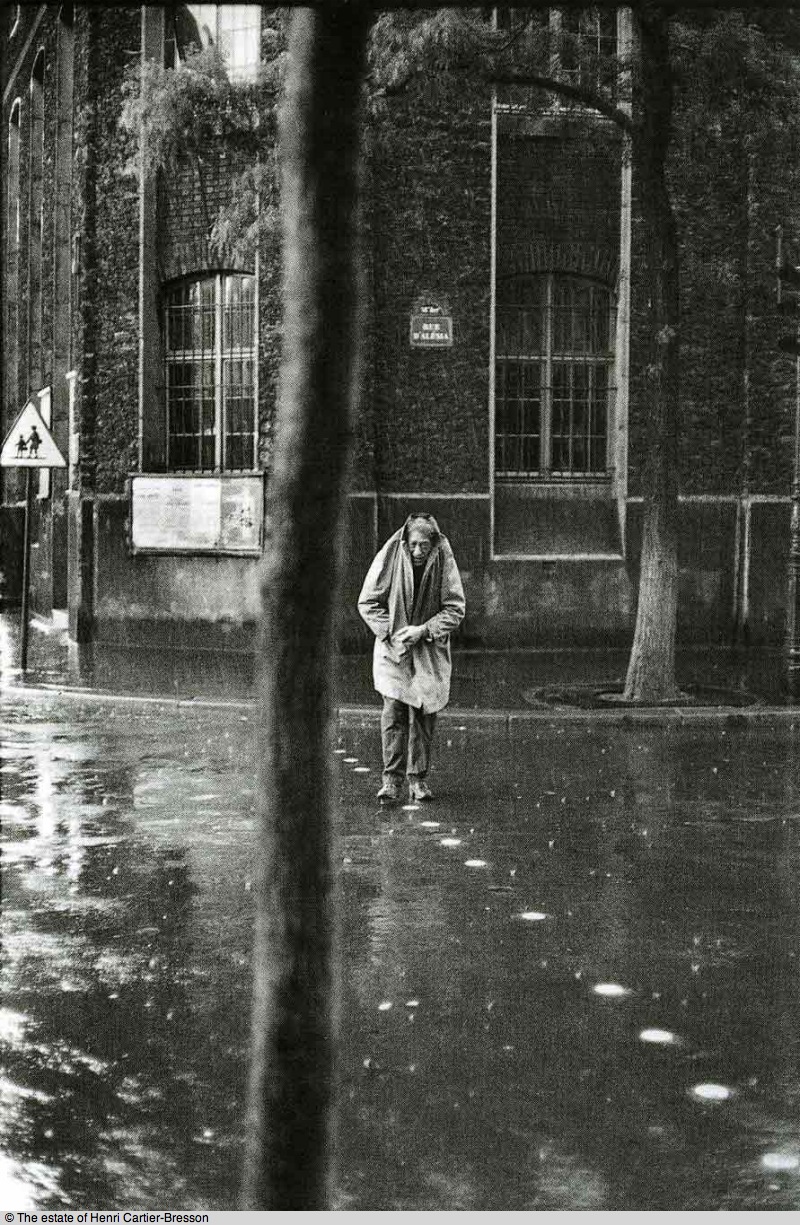
I do not know of any photograph of Horowitz taken by Cartier-Bresson, but if there was one, I believe it would have had the same intensity and insight as HCB’s portrait of Giacometti, one of the very greatest pictures ever taken.


Alberto Giacometti on the Rue D’Aléma in Paris

If you are into Giacometti, that is.

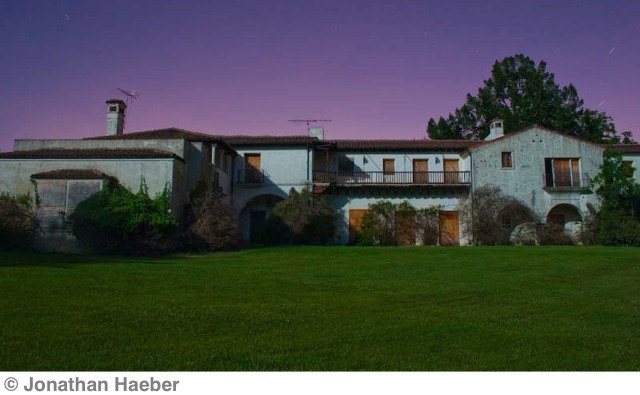
The Jackling Mansion

Great pictures of this controversial building

Click here for a wonderful selection of pictures of the Jackling Mansion, Steve Jobs’s home that he very much wants to pull down to build something useable.

Can’t say I blame him looking at these. It’s what I think of as a Wrecking Ball Special. Jobs probably needs to step up the bribes, er …. computer donations, if he’s serious about tearing down this eyesore which looks more like the No Tell Motel than any mansion I have seen. Once, a long time ago in America, a man’s home was his castle to do with as he saw fit. No more, it seems.

You can see more of Haeber’s work here.

So waddya care if it’s posed?

It’s the result that matters, not the means

Apropos nothing, I was reminded of a comment a fellow photoblogger made, addressing one of my snaps. I was heavily into photoblogging three years ago but got tired of all the sycophancy and lightweight comments passing for constructive criticism. Hardly a conduit for learning and improving.

His words were to the effect of “I would rate it a 10 if it was not posed”. Charming and comical at the same time. Viewed logically, he was awarding points for a mixture of luck and skill in taking the picture clandestinely. I’m not sure I understand that. I’m all for rewarding spontaneity when it comes to the performing arts, say, or scientific research. That’s how breakthroughs happen. But for a medium whose sole appeal is to the sense of vision, what does it really matter whether the picture was spontaneous or not?

Allow me to illustrate with four examples – Posed, I’m Not Telling, Sacrilege …. and a Real Corker:

1 – Posed:

Surely on the short list of all times great ‘decisive moment’ snaps, is Robert Doisneau’s ‘Le Baiser’:

Doisneau, whose work I adore, was your typical French leftie-with-commie-sympathies but, God bless him, was happy to admit that his most famous picture was posed.

2 – I’m Not Telling

This is my picture which occasioned that funny remark at the introduction to this piece:

All I will say is that it’s always awful fun snapping pictures of my beautiful son.

3 – Sacrilege

The thought that the single greatest photograph of the Twentieth Century was posed is pure sacrilege.

Yet it is that very thought that gave life to this entry …. have you ever wondered that the balletic figure on the wall and the fatso about to splash are just too much of a coincidence?

4 – A Real Corker:

You think I was going to ask a guy who does not even speak English to pose for this? Get real:

Still, whether it’s posed or not is irrelevant. All that matters is the result.

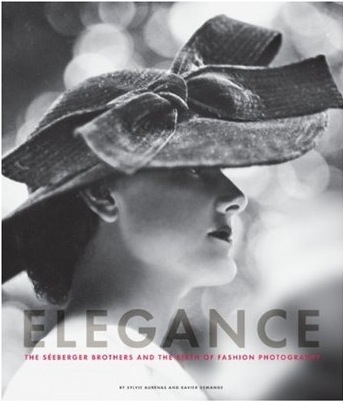
Are art books dead?

Perish the thought

For an index of all my book reviews click here.

One of the simple, yet sublime, pleasures in life is to stroll past a bookcase and be rewarded with some gem long forgotten. A moment later and you are on a trip to a place unknown, basking in California’s late sun.

The thick art paper invariably used in photography books permits high quality reproduction and the tactile and olfactory pleasures, coupled with the user’s choice of sequential or random access …. well, there’s a lot to love about Gutenberg’s invention.

As machines go, the printing press has had a decently long life of 570 years and counting, though it’s a piker compared to, say, the catapult (an elegant, simple tool) or the wheel. Compare those to the lives of sound reproducing media – wax cylinders, shellac 78s, LPs, stereo LPs, Cassettes, 8 Track, CD, iPod – none has lived more than a couple of decades.

Yet while I am committed to getting clutter out of my life (my ideal being Woody Allen’s place in Sleeper), I still cannot get worked up about looking at photography books on a screen. I recognize that some media – black and white comes to mind – benefit greatly from transillumination – but the magic of a book compares favorably to the netbook warming my lap as I type this. I would have said ‘frying’ but I got rid of my MacBook in the interest of my testicles.

The transition to reading news, analysis and fiction from paper to screen is accelerating, so you can bet that we will have full color Kindles, or whatever, before long. Maybe the screen will become a flexible pellicle with pictures sent wirelessly for it to display; that might work, I suppose, but I think this is still a bit sci-fi.

Meanwhile, I am going to stroll past my bookcases.

Alec Soth

An interesting artist

When you read that Alec Soth is represented by none other than ace salesman Larry Gagosian, alarm bells tend to go off. Isn’t this the same carpetbagger who persuaded the world that a $100mm diamond encrusted skull was something worth buying?

In Soth’s case the concerns are ill founded, for his work is insightful, sensitive, and original. I especially enjoyed the Fashion magazine section of his web site. It’s a quirky, somewhat sardonic, look at the loons and twits who make up the modern fashion world, a world where publicity and labeling are more important than quality and originality.

Well worth a look.


Two prize twits – Karl Lagerfeld and some other dude at Chanel

Soth’s site has several broken links – inexcusable – but you can also find his work at the Magnum site.