Category Archives: Photographers

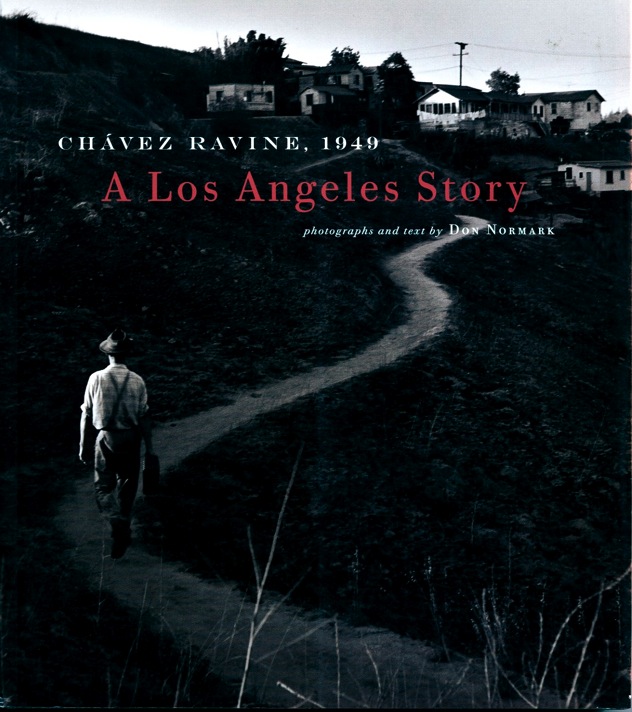
Chavez Ravine, 1949

A fine book of pictures by Don Normark.

Click the picture.

This wonderful book, published in 1999 and available from Amazon, showcases the pictures taken by Don Normark when he stumbled upon a Hispanic area of Los Angeles near what is now Dodger Stadium. Little was he to know that one year later the slums there would be condemned to be replaced by a public housing development. Characterless slums replacing charismatic ones.

Only many years later did Normark realize what he had; he tracked down the former residents of Chavez Ravine and documents their recollections here – a place with vibrant memories illustrated with his superb photographs. That this tightly knit community of Latinos allowed a white boy into their midst is wonder enough. But his photography makes it clear just how blessed his many visits would turn out to be.

Mercifully Normark avoids the trait of most ‘photojournalists’, who somehow think their training in darkroom chemicals qualifies them to be political commentators. In much the same way that Hollywood actors and singers suddenly conclude their fame empowers them to pontificate on geopolitics, once that Oscar is on the mantle or the platinum selling CD is on the wall. Hey, it’s free publicity, no?

None of this sort of nonsense is to be seen here. What you do see is a sensitive, no, more than that, dignified, portrait of a vibrant community of tightly knit people, shortly to be cruelly replaced by a development crafted in a smoke filled room by corrupt politicians and their paymasters, corrupt developers.

This is a very special book which deserves to be on every photographer’s bookself.

Leica – Witness to a Century

A fine chronlogy, if factually flawed

I picked up my copy of this book a couple of years ago from overstock bookseller Edward R. Hamilton for a few dollars. It’s actually worth that sort of money.

This is the last place to go for factual accuracy regarding the various Leica models; I am no maven but could scarce find a page without several technical errors accompanying each of the illustrations of the many models of cameras made by Leitz over the years.

On the other hand, the book does a fine job of showcasing the work of some great photographers from Oscar Barnack, the inventor of the Leica (he was a fine photographer), down to modern times. Especially pleasant to see is the work of a couple of relatively unknown Italian photographers, probably attributable to the nationality of the Italian author, Alessandro Pasi.

And, technical errors apart, who can argue with the caption for the M3, first sold in 1954? “The turning point: Leica M3”.

Indeed.

Take 55

A useful and inexpensive photography book series

There are many photographers whose work I enjoy but not enough to splash out big bucks on a monograph of their work.

Enter the ’55’ series of small paeprbacks published by Pahidon.


Panasonic Lumix LX-1 included for scale

I think that means there are 55 pictures in each 128 page book, as they are printed one every other page, with descriptions on the left. Phaidon says that their goal is to emulate the Penguin paperback pheneomenon of the 1930s which made so much great literature available inexpensively to so many. They want to do the same for photography. A laudable goal.

These are easily obtainable remaindered from on-line booksellers. I generally pay inder $4 (under $4!) for each. While the pages are small, the quality of printing is high and it’s an economical way of finding out if you want to learn more of an individual’s work.

Phaidon continues to list a dozen or so on what has to be one of the worst designed web sites of all time, and you can do better for less by simply going to Powell’s Books.

Margaret Bourke-White – early work

A great woman photographer in a man’s world.

She was beautiful, well educated and had a strong sense of design. That Margaret Bourke-White (1904-1971) photographed the first cover of Fortune magazine in 1930 is well known. It is no less surprising a fact today, when one considers the extent to which men dominated journalistic photography at the time. Indeed, just three years earlier, Bourke-White had to lobby for weeks to be allowed into the Otis Steel Mill in Cleveland, for her gender was a ‘do not enter’ sign writ loud and clear in a man’s world. Fitting, then, that the resulting pictures, taken in 1927, made her famous.

This book chronicles her Machine Age photographs, taken through 1936, before she grew into a great humanist photographer, one adopting the candid style that the Leica had made possible. You will not find Leica pictures here. No, large format was the order of the day and Bourke-White embraced it enthusiastically, reveling in the fine level of detail the medium afforded.

Perusing my collection of photography books the other day I realized with some dismay that there was not a single one dedicated to the photography of Margaret Bourke-White. That omission was quickly corrected. This volume, published by Rizzoli in 2005, remains available from Amazon. You will not find a photography book with better quality reproductions, the pictures being printed with great tonal range and depth.

Bourke-White was not loved by the dominant working class male photographers of the day, a fact well illustrated in the excellent text by Stephen Bennett Phillips, which is quite devoid, mercifully, of dry academic drivel, and a fascinating read. As Phillips points out, where a Walker Evans would record his subjects in dry, unemotional, square on detail, Bourke-White could never resist the soaring diagonals which render her photography of man made objects so exciting. Further, she committed the cardinal sin of working for Big Business, becoming one of the highest paid women of the day, rather than choosing to starve nobly in some unheated garret. In these, her early works, people are mere design elements in pictures which glorify machines. Only later would her style change and adapt, and people would become the subject.

This book is not for everyone. Certainly it will stir the socialist souls of those convinced that industry exists to dehumanize and control. But for those who see the Machine Age, that time during which America simultaneously became the most powerful and most generous nation that the world has ever seen, as a true reading of America’s greatness, will revel in the magnificent photographs on display here.

Richard Gere – Photographer

A moving book of pictures chronicles Tibet.


Pilgrim. Photographs by Richard Gere

I have long enjoyed Richard Gere as a film actor, not least for his light touch and excellent timing. For whatever reason, he seems to have fallen out of favor with US audiences, yet finds himself more popular than ever in Japan, where his movies are invariably huge box office hits.

But I’m not writing about Gere the actor here. Rather, this piece is about Gere the photographer, a man who has been a long time devotee of Tibetan Buddhism and documents his faith here. His love for the country and its gentle, cruelly oppressed people, shows well in this large book. Gere spared no expense in production, for the book is beautifully clothbound with the sixty-four pictures reproduced in warm monochrome tones on Mohawk Superfine acid free paper (I quote from the Appendix). Suffice it to say that the look and feel of the whole project is of something of the finest quality.

Gere’s photography is noteworthy. He does not hesitate to publish pictures which are blurred because of camera shake, where the effect justifies it (indeed, the cover picture is blurred) nor to use slow shutter speeds to blur moving people in otherwise sharp surroundings. This is no mere affectation for leafing through this book shows that the effect is used well and never detracts from the emotion of the pictures.

And emotional they are, none finer than that of His Holiness the Dalai Lama on page 63 or the simply gorgeous, there’s no other word for it, picture of the hands and prayer beads on page 48.

It doesn’t hurt to read that Gere donated all his profits to Tibetan charities.

Perhaps the biggest challenge with a book like this is the celebrity status of the photographer, but this is miles away from another tome of lousy snaps by yet another underemployed spouse franchising her marriage to a rock star. Gere, clearly, is not only the real thing in his beliefs, the photography is simply beautiful to behold and very moving.

The book appears to be out of print; my used copy came from Powell’s Books for the not inconsiderable sum of $35. Money well spent.