Category Archives: Photographers

Kodachrome

Everything looks worse in black and white

Smirking with ridiculously self-satisfied glee at a joke he has just told to the wife of one of his flunkies, Hitler reaches for the cookie bowl. His pasty faced complexion contrasts strangely with the tanned, Aryan health evidenced on the woman’s beaming face, her gingham dress replete with red and white stripes.

Turn the page and there’s a post-Bitzkrieg Warsaw in September, 1939, its ancient buildings just so much rubble, with a proud, well fed line of Wehrmacht soldiers guarding their spoils, grey helmets shining in the sun, the sky a pure azure, doubtless wondering about that evening’s forthcoming excesses at the cost of their Polish captives.

One more page and Rotterdam is in ruins, one hour after the German bombardment, the sky a threatening dark indigo this time.

One more page and it’s the turn of the French, surrounded by German troops, brown shirts everywhere.

Yet another page and there’s a rotund, self-satisfied German actress in Hitler’s Chancellery, massive gold necklace and ruby red lips glistening just so in the Berlin of 1940. Enjoy it while you can, baby.

The sheer depressing nature of these pictures, blow after blow after blow, each speaking to the Master Race’s self-pronounced superiority, has a strange way of jolting the viewer into reality. Suddenly you are wide-eyed with amazement when you realize all these pictures, by unnamed photographers, were taken on Kodachrome.

Many, many years later Paul Simon was to crystallize the essence of this very American invention in the lyrics of his song. He was doubtless writing about the demise of TriX:

When I think back
On all the crap I learned in high school
It’s a wonder
I can think at all
And though my lack of edu—cation
Hasn’t hurt me none
I can read the writing on the wall

Kodachrome
They give us those nice bright colors
They give us the greens of summers
Makes you think all the world’s a sunny day, Oh yeah
I got a Nikon camera
I love to take a photograph
So mama don’t take my Kodachrome away

If you took all the girls I knew
When I was single
And brought them all together for one night
I know they’d never match
my sweet imagination
everything looks worse in black and white

Kodachrome
They give us those nice bright colors
They give us the greens of summers
Makes you think all the world’s a sunny day, Oh yeah
I got a Nikon camera
I love to take a photograph
So mama don’t take my Kodachrome away

Mama don’t take my Kodachrome away

Mama don’t take my Kodachrome
Mama don’t take my Kodachrome away

Mama don’t take my Kodachrome
Leave your boy so far from home
Mama don’t take my Kodachrome away
Mama don’t take my Kodachrome

Mama don’t take my Kodachrome away

And if you want to catch the spirit of the piece, go no further than the lovely Coneheads on DVD, to see what I mean.

The Leica may have been the greatest machine invented for photography, and its gritty, grainy black and white film stock enshrined an era seen through the eyes of street photographers everywhere. But the snaps were not color. And pragmatic Americans, ever looking for the latest gadget, the true reality, wanted color. So Kodak gave them Kodachrome.

The single greatest photographic invention since the Leica.

The book is ‘Kodachrome, 1939-1959, The American Invention of our World’, and you can get it for chump change from Amazon.
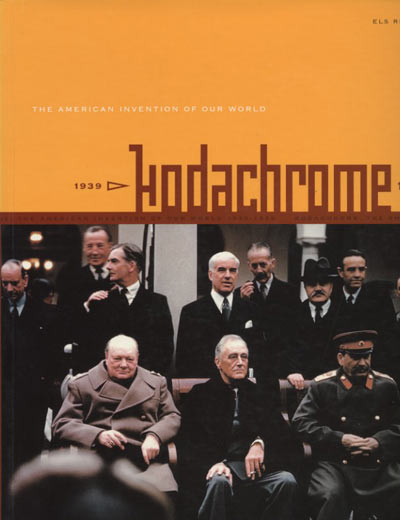
Yalta, 1945. Stalin decides the future of Western Europe while WSC and FDR look on. Click the picture.

It is, perhaps, unfair to refer to this as Kodak’s invention, though Kodak deserves credit for letting two professional musicians, one a pianist, the other a violinist, take up laboratory space in upstate New York in 1930. Leopold Mannes and Leopold Godowsky, Jr. just happened to be keen amateur photographers and geniuses at chemistry. Clearly, God did not allocate talent equally. After thirteen years of research, Kodak announced Kodachrome on April 12, 1935 as the first continuous tone color film. Imagine a thirteen year development cycle for anything today.

That early emulsion faded badly but by 1938 the Leopolds (‘Man’ and ‘God’ as they were known in Rochester) got it right and the Kodachrome you can still – if only just – buy today is little changed. Best of all, unlike any other color film ever made, processed and properly stored it is virtually fade proof. History may not record how Mannes and Godowsky felt about their emulsion being used to photograph the creator of the Final Solution, but the oh! so satisfying picture of German prisoners of war in a prison cage on Normandy beach (page 44) doubtless warmed the cockles of their hearts, especially as it was taken on the emulsion they created.

Kodachrome in 1938 was some 12 ASA in speed. Later, as Kodachrome II it became 25 ASA, where it stayed until being discontinued, now as Kodachrome 25 (I suppose that sounded faster) a couple of years ago. Meanwhile Kodak had also added Kodachrome X (later Kodachrome 64) and Kodachrome 200. For years, such was the repute of this emulsion, National Geographic would only accept Kodachrome slides for reproduction in its pages.

Jane Russell frolicked in the hay for all to admire for a poster for her film ‘The Outlaw’ in 1944. Howard Hughes, who bankrolled the movie, famously remarked “There are just two reasons to go and see her”, summarizing succinctly what every American male was thinking. Americans were happy in 1944, if not gay, and Kodachrome captured Jane’s …. womanhood just so. No one organized a protest, men continued to eat red meat and smoke Marlboros, and women had 2.4 children and craved a starter home in the San Fernando Valley, north of Los Angeles. Political correctness, refuge of cowards and lawyers, had yet to raise its ugly head. Marlene Dietrich looked ravishing in Kodachrome and jewels in 1948 (it’s OK, she was on our side) and General Douglas MacArthur could look macho in his jeep in 1950. Doubtless the vain General liked what Kodachrome did for him, even if Harry Truman later fired him for insubordination.

So a vital part of the chronology of American life, of what it meant to be American, is recorded for all time on fade free Kodachrome, in true colors that tell how it was.

There’s Elizabeth Taylor, ravishing in a white dress. The young JFK with Jacqueline Bouvier, film stars both, enjoying a game of tennis. Brooklyn Dodger Jackie Robinson helping destroy one of the last great bastions of White American bigotry, baseball. Marilyn entertaining the troops, her generous lines lovingly rendered. Hitchcock looking like … well, like Hitchcock, ruddy pink face and cigar. Kodachromes all. The El still ran in New York and Kodachrome proves it. Gamine Audrey Hepburn and blowsy Jayne Mansfield showed their true colors. Tarty Shirley MacLaine juxtaposed with a sneering Elvis. Zapruder used Kodachrome in his 8mm movie camera to record JFK’s murder in Dallas. Tricky Dick tried to look like presidential material next to Ike. Not very successfully, let it be said. Even Kodachrome could not hide the fact that his sly smile might just be something to worry about. And even the great Walker Evans got in on the act with a storefront snap in Kodachrome, though in this instance it’s only fair to add that he should have stuck to black and white.

I used Kodachrome exclusively during the period 1977 through 1990. The absence of grain, the consistency of processing by Kodak, the tonal range and color accuracy, all were simply wonderful. Eventually color negative films would rival, maybe surpass, these qualities, and once you could scan the originals and save them to properly backed-up hard disks, fading ceased to be an issue. For in much the same way as I used TriX during the years 1971-1977, Kodak showed what world class products were all about.

You can still get Kodachrome. K25 is no more and Kodak doesn’t want you to know about the alternative as evidenced by a search on their web site:

But go the the B&H web site and Kodachrome 64 can still be had in 35mm cassettes, in 64 and 200 ASA speeds. Only one lab remains in America that can perform the wildly complex processing of this emulsion, and the lovely 120 film size disappeared years ago, as I found to my cost. Unearthing two rolls from the dark recesses of the film shelf in the fridge the other day, it transpired that no one, not even Kodak UK, processed this size any more. Oh! well, I had to throw them out. Just think, through the late 1950s you could get Kodachrome in sizes up to 8″ x 10″. Imagine that. Today it’s 35mm or nothing.

And the inventors? Kodak’s historians have wiped them from the memory banks. Search on Mannes or Godwosky and you get nothing. Shameful.
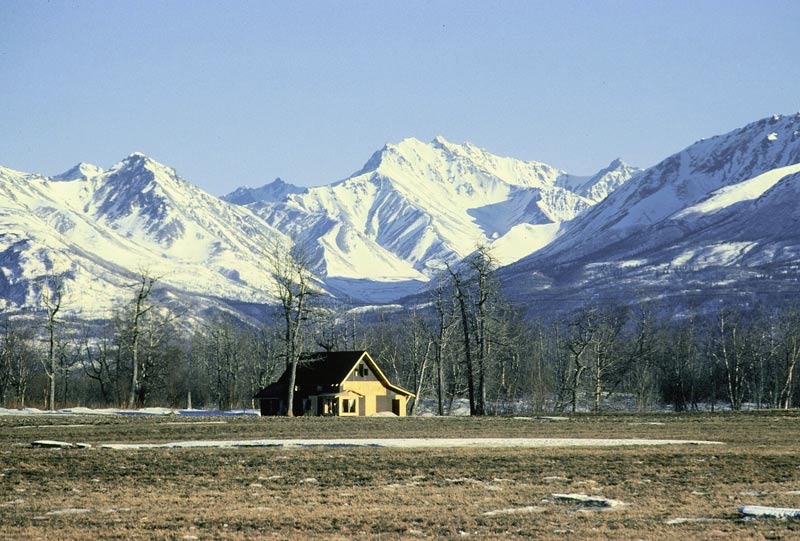

Matanuska Valley, Alaska, 1978. Leica M3, 50mm Summicron. Kodachrome II.
Taken by this newly affluent immigrant shortly after arriving in America.
At last I could afford not just color film, but Kodachrome, no less.

So if you still use film but have never used Kodachrome, please rush and get one of the remaining rolls now. Your scanner’s dust removal software will not work (silver is required in the emulsion for that and Kodachrome has none), it’s not especially fast by today’s standards, but do you really want to go to your grave and say “I never used Kodachrome?”. No, I didn’t think so.
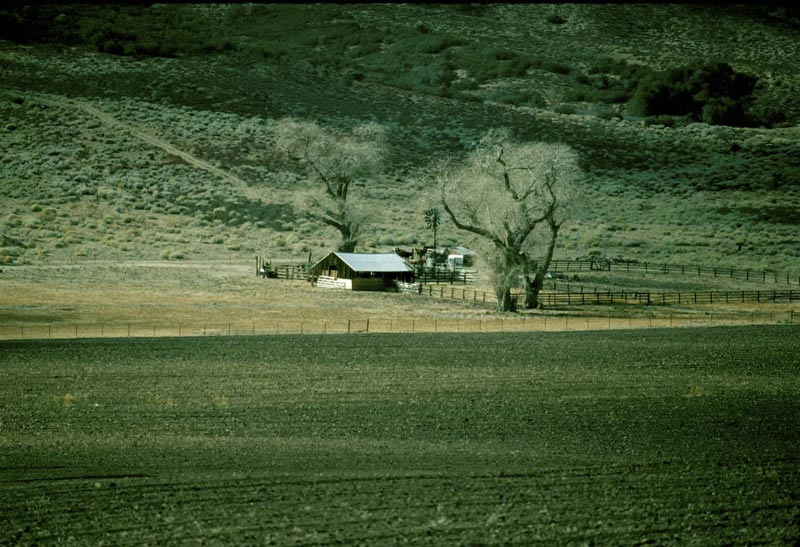

Lake Elizabeth, California, 1990. Leicaflex SL, 180mm Apo-Telyt-R. Kodachrome 64. One of my
last Kodachrome pictures. After that, scanners became affordable and Kodak color negative film,
impermanent as it may be, provided a far faster processing turnaround.
Looking at pictures

You can’t beat natural light

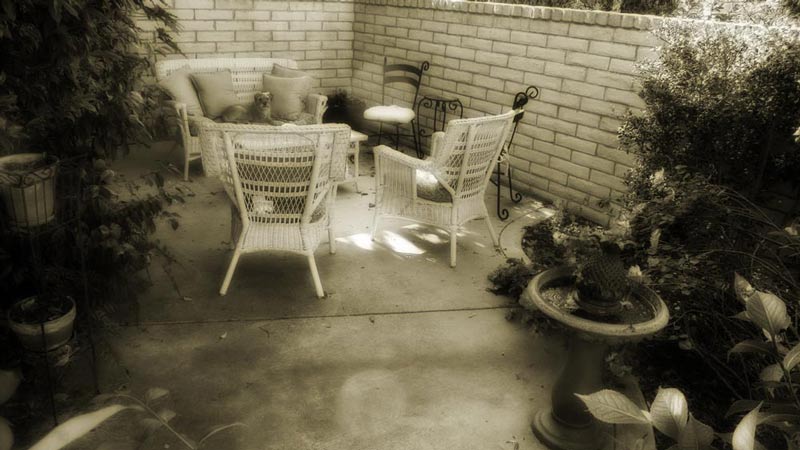
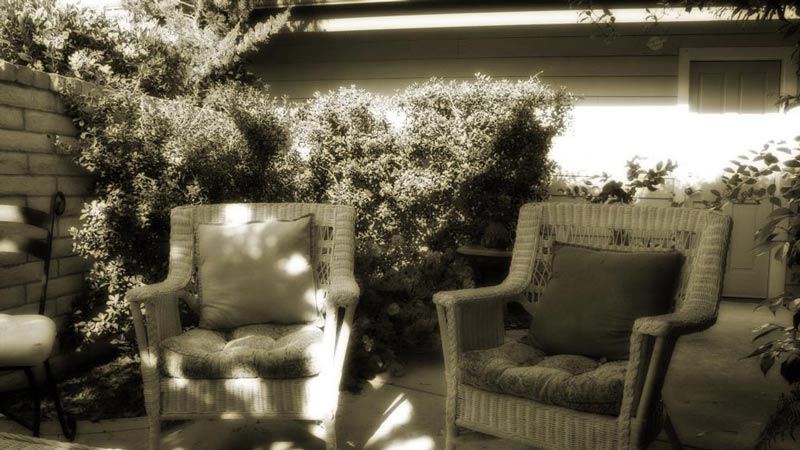
As we look forward to six dry months in central Caliornia, it’s nice to have a sheltered outdoor spot to look at pictures on those long, warm summer evenings.

This little walled patio on the north side of our home was a complete mess when we moved here a couple of years ago. As the US Government has yet to craft a method of taxing sweat equity, I set about fixing it up to make a pleasant enviroment to better enjoy the occasional book of pictures. The only taxes involved were iniquitous sales taxes which, wherever they may go rest assured it’s not to fix the local roads and freeways, which resemble those of a third world nation.

No matter. Get rid of the horrible hot tub that so spoiled this lovely spot, add a few rose bushes and magnolias, some mulch, a small fountain to set the tone and a few pieces of wicker furniture from the far east and you have the makings of a fine outdoor reading room. The tub was sold to a neighbor and the proceeds invested in what you see here. Throw in a Border Terrier and things are nigh perfect.

Yesterday evening I was leafing through Michael Kenna’s work in the beautifully printed ‘A Twenty Year Retrospective’ and couldn’t help but remark on how the prints looked so much better in the warm outdoor light. His photographs are reproduced in a gentle sepia which adds greatly to the overall feel. Kenna has a strong, consistent style and while the book credits him with works in many US public gallery collections, you would probably expect to find it on the wood panelled walls of classier business institutions like private banks and financial advisors.

Anyway, with all that sepia going on, I grabbed that little jewel, the Leica DP, and took a couple of snaps to illustrate this piece. A few seconds with Photoshop saw the RAW images converted to TIF files whence two more clicks saw monochrome conversion and sepia toning.

Controls and confrontation

Say what you think. Dissemblers are losers.

In the old west, men used to settle their disputes with six shooters on Main Street. Justice went to the fastest. A cruel system, true, but one devoid of the greatest plague which subsequently infested this great land.

Lawyers.

But it’s not the lawyers who are to blame. Like any whore, they exist solely because the demand is there. Growing mightily since those Wild West days, Americans have lost the guts for confrontation. Instead, they started retaining agents, lawyers, to do their arguing for them.

These agents, of course, speedily recognized they were on to a good thing and before you know it you had class action shakedown experts (pay me now or pay me later) and the tort bar.

What, of course, accounts for this sad state of affairs is a lack of parental guidance. “Believe what you say, tell the truth, and be prepared to fight for it” gave way to “Here’s the number of a good lawyer”, as if the use of “good” and “lawyer” in one sentence were not one of the greater contradictions in modern English usage.

What made me think about this was an article in the Wall Street Journal the other day explaining how on line photography hosting services were employing people to try and screen out pornography. Now this must rank right up there with the comical attempts of the Chinese and Singapore dictatorships to control access to the internet. Evidently, there are teams of poor schnucks at hosting sites charged with reviewing tens of thousands of pictures daily to censor out the bad ones. Others have adopted computerized approaches to try and recognize offensive material. Snag is, a bare bum is, apparently, very much like an apple pie to these programs, so Aunt Minnie’s latest creation goes in the trash heap with the Playmate of the Month.

God, America and Apple Pie….and Playmates.

A moment’s reflection leads to the conclusion that third party censorship is wrong. Again we have delegated control to agents rather than taking responsibility for our own actions. Where the solution to the problem rests is with proper parenting. Teach the child was is good or bad and you no longer need some culture Czar to make your decisions for you.

Which translates, rationally, to a means test for parenting. When you have a child you make a significant commitment for 15 to 20 years to another human being. Our society has concluded that you need certification to own dangerous things (guns, cars) but cares not who has a child. A means test for parenting would take care of many of the problems in our society. Fascist you say? Ask a parent whose child has been murdered by a drunken driver or a drive-by shooter.

An extension of this theme, as it affects photography, was suggested by a friend the other day. It doesn’t hurt that she is also a fine photographer. That means I pay more attention to her writings. I had sent her an intriguing piece, compiled by experts, on the state of the art in digital camera sensors, thinking it was interesting to see how quickly digital has surpassed film in every respect. She wrote back to the effect that all this technological splitting of hairs has little to do with taking good pictures.

Of course that is right. Digital or film, it’s just a means to an end. I happen to be a digital convert simply because the time from snap to print is shorter, and I have one day fewer left on earth than I did yesterday. That makes digital better for me. Maybe not for you.

But to complete the circle back to the thrust of this piece, which is all about self determination and courage in one’s beliefs, she goes on to suggest that maybe there should be a means test for aspiring photographers. If all you propose to do is take pictures of garbage well, sorry, you cannot buy this camera.

I pretty much despise censorship in all its guises, yet make an exception when it comes to parenting. So I may be talking out of both sides of my mouth. But I must admit to giving my correspondent’s thought more than passing consideration because so much of what passes for photography out there is pure, unadulterated garbage.

Were we to be more outspoken about this, more willing to correct the inept and expose the frauds, in other words if we had more guts, well maybe photography standards would rise across the board.

The most fun I ever had taking pictures

Before digital came along, that is!

The seventies were a truly miserable time to be in England. Administrations alternated between the senile Conservatives, devoid of ideas and wedded to the status quo, and the Labor party, its members fuelled by the politics of envy. A weak Conservative Prime Minister, Ted Heath, caved to the blackmailing strikes of the miners. He alternated power with the socialist Harold Wilson who went along merrily with the trades unions funding his party, doing whatever it took to stay in office. Neither ‘leader’ had personal convictions worth a damn.

I had graduated a mechanical engineer from University College, London in 1973 intent on working for Rolls Royce Aircraft. There was only one small snag. The year I graduated Rolls went bankrupt, as ingested birds shattered the innovative carbon fiber turbine blades in its RB211 engine, rendering it useless. The engine was intended for Lockheed’s superb Tristar passenger jet and Rolls almost took Lockheed down with it. Well, the alternative for an engineering graduate who actually wanted to be an engineer was to work for some big government institution or become an academic. Hardly palatable alternatives for one dirt poor, ambitious young man. Realize that this was a country that accorded the sobriquet “engineer” equally to the fellow installing railroad ties and to the chap at Rolls Royce. Still, I suppose the railroad ties did not snap like so much brittle chocolate.

So I decided to emigrate to the greatest country on earth, but there was a small matter of qualifications. The business of America is Business, and I didn’t know a balance sheet from an income statement. Taking advice from a smart merchant banker my mother somehow steered me to, I decided to learn about finance with another degree on the wall. It’s a damnable comment on the English educational system of those times that the very concept of an MBA did not exist, whereas in America it had been around for the best part of a century. It wouldn’t do now, would it, to teach business? Muddling through was the preferred method, preferably aided by good choice of parents.

Well, I had had the privilege of working with Americans as they visited Britain, over on tours from New York or Boston or Chicago, and I learned more from them about business four years firm than in my whole life until then.

The last thing I did before taking that one way flight was to visit Paris. This was in 1977. I had no savings. My most precious asset was my Leica M3 and its 35mm Summaron lens with that clunky viewfinder appendage. So I borrowed fifty pounds from a sister, got on the ferry and next thing I was at Gare du Nord looking for my seedy garret. My first goal was to visit the Louvre, the Jeu de Paume and the Orangerie to feast on three of the world’s greatest art collections. A related interest, of course, was to take pictures, so the M3 and a few rolls of film came along.

There was no draconian security in those days, of course. Photography was permitted everywhere and no one really minded very much. Especially if you were reasonably discreet. The Leica and I were a seasoned pair by now. We had been recognized time and again in the photographic press, culminating with the award of the Photographer of the Year prize by Photography magazine, the leading UK monthly, and, better yet, had been published in Leica Fotografie, the house organ where all things Leitz were good.

To whom did I look for inspiration in those days, photographically? Well, that’s easy. Cartier-Bresson, Doisneau, Kertesz, Brassai. In other words, I was a street photography junkie, though I didn’t know that word at the time …. Make it fleeting, let serendipity arrange the forms just so and click. Leica. 35mm lens. TriX. D76. A combination that had seen thousands of photographers through for years on end.

The Louvre was a magical place back then. I. M. Pei, great architect that he is, had yet to con gullible Parisians with the ugly pyramid that defaced one of the world’s great spaces, much as the Pompidou museum had already done a few blocks away. Care to revisit the latter and see how well it has aged? I don’t think so.

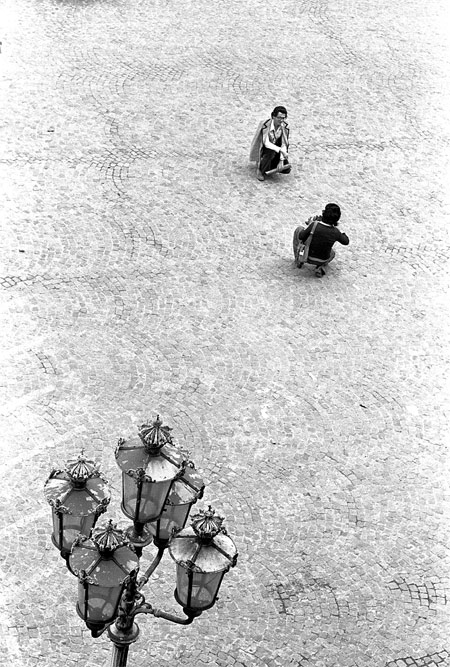
The forecourt of the Louvre before I. M. Pei. Leica M3, 35mm Summaron. TriX/D76.

The first and prevailing sense one had on entering the museum through its vast facade was the smell of oil paint. Artists were permitted, encouraged even, to bring their oils and easels and practice by copying the works of the masters. The lighting was, of course, magic, like only Parisian lighting in the spring can be. And as this was before everyone had money, before equality had raised its ugly head, the museum was far from the zooed place that modern art collections have become. In the words of the philistine American to his wife, with but one hour to catch a flight, confronted with a priceless Italian church to view: “OK, honey, you do the inside and I’ll take the outside”. Drive-by tourism. No, people had more time to savor art back then.

What passed for fashion in the seventies. Mona at the Louvre. Leica M3, 35mm Summaron. TriX/D76.

I forget the details, but suspect that I visited the Louvre on all but one day of the week I spent in Paris. And I also took pictures, the Leica by now a part of me. Second nature.

And until good, responsive digital cameras came to market, that’s the most fun I ever had making pictures.

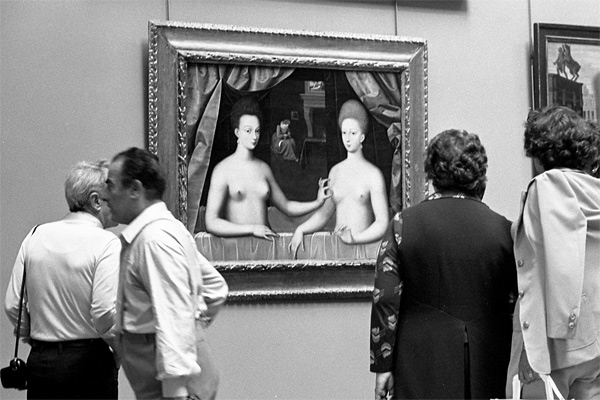
Early porn. Louvre. Leica M3, 35mm Summaron. TriX/D76.

In case you wonder, this painting is of Gabrielle d’Estrees and one of her sisters in the bath, c. 1595, painter (mercifully) unknown. Gabrielle d’Estrees was the mistress of that old Frog, Henry IV. In her hand she holds a ring given to her by the king as a sign of their bond, and her sister is pinching her nipple indicating she is pregnant with the king’s child. Yeah, right. The surrealistic background image is of a servant sewing baby clothes.

Click on the link in the left hand column for details of the book that resulted. That will take you to a written presentation along with my commentary, so you can hear what I really sound like!

Still movies

Some of the best still photography is in movies

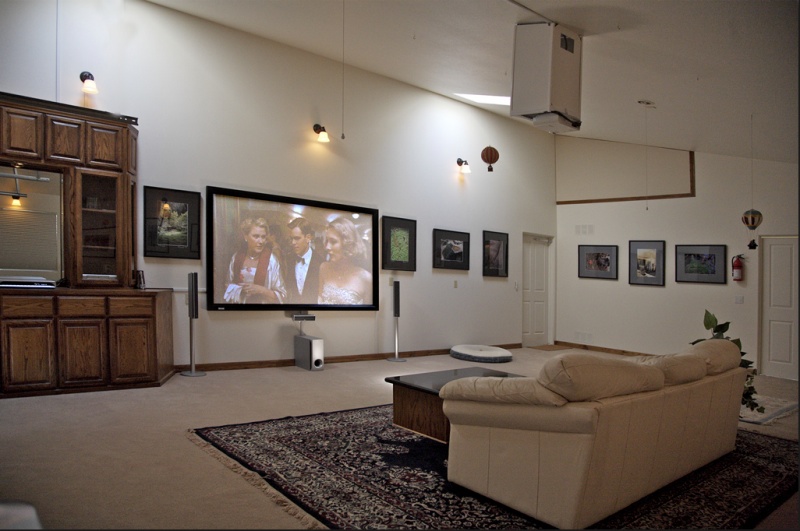
Once I realized that the carpal tunnel problems I was having, meaning wrist pain when working my hands hard, were not going to go away, I sold all my woodworking equipment and set about converting the woodworking shop to a home theater, with the following result:

Completed in time for last Christmas, I have maintained my commitment to watching a movie a night ever since and must say I have rarely had so much fun. 1,000 watts of surround sound and a 100” screen are not that difficult to enjoy!

So with some one hundred movies added to the growing collection at home, I stopped to think what was it that I enjoyed most on the big screen, forcing a narrowing down to just three movies.

Easy.

Luchino Visconti’s ˜Death in Venice” (1971)
Sergio Leone’s ˜Once Upon a Time in the West” (1968)

and

Walter Hill’s ˜Streets of Fire” (1984)

On reflection, the common thread running through these films includes a surpassingly simple plot (writer goes to die in Venice and becomes infatuated with a young boy, gunman seeks revenge, tough guy rescues former flame from kidnappers), magnificent music (Gustav Mahler, Ennio Morricone, Ry Cooder and Jim Steinman) and stupendous settings (Venice, the great American West, 50s Chicago).

But the surpassing attribute of all three is easily identified and is the primary reason I am so attracted to these masterpieces.

Stunning still photography.

Still photography? In a movie?

Death in Venice is little more than a series of stills, making up a movie. Lush beyond belief, it’s what makes Visconti such a favorite at the old abode.

Once Upon a Time in the West emulates the Visconti style, or maybe I should say that Visconti emulates Leone, the western having been made first. Some close-ups last for minutes (minutes!) on the screen.

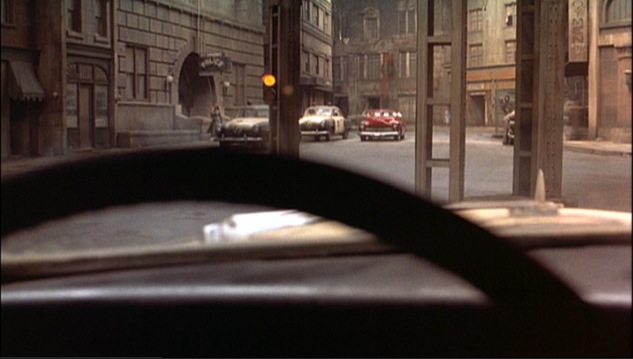
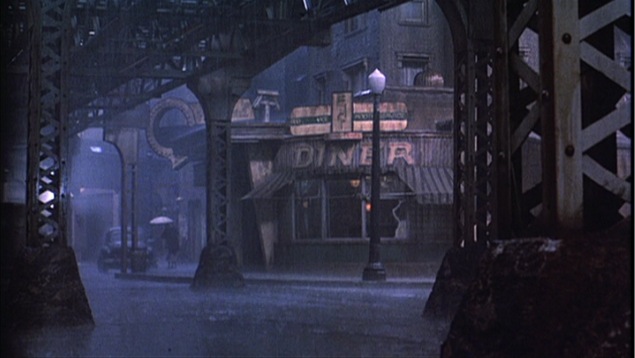
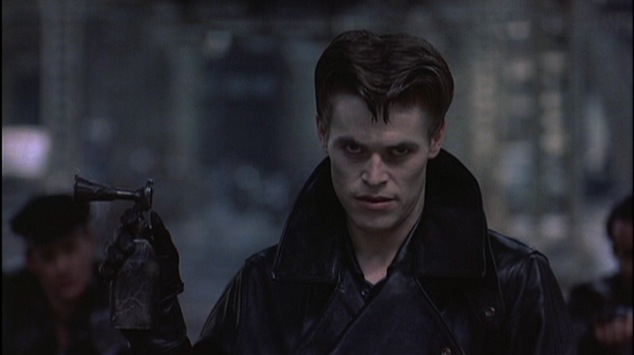
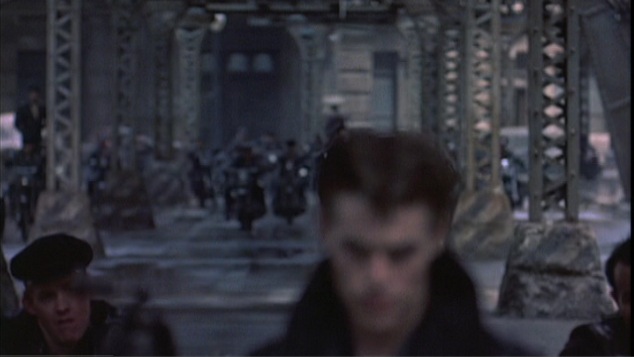
But Walter Hill’s Streets of Fire is the most photographically arresting of the three. Set in a permanently dark, wet Chicago, mostly under the elevated subway (the “El” in local parlance), it’s all neon, reflections, brooding atmosphere.

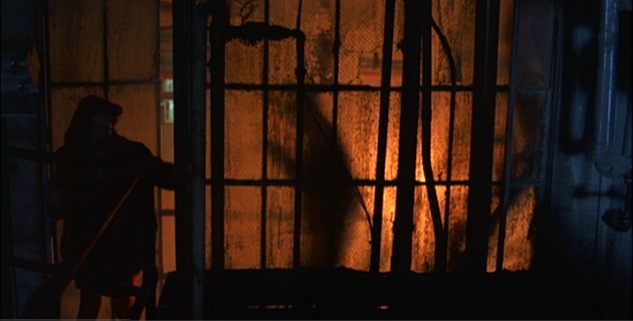
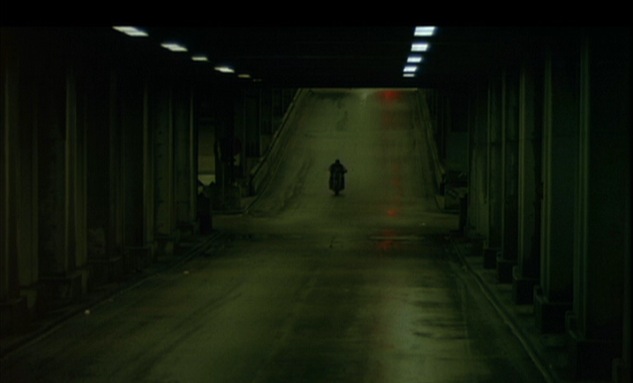
To illustrate, here are some stills from the great cimematographer Andrew Laszlo:

The bad guy makes his first appearance in the music hall, intending to kidnap the star heroine:

Outside the police station, the good guy is seen driving by in his hot rod:

Abstract expressionism at its best:

The good guy returns, ever the loner, after rescuing the girl:

A wonderful shot of the diner around which much of the action centers, seen through the support struts of the El incredibly atmospheric:

Before the final confrontation between the forces of good and evil, Hill pulls off an overhead tracking shot which equals that incredible one in ˜Once Upon a Time in the West” where the camera rises way above Claudia Cardinale’s head to show the new western town being built. Here Hill may not have the advantage of Morricone’s soaring score, yet he does something magical from a photographer’s perspective. He starts with a shot of the bad guy holding up an air horn to summon his evil team:

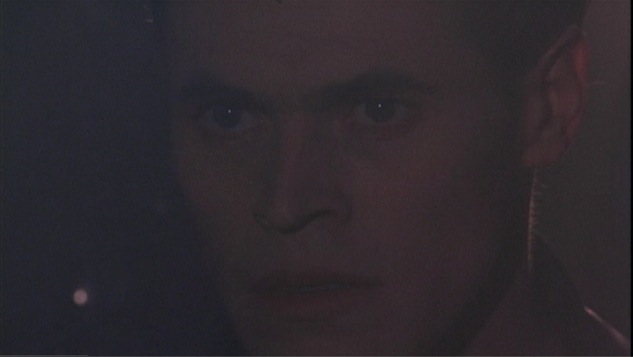
Then, as the camera rises, he switches focus to the evil hordes assembling in the background, the change in focus transforming the bad guy’s face into a death mask:

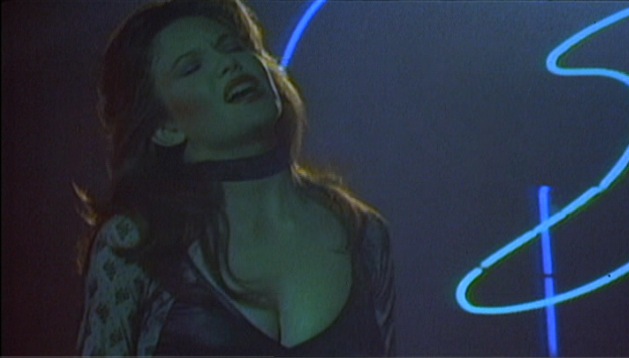
The movie has a nice symmetry to it, ending where it started with the heroine giving a driving performance of a rock number in the broken down hall. Both are by Jim Steinman – the fabulous ‘Nowhere Fast’ to open and the even better ‘Tonight is What it Means to be Young’ to close this masterpiece of a movie:

And there’s that neon again, the background to her singing reminding one of nothing so much as a work by the futurist Marinetti.

As for the ending lyrics, beat this:

Let the revels begin
Let the fire be started
We’re dancing for the restless
and the broken-hearted
Let the revels begin
Let the fire be started
We’re dancing for the desperate
and the broken-hearted

Let the revels begin (Tonight is
what it means to be young)
Let the fire be started (Before
you know it it’s gone)
We’re dancing for the restless
and the broken-hearted
Let the revels begin
Let the fire be started
We’re dancing for the desperate
and the broken-hearted

Say a prayer in the darkness for the magic to come
No matter what it seems
Tonight is what it means to be young
Before you know it it’s gone
Tonight is what it means to be young
Before you know it it’s gone.

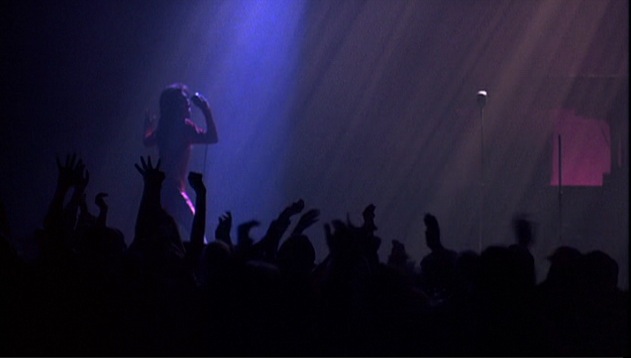
Finally, the picture of the heroine on stage with a foreground of clapping hands, a scene which might as well have been lifted from one of Hitler’s Nuremburg rallies in the late 1930s:

The only thing wrong with this movie is that there is so much of this kind of thing that much is easily missed on a first viewing, but I cannot think of a better reason for an aficionado of film to rush out and install a home theater.

As for photographers, it’s simply a must.

Update December, 2017:

Streets of Fire is finally available on BluRay. Amazon has it.