Category Archives: Photographers

Erwin Blumenfeld

There’s a lot to learn from this great photographer.

Whenever I get tired of reading yet another homage to Ansel Adams, that most glorified of darkroom technicians, I turn to the work of a real photographer who also happened to be a competent technician. The difference is that visualization never takes second place to darkroom technique with Erwin Blumenfeld.

Another in a long list of German outcasts, Blumenfeld (1897-1969) chanced upon a darkroom in his retail store in Berlin and a lifetime’s addiction started. Changing careers, he made his at Vogue and Harper’s during and after the war and was given remarkeable creative freedom.

His influence spread wide, his work a mix of the abstracted and the expressionist.

The other day I was rewatching the greatest Western film ever made, Sergio Leone’s Once Upon a Time in the West and there, right in the middle, is a jaw dropping shot of Claudia Cardinale, whom the camera observes from above and through a screen atop her four poster. Now every image of Claudia Cardinale is an occasion for rejoicing, it’s just that this one immediately says that Leone was a Blumenfeld fan, and the movie is nothing more than a succession of glorious still images. Blumenfeld’s net of influence was cast wide.

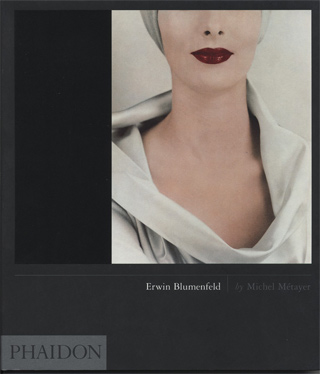
The book’s cover picture is but one example of where less is more. Appearing on the cover of Vogue in October 1952, it personifies glamour, class, sensuality and eroticism yet nowhere are the model’s eyes to be seen. Seldom has a Jacques Fath dress or a gorgeous neck been done greater justice.

And as you leaf through this slim book, just the right length to prevent overload, you realize that Blumenfeld’s compositions are what makes the pictures so striking, never mind the peerless technique.

It’s a whole lot more fun than those wretched Adams prints.

At the movies

Three great films about photography

Hollywood, for the most part, has not served still photographers well and there is little of note when it comes to portraying the profession. By the way, have you ever wondered why we refer to photography and prostitution as professions, when either can be practiced with a bare minimum of education? These are trades, not professions, though each doubtless includes some real artists in its ranks.

However, three films come to mind which not only do photography justice, but are also shining examples of great film making within their respective genres of comedy, drama and musical.

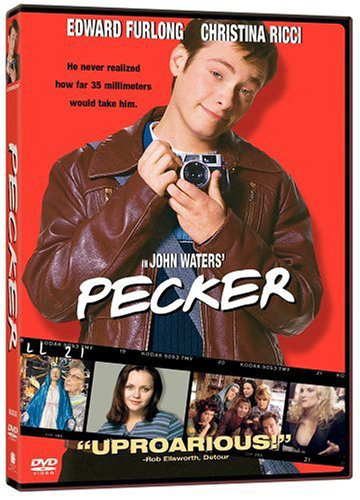
First comedy. John Waters’s ˜Pecker”(1998) is, well, a typical John Waters movie. Something to offend everyone and hilariously funny for all but the thinnest skinned. This comedy portrays a teenager who is accidentally vaulted to stardom for his snapshots and somehow manages to survive the experience. No great substance here, but an absolute hoot to watch. Filmed, of course in Baltimore, which is the director’s home town.

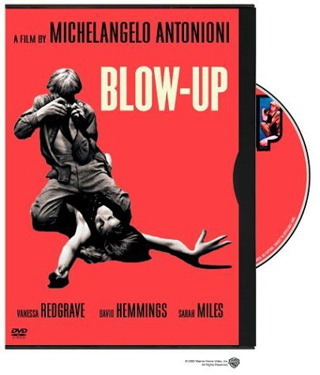
Next drama, and here we are talking of a very great film indeed, made by the splendidly named Michelangelo Antonioni – a name to conjure with. “Blow Up”, dating from 1966 and purportedly modeled on the working-class-photographer-who-made-it-big David Bailey, the anti-hero, played expertly by David Hemmings, thinks he has photographed a body in a public park. Or has he? Full of mystery and great acting, filmed in a 1960s London largely devoid of people, the film has a haunted air. It’s a fascinating piece of history that bears repeated viewing and denies the audience simple solutions or a nice ending.

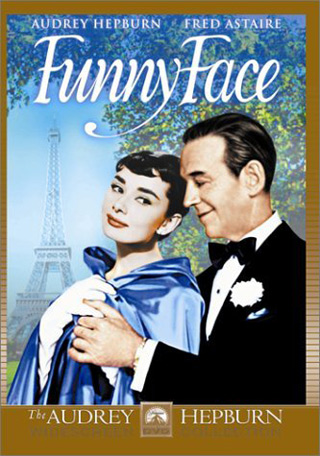
But I have saved the best for last. A delightful confection with Fred Astaire and Audrey Hepburn. ˜Funny Face” was made by Stanley Donen in 1957, which seems a long time ago. Add the wonderful Kay Thompson and you have a prescription for champagne. French champagne (is there any other kind?) as the whole thing largely takes place in that most beautiful of cities, Paris. Mercifully, Parisians take up negligible screen time.

Fashion magazine photographer Astaire, modeled on Richard Avedon who advised on the movie, is invariably draped with Rolleiflexes, though almost all the pictures he takes are made on a huge field camera. Even the action shots. Not that hard to believe when you realize the shutter lag on this monster is far less than that on most modern digital wonders.

Kay Thompson’s opening number, ˜Think Pink” is simply a show stopper. Diana Vreeland at Vogue was never this much fun.

And, of course Audrey Hepburn. Like her or hate her.

Astaire being Astaire manages to dance and sing between photo opportunities and Hepburn almost keeps up with him.

Let’s see, what else?

Well, did I mention the Givenchy gowns? Or George Gershwin’s music?

Should you ever get jaded with the process of taking pictures, just pull out this movie and watch the sequence in Paris where Astaire snaps Hepburn in a variety of posed settings, each snap appearing immediately on the screen once taken. When the cape swirls about her head and she squeals “Take the picture. Take the picture.” you are reminded of the sheer joy and excitement of photography. Just like the time that first black and white print appeared in the developer tray in your darkroom.

Impossible to think that any self respecting photographer would not have this magnificent movie on a shelf at home.

Stumbling about

Visit twenty new photography sites daily

One of the great frustrations of finding new photography on the internet is not knowing where to look.

You read about a site here, a friend recommends one there, in other words pure serendipity.

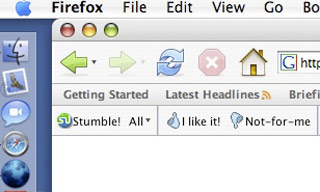
Now the StumbleUpon tool may not remove the random chance aspect of the search, but it does at least make finding new work easy …. and enthralling. The tool plugs into the Firefox browser and appears in a menu bar like so:

If you don’t use Firefox you can download it free from the web. Mine runs on an Apple and it may even run on a Windows PC, though candidly I couldn’t care less whether it does or not as I do not care to use the deeply flawed Microsoft operating system. I prefer something that does not constantly lock up.

The picture above is a screenshot of Firefox from my iMac. Download the tool (http://www.stumbleupon.com/), tell it you are interested in Photography and then click on the ‘Stumble!’ icon. You are taken to a random photography oriented web site. Click again and another site pops up. The rate of repetition is very low, so if you see something you like be sure to bookmark it.

Sites vary but the ratio seems to be about 80% photography: 20% technical instruction.

Every time I have Firefox on the screen I find myself heading for the Stumble! icon and discover wonderful images on many talented photographers’ web sites.

Irving Penn again

The man was a God, but why the pretentiousness?

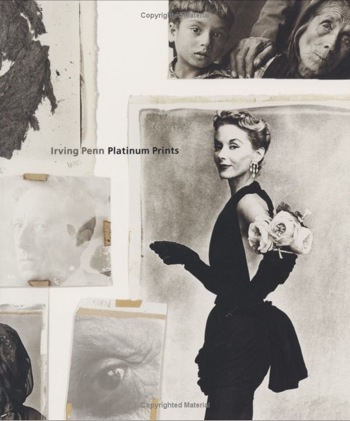
Proving yet again that there’s no money to be made in Art Books, I splashed out the princely sum of $31.50 on “Irving Penn Platinum Prints”. This book had no expense spared at the altar of authenticity.

Now before you accuse me of being unduly critical, a quick check of my earlier piece on Penn’s fine book “Worlds in a Small Room” may be found here.

The man, clearly, is a God in the history of twentieth century photography.

So when I decided to blow serious coin on “Platinum Prints” it was not without foreboding. I have always eyed anything which purports to apply Secret Sauce to a common or garden process with deep suspicion. And, sadly, skepticism was more than justified in this case.

Yes, the famous pictures are all there – that old fraud Picasso, the future Mrs. Penn (well, at least the guy was straight, or it was one hell of a cover), that great black and white Vogue cover of the mesh vail, the Harley Hell’s Angels disguised as Greek gods, the mud people, Cecil(y) Beaton, all those neo-Sander portraits of horny handed sons of toil, those foul/smelly/gorgeous cigarette butts. In other words, Penn’s finest. No question, the reproduction quality of the prints is beyond criticism.

Then, over that height of civilized existence, the evening vodka Martini, I chanced on the back cover of the book only to see the following solemn inscription: “Over the years I have spent thousands of hours silently brushing on the liquid coatings, preparing each sheet in anticipation of reaching the perfect print. Irving Penn”.

Phew!

So the guy:

1 – Despite working for Vogue with all its resources, values his time so little that he has to make his own prints. Something a trained monkey can do reasonably well.

2 – He elects to waste thousands (thousands – do you believe that?) of hours in a darkroom rather than share more of his great vision with the world.

3 – An exotic process is clearly involved. Do I smell snake oil?

I yield to no one in my admiration for Irving Penn. Unlike his fake contemporary, Richard Avedon, Penn had an eye for what he believed in, not for what would sell. He was the Real Thing.

But then he has to go and tell the world that he is using some inane, archaic process to make his prints. They are no better for the fact that he wasted thousands of hours on them, and that means they really are awfully good. Buy the book, disregard the blurb.

Just because the printing process is complex does not mean the print is a good picture. Thank goodness Penn’s work transcends the nonsense this book propounds.

Pseuds’ Corner


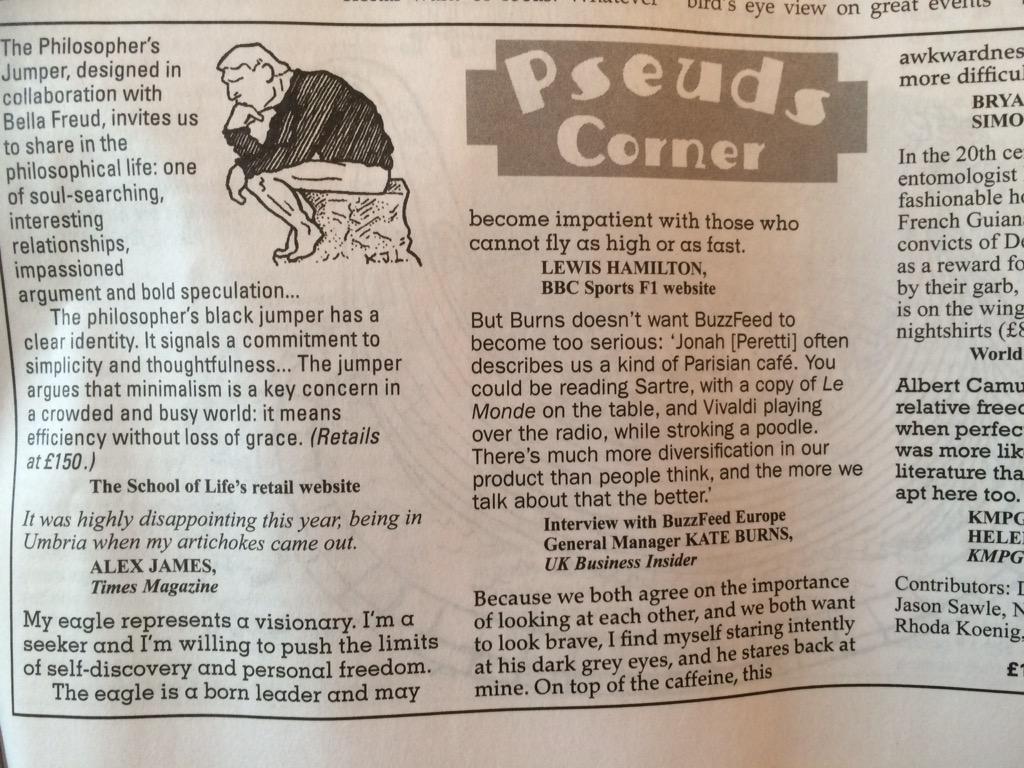
The English satirical magazine Private Eye has long published a column named Pseuds Corner where pretentious nonsense is reprinted in all its glory. For example:

“The sheer courage of these pieces is breathtaking. The space inside, the gap between the walls, narrows, widens, breathes in and out (if you can speak of massive iron “breathing”, which in Serra’s work you can) and eventually rewards you with an inner chamber, from which you have to follow the same route out each emphasizes the ancient Greek philosopher’s Zen-like adage: hodos ano kato mia kai hote, “the way up and the way down are one and the same.” A maze would be fussy; it would interfere with the stupendous directness and logic of Serra’s spatial language. Robert Hughes on the Richard Serra installation at the Bilbao Guggenheim.

Phew!

Well, I never cease to be amused by the vast volume of Pseuds’ Corner prose that the world of photography attracts. Here are some recent examples – the names of the authors and publications have been suppressed to protect the pretentious.

“After a small quantity of test rolls (about 25 in all), both my regular Tri-X, some Lucky 400 made in China and Fuji Acros my personal feeling is: If you already have a later version of the Summicron 50 (and who doesn’t) or a clean 50DR Summicron you would not see much difference on your negatives (from pictures taken with the lens under review).”

From a a self-proclaimed Leica “expert” whose claim to fame seems to be ownership of dozens, if not hundreds of lenses for his Leicas (such fame is certainly not based on the quality of his photographic output).

“As W became better known, he was forced to try to explain in words matters that he knew could not be explained at all, but that might with luck be demonstrated in pictures.”

From the introduction to a book of photographs of a vastly overrated machine gun shooter whose demise caused many a moist eye in the accounting department at Kodak.

“Dualities have always been a feature in M’s life and work. He speaks of a “dark Manichaean flavor” in his earlier urban subjects, but that is not an element in his landscape work.”

From the notes to a book of M’s landscape photographs which prove without a shadow of a doubt that he should have stuck to street shooting.

“E’s affection for photography began at the time when he was starting a new life of sobriety. It is almost as if photography, with its directness, truth, and poignancy, became symbolic of this new life.”

From the introduction to a book about a manic collector of seemingly every famous photograph under the sun.

“Michael works in a special place; on the edge of darkness and light. His images hold a mirror to each viewer’s soul and conscience.”

From the introduction to a book of photographs by a darling of the collector set who has basically taken the same photograph a thousand times over the past twenty years.

“For his simplicity and his unbridled passion for his art, for all that has gone before and for all kinds of other reasons, a lot of which have nothing to do with photography, but a lot to do with art, and for never knowing when to stop chasing rainbows, B is a hero to his own generation and beyond.”

Introduction to a book of photographs by a famous fashion photographer.

“Technical fetishism also has its theoretical counterpart, namely the art of photographing.”

Introduction to a book of one of the most famous street photographers.

* * * * *

I didn’t make these up. Honest. I just went to the largest photography books in my library. The larger the format of the book the more of this sort of clap-trap is to be found in its pages. That does not mean you should stop buying large format books, only that you should look at the pictures and disregard the turgid prose. And remember – no Pseud ever took a good picture.