Category Archives: Photographs

Civilisation

A great and erudite teacher.

I had the most extraordinary case of deja vu the other day, having indulged in the DVD set of Kenneth Clark’s Civilisation. I mention this as I have frequently maintained that there is more for photographers to learn from the art of the Renaissance than in any other field of visual rendering. Click on Paintings for more.
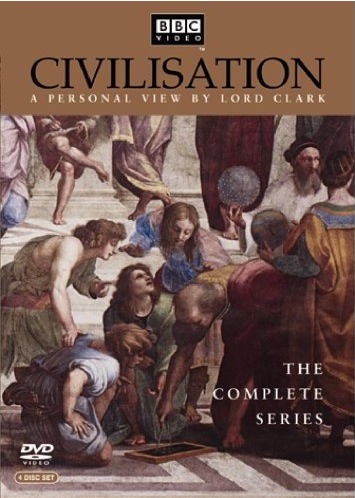
The nature of this strange flashback was that, as Lord Clark was extolling the insane abstraction to be found in Giotto’s faces (Giotto died in 1337, so hardly a Johhny-come-lately) I found myself rooting for something on Giorgione and, suddenly, Clark is talking about him. Now I want some Caravaggio and sure enough, up it comes. Then Donatello, Veronese and Michelangelo. What was going on here? My every wish was Clark’s command!

Then it struck me. Civilisation was released by the BBC in 1969, when I was 18 and just getting serious about the Renaissance. Until then I had been fixated for years on the Impressionists, later Cezanne for his nascent cubism and Degas for his perfect sense of line (until Seurat chanced on the scene, that is). The Old was not for me. All those stuffy oils, over framed, in big galleries. Well, the reality is that, unknown to me these 40 years, Lord Clark had been my teacher. So perfect was Clark’s taste, so beautiful his mellifluous use of that most gorgeous of languages, English (it has fallen out of use since) that I sat entranced and overjoyed at this journey of artistic and spiritual discovery.

As a photographer you are interested in images. As a photographer, your education remains incomplete without an appreciation of the Renaissance and there is no better way to gain that than with this series. Sure, Clark doesn’t affect polyester clothing or make any effort to conceal his patrician leanings. On the other hand, he has no cynicism or snobbery in his make up and the whole is simply a delight. I guiltily admit to having put in the first DVD last night and found that I had sat through four episodes before it was time for bed.

I think you may have the same reaction.

Pool

Or snooker to those of you in moister climes.

When I was a lad attending the School of Engineering at University College, London, it was a well worn saying that had it that a Third Class degree was the Gentleman’s Degree, suggesting, as it did, that the honored recipient had done just enough studying to pass, while devoting the bulk of his time to the role of Gentleman About Town.

One of the vices enjoyed by that urbane boulevardier was, of course, the civilized game of snooker. Change things around a bit, number the balls and you have pool on this side of the Atlantic. It’s as fine here as there.

And while Hollywood would have it that pool players generally hew to the personality of Bogart and the ambience of smoke filled, dank halls, the reality is that it has always, at its core, been a gentleman’s game. The Victorian connotations of the ladies retiring to wherever ladies retire while the men light up a stogie and pour another one (sort of like Alan Greenspan) remains accurate.

At least to this pool player. For while my degree most certainly was not Third Class – the poor kids of parents as foreign as a fruitcake have no time for the town – my affection for the pastime of knocking a few balls around on a piece of felted slate remains firm. And the communal facilities just happened to sport a snooker table.

Well, to cut to the chase and get the photographic content in, I finally acquired a pool table after three years of nosing about in CraigsList. Realize that the population density in central California is just a tad lower than in LA and San Francisco. So specialized toys like pool tables can take a while to find.
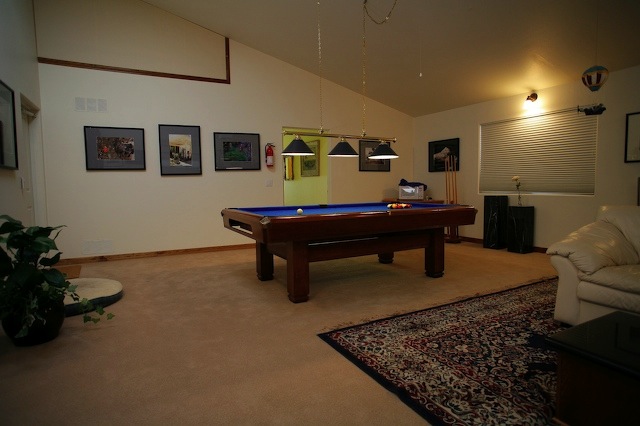

Brunswick Hawthorn in place. 5D, 20mm.

Mine is a Brunswick Hawthorn, beloved of presidents (Ol’ Abe, no less, was a customer) and rock stars, and numbers one Julian Lennon amongst its owners. Add new felt and cushions, a bit of surgical work on the lovely Art Deco brass corner pieces by yours truly (poor design ensured they were constantly falling off as you can see above) and more time than I care to relate on a ladder installing the lights, and my gross investment of $750 doesn’t seem so bad. Priced new pool tables lately? We are talking Italian slate here! We are knee deep in solid mahogany from back in the days when we knew how to handle those rain forests.

Well, after all the efforts of installing the slate, the felt, levelling, lighting, etc. it occurred to me that a good photograph for the wall of the home theater/pool room was called for. So, not 90 minutes ago I snapped this and hope that you enjoy it.
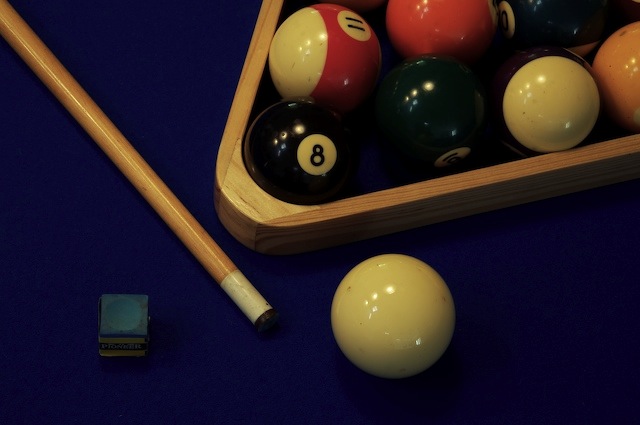

Warm overhead lights. Added some yellow to enhance the antique look in Aperture. 5D, 85mm, 3 seconds @ f/22.

Oh!, and by the way, the 18″ x 24″ print is coming off the Hewlett Packard DesignJet 90 right now. If you would like a print, drop me a line. See what the 5D and a fabulous lens can really do.

Ways of Seeing

No, not the one by John Berger.

One of the books on art I enjoyed most was John Berger’s About Looking which went on to become ‘Ways of Seeing’ when the BBC filmed it. What was especially interesting about the piece is that it is cast in the author’s Marxist viewpoint of the world, where every object or possession is examined through the eyes of society rather than seen as the thing itself. That is no bad thing. After all, are we not told that small minds speak about people, middling minds talk about issues and great minds cast about for concepts? Berger is all about concepts.

The only snag with this thinking is that just because the author addresses concepts does not mean that his frame of reference is sane.

But, for much the same reason that I sometimes read the New York Times or watch Fox News – a recheck of reference points on the loonie left and the psychotic right – it is always an education to read the works of a Marxist as it serves to freshen one’s ideas about freedom, personal responsibility and the sanctity of the individual. So far, my belief in these attributes has only been strengthened by digesting the claptrap put out by these media.

Just think. In a perfect Marxist paradise there would be no music – you might, after all, enjoy it more than I, and we can’t have that. There would be no art – we all look alike and dress alike and live alike, do we not, comrade? And, worst of all, there would be no photography. That is the purest form of subversion. You want my likeness? The Ministry of Truth will not like this, you know.

Crazy? Ever seen any good snaps of Mao’s totalitarian China?

No. I didn’t think so.

No photography. Just think.

Horst and Hoyningen-Huene would never have made their homo erotic-tinged masterpieces. Mapplethorpe’s illustrated history of perversion would never have been seen. Newton’s jejeune dirty pictures would not have been published.

Hang on. Maybe Marxism would not be so bad for photography.

Just a minute, though.

That means we would have never been afforded the chance of seeing the guilty confections of Beaton. The just-so elegance of Cartier-Bresson. The soaring aristocracy of Blumenfeld. The gay abandon of Doisneau. The passion and sophistication of Parkinson. The guts of Bourke-White. The vision of Evans and Weston. The courage of Adams and McCullin and countless others. And, yes, even the second rate candy box tripe of Ansel Adams.

So maybe Marxism is not such a good thing.

I was reminded of all of this on reading in the Wall Street Journal (centrist mostly, loopy right on the OpEd pages) of the Met’s exhibition of no fewer than 228 pictures from its Dutch collection. Thank heavens for the robber barons. They provided labor for all and bequeathed great art collections to the Met. Works for me. And that got me thinking about the differences between religious art (meaning ‘Vatican-religious’) and secular art (being the Dutch and Belgian schools of the 17th century and their British and German forbears).

While painters of both schools were working on commission, the Vatican types enshrined their subjects, whether biblical or Papal, in halos and angels, the better to hide the foul stench underlying their accession to power. The Dutch chaps surrounded their clients with the attributes of wealth, perhaps never shown better than in Holbein’s ‘The Ambassadors’ (OK, so he was a German painting in England. The point is he adopted a secular rather than religious tone). And the stench? There is none. As my grandfather used to remind me, pecunia non olet. Money does not smell.


Holbein. The Ambassadors. 1533. The National Gallery.

The fine cloaks, the tools of navigation, attributes of wealth like the lute, are all seen large. These people are rich and successful. Of course, most photographers care not a whit for that. All they can fixate upon is the elongated skull in the foreground which, viewed obliquely from the lower left, shows itself in full splendor. You can interpret it as you like but I have long preferred to think of it as the ultimate statement in secular art. It is there because the clients wanted it there. It’s as spontaneous as, say, a White House speech or a politician at the site of an airplane disaster.

That’s not to say that the Vatican types didn’t try to subtly subvert the system. Take a look at Caravaggio’s ‘Supper at Emmaus’ – the one in the National Gallery is the corker, not the one in Milan.


Caravaggio. The Supper at Emmaus. 1601. The National Gallery.

At first it is what you want to see. Christ surrounded by fawning apostles on his resurrection. I first saw it on the obligatory school outing, short trousers and all, when I was maybe 10 years old. And, like every misbehaving schoolboy, I stuck my nose in the canvas and all I could see was the imperfections. (OK, so my mother was Germanic and demanding. Leave it.) The tear in the sleeve. The worms in the fruit. The ravaged and bloated faces. Years later, the secularist in me acknowleges how smartly Caravagggio has hidden the stigmata, despite their being the object of focus for the two at the table. He isn’t buying it! In every possible way the painter is saying “Screw you and your religion” and I fell in love with him there and then. Even if my original admiration was for the worms. And even if I was having to go to mass three times a week.

Another guy who got it really right, meaning he got paid though his clients didn’t notice his work was no less subversive, was Mantegna. In his Death of St. Sebastian (I am reproducing it in a large size here as the detail in the painting merits it) you must agree at first glance that, surely, this is the proto-religious picture. The martyr is well and truly martyred, and true to form, is saving his dying gasp for the one true God, with that damnably condescending look of forgiveness for his killers. The only snag is that Mantegna, like some latter day cartoonist, has neatly insinuated two of the shooters at the lower right. And what do you think the one is saying to the other? “Nice shot, Ernie?” “Fancy a couple of quick ones at the pub?” “Did you catch the thing at the Coliseum last night?” It is a superbly crafted piece of subversive, secular propaganda.


Andrea Mantegna. The Death of St. Sebastian, 1480. The Louvre.

Now do you see why Sebastian’s expression gets my goat? Don’t you think a guy who just got one through the privates would at least admit to some pain? And the painter was Spanish. Can you say Spanish Inquisition? Catholicism’s version of modern Islam. Whoever painted this had real courage. Viva Mantegna!

So great painters were making ‘photographs’ 500 years ago. The Decisive Moment was there – it just took a while to place it on canvas. No 1/60th @ f/8. Their genius in reducing imagination to canvas gave us works like those above. Not being as good, we needed Kodak and a button to press. And by the time real photography came along the religious had disappeared. The world, as western hemisphere photographers know it, was secular. And hooray for that. May all our photographs be as subversive as those of Holbein, Caravaggio and Mantegna.

About the snap: Green

Green


Date: 1987
Place: Near Ojai, south central California
Modus operandi: Riding my motorbike on a pleasure trip
Weather: Perfect leather jacket weather
Time: 11 am
Gear: Pentax ME Super, 40mm Pancake Takumar
Medium: Kodachrome 64
Me: Awestruck by the lack of any color except green
My age: 36

This lovely cherry orchard was impossible to miss, and it was a moment’s work to capture this monochromatic palette featuring my favorite color. Look hard and you will see a deer on the right.

My landscape photography was much influenced by a Dutch photographer named Kees van den Berg – hard to find anything on him nowadays – and his simple use of color.

The little 40mm ‘pancake’ lens, so nicknamed as it was very small and flat, made for a fine travelling companion with the very compact ME Super body. Pentax continues to make pancake lenses for its DSLRs and should be applauded for it. You can see another one of my snaps with the pancake here.