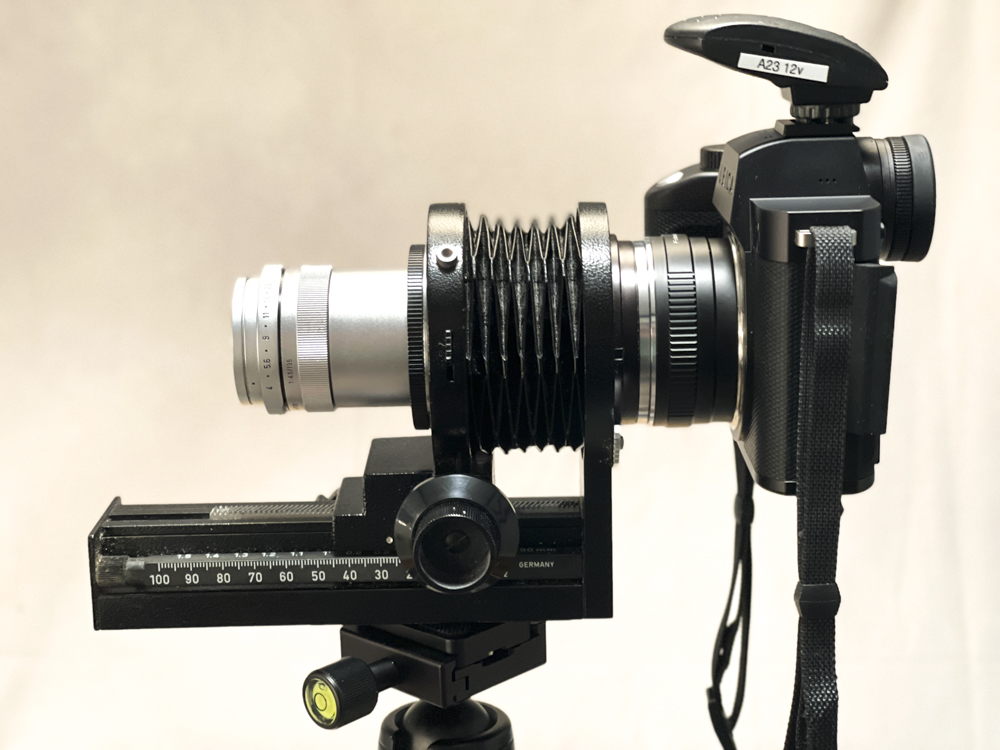
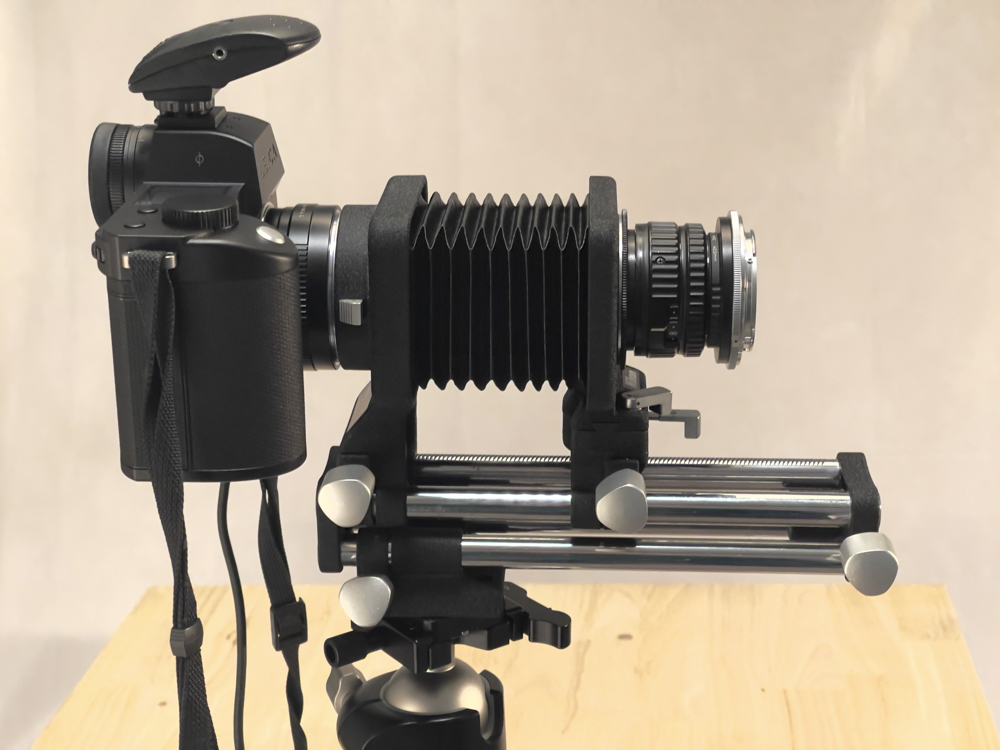
Superb on the Nikon PB4 bellows.
For an index of all Leica-related articles click here.
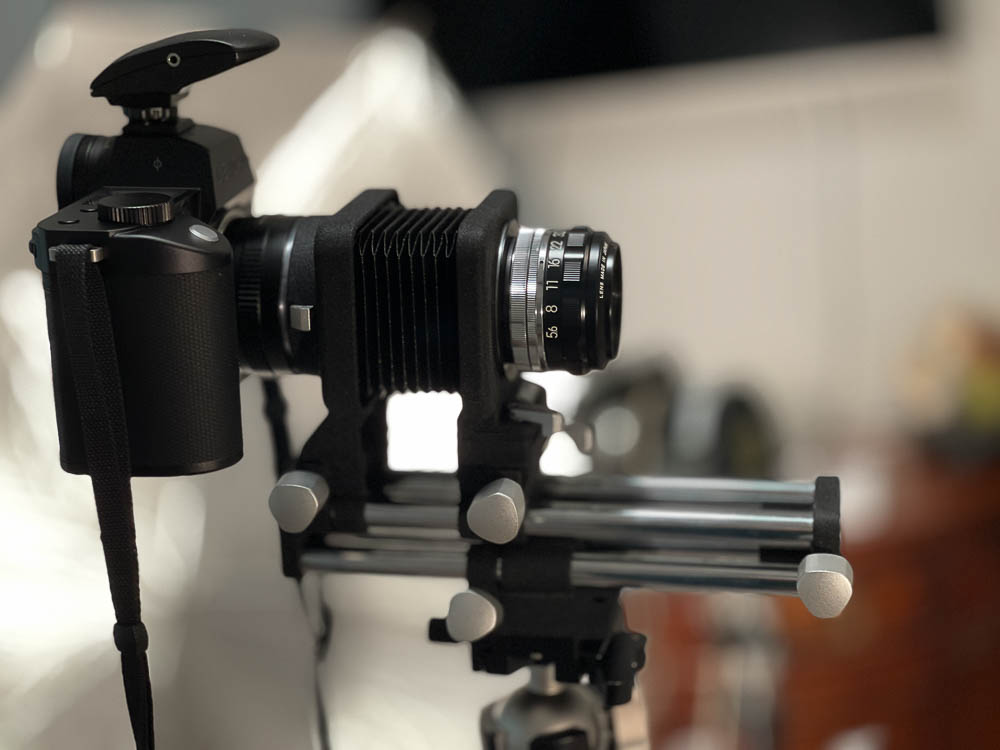
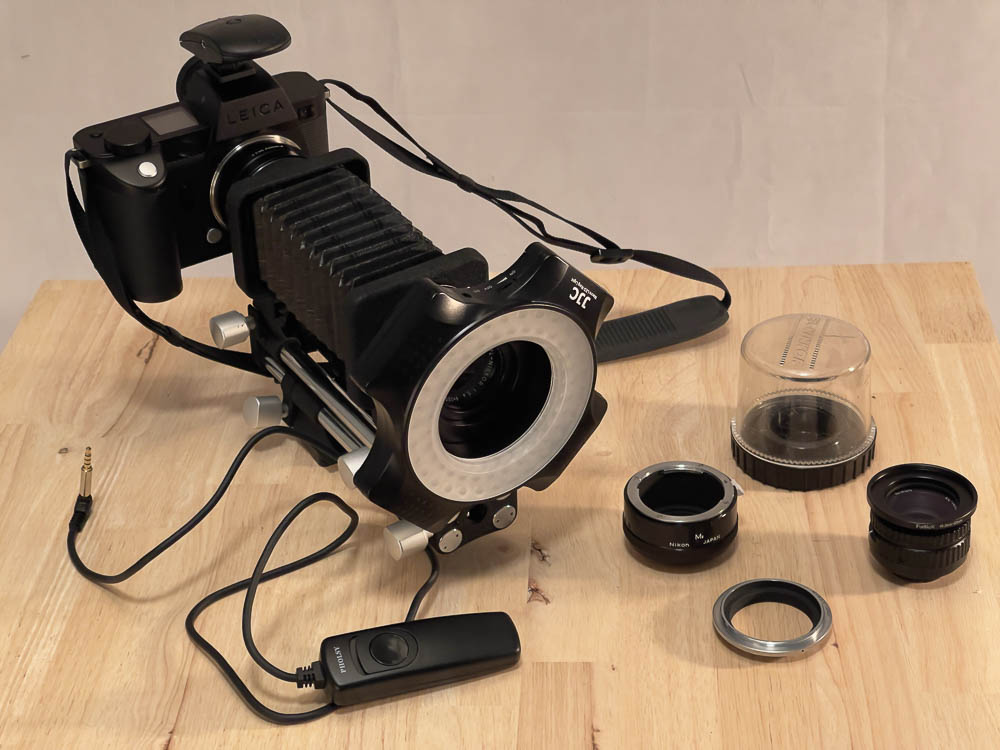
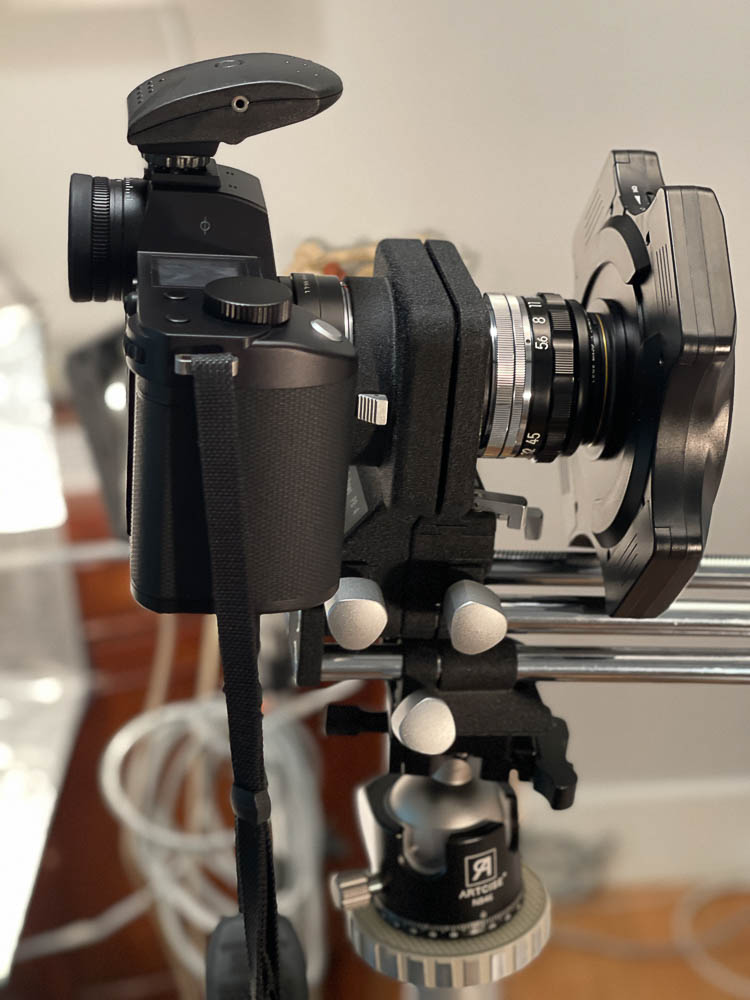
The 135mm f/5.6 El Nikkor on the SL2-S and PB4 bellows.
History:
Nikon went all out with the design and execution of the 135mm f/5.6 El Nikkor enlarging lens. Only the seriously disturbed use darkroom enlargers any more but enlarging lenses of that era are perfect for macro photography. They have no automation, and none is desired in macro work, and are computed with a very flat field. They are also an exceptional value on the used market.
Mine is from the third of four batches, with the last batch sporting a 52mm filter diameter, compared with 43mm for the first three. I would guess it was made around 1980. There appear to be little if any other changes between batches, though the fourth may have added multi-coating.
Why 135mm for macro work?
The 135mm focal length provides ample subject-to-lens separation making even the use of bulky strobe lighting easy. The downside is that the maximum reproduction ratio with this focal length and the PB4 bellows is 1:1, meaning life size. If you want to go bigger either additional extension tubes or a shorter focal length are required.
The image circle:
The 135mm f/5.6 El Nikkor was computed to enlarge up to 5″ x 4″ negatives, meaning the image circle diameter the lens projects in macro mode is 7.1″/180mm, meaning very large indeed, and it’s this large image circle which comes into its own with the Nikon PB4 bellows when the bellow’s front panel tilt and shift features are being used.
Here’s a simple illustration:
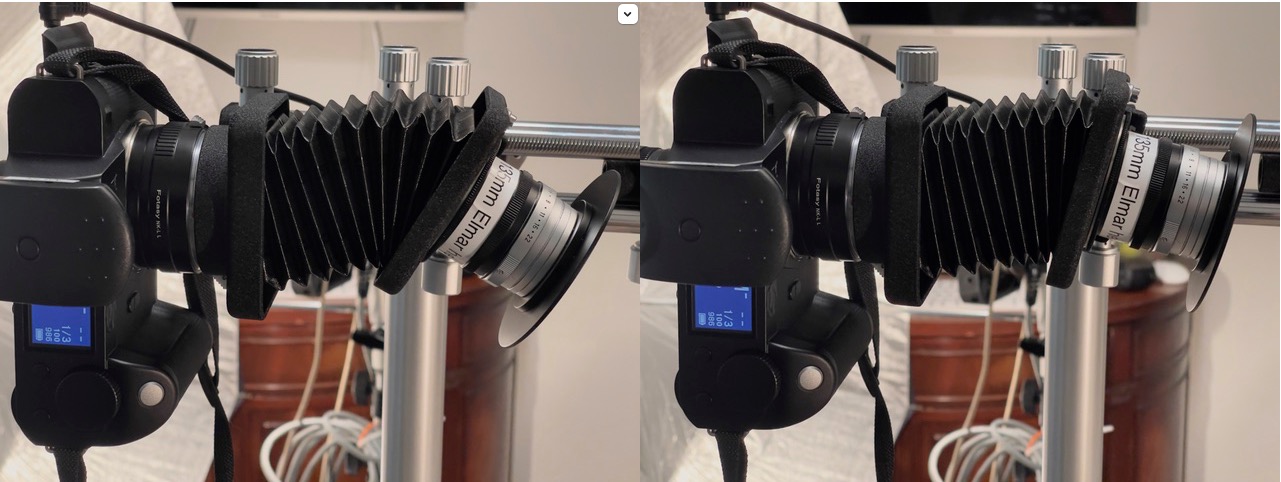
Maximum tilt with the 135mm Leitz Elmar (left)
compared with maximum tilt usable (right).
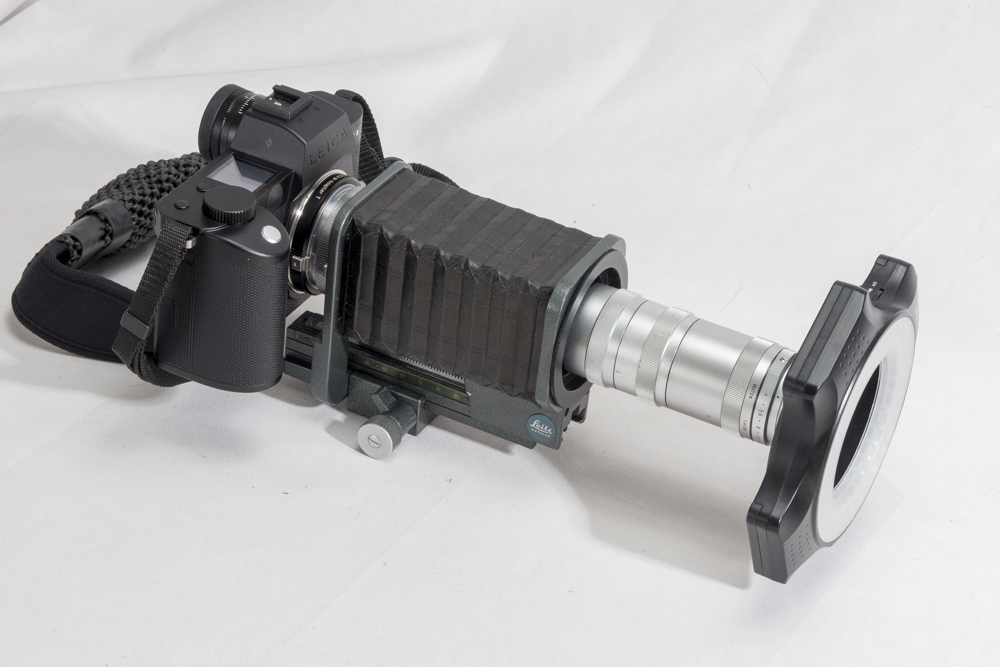
Compared with the 135mm Leitz Elmar:
The Leitz 135mm Elmar lens head is an outstanding performer in the macro range but its image circle is computed for a 2.1″/53.9mm diagonal, that of the 24mmx36mm full frame digital sensor or film stock. The right image above shows the maximum tilt that can be used on the Nikon PB4 bellows before the image circle runs out. That measures at 11 degrees. By contrast the left image, above, shows the full tilt available, which is 25 degrees, at which point the viewfinder is completely black. There is no image.
Perform the same calisthenics with the 135mm El Nikkor fitted and there is no issue. At full tilt of 25 degrees the image remains bright and evenly illuminated across the full frame. That’s the benefit of a large image circle.
Cost and build quality:
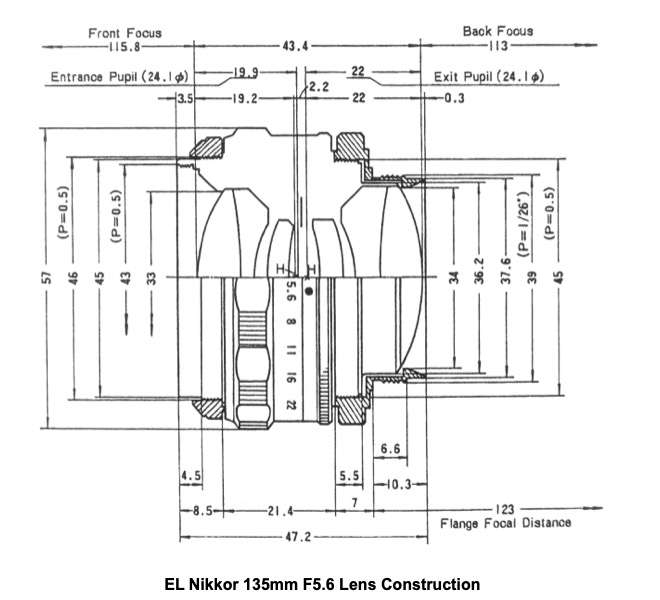
And that’s not all. First, the lens cost me all of $65 in mint condition including the original Nikon ‘bubble’ case and front cap. Second, the focus range on the PB4 is from infinity to life size, meaning a 1″ x 1.5″ object fills the frame at the closest focus distance. Third the build quality is out of this world, all glass and metal with a massive removable rear ring with takes the 45mm enlarger mount tread down to the standard M39, or Leica Thread Mount, which is 26 threads per inch and 39mm in diameter. And, sparing no detail, Nikon has fitted the lens with a diaphragm which sports no fewer than 12 leaves for the smoothest rendering of out-of-focus areas, This lens comes from the great Metal Era of Nikkors. There are click stops from f/5.6 all the way down to f/45. The lens has a symmetrical design with 6 elements, arranged thus:
Reversed use:
The front filter thread is 43mm so adding a 43-to-52mm step-up ring allows use of the lens reversed on the BR2 or BR2A Nikon lens reversing ring when magnifications in excess of life-size are contemplated. (The BR2A was a minor redesign to avoid damage to microchips on chipped Nikkors). If you decide to purchase a 135mm El Nikkor make sure it comes with the 45mm to 39mm rear chrome step-down adapter ring which converts the lens to Leica Thread Mount, as these seem impossible to find in the new or used markets.
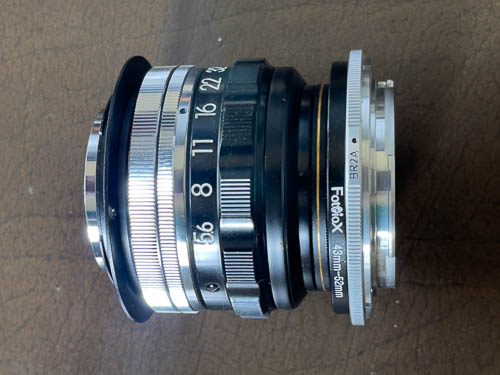
The lens with an M39-to-Nikon F adapter at left,
the chrome Nikon 45-to-39mm step-down ring,
a UV protective filter, a 43-to-52mm step-up
ring and the BR2A Nikon lens reversing ring.
The BR2A can be mounted in any of three 120 degree apart orientations to ensure that the aperture scale is clearly visible. That’s not as nice as the eleven click stop orientation feature in the 80mm f/5.6N El Nikkor, but it does the job.
Performance:
How’s the performance? In a word exceptional at all apertures down to f/32 in the center and down to f/16 at the extreme edge with no tilt applied. At full tilt the extreme edges stay almost the same with the very small loss in resolution only visible at huge enlargement ratios. Overall, tilted or not, the sweetest of many sweet spots is found at f/16.
Here are the extreme edges untilted and tilted 25 degrees (the maximum available) – view this on a 32″ display and you are looking at the equivalent of an 72″ wide print:
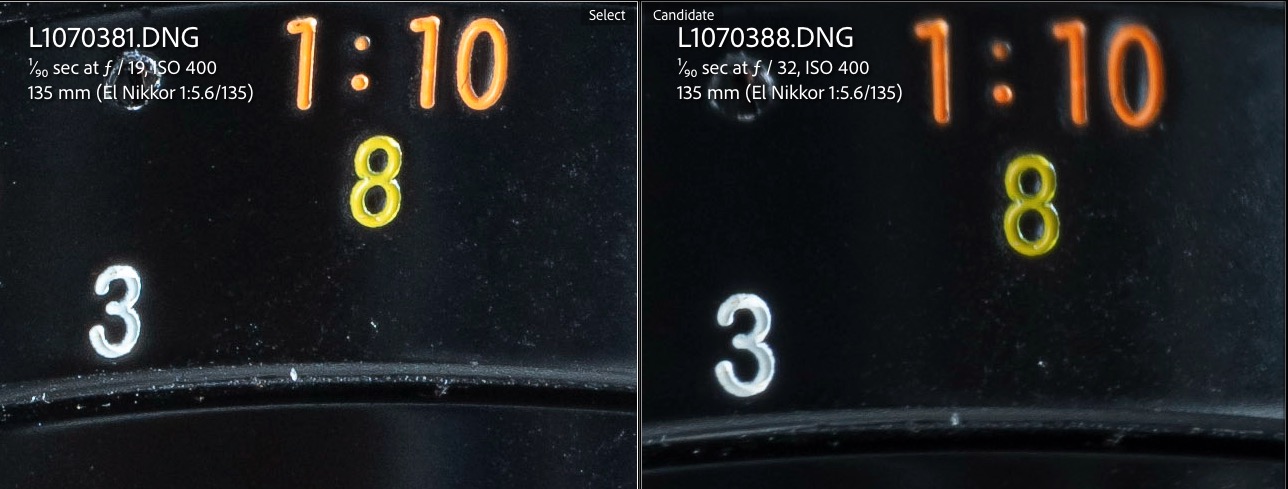
Extreme edge with no tilt on the PB4 (left)
and maximum tilt (right). Apertures are
not reported correctly – f/16 was used.
How does the El Nikkor’s performance compare with that of the 135mm Leitz Elmar?
The comparison here is with no tilt or shift as the Elmar cannot handle much of either. The El Nikkor was at f/16 and the Elmar at f/11 – the sweet spots for the respective lenses:
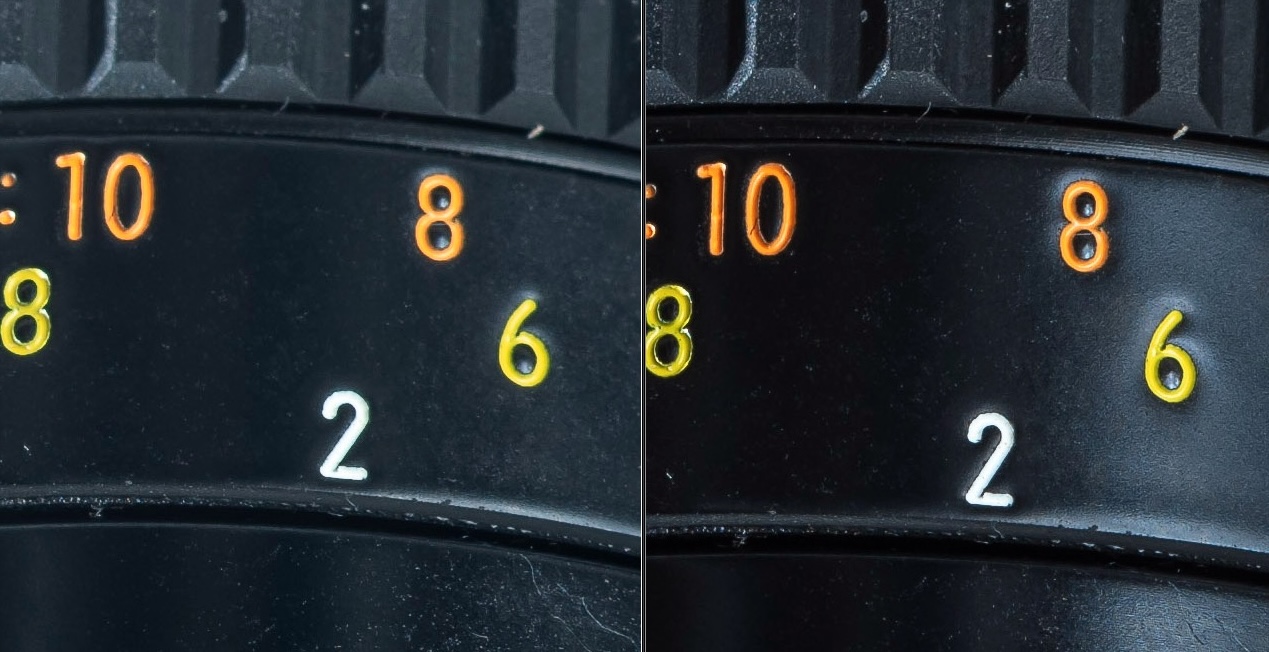
Center resolution – El Nikkor (left) vs. Elmar (right), no tilt or shift.
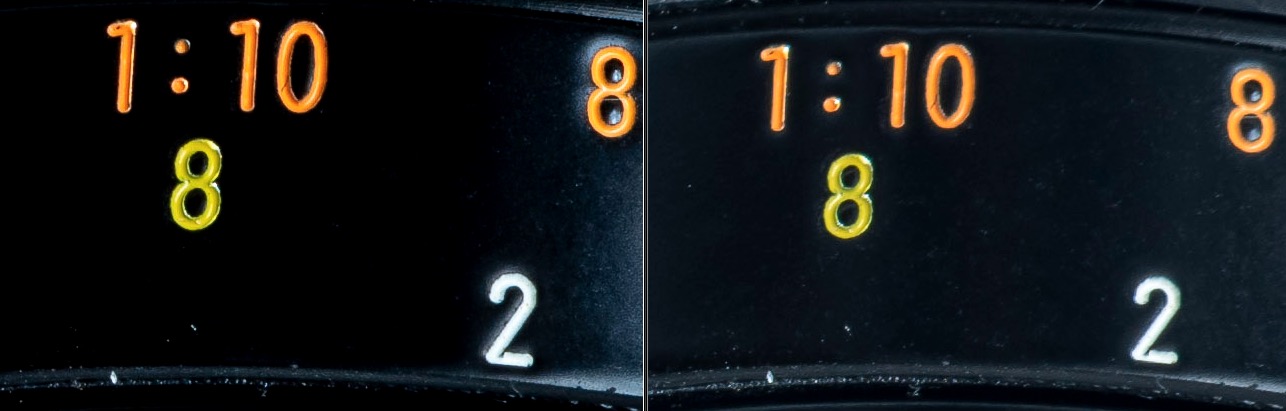
Extreme edge resolution – El Nikkor (left) vs. Elmar (right), no tilt or shift.
The El Nikkor shows marginally higher resolution than the Elmar in the center, while there is nothing to choose at the extreme edge. Given that a good used Elmar typically retails for $150-200, the El Nikkor is the better buy, and the best choice if tilts and shifts are contemplated using a Nikon PB4 bellows. On the other hand you can happily use your 135mm Elmar in its rangefinder mount on a film or digital Leica M, or even on a screw thread Barnack Leica if you have the M39 version.
Use at normal distances:
You can always use this lens and bellows combination for images at normal subject distances, all the way out to infinity. This is about as sane as using a darkroom and enlarger but a quick check confirmed that the central definition is on a par with the 135mm Elmar at f/5.6 and f/16 but with considerable corner smearing at f/5.6 and still some at f/16. The Elmar is clearly superior. Stick with a regular 135mm lens for regular distances.
Going larger than life-size:
With the PB4 bellows fully extended the largest magnification ratio possible with the 135mm El Nikkor is 1:1, or life-sized. If you need greater magnification then the 80mm f/5.6N El Nikkor is recommended. Also a six element design it is easily reversed for larger than life images and every bit as good. While the third version of the 135mm El Nikkor (above) is single coated, the ‘N’ version of the 80mm El Nikkor is multi-coated. I doubt that makes any realistic difference in the results. The 80mm also sports a large image circle to allow full use of the tilt and shift functions of the PB4 bellows and costs about the same as the 135mm on the used market. The one downside is the shorter subject-to-lens distance.