Category Archives: Nikon lenses

Some of the best optics ever

Nikkor 300mm f/4.5 ED IF AIS MF lens

Alphabet soup.

When I added the 300mm Nikkor manual focus lens to my little D700 outfit, it was with the realization that this relatively little used optic did not justify spending a lot of money. So it was off to KEH.com where I picked up one marked ‘BGN’, meaning something between a beater and a dud. However, having purchased from this business in the past, I knew that they grade conservatively and earlier ‘BGN’ purchases had invariably resulted in fine gear with typical superficial markings from use. And so it turned out this time.

What I received, for less than one quarter the cost of the current f/4 AF optic, was a lens with pristine glass, a beyond smooth focus action and …. a wobbly telescoping hood. The trombone assembly for the latter is attached with three small screws and it was a matter of moments to remove it, disclosing that the cork friction strip inside was worn out. I took the easy way out and wrapped one-and-a-half turns of 3M Flue Tape around the inner cylinder and while the result is not pretty the wobble is no more. This is a thin, metallic tape with strong adhesive, and one $8 roll will do more lenses than you want to think about. I’ll give it a spray coat of high temperature matte black paint, of the kind used on car engines. It’s tough and will hide the tape nicely.

The lens focuses down to 8.2 feet (2.5m), which is like a 50mm lens at 16″. That’s close. It also focuses well past infinity, to compensate for warm days, owing to the expansion of the metal used in its construction.

Contrast is high, identical to that of the other two lenses, putting a well deserved lie to all the claptrap you read about ‘designed for digital’ lenses. This is a film era lens (around 1990s vintage) and works perfectly with the sensor in the D700. ‘Designed for Digital’ is yet another advertising hoax designed to separate the gullible from their money.
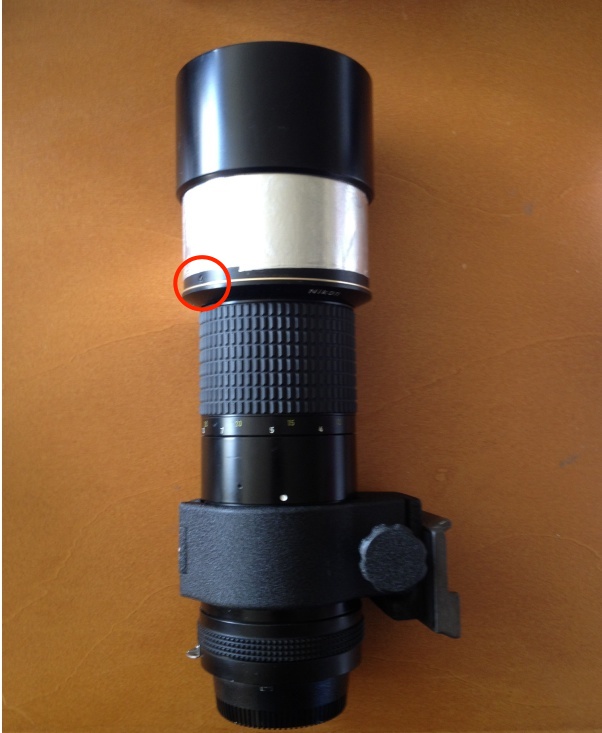
300mm MF Nikkor. Flue Tape prevents hood wobble.
Circle denotes one of the three trombone retaining screws.

If following moving action is your thing, this lens is not for you. Auto focus will make life much easier in that case. But my primary use is for architectural details, used as often as not with my Manfrotto monopod fitted with a QR release, so I’m in no hurry. The D700 has a focus confirmation light in the finder, with arrows showing which way to turn the focus collar if you are out of focus. This works really well but is very sensitive. In practice, other than at full aperture, I find that simply focusing on the screen works well, the high f/4.5 focusing aperture making images snap in and out of focus readily. The lens shows a hint of chromatic aberration wide open with high contrast subjects, but otherwise has no bad points. With the removable collar it weighs 2.2 lbs. and balances nicely with the heavy 2 lb. D700 body. I dialed it into the ‘Non-CPU lens’ menu on the D700 so the EXIF data correctly reports that a 300mm lens was used.
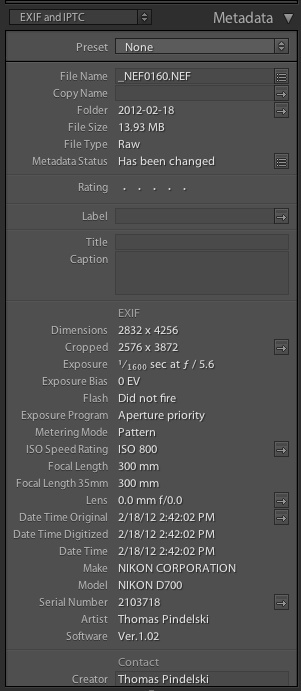
EXIF data in LR3.

Unfortunately, Lightroom sorts on the ‘Lens’ field when filtering images, so only the actual EXIF for an image will disclose that a 300mm lens was used. The ‘Focal Length’ and ‘Focal Length 35mm’ fields do not constitute searchable EXIF or IPTC data in LR, as far as I can tell. Good luck getting Adobe to fix that.

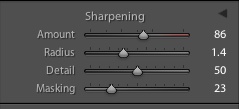
By virtue of the Internal Focusing design, operating the focus collar moves a selection of elements internally, not the whole lens barrel, so the length of the lens remains fixed and the action is butter smooth. Just a joy to use. I would describe the rendering of micro-detail as close to that of the very expensive 16-35mm and the bargain 85mm D designs, but not as good through f/5.6. At f/8, however, micro-contrast really kicks in and the definition equals that of the other two. A touch on the Clarity slider in LR3 mostly puts matters to right at f/4.5 and f/5.6, and I am finding that the 86/1.4/50/23 Sharpness settings in my import dialog in LR3 for the other two lenses works well.

The tripod collar, easily removed, is well designed, but not in the class of the one on the 400mm f/5.6 Canon L, adopting a threaded fastener in preference to the superior cam lock used by Canon. There is no Vibration Reduction, which keeps the weight down but that savings is offset by the need to carry a support if slow exposures are contemplated. With the collar removed I find the lens easy to handhold.

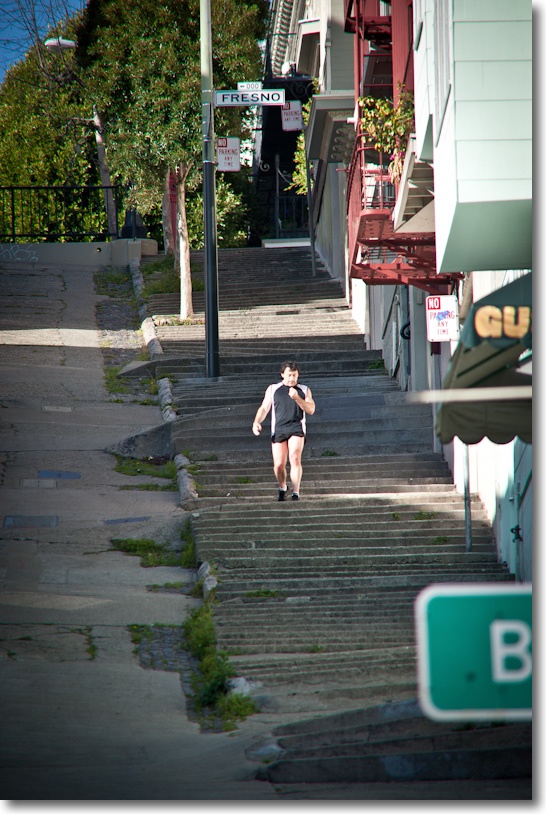
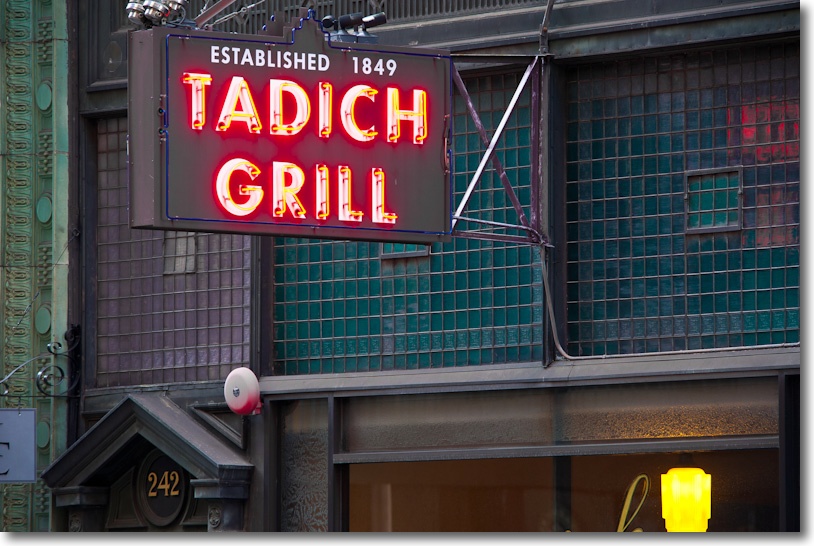
Wringing it out yesterday I made a few snaps in San Francisco in late sun, all at 800 ISO and mostly with a monopod. These are almost all straight from the RAW originals, with minimal post-processing, with the usual sharpening on import into LR3. The lens retains Aperture Priority (my choice) or Program exposure automation on the D700, with focus at full aperture:
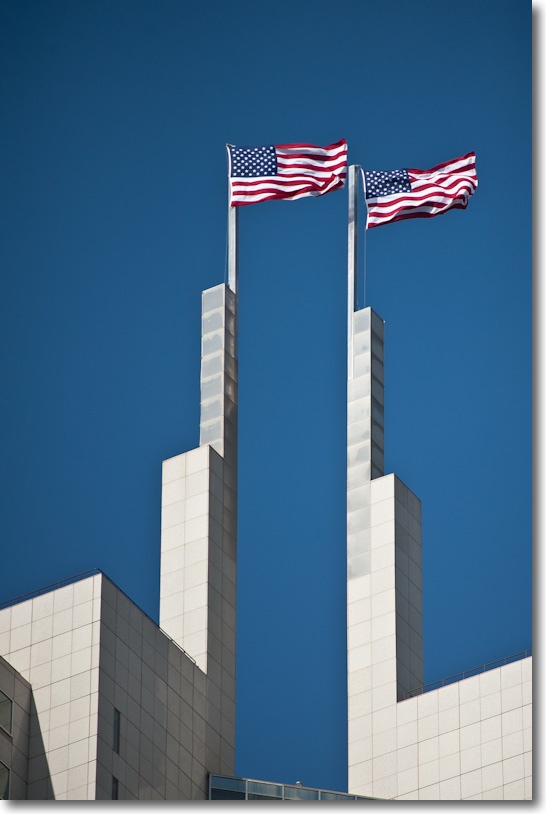

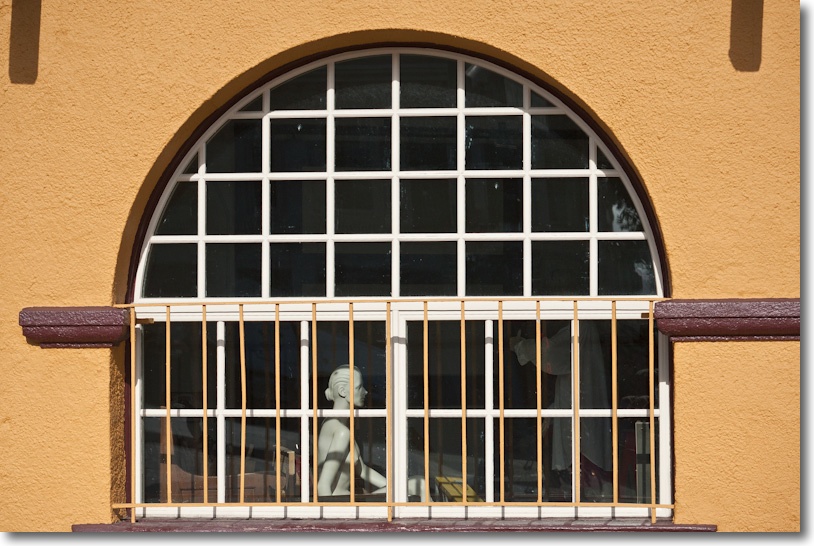
To get a sense of what the lens can do in huge enlargements, here’s a snap at f/8, 1/50th second, ISO 800 with monopod:
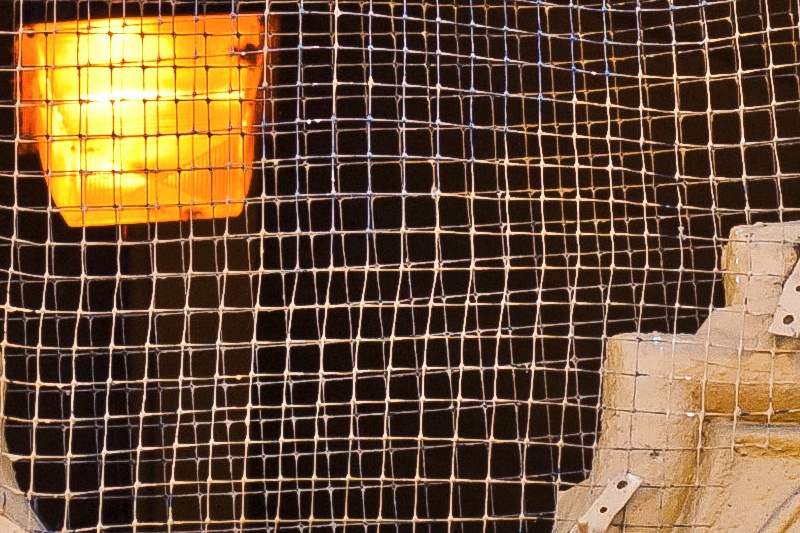
Here’s a section from the top left which would make a 40″ x 60″ print:

Not too shabby – notice the level of detail retained in even low contrast areas.

Adding a CPU:

While many lenses allow simple glueing of a CPU to the rear baffle, the baffle on this lens is too large in diameter to provide the required clearance for the CPU.

I therefore set to machining the baffle on my 300mm f/4.5 ED-IF Ai-S lens. The baffle is retained by three radial, countersunk Philips screws. The fourth, proud, slotted screw is for the stop down lever and is not touched.

After doing some measuring it turned out to be very simple. The full thickness of the baffle has to be removed and the depth of removal is conveniently denoted by a ridge on the baffle, visible once removed.

After marking the position of the CPU with a fine scribe, removing the three screws allows removal of the baffle. It shows traces of threadlocker so it would likely be smarter to use some local heat from a soldering iron on the screws first. I lucked out.

The lens’s tripod collar is removed in these pictures.
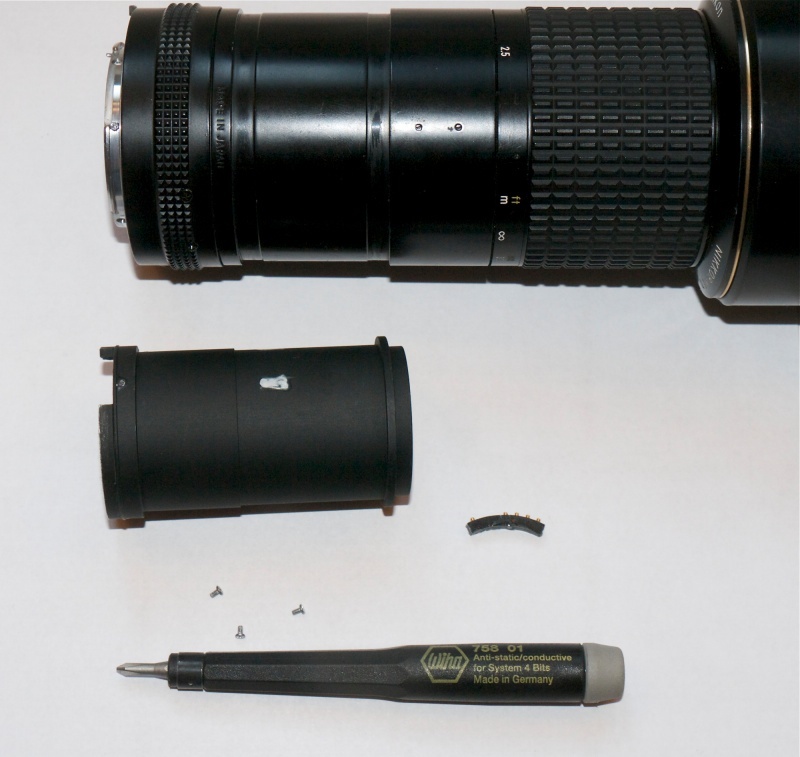
Three screws removed, the baffle can be slid out.

The thickness of the CPU body material is identical to that of the baffle’s wall, I used a Dremel cut-off wheel, a metal saw and a fine file to make the slot in the baffle. A milling machine would have been nicer! The CPU is circled in red below.
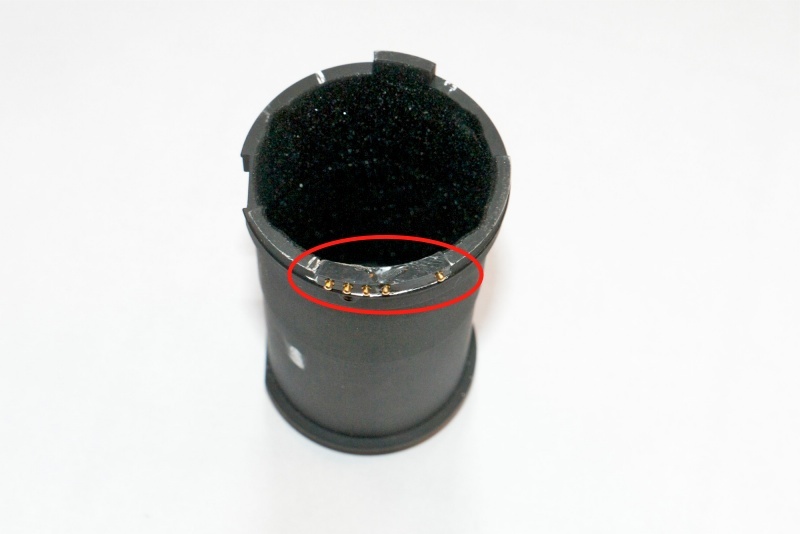
The CPU in place.

This lens’s baffle is 1.613″ in. outside diameter. The wall is 0.118″ thick, thus the inner diameter is (1.613 – 2 x 0.118) or 1.377″. (It is hard to directly measure the inside diameter owing to various reliefs in the metal). This is right in the range of 1.364″ (75-150mm Series E Nikon zoom) through 1.427 (50mm f/2 Nikkor-H) which allowed a straight glue on of the CPU, so glueing the CPU in place such that it’s base (non-contact side) is plane to the inner diameter of the baffle confers the right contact position.

Lens correction profile:

This lens has some chromatic aberration at full aperture and modest vignetting which disappears by f/8. You can download my custom lens correction profile for use with PS or LR by clicking here.

Legacy Nikon lenses

Jewels for pennies.

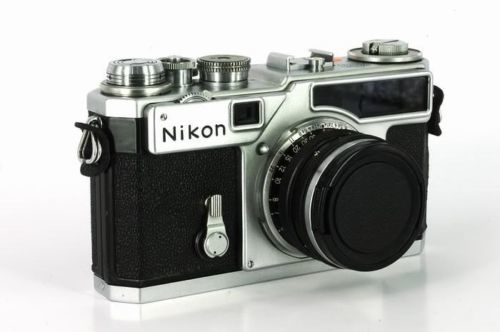
When photographers of the caliber of David Douglas Duncan of LIFE first started traveling to Japan in the 1950s they quickly learned that Canon made superb Leica screw mount lenses. These were easily adapted to Leica M bayonet bodies and provided rangefinder coupling as often as not. They spread the word and Canon, in that regard, may have done more to boost the Japanese camera industry than any maker since. Later, of course, Pentax came out with their wonderful SLRs with instant return mirror and Nikon trumped all with the Nikon F SLR. Rangefinders were abandoned, though not before Canon with the 7/7S and Nikon with the S1/S3/SP created two of the great classics of the rangefinder era. These, especially the SP, command collector prices today. The Nikons introduced the titanium curtain focal plane shutter which had a lot to do with the legendary toughness of their successor, maybe the greatest SLR ever made, the Nikon F. The camera that documented Viet Nam.

Nikon SP.

Working as a kid at the Dixons sales counter in London, I had the opportunity to handle many of these as the used market was flooded with owners upgrading to the Nikon F. The feel and sound was similar to the F, meaning robust and solid. But when Nikon went to SLRs, like Canon they realized that the small lens throat of their rangefinder bodies would make design of lenses difficult, especially of the short focal lengths which had to adopt a retrofocus design if the SLR’s flapping mirror was to clear the rear element. So both makers went to larger diameter bayonet mounts, Nikon abandoning the Contax bayonet on the SP and Canon moving on from the Leica 39mm thread mount. Since then, Canon has adopted no fewer than three bayonet mounts for its SLRs. The early Canonflex style, the FD of the ’70s era and then the EF in use today. Nikon, by contrast, has stuck with the original F mount, albeit with adaptations for indexing the maximum aperture on later lenses – the AI and AIS models.

The differences in design philosophy are non-trivial. Forget early Canonflex lenses – too few choices are available and good luck adapting these to anything. Further, for the modern Canon user, FD lenses are mostly a lost cause. The trouble is twofold. First the flange to film/sensor plane distance for the EF mount is 2mm less than for the FD mount. That means that unless your FD-to-EF adapter includes a negative lens element in its design, you will be unable to obtain infinity focus using an adapted FD lens on an EF mount body. Second, as Canon went to an electronic aperture setting mechanism with the EF mount, you will lose automated aperture stop down with FD lenses on an EF body. You focus at maximum aperture then stop down what is now a manual lens to working aperture, the finder screen going dark in the process. Further, even if your adapter has a crappy negative lens to destroy the great definition of your FD lens while reclaiming infinity focus, there is no electronic focus confirmation. You go by what you see on the screen. This is a great shame as it means that, to all practical intents, the magnificent range of FD lenses is not usable on modern Canon bodies.

The contrast with Nikon’s approach could not be greater. With very few exceptions, every Nikkor lens can be used on a current Nikon body, with pre-AI models requiring a $25 machining adaptation to fit and work. The sole exception is mostly early fisheyes which required a mirror lock-up and external finder. No mirror lock-up exists on the modern DSLR Nikons (save for sensor cleaning) so these lenses are not usable. Nikon retains a mechanical control for aperture stop down to this day, so even early Nikon F lenses will retain aperture automation. Auto exposure measurement at full aperture is retained and bodies like the D700/D3 and others provide an electronic rangefinder confirmation of optimum focus, denoted by a green diode in the finder. Out of focus results in one of two arrows pointing in the direction the lens mount has to be rotated.

Why would anyone care? Well, because unless you must have autofocus, these manual focus Nikon lenses are some of the best ever made. In the early days there was only one range – no bargain basement models where design corners had been cut. The mounts were massive, the construction fabulous and the optics outstanding. One of the nicest things about working as a sales clerk at Dixons in the late ’60s was that I was allowed to borrow gear for the weekend (anything except the Leicas!) and I often found myself with a Nikkormat FTN, with the 24mm, 50mm, 105mm and 200mm Nikkors. All these optics were superb in every way. A 16″ x 20″ print was expected, not exceptional. The Nikkormat replaced the bulletproof shutter in the Nikon F with a somewhat fragile shutter (later improved) but came with compact TTL metering on most models and was a sweetheart to use.

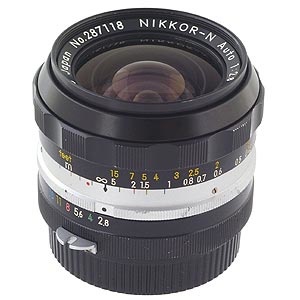
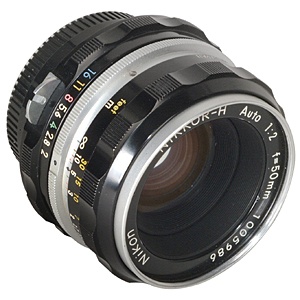
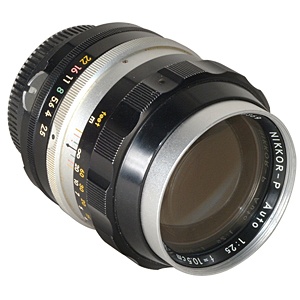
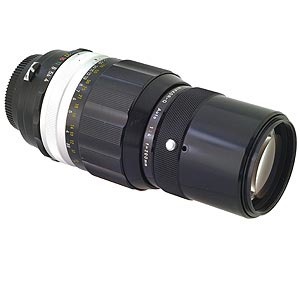
Here’s what some of those great lenses sell for today – I have illustrated the scalloped metal focus ring versions which are my absolute favorites for look and feel:

Nikkor 24mm f/2.8 – $150 used.

Nikkor 50mm f/2 – a true competitor to Leica’s Summicron. $50 in mint condition.

Nikkor 105mm f/2.5. $75.

Nikkor 200mm f/4. $40.

So for $315 you get a complete outfit which will do you proud anywhere in the world, provided you don’t mind the absence of autofocus. In the case of these lenses, you can use Aperture priority or Manual exposure measurement. Add $25 per lens if it’s non-AI, to convert it for your DSLR. These lenses have no electronics, but if you want all the bells and whistles offered by matrix metering, want to add Shutter priority and automated EXIF data posting to the picture file, this is done by adding a CPU to the lens and typically runs $80 per lens. A detailed illustration of Nikon lens mounts appears here.

There are some wonderful bargains out there for Nikon users, even if they have bodies which were not even thought possible when these great optics were made.

D700 – in the studio

Winston at ten!

The D700 and 85mm lens arrived just in time for our son’s tenth birthday and the obligatory annual studio portrait, so it was out with the Novatron gear. I decided to shoot tethered to the MacBook Air, connecting the D700’s mini-USB socket with a USB cable. This gives large screen previews of exposure etc. Lightroom 3 makes this easy, yet my first attempt returned an error message saying “No camera detected”. I rummaged in the garage cardboard box where the mess of cables makes its home, and found several with the requisite connectors. The second one worked fine and continued to do so when extended with a further cable. No need for ‘factory authorized’ this or ‘premium priced Nikon’ that.

First I snapped a couple of test shots to see what the D700’s sensor, with its modest pixel count, can deliver. On paper, it should yield prints three times the size of those I get from the 16mp MFT sensor in the Panny G3, which allows for grain-free prints sized 24″ x 16″. That sensor is one quarter the area of the D700’s, so ‘stretch’ those pixels over 4 times the area and you get 4mp effective density. The D700 is some 12mp, or three times the enlargement for the same pixel density, meaning 72″ x 48″.

I tested that on my Dell 2209WA displays and, indeed, the definition held up fine even at 90″ x 60″ effective size. large enough for me, making me wonder who on earth needs the 36mp of the just announced D800? Not to mention a monster file size which takes three times as long to download. Whatever.

A little more tweaking to establish the optimum settings for import sharpening with the 85mm f/1.8D Nikkor yielded the following, required to counter the Anti-Aliasing filter in front of the sensor, there to prevent ‘jaggies’. Using RAW, with 1:1 previews in Lightroom 3, I settled on the following:

D700 LR3 file import sharpening settings.

That’s a bit more aggressive than the Canon 5D needed and may, of course, vary between lenses, but it’s just right, and at the cusp of where sharpening artifacts just start to appear. This is not prescriptive – each to his own. Color rendition seems neutral with default body settings, so no changes there. These were determined using LR3 using the 2010 Process. LR4 introduces yet another Process (will Adobe ever stop this nonsense?) and the Beta version is buggy. As a fellow photographer (and many on the web) report, try converting 2010 process files to 2012 and LR4 crashes, in both Windows and OS X. So I’m sticking with LR3 for now, especially as the changes in LR4 are aimed more at Adobe’s P&L than photographers’ needs.

One unexpected benefit of tethered capture is that the subject can see the results withing a couple of seconds on the laptop’s display. 10 year old boys aren’t exactly renowned for having great attention spans when their pictures are being taken, but this mechanism both kept Winston interested and helped him with posing. Neat.

We took about four dozen snaps and maybe six or so were ‘keepers’. This one stood out.

Winston Howard Hofler, aged ten.
D700, 85mm f/1.8 at f/5.6, ISO100.

The highlights in the hair are from a boom mounted top light, in the style of the great Hollywood photographer of the stars, George Hurrell. In addition to the boom, two other strobe heads, in umbrellas, were used. A related benefit of strobes is that you don’t get the huge retinas that strong incandescent lights cause.

Nikon FF lens selection

Keeping it simple.

Yesterday I mentioned that I had bought a Nikon D700 full frame body. The project I need this for, which will span an extended period, involves documentation of a large building site and its people. The environment will be dusty and dirty, hence the appeal of the D700’s dust sealed body.

As I want to keep it simple and because Full Frame gear is so heavy and bulky, I set to determining the optimal lenses for the project. There’s no need for anything very long, but the highest optical quality is essential given the need for large prints. I set the goal of keeping things down to just two lenses, which meant either a prime ultrawide plus a medium range zoom or an ultrawide zoom with a prime portrait lens. Long time pro-Nikon using friends were invaluable in slimming down the selection based on years of practical experience with the short listed optics.

My shortlist was as follows:

Option A – ultrawide prime plus mid-range zoom:

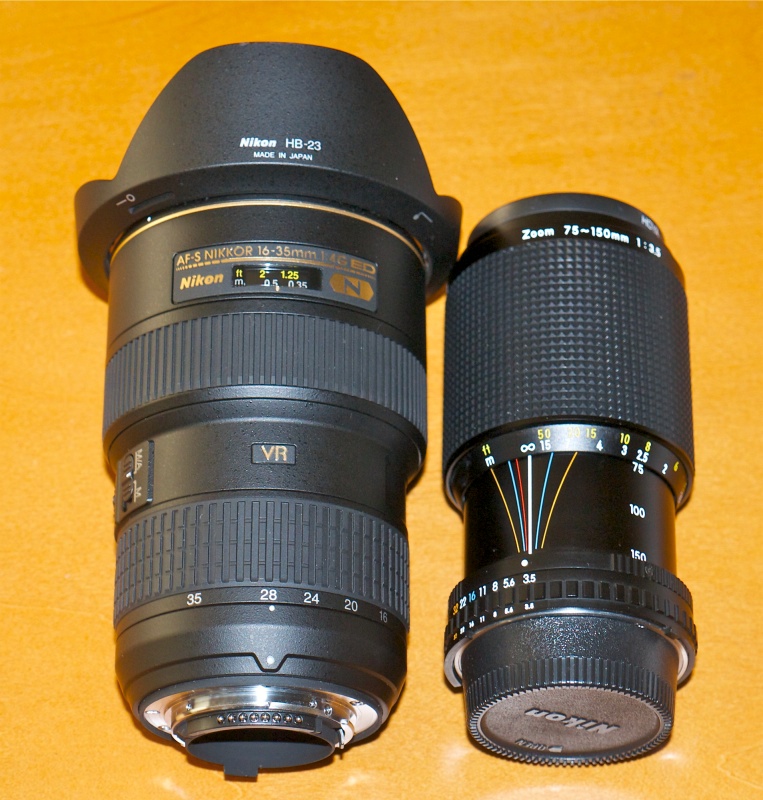
10 ounces. I had tremendous success using the (sadly discontinued) Canon 15mm full frame fisheye on my Canon 5D and ‘defishing’ the result in LR3 for an effective focal length of 12mm. Micro contrast was decent if not fabulous, and for what you got the lens was inexpensive. So the Nikon equivalent was a natural candidate for a prime ultrawide.

32 ounces. Everyone raves about this lens as one of the very best ever mid-range zooms. It is reputed to surpass primes for sharpness, but that performance comes at a tremendous weight penalty for the fast f/2.8 aperture, which does not drop at the long end.

24 ounces. An alternative mid-range zoom which adds length but trades it for a one stop slower f/4 aperture, while also shedding weight in the process. I don’t really need 120mm but the lens came highly recommended from Nikon users I know, and they have forgotten more about the marque than I will ever know. One big advantage is the inclusion of Vibration Reduction, missing from the 24-70mm optic. Incidentally, I owned the Canon 24-105mm L lens with my 5D and while it was optically fine, it was unusable. The lens has zero sealing or baffling so, when zoomed, it acts as a powerful air blower blasting dirt onto the 5D’s sensor. It’s so bad that you can remove the lens and feel the ‘whoosh’ of air when it’s zoomed. Once I stopped using it I no longer had to clean the 5D’s sensor after each outing. The 5D/II largely fixes that with a sensor dust removal system, but that body was not available at the time I was a 5D user.

Option B – ultrawide zoom plus prime portrait lens:

34 ounces. Another optic everyone loves, very wide and very heavy. I was troubled by the exposed front glass whose profile prevents use of a protective filter, but the optics are known to be as good as it gets. A miracle of optical engineering.

24 ounces. A lens almost as wide as the 14-24, lighter, has VR (likely not needed at these short focal lengths) but with known heavy barrel distortion at 16-17mm. I downloaded a specimen imaged from Photozone, loading it in LR3 where I found that correcting the barrel distortion was very easy. The extreme edges are not the greatest at f/4 and 16mm, but quickly improve by the time you get to f/8. Otherwise it’s a crackerjack optic and much lighter than the 14-24mm. At 18mm and full aperture the only extreme edge aberration is slight color fringing, easily corrected in LR3. Definition is to die for, requiring the merest hint of sharpening in post processing. Note that Photozone’s results are for the non-IF Mark I version. Mine is the IF Mark II; we’ll see if it’s better.

13 ounces. Once again, I had tremendous results with the similarly specified Canon on the 5D. This optic has been around for ever and has a tremendous reputation. This lens is discontinued, replaced by the new ‘G’ verison which deletes the aperture ring (not needed on the D700 in any case). The older lens is a known quantity and easily found lightly used.

23 ounces. The costlier f/1.4 variant is simply faster than I need and way too heavy to carry around.

The decision:

I went with a new 16-35 zoom, which comes with a four year Nikon USA warranty. Used examples sell for just 10-15% less and do not come with a warranty – a false economy. Like all Nikon’s pro zooms, the lens is dust sealed which is ideal for my contemplated use. The wide angle range meshes nicely with my way of seeing – I tend to see ’35mm and wider’. The lens does not change length when zoomed and the rear element is fixed, so that there’s none of that dust pumping action enjoyed by Canon 24-105mm L users. The lighter weight compared with the other shorter zooms is a significant point, also. Then I added a used 85mm f/1.8 ($339). It’s not dust sealed but, at that price, who cares? And the wide aperture is ideal for close-up portraits with blurred backgrounds, something the zooms here cannot offer. At f/2.2 the 85mm is near its peak performance.

Thus the total outfit weight is D700 – 35 ounces, 16-35mm – 24 ounces, 85mm – 13 ounces, for a total of 4.5 pounds. Well, it’s not MFT but that’s the penalty you pay for full frame quality. My Panny G3 with the Oly 9-18mm, and the Panny 14-45mm and 45-200mm lenses weighs in at just 3.0 pounds and that includes a really long 90-400mm zoom. Drop the zoom and the Panny kit comes to a scant 1 pound 12 ounces which is the fairer comparison, though there’s nothing to compare with the fast f/1.8 included in the Nikon outfit. So full frame means lugging an extra 2 pounds 12 ounces – the price of respectability!

Modern DSLR users are spoiled for choice, but the above reasoning, with help from friends, got me through the jungle.

Nikon buyers beware

The grey market is a mess.

I recently bought a Nikon full frame DSLR and some lenses. Last time it was Canon (the 5D, sold long ago, and excellent in every way) so this time I thought I would give Nikon a shot. I am brand agnostic. I elected the D700, shortly to be replaced by the D800, because it is affordable used, well built, dust sealed, there’s lots of lightly used inventory out there and because the pixel density and low light performance are ideal for my needs. Most importantly, it’s full frame which is what’s needed for true wide angle snaps with the best optics out there.

The Grey market racket:

But, being cautious by nature, it was not lost on me that Nikon products in the US are frequently sold as both “USA import” and “Grey market”, the latter a few dollars less. The greys circumvent Nikon USA as the importer, thus denying the business the profit it might otherwise earn. So what does Nikon USA do in its infinite stupidity? Why, try and cartelize the import racket by refusing either warranty or post warranty service to any grey market camera in the USA. And while there are instances of a lucky few managing to get service on their ‘greys’ it’s not like you want to take the risk of your megabuck D700 or D3/4 ending up as a brick because you have to send it to south central Mongolia for service, which will take a year if you ever get it back at all, covered in yak goo.

An example of split pricing – Grey and USA. No, the economics do not add up after shipping.

Further, the accountants at NUSA, really getting the pencil between their teeth now, have started refusing to sell parts to non-authorized dealers, arguing that special gear is needed to fix their fancy hardware. Mercedes tried that racket 25 years ago and lost a massive class action suit, which not only required them to sell parts but also dictated that the related diagnostic equipment be made available. It was nothing more than a crude land grab aimed at putting tens of thousands of independent repair places out of business.

Let’s hope Nikon is next to be sued. In one fell swoop NUSA has:

  • Upset any grey market buyer who cannot get his camera serviced. It’s not like he checked this out when saving his $50.
  • Made absolutely sure that the buyer will never return to Nikon products, destroying brand loyalty and repeat sales.
  • Generated abysmal word of mouth from every abused owner.
  • By refusing non-warranty service to grey owners, decided to pass on the income stream that results.
  • Remained completely clueless whether their childish attempts at price controls have any effect.

A basic principle of economics is that “All control drives up price” or, in NUSA’s case, destroys profits. This is what happens when you let accountants run a business.

Now given that I had decided to buy my D700 body used, it was clear that I would have to establish that it was a legitimate USA import. So I tried eight sellers on eFraud, each claiming his camera was bought at B&H NYC. Can I see the invoice please? No, I have lost it. Well, given that the camera is <4 years old and B&H keeps 5 years of invoices on line, could you please download yours and copy me? Silence. Eight out of eight. You wanna get cheated? Hasten over to the 'Bay.

The shutter activation lie:

The other bit of cheating the fraudsters there indulge in is the ‘shutter activation’ count lie. They reset the camera’s counter and claim that the number of the file indicates the count. Nonsense. So of each seller I asked for a current NEF (Nikon RAW) file. I would then upload this to MyShutterCount.com and get the true number. In all cases but one, the true count was far higher than the advertised one. No surprises there.

The one I bought had a count which exactly matched what the seller stated and it came with an original B&H NYC invoice. Easy. It’s not like I need the remaining count to be huge. I do not. But the last thing I want is a pro’s beater on its last legs.

The true shutter count on the used D700 I bought.

The quoted life of the D700’s shutter is 150,000 activations, so I’m not exactly going to trouble that ceiling.

An alternative to determine true shutter count:

You snap a JPG image and drop it onto Preview, dialing in the application as below:


Shutter count on the author’s 2005 Nikon D2x body.

The shutter count is disclosed in the highlighted row.

Stay safe:

If you are going to buy costly Nikon gear in the US, do yourself a favor. Forget saving $50 on grey imports. And when you get that purportedly USA import in your hands, check the serial number with Nikon to make sure your vendor has not tried to cheat you. Yes, it happens.

Finally, don’t buy on eBay. The odds against finding an honest seller are long and the gear will be marked up 7%, 3% for PayPal and 4% for eBay fees. I bought my used body at Fred Miranda which also happens to be where I sold all my Canon 5D gear. It’s largely the province of Nikon and Canon users, and I have only had good experiences as both seller and buyer.

Other brands:

I haven’t checked for other brands but if you are contemplating costly aquisitions of Canon, Sony, Pentax, Fuji, etc. gear, you should do your due diligence before buying grey. The Japanese are not exactly known for original thinking, so it’s a fair bet to assume that other Japanese manufacturers are adopting similar policies.

* * * * *

For the many micro-four-thirds aficionados who visit here and enjoy the intimate style of street snapping that compact gear encourages, fear not. I have not gone to the dark side. Indeed, there could scarcely be a less appropriate camera to that sort of work than a full frame DSLR with a honker lens attached.