Category Archives: Hardware

Stuff

No more black market

My days as a spiv are over.

Let me step back. The sole reason I ordered the Fuji X100 from Amazon some three hundred years ago was that it was an affordable digital Leica M2. The latter, fitted with a 35mm Summicron lens, was the street snapper’s ideal in the last decades of film. The X100 promised to be its equivalent in a digital era. Make no mistake. The marketing materials, the sales pitch, the schtick, it was all about being a poor man’s digital Leica. Right down to the branding which had it putting that finderless toy, the Leica X1, to shame. Made in Germany, that one you know. Uh huh. Maybe Fuji should have named its offering the M900 to confer greater credibility? And maybe an even more ridiculous price?

For those not attuned to the finer subtleties of the English tongue, the definition of a spiv is attached for reference:

The genus saw its best (or worst) days during the second world war and in bombed out London could pretty much get you anything your heart desired …. at a price.

Now like most, I’m one of those chaps who prefers not to pay full retail but had you told me that I would be a black market merchant a few weeks ago I would likely have shown you the exit. But two things happened.

First, after a spot of reading I determined that the Fuji X100 would simply be a replay of the Panny 20mm when it came to focus speed. Those few souls afflicted with the street photography bug who can actually take a picture reported that the camera simply did not focus fast enough. That’s not to say the Fuji X100 is not beautifully made, nor is it to allege that it has poor image quality. By all accounts it comes up aces on those metrics. So it has appeal to many, me included.

However, I do not buy cameras solely for looks, and IQ from the smaller sensor in the Panny G1 is perfectly fine for large prints. But, most importantly, the G1’s focus response with the kit zoom is fast and the forthcoming Panny G3 suggests that whatever ails that tiny sensor is about to be fixed. And I can continue using the excellent kit zoom from the Panny on the G3 if the latter delivers.

So by the time Amazon despatched the X100 I had made up my mind to return it, sight unseen. While not chump change, $1200 is not something I am about to lose sleep over, but I just could not bear the prospect of yet another huge learning curve concluding in blurred street snaps as with that Panny 20mm.

Wait a minute, I hear you say. You sold the thing without so much as trying it? What qualifies you to make any conclusion based on hearsay? Simple. The economics of the risk/reward equation do not solve. It would take several hours of my time to get familiar with the camera and its software, hours worth considerably more to me than the modest cost of the hardware. At best I reckoned there was a 30% chance of the camera meeting my needs, specialized as they are. So the economics do not remotely solve. Had the odds of the X100 being a fast focuser been better, I would have opened the box. Elementary, my Dear Watson.

Now that X100 was scheduled for 2-day shipping from Amazon and it was not lost on me that new samples were selling for $1600 owing to the supply backlog. Well, would you leave $400 on the sidewalk were you to spot a like sum lying around? I thought so. Heck, nor would Bill Gates. So I determined to advertise the camera and make my first and likely only black market profit.

Well, as luck would have it, Amazon cocked up delivery royally and the package got stuck in Utah for two days. That’s what happens when residents of a state forswear alcohol. By the time the thing arrived, the black market premium had eroded to $175. Thanks a lot, Amazon. Anyway, it’s winging its way to a happy owner as you read this and I have $175 toward the G3 – and no learning curve in my future. And a 15% gain on no cash out is not so bad, either.

I got an interesting lesson in supply-demand dynamics and some happy user paid a modest premium for unobtainium.

But my days as a spiv are most certainly over. And I don’t even dress flashy, like.

A wireless remote for the Panasonic G range

Cheap and effective.

For a delivered price of $20.98 you can buy a wireless remote for any G-series Panasonic camera on eBay, shipped from Hong Kong. Mine took two weeks to arrive, complete with transmitter, receiver, a cord for the latter and the requisite two batteries. The 23A battery goes in the transmitter/trigger and the CR-2 in the receiver. The short cord goes from the receiver to the socket on the G1. Note that the CR-2 battery is wrapped tightly in plastic which must first be removed. The receiver itself fits in the flash shoe on my G1 but has no contacts of its own. If you are using the flash shoe for something else, like an external finder, or if you are using the in-camera flash, you can Velcro the receiver to some other convenient point on the camera’s body.

Here’s how it looks in practice:

The uWinKa wireless remote. Cord connections from/to the G1 circled.

I tested it at home and it still worked fine from 50 feet away and through several walls, so the claimed range of 100 feet is believable. Flashing LEDs on the remote (taped off in the picture) confirm operation, as does a flashing LED on the trigger. The only thing you have to do is to remember to power up the receiver (camera end) with the on/off switch. There’s a choice of 16 code settings, changed with microswitches on the bodies of both devices, in the event of interference from other RF devices. Both receiver and transmitter are very small, in keeping with the scale of the Panasonic G1. Weight is negligible.

The trigger has a two position switch which is appropriately stiff on mine to preclude accidental switching – instant release or five second delay – which you can use nicely with the 3 or 10 second delay on the G1 to give you a choice of 5, 8, 10 or 15 seconds. The claimed delay is 3 seconds, but mine delivers 5. There’s also a Bulb option. You are meant to hold the button on the trigger for 5 seconds and the shutter should remain open until the button is pressed again. I could not get that to work. Hardly an issue. Finally, a brief press on the trigger button will focus the lens but not release the shutter. That worked for me. There’s an extendable antenna on the transmitter for longer range use. It’s extended in the picture, above. There’s also a release button on top of the receiver but I can’t say I have found a use for it, though it works fine.

All except the Bulb option works perfectly. The only hitch I encountered was that I had to reverse the provided cable from receiver to camera to make it trigger the shutter. The behavior is repeatable suggesting that there’s a diode in the small box in the connecting cable which transmits current in one direction only. The cable bears no directional markings so if yours does not work simply reverse it. While I haven’t tried it, I would be prepared to wager that this device will work fine on any camera which has a three pole mini-coax socket on the body. Try at your own risk.

The accessory shoe for mounting on the camera is flimsy; you can remove it by removing the one black Philips screw retaining the bottom cover and then the two chrome ones retaining the shoe from the inside. Use a fine flat file to ‘machine’ down the retaining prongs thus exposed (they are unnecessary should you decide to restore the shoe, as the two retaining screws prevent rotation in any case), thus procuring a plane base, and use industrial strength Velcro to stick the remote to some convenient flat part of your camera instead. One warning – Velcro adhesive refuses to adhere to the rubberized body on my G1!

Or, as the French might so elegantly put it, plus ça change, plus c’est la même chose. That one,, for the 5D, is quite a bit larger than the one profiled above.

The new iMacs – 2011

Still a poor choice for photographers.

From a reading of the specs of the latest iMacs, the reasons to upgrade are:

  • You do a lot of moving of large video files. The new Thunderbolt connector is 10x faster than USB but peripherals using it are rare and only just coming to market.
  • You need three displays. Existing iMacs can support two (iMac + 1 external). The new ones can support three (iMac + 2 external) using Thunderbolt. Once again, the only displays currently using Thunderbolt are the overpriced and glossy-only ones from Apple which simply cannot be properly calibrated for serious photography use. Once it becomes available, a good Dell matte display will be half the price of the add-on Apple one, the latter too garish/bright/contrasty, just like the display in every iMac since they went all glossy four years ago.

The modest CPU and GPU speed increases are not a compelling reason to upgrade.

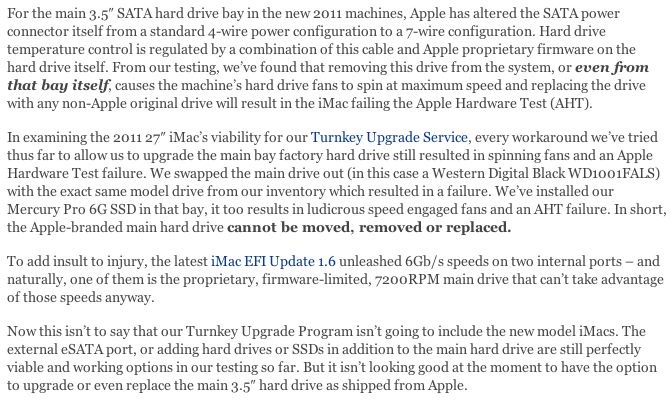
Further, AAPL still has issues with graphics cards overheating (which killed both our white non-glossy iMacs and made me build the Hackintosh – these were the last iMacs with a screen that could almost be properly profiled for photography use). Still? Well, yes. Why do you think the iFixit tear down shows that the graphics board in the latest iMacs is removable, rather than integrated on the motherboard? Because they expect to replace many, testament to the poor cooling of the part in the tight confines of the box. Form over substance design continues at Apple. Plus, as you need to remove the motherboard to access the removable GPU, you need to be very skilled or very lucky. And then where do you get the replacement? It simply does not solve.

Click the picture for the iFixit teardown of the latest iMac.

If you need a good photography machine and must have Thunderbolt, the best bet is to wait for the Mac Mini to add that connector and hook it up to a couple of proper displays from Dell. Or for higher speed, build a Hackintosh.

Save your money unless the above are compelling reasons for you.

The single best thing you can do to make your iMac significantly faster is to add a Solid State Drive for the OS and applications. It can sit externally – internal installation is sheer hell – and you tell System Preferences->Startup Disc to make the SSD the one to start from. Install OS and copy over apps and you are set. You continue to keep data on your existing internal HDD which is big and cheap. The SSD is small and costly but it dramatically increases start-up speed and application loading. I added an Intel SSD (only 128gB) to the Hackintosh and the difference is night and day. I use maybe 50% of it – OS + apps only. Far more real world performance increase than newer CPUs or GPUs. It cost me $225, and prices continue to fall. Once you have used an SSD there’s no going back. Also, an SSD has no moving parts – always a good thing.

The Panasonic G3 – soon?

Here’s hoping.

My Panny G1, bought in July 2009 was discontinued about a year ago. Panasonic replaced it with the underwhelming G2. The latter added a movie mode and a touch (more like “push”) screen.

Panasonic G3? I wish!

A far more significant improvement was in the recently introduced and costly ($1,000 body) GH2 which added the second ever MFT sensor. All Panny and Oly MFT cameras have shared the same sensor until now. This increased the pixel count and reviews suggest that the noise and resolving properties are now comparable to the considerably larger APS-C sensor in the best models from Canon and Nikon. A related benefit is the professional quality movie mode which has many pro movie makers dumping their costly video gear in favor of the superior GH2. Impressive.

Now it’s not like the results from the G1 are bad. I have little difficulty consistently producing 13″ x 19″ prints from mine and, with extra care, 18″ x 24″ is possible. That’s larger than 99.9% of users will ever make. As for display on a big TV screen, there are no issues. Everything looks great. However, an even better sensor, especially one with less noise at 1600 ISO, would be welcome. So would deletion of the useless prism hump on the G-series DSLRs, placed there by Panny’s admission to make traditional DSLR switchers comfortable. Or something silly like that.

The reason the mock up, above, interests me is because not only is the prism hump gone, the body also includes the EVF from the G1 which is as good as it gets. Meaning that, unlike the GF1 and GF2 which include an LCD finder only or an add-on EVF which makes them bulkier than the G1, you get a proper, integrated finder. Plus that improved sensor. Anything that allows me to be more careless when pressing the button, in the interest of getting the picture, is a good thing. So faster ISOs made possible by a less noisy sensor means faster shutter speeds. That means a higher success rate in street snapping.

The rumor mill has it that Panny will announce the G3 on May 11, in London. Let’s hope that the recent earthquake in Japan does not delay that.

The G1? Still a superb bargain. I paid $640 for mine and Amazon still sells new ones for $550 with the kit lens. Mint to new ones sell for under $250 for the body only on eBay. If the G3 is too costly or delayed, I have no difficulty recommending the G1 to aspiring street snappers who will not miss a movie mode. And forget the touch screen. No one needs that.

Price? I’m guessing $650-700 for the body only. They may have to discontinue the GF2 as who wants a non-EVF body of comparable size at a like price?

The Fuji X100 – time to wait

Not ready for prime time.

I have been reading David Pogue, the New York Times’s technology columnist, for ages. What he lacks in sheer technical knowhow he more than makes up for in his ability to get to the point of the real world user. Sort of like Consumer Reports. Neither may know exactly how fuel injection works, say, but both will tell you straight whether the car can be guaranteed to start when the ignition key is turned. That’s what users need.

So while his review of the Fuji X100 is replete with a howler or two which will make ‘experts’ cringe (he describes it as a great portrait camera, despite the short lens, etc.) he does hit the nail on the head in disclosing what is now a worryingly frequent complaint on chat boards from those lucky enough to have got an example of this rare beast. And as I am more likely to believe Pogue than I am the average chat board aficionado, here it is, plain and simple:

“You should also know that the camera doesn’t focus quickly, especially in low light.
It does have an autofocus assist lamp that comes on in dim rooms,
briefly providing enough illumination for it to focus,
but time is going by meanwhile.”

First, forget using an autofocus lamp. This camera is meant to be stealthy, not a walking advertisement. Next, with my jarring experience with the 20mm Panasonic for the G1, which I returned almost as soon as I bought it, I am super sensitive about fast autofocus. The Panny was simply unable to focus fast enough for street snapping, delivering a 30% focus failure rate in the almost 500 exposures I made with it, and I don’t propose to relive the experience with the X100. I suppose you could use the camera for landscapes or whatever, but fail to see what it adds compared to the regular DSLR in that regard. The fact that the X100 is small, has a real optical finder and is quiet and unobtrusive, is what turns my crank, and street snaps are what I mostly do.

Yes, there are several other quirks in the design which can be cured by Fuji tweaking the software (button assignments, menu layout and the like), but speeding up the focus operation is not, I would guess, one of them. Your focus motor is either fast or not. In this case, it increasingly seems not.

This is not the low risk prospect that buying the iPad on Day One of availability was. Apple had several years of touchscreen development under its belt with the iPhone so screwing up the iPad was not a big risk. By contrast, what we have in the Fuji is a camera with a massively complex EVF/OVF eye level finder from a low volume manufacturer not known for making like products. That’s high risk in my book. The X100 Mark II will likely get it right, and I’m also hoping that the likes of Panasonic come out with something as good or better by then, at a saner price.

So, for now, I will either cancel my X100 order or flip the camera on eBay if it still commands today’s 50-100% black market premium at my date of purchase. Free money is never a bad thing. The latter option will, at least, allow me to try it for myself.