Category Archives: Hardware

Stuff

Cameras and aesthetic design

Why are so few beautiful?

A friend kindly emailed me to alert me that a web chat board was offering a camera as a prize for the best picture taken in the style of Henri Cartier-Bresson. A worthy goal which will doubtless see some great work submitted.

Then I got to looking at the prize and was struck by how inexcusably ugly it was. Going by the name of the Zeiss Ikon ZM, there is no other way to describe this brick than in one simple word whose meaning needs no explanation: Ugly. I was going to preface the U word with a vulgarity describing part of the anatomy, the bit you sit on, but good taste prevailed. You get the idea.

Equipment, it seems to me, is merely a tool to do the job, so dwelling on it to excess is not productive. But this kind gesture on my friend’s part, who suggested I should submit some of my street snaps to the contest, got me thinking about the aesthetics of equipment, or more specifically, why so little in the way of camera gear is remotely attractive to look at.

So, like most photographers, I thought about the equipment I have owned, have borrowed and have lusted after. And in the interests of keeping this piece upbeat, I will concentrate on the cameras my eye remembers as beautiful, a work of art to hold and use, rather than all the others. And that is important to me. The old saw that has it that a poor worker blames his tools has it all wrong. It should be that a good worker uses beautiful tools. You think Michelangelo and his buddies didn’t discuss paints, brushes and canvases? Sure they did.

So I won’t refer to the brutish ugliness of the Nikon F, nor the brick like facade of the Mamiya RB67, nor even the Leicaflex SL – a face only a parent could love – in this brief Statement of Preferences. And I will most certainly not refer to the Kodak Ektra.

The post-WWII list is, sadly, a short one.

Headed, of course, by the chrome Leica M2. The most perfect blend of form and function ever designed. Color it black and you have nouveau riche – the young up-and-comer’s Porsche 911. Make it chrome and….aaahhh! Yes, this one is mine. With the wonderful 35mm Asph Summicron, no less.

But before that exemplar of taste and execution came along there was something equally fine to be had in the Zeiss Ikon Contax II and IIa. Forget the metered version with the ugly bump for the selenium cell meter. The un-metered camera was simply beautiful and aeons ahead of the cheesy looking screw thread Leicas of the time with their miserable viewfinders. A top hat compared to a cloth cap. Note the beautiful symmetry of the finder windows and the knobs, the gorgeous proportions of the body. You just must pick it up.

No Rolleiflex twin lens reflex can be left out of this reckoning with, perhaps the metered 3.5F at the pinnacle, the lens being just the right size for the body, something lost in the 2.8 variant. This one was mine until I gave it to a friend.

Whether it was because so many of the greats used it – Avedon, Penn, Beaton – or whether it had that secret something, call it balance, proportion, despite the rectangular shape, the Rollei is a beautiful camera.

Some miniature format cameras had that something called beauty too. Two of the best were the Tessina and the Minox. Regardless of their clandestine Cold War role in life, these two, especially the watch like Minox, had the secret ingredient. Have you ever opened a Minox for action? Try it. Sensuality redefined.


At the other end of the size spectrum, Linhof had what no American manufacturer could approach. A divine aesthetic sense. I won’t say anything about the Crown Graphic (heck! I own one) but just feast your eyes on this Super Technika.

Aaah!

Now that is a camera.

Now there’s a lot of German equipment permeating this piece. A nation that makes fine cameras and killing machines. But its eastern emulator, Japan, has had some pretty fine things to contribute to camera aesthetics too.

Take the fine line of early Canon SLRs. This is an FT. Note the finely sculpted controls and the general balance of the machine.

Olympus made a fine effort with the Pen F and even the bold gothic letter “F” seems to work well for this courageous, innovative design. A camera with a sweet, feminine grace, with a bold escutcheon. I loved mine. Wish I had never sold it.

They tried later to recapture the spirit of the Pen F with the OM1 but the magic spark was, alas, gone.

Then two really great Japanese designs come to mind. One very good – the Pentax MV/ME. Another camera with jeweled precision and an absolute joy to use. My ME Super fell apart but not before we had had the most wonderful relationship.

But their earlier Pentax Spotmatic was, after all, an impossible act to follow. Here was a camera that was a joy to behold. To hold. To use. Forget all that nonsense you read about the Japanese being imitators. Just take a glance at the raw sensuality of the advance lever. The most beautiful thing to ever grace a mass produced object. And note those angled “Zeiss” corners. The sincerest form of flattery is imitation. This was something that you would think should have set an example for the designers of the miserable looking Zeiss Ikon ZM, that execrable excresence passing for a camera. An example of which, sadly, they seem damnable unaware. As unaware as they are of their company’s glorious history of design.

The Photographer-Mule migrates up-market.

So you thought the nation with the largest contiguous border with the most successful, the most powerful, nation the world has ever seen, not to mention the most altruistic, had nothing to offer but cheap prescription drugs and cold winters?

Well, think again.

Dialing up the foul eBay the other day in search of a better price on a used LowePro Omni Trekker bag the better with which to carry my magnificent fifty year old Crown Graphic and its many film holders and accessories, I came across a Canadian vendor selling new versions at half the price of the ones available to those of us who count ourselves blessed to be Americans.

So I splashed out my $119 (US) and no less than five days later the new Omni-Trekker, or at least a very good rip off, tags and all, was on my doorstep.

My dog was happy, as it meant a cookie from the UPS man. I was happy as someone from Canada had actually shown some business acumen (we need all the friends we can get) and geopolitics was happy, reassured that maybe those neighbors of ours were not complete losers after all.

The point of this preamble, of course, is that humping the Crown over California’s magnificent landscape, rugged as the camera is, in an old LA Rams gym bag, the Linhof tripod carelessly slung in insouciant manner over the other shoulder, was not a prescription for longevity of either the equipment or the operator.

So on my 140 mile round trip trek to that Top Secret Highway One Location today, the casual observer would have spotted a rather well dressed gent, yes, Harris Tweed cap and all in deference to Her Majesty and our northern neighbors, sporting nothing less than a magnificent LowePro Omni-Trekker bag (or cheap imitation thereof – you decide) in backpack manner with Linhof tripod prominently displayed. Thank goodness for quick release straps.

It has to be said that this huge investment in carrying capacity and function paid dividends. First, in reducing the stress caused by its predecessor, the LowePro earned its keep right there. Second, in spreading the load over the body, sternum and waist, it made a damnable trek into something more resembling sheer bloody hell. A whole lot easier, in other words.

But. most importantly, this Canadian import made it possible to reach places heretofore unknown and that’s what makes for great photographs.

So if you don’t care how you carry your equipment, think again. Canada is not just a haven for those favoring socialized medicine. You can also get cheap camera bags there.

More large format adventures

I finally got the first 4”x5” negatives back from the processor and began making some 13” x 19” prints. Amazingly, I had managed to load the film in the right way around and all the exposures, using my highly refined Modified Zone System (see June 25, 2005, below), were spot on. It probably did no harm to use negative film with its enhanced latitude for error even if the orange masked-negatives are harder to evaluate than transparencies.

My first reactions on getting the 13 negatives back was shock – those are really large pieces of film – and satisfaction when I saw just the very high level of definition they possessed. The mask in my flat bed film holder is actually 3.7” x 4.7”, so a 13” x 19” print works out to an enlargement ratio of only 4x so it’s hardly a surprise to see that sharpness and detail are the order of the day.

On my first outing I had taken just four pictures, constrained by the fact that the Crown Graphic camera came with just two film holders. One of those four was double exposed. Don’t ask. What with all the rushing water and beauty of nature going on, I couldn’t hear the shutter trip so tripped it….again. Now if I had been using a Holga or similar toy camera the result would have immediately qualified as Art, but I instead consigned it to the round file.

On my second outing I had taken 12 more pictures, using the six additional film holders I had since acquired. Well, that turned out to be 11 pictures as I had inserted one of the film sheets incorrectly and had to pull the holder out of the camera without its dark slide, the latter proving impossible to replace. There I am, standing in the middle of the street, struggling with a sheet of film, more than a tad over-exposed, hoping no one was witnessing this debacle. Indeed, I found out that I have to do a good deal more practicing with film loading as a couple of my other shots were less than centered on the sheet. However, the film is so much thicker than 120 roll film that handling it is a joy and no cotton gloves are needed as it does not buckle when held by the edges.

Scanning on my flatbed was very simple, if slow, at 2400 dpi – I reckon that will give me the requisite 300 dpi at an 8x enlargement ratio, which is a print sized no less than 32” x 40”. Now that is really large! I found there is no need for a glass film holder, once more thanks to the high rigidity and flatness of the negative. The scans in PSD or TIFF format come in at 280 megabytes, give or take, and that takes a while to load on the computer.

Over the past week I had finally bitten the bullet and decided to upgrade my outstanding Apple iMac G4 (the one that had locked up once in thirty months on, you guessed it, a Microsoft Excel spreadsheet) to an iMac G5. A colleague had reported how his dad was loading large files in no time, so it wasn’t just the mildly enhanced CPU speed at work – Apple must have done something to upgrade image processing. By way of comparison, as 250 megabyte medium format scan which would take 90 seconds to load now loads in 10 (yes, 10!) and all related actions – like rotation, levels, sharpening, etc in Photoshop are similarly faster. The time savings really add up, for 90 seconds is too short to leave the computer to do something else and too long to be fun.

Once I took a hard look at the scans I could see that the four element Schneider Xenar lens – probably single coated given it’s 40+ years in age – is a tad prone to flare into the light, so I will have to watch that, but covers with high resolution to the edges of the frame, although I should add that I have not used any swings or tilts to really test edge definition.

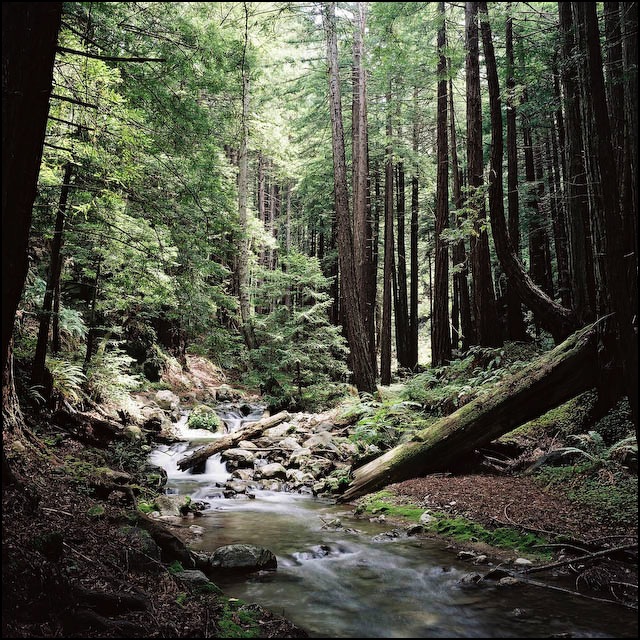
Anywhere, here is a much reduced version of my first every 4” x 5” photograph in one of the magnificent redwood forests off Highway 1 in California – 4 seconds at f/32 if you must know:

On my second outing I had decided to use the Crown as a hand held rangefinder camera and while this occasioned more than one questioning look from passers by (they did at least give me generous space on account of my presumed lunacy), it turned out to be wonderfully engineered for just this purpose, even if film changing is a bit of a challenge if you only have two hands. The New York street photographer of the 1940s, Weegee, knew what he was on to.

Here’s the first hand held shot in one of those many broken down old towns in central California:

So, all in all, this Crown Graphic experiment has all the makings of a beautiful friendship, once I learn to load those film holders correctly.

Does equipment matter?

This is a tough question.

When I was a kid my pictures were lousy.

The composition was poor.

The exposure was wrong.

The processing was worse.

And the subjects were uninspired.

Though I had a deep appreciation of the arts and many years of studying the masters of photography in my psyche, my pictures reflected little of this acquired knowledge.

I also used poor equipment because that is all a kid can afford.

Then I worked and saved mightily and my first Leica came along. This is the first picture ever taken on that Leica, on the day of purchase, August 2, 1971:

The light is just so, the exposure fine, the moment captured.

So what happened? Did I suddenly become a much better photographer because I used a Leica?

The answer is an unequivocal and resounding Yes.

You see, what happened here was that the very fact that I had inherited a duty of care, of quality and of accomplishment in the ownership of this magnificent instrument made me rise to the occasion. Every driver is a better driver in a Ferrari. Every rider rides better on a Ducati. And every photographer is a better photographer with a Leica.

So the conclusion of this short parable is simply this: Get the best camera you can afford. Stop making excuses about great pictures being taken on lousy equipment. They never were. The reality of that costly purchase will force you to become a better photographer too.

Losing my (large format) virginity.

So I arrive at my Top Secret Highway One location on California’s magnificent coastline with my “new” Crown Graphic and its Schneider Xenar 135mm f/4.5 lens. My Linhof tripod, sturdy but weighty, in a Scottish Tartan bag over my shoulder, the tripod some two inches longer than the bag with the latter’s microscopic strap cutting through my shoulder. Add to this the fact that my prized new Crown is wrapped in an old black terry cloth towel, my initials still proudly stitched in its corner, with two rather tired wooden film holders chucked in a bag emblazoned with an “LA Rams” logo, and you will correctly conclude that this picture taking trip was something less than D Day in its level of preparation.

I had somehow managed to locate my Weston Master V exposure meter. More surprisingly, it checked out well against any number of other scientific devices in the household, despite being on its second selenium cell. I have owned it 35 years, having bought it new. Adding accident to good fortune, I had actually remembered to bring along my pristine, new, $5 12″ cable release, a famous General Brand no less from B&H, or I would not have been able to manage a steady shutter release at the long exposures called for. At least it said Made in Germany on the box. A Schneider lens would accept nothing less.

Let’s see, what else? Oh! Yes, the 8x Schneider loupe I use to check negatives finally afforded me the opportunity of attaching the lanyard to its ears, thus ensuring that I would be mistaken for Steven Spielberg or, at the very least, Richard Attenborough (on account of my Harris Tweed cap), on my trek through the redwoods, the loupe dangling in a cavalier manner from my neck and bouncing suggestively on my manly and heaving chest.

And heave it did, for I soon found myself struggling up a trail made by the Chief Sadist at the National Park Service, its angle to the horizontal at least 45 degrees, as I aimed the LA Rams bag this way and that to avoid a nasty crack on any number of rocks that planned unprovoked attack on my precious Crown Graphic, the while struggling to keep the wretched tripod bag on my shoulder.

In other words, my packing of the large format kit needs some work.

After more of this than I care to remember, I arrived at the destination I had dutifully scouted out not three days earlier. Living in proximity to Highway One and all its magic allows no excuses for ignorance of the territory. By the time I got to the waterfall of choice, deep in the redwood forests of coastal California, three things were evident:

1 – The cardiac arrest profession would stay in business
2 – A Harris Tweed cap has pretty poor venting for an overheated head
3 – Doing this without a copious supply of martinis in the car cooler is foolish, nay, life threatening.

So on to the business of taking pictures.

First, I checked the immediate vicinity, say 100 miles in all directions, to confirm no one would be around when I dropped the camera/pulled the film holder from the camera with the dark slide in the other hand/slipped in the mud with tripod in close pursuit. There’s only so much embarrassment a fellow can take.

Then, having presciently placed quick release plates on both the Crown Graphic’s tripod sockets, it was a matter of moments to change from landscape to portrait orientation, previewing matters in the Crown’s decent optical finder.

I had left the rear hood for the ground glass at home, preferring to check focus with the Schneider loupe (Spielberg Edition), not least because my eyesight is so poor that any hope of focusing without a loupe would be akin to hoping for a date with Sophia Loren. Composition was easy as I have developed the knack of pre-visualizing the field of view of a 35mm lens on my Leica after years of use in the streets. The 135mm on 4×5 is just a little narrower than the Leica’s 35mm.

Using the old cloth towel confirmed that it was too small, and even then things kept getting steamed up in there as copious amounts of moist vapor emanated from my fevered skull. No one told me you had to take a 5 minute break before focusing a field camera. I also learned it is very tricky to try and focus while keeping your Harris Tweed cap in place, so sartorial compromises had to be made in the pursuit of Art. I chucked the cap on the ground.

Once I cooled down, everything was fine. Focus at the f/4.5 maximum aperture was, literally, a snap once I remembered to open the lens (you cock the shutter, move a little button lever on the lens mount towards the film plane, then release the shutter) and easily confirmed with the excellent coupled rangefinder on the Crown which I had taken pains to align before setting out. Indeed, it has to be said that the ground glass added little value to this effort other than forcing me to think upside down. The optical viewfinder is accurate and parallax corrected down to six feet. If all else fails, the erectable sports finder is close enough and gives, goodness knows, a life size image as there is no glass anywhere in sight. It too is parallax corrected – you move the eyepiece up and down on a calibrated scale.

Now I’m trying to recall my mental check list. I have the composition down and the lens focused. Things are reasonably secure on the Linhof which is sporting a Leitz large ball and socket head, which seems perfectly adequate given the light weight of the camera. Close the shutter. Important step that. Insert the film holder, praying once more that I loaded the film correctly, notches to the top right of the dark slide as you face the to-be-exposed surface.

Now for some Zone stuff. I should point out that ever since I read about it as a kid over 40 years ago, that the Zone System struck me as the biggest piece of bunk since Social Security. God alone knows how many great pictures have been missed as Zonies did their arcane computations. It did sell a lot of books, I suppose. With my Weston, about as non-directional a device as you can find, my system, soon to become renowned as the Modified Zone system and the subject of a thousand page monograph, is far simpler. I will disclose it here at no cost to the reader, although signed copies of the first edition of the monograph, with a limited printing on one million copies, will be available shortly at $99.95 each.

Ready? You point the Weston at the darkest bits you want to come out. The needle says 6.5. You point it at the lightest parts you want detail in. The needle says 9.5. You take the average. 8.0. Twiddle the dial and you get 3 seconds at f/32. Use negative rather than slide film and you gain latitude for error. I added a second for luck and for reciprocity failure.

Insert the cable release. Set the aperture to f/32, the shutter to B, tension the shutter.

4 seconds? Wait a moment. I have never used anything slower than 1/15th. Oh! Now I remember. This is from the smelly, foul chemical filled darkroom days. Quite literally the Dark Ages of photography.

Elephant 1. Elephant 2. Elephant 3. Elephant 4.

Reinsert dark slide the other way around to remind you the film is exposed (I hope) and twiddle the little lock thing on top to prevent that side ever being used again. Pull the film holder. Collapse exhausted.

I have just taken my first ever 4×5 photograph at the tender age of 53.

And here it is: