Category Archives: Hardware

Stuff

Folders and collapsibles

Back in the day.

There is no more need for folding cameras or for those with collapsible lenses. Modern iPhones give 99% of photographers more than they will ever need and we will see periscope zooms in small packages in a generation or two. Quality is unsurpassed for the designed display medium which is a laptop, and the technology superb.

But before the iPhone there were many attempts at crafting small bodies and these involved either retractable lenses or collapsible fronts, the latter approach generally requiring some form of light tight bellows. Here are some of the best examples of the genre.

The grandfather of collapsibles is the Leica, whose 50mm f/3.5 Elmar lens retracted into the already compact 35mm film body to craft a device which could (more or less) be slipped into a large suit pocket or into an overcoat. Leitz soldiered on with collapsible 50mm (and a 90mm f/4 Elmar) well into the M era (1954 on) and even the vaunted early 7-element Summicron came in a collapsible mount.
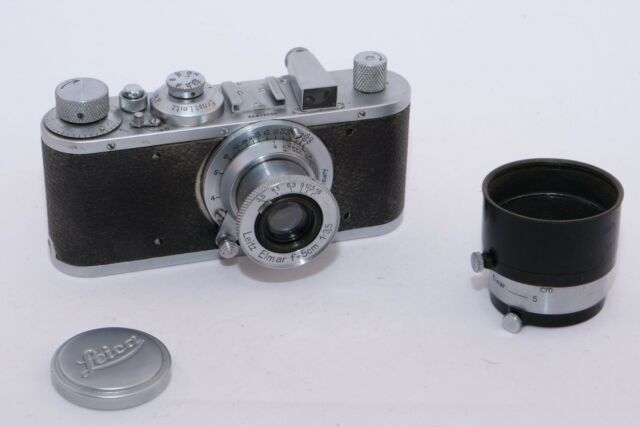


The Leica Standard of 1937

The hood made a nonsense of the concept and should be avoided. There was no interlock so if you forgot to extend the lens you would get a blurred blob in lieu of a picture. But the lens was decent (a 4 element Zeiss Tessar design ‘borrowed’ by Leitz), so long as you remembered to remove the lens cap.

A really clever variant, this one a folder, was the American Crown Graphic, much beloved of press men before smaller offerings came along. It took massive 4″ x 5″ negatives, was sharp as a tack and very light and compact given its capabilities, which included a tilting front and interchangeable lenses with rangefinder coupling. I found mine to be a delight to use.
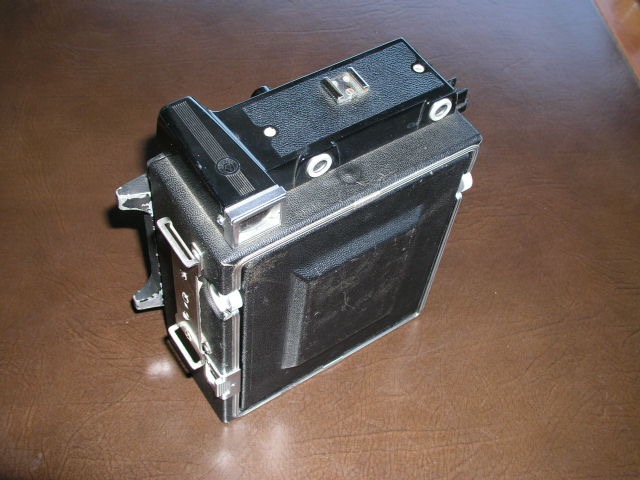


Crown Graphic, collapsed. 1947.
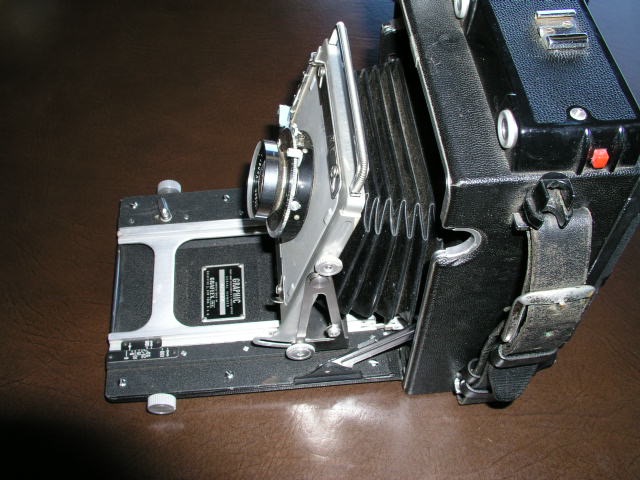


Crown Graphic, tilt front on extended baseboard.
Note the coupled rangefinder.

The Crown Graphic was arguably a variation on the earlier Zeiss Ikonta which took 120 (2 1/4″ square) film and commenced manufacture in 1929, going through many versions with post-war models offering an excellent 75 or 80mm f/3.5 Tessar in a Synchro Compur leaf shutter. The Tessar used here was ‘better’ than that found on 35mm cameras for the simple reason that you did not have to enlarge the image as much when making prints. Truly compact when collapsed given the large negative size, this was one of the best high quality/small size cameras of the era.
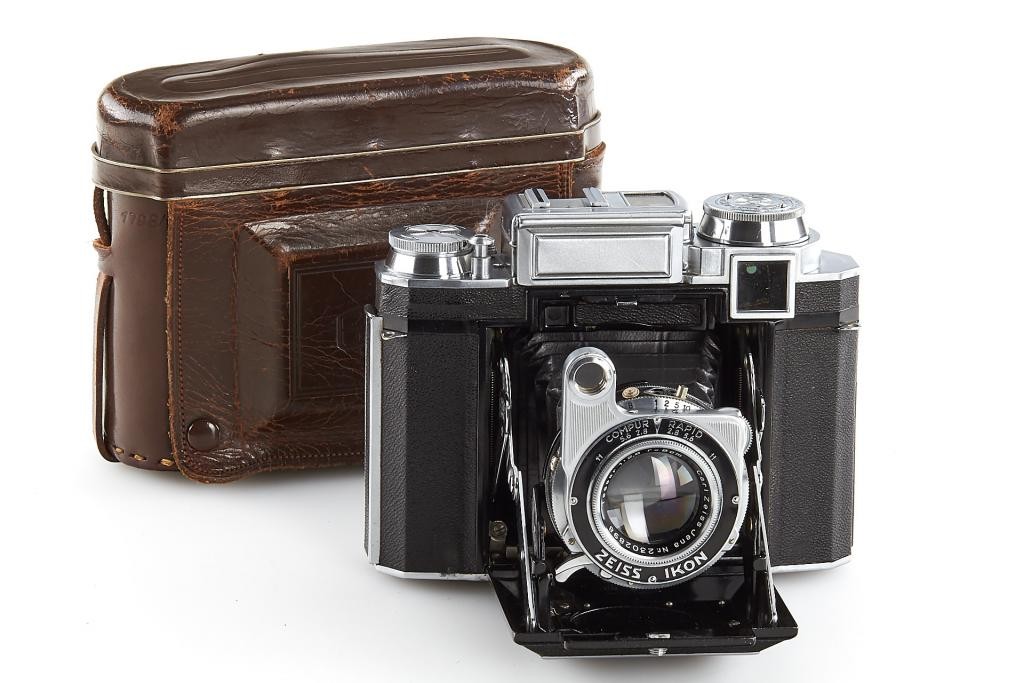


A late 1950s Super Ikonta 533/16. The auxiliary lens attached to the main taking lens is a rotating prism for
the coupled rangefinder. Checkout the small size of the carrying case which
accommodated the camera with the lens collapsed. Uncoupled selenium cell meter atop.

Kodak had an excellent, if complex, set of offerings in their Retina series, all made in Germany, and culminating with the Retina IIC (no meter) and IIIC (uncoupled selnium cell meter), The front element was detachable allowing 35mm and 80mm converter lenses to be attached. These were gargantuan and the quality only so-so, but the base offering of the Rodenstock Heliogon or Schneider Xenon 6-element f/2 50mm standard lenses was excellent. The camera’s Achilles Heel was a pot metal rack for the base-mounted film advance lever which would strip with use:
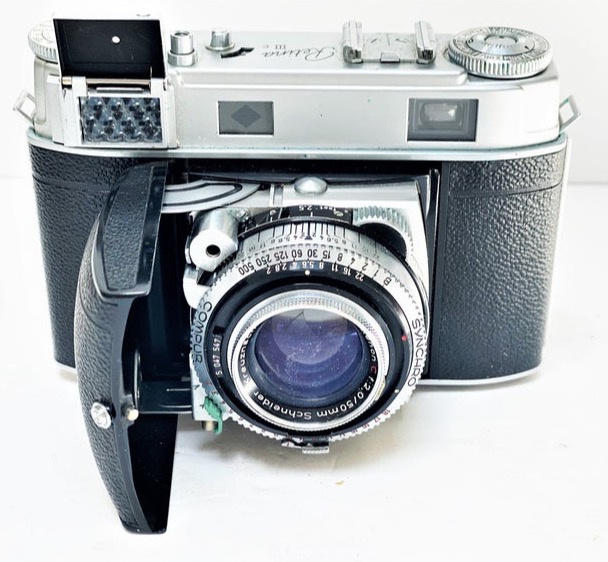


Retina IIIC. The finder on late models came with 35, 50 and 80mm frames.
The raised flap on the meter denoted low light use. 1960.

Rollei came along with a stroke of genius in 1963 with the Rollei 35, whose ads correctly boasted that the camera was not much larger than a 35mm film cassette. The collapsible lens – with an interlock no less – was the time honored Tessar and a coupled CdS meter was included.
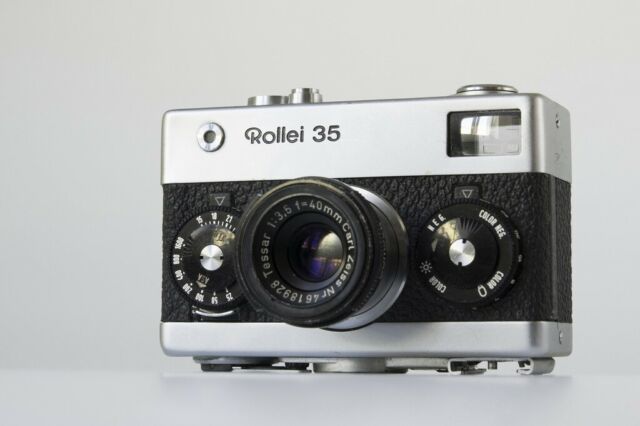


The Rollei 35. The 35S variant offered an f/2.8 optic.
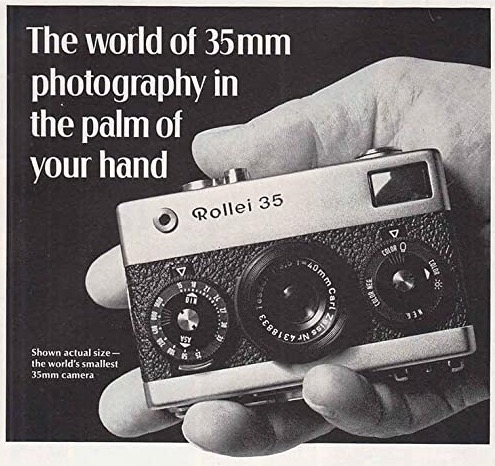


Period ad for the Rollei 35.

I travelled all over the world with mine and while focussing was by guess – there was no rangefinder – the results from the 40mm lens were excellent. Mine came in enameled black, making it pretty stealthy.

But the genius designers at Olympus were not to take this lying down and came up with something infinitely superior in their Olympus Stylus in 1991. It had autofocus for the 35mm f/2.8 lens, a length which was perfect for street snapping, and a flash was included. This was a clamshell design. Slide open the lens cover and the lens would extend. The camera was well made, housed in a tough resin shell, and I literally beat mine to death when it failed after many journeys and hundreds of rolls of film. Yes, the film rewound automatically at the end of the roll. One handed operation was a breeze and over 5 million were sold. I consider the Olympus Stylus the best collapsible camera made.
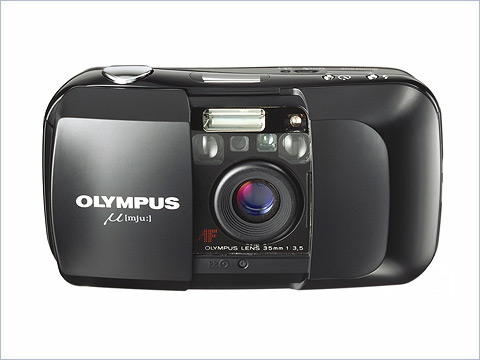


The f/3.5 lens became f/2.8 later.

Olympus fades

Camera business sold.


The announcement.

The buyer is the same that bought Sony’s Vaio laptop business a few years ago. Ever seen one since? No, I thought not. And that will likely be the fate of Olympus cameras, too.

What is surprising is that this took a full decade after Olympus perpetrated one of the largest accounting frauds in history, hiding $1.5 billion in investment losses. Japan Inc. covered for that but could not cover for a failing sector – the stand alone camera business.

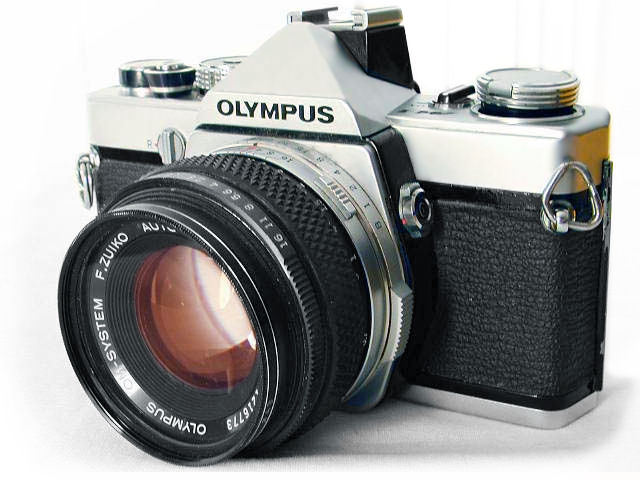
Over the years Oly has made some excellent innovative cameras, including the half-frame Pen F with the side flapping mirror and the compact OM1 in the film era.


The excellent OM1 – small, quiet and with a great selection of lenses.

But the failure of Olympus is not the result of accounting fraud. It’s the same cause that will see Pentax, Ricoh, Sigma, Panasonic and probably Nikon exit the camera business in the next few years, once corporate pride and loss of face are dealt with. The reason is a catastrophic failure to innovate. The high prices of even entry level DSLRs or mirrorless cameras, typically north of $600, puts them in square competition with the iPhone and its outstanding camera. The computational photography aspects of the cell phone’s camera moxy include variable depth of field, exceptional night imaging and the ability to instantly share images with the world. No traditional camera body, be it FF, APS-C or MFT can offer those features. And Apple is just getting started with its in-house designed Axx series of CPUs, now migrating to their laptops and desktops. And Apple’s in-house designs make it very much harder for the serial thieves at Samsung to keep up, fair reward for their crimes.

The other survivors? Canon, for whom cameras are a small revenue center and Leica, which changed its business model years ago. They now no longer make cameras, focusing on jewelry.

So goodbye, Olympus, and hullo, iPhone. It’s time to move on.

Apple to fire Intel

No more Intel CPUs.

I well recall the growing disaster of the IBM PC CPUs, the G3, G4 and G5.

Apple used these in their desktops and laptops through 2005, when Steve announced that Apple would be dropping the IBM CPUs in favor of Intel CPUs.

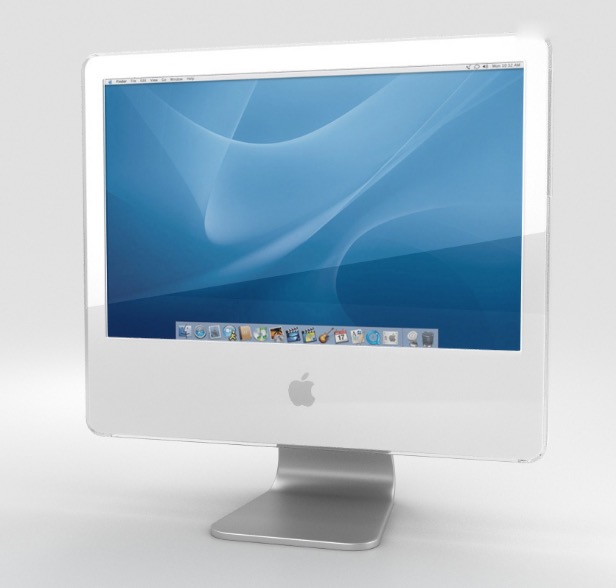
The best laptop at the time was the Apple Powerbook G3 which used the G3 PowerPC CPU. The problem was that as speeds increased with the G4 and G5 the CPUs ran hotter and hotter and Steve concluded that, as IBM was unwilling or unable to address the heat and high power consumption issues, a change was called for. Indeed at the time I recall using a G5 iMac and the machine could have doubled as a toaster. It revved up the fans at the slightest provocation and you just knew that its service life would be limited. I sold it and went to Hackintoshes when Apple switched to Intel. The Macs of the time were too expensive for my taste.

When the first Intel CPU Macs were introduced they came with a truly brilliant application named Rosetta. This ran invisibly and was an emulator which ensured that if you fired up a PowerPC application that it would run seamlessly under Intel’s architecture. That took years to develop, was invisible to the user, and it will be intriguing to see how Apple does like magic this time around.


The G5 iMac – the Apple toaster.

Now it seems that Apple is about to announce that it is switching from Intel to ARM CPUs in its laptops and desktops and the reasons appear similar – too much power consumption, too much heat and too slow a development cycle. And this time Apple will have total control over the CPU’s design, predicated on its years of expertise with the Axx series of CPUs in the iPhone and iPad. I can testify to the prowess of the A13 ARM CPU in my iPhone 11Pro which is a wonder and a great pleasure to use.

For the full story check out this Apple Insider article, which also includes details on the financial aspects of the switch. It is written by the estimable and always dependable Daniel Eran Dilger.

Three hundred bucks a year

High end photography has never been cheaper.


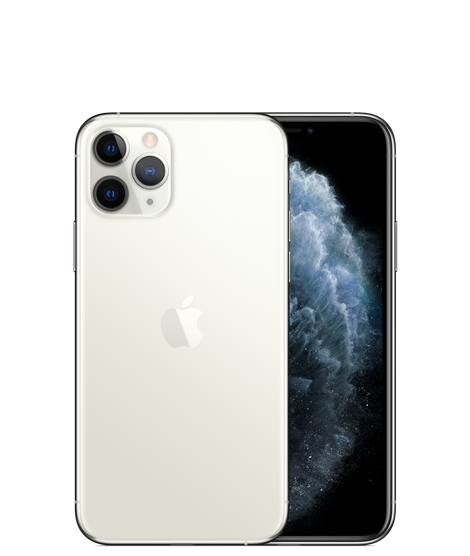
The iPhone 11 Pro lens array.

The ever bubbling rumor mill has it that this year’s iPhone 12 Pro will come with a 60+ megapixel sensor and a fourth ‘time of flight’ lens which will enhance virtual reality viewing as well as providing more granular depth map data for selective focus effects, rendered in software.

I will immediately list my iPhone 11 Pro on Swappa and will sell it for $300 less than its iPhone replacement. This is the extent of my annual hardware cost, the equivalent of a few rolls of film plus some prints or another lens for a DSLR or mirrorless body. Photography has never been cheaper. And I get a new camera annually, comfortable in the knowledge that every iPhone camera has been better than the one which came before it.

Night Mode optimisation

A modicum of care does the trick.

Night Mode is one of those brilliant enhancements in the iPhone 11 which obsoletes every ‘serious’ camera on the market.

Those 8 billion plus transistors in the iPhone’s A13 chip are put hard to work taking multiple images and then stitch together the best bits for a stunningly good result. And the device’s outstanding HDR technology makes sure that the dynamic range is constrained to what the technology can handle. No highlights are burned out.

Still, a modicum of care will be repaid with the best possible images. If you use the iPhone’s default Camera app, Night Mode is automatically invoked when needed. You cannot force it ‘on’.

When Night Mode is active a yellow flag appears at the top left of the iPhone’s display and the image ‘seen’ at the time of exposure remains frozen on the screen. When processing is complete some three seconds later – and you are warned to keep the camera still – a second image appears on the display showing what was recorded. If you notice a significant shift between the locations of objects in the second image compared with the first then it’s more than likely that the result will be blurred. I obviate this problem by using a monopod, which eliminates vertical motion which is the real killer here. I don’t bother with any attachment device, simply holding the iPhone tightly against the top of the monopod. The results are peerless, as these two images from the garden at night illustrate. The extreme dynamic range will only embarrass your DSLR or mirrorless monster. Don’t bother. Get an iPhone 11 – these are SOOC, naturally: