Category Archives: Hardware

Stuff

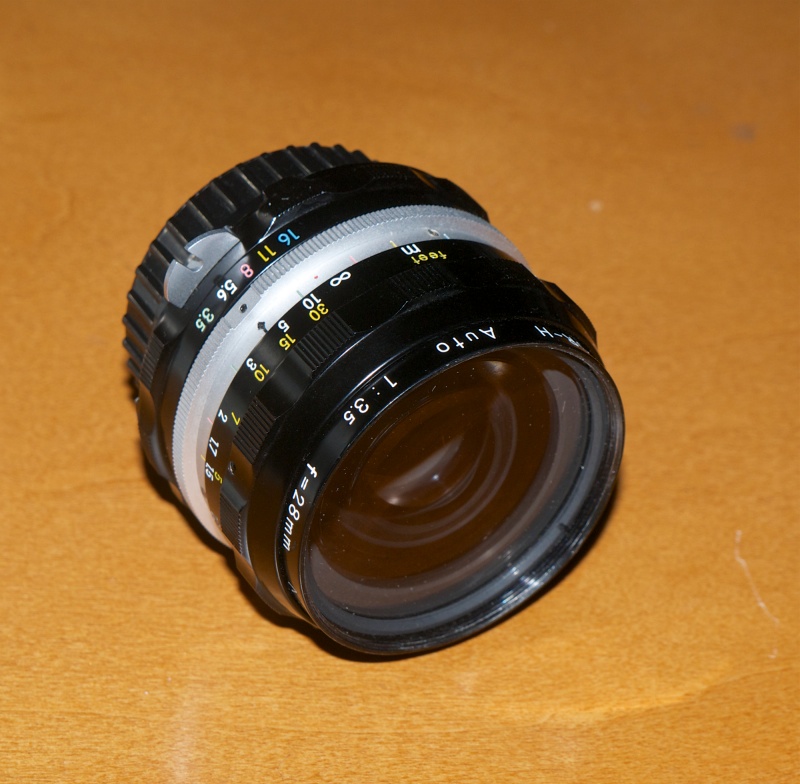
Nikkor-H 28mm f/3.5 lens

A lightweight 28mm.

This one seems to have slipped through the review mill, so here are the details.

Mine is the pre-Ai version of 1971 with the metal scalloped focus collar . It’s considerably smaller and lighter than its f/2 sibling and can often be found for around $40. My mint copy ran $63 delivered. Construction and engraving quality represent the very best Nikon ever accomplished. The lens is a fine match for lighter bodies; it tends to be a bit too small for best handling on the larger bodies with battery grips.

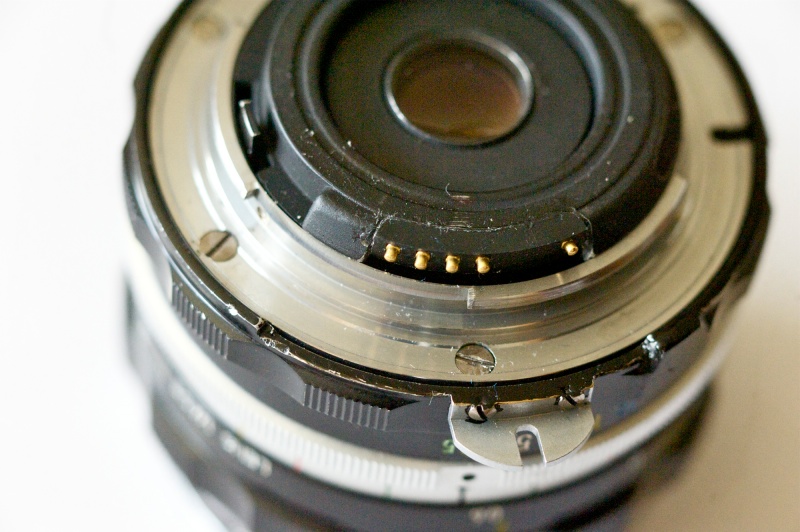
I removed the five slotted screws retaining the bayonet flange, removed the aperture ring and filed down the necessary relief to clear the aperture feeler on modern Nikons, making this into an Ai lens. You can see the relieved arc in the picture below.

CPU installation on this one is tricky as the rear baffle is sloped, for some reason. It has to be removed and cut back to create the plane perpendicular surface to which the CPU is glued.


CPU installed after the baffle was cut back.

As usual I have created a lens correction profile which you can download here.

This file includes three profiles, at f/3.5, f/5.6 and at f/8. LR and PS will use the closest match. The 28mm f/3.5 shows vignetting at f/3.5, disappearing by f/5.6 with very minor barrel distortion being corrected.

This profile is for the pre-Ai and Ai versions, which had 9 elements in 8 groups. I have not tested this profile with the later Ai-S lens, though it appears to have a similar optical design.

If you use a filter, make sure it’s a slim one. The correct hood is model HN-2. I use one with a standard slim Nikon 52mm UV filter.

As is common with pre-AiS lenses, the aperture stop down lever exhibits substantial non-linearity, as illustrated here so you really want to pass aperture control from the camera to the lens’s aperture collar to assure proper metering.

The lens is sharpest between f/5.6 and f/11 where it cedes nothing in definition to its far costlier sibling.

Pixel peeping the D2x

Quite exceptional.

The Sony designed sensor in the Nikon D2x has a couple of things going against it. The design is some 9-10 years old and the sensor is APS-C. Half the size of a full frame one. Total pixels are just over 12 mp.

I keep reading about how this sensor cannot handle ISO400 or anything faster and how limited it is when it comes to large prints, so I thought I would do a bit of pixel peeping at extreme magnification ratios.

Here’s the original image. It was taken using the 85mm f/1.8 AF-D lens in overcast light at ISO400 and 1/1000 second and f/2.8, using autofocus.


Funny hats. Market Street at the Embarcadero, San Francisco.

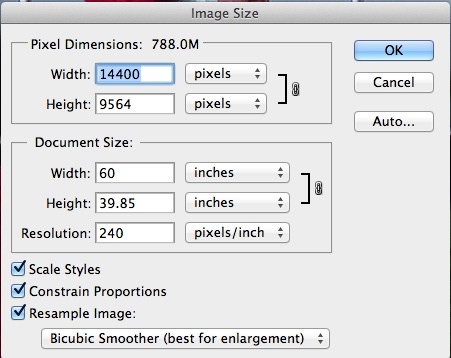
I exported the RAW original as a TIFF from LR to PS CS5 where all I did was to enlarge the image using the Image->Image Size->Bicubic Smoother telling it to shoot for a 60″ wide print. This takes out the jaggies which are just becoming visible at this huge size. Then back in LR I tweaked the sharpness sliders a bit until it looked good. The whole thing took seconds to do. I then magnified the PS processed image to an equivalent width of 80″ (that’s over 6.5 feet!) and took a screen shot which appears below:


Center section of an 80″ print.

Viewed at 2 feet from my 21″ display the image is perfect. Large areas of smooth tone are just beginning to show noise if you stick your nose in it.

Here are the PS CS5 settings:

The original Nikon RAW file of 20.2MB swells to 827MB after the PS step, giving even my nuclear powered Hackintosh pause for thought, meaning a second or two to pop up the greatly enlarged display image.

The sweet spot for this sensor is reputed to be the native ISO of 100, whereas the above is at ISO 400, so there’s s good deal more performance yet to be squeezed out for the most critical results. Further, the native ISO of that old sensor is also known for outstanding color rendering, matching the best that is available today. I must give that a shot one day.

Not half bad for an obsolete sensor and body with a middle of the road lens. Sure, the latest sensors have better dynamic range and can go to unheard of ISOs, but for my purposes there’s not an awful lot wrong with the D2x, a bargain if ever there was one. Now excuse me while I get the glue out and reattach a bit of the rubber covering which is coming off the body ….

Nikon voice memos

Smooth Lightroom integration.

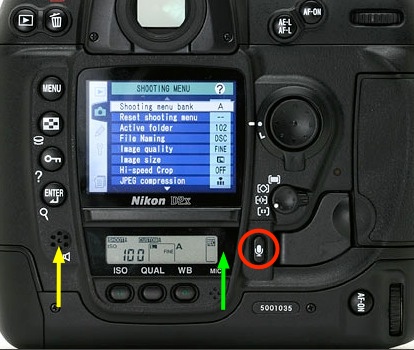
One really handy feature in the Nikon D2/D3/D4 bodies is the ability to record a voice memo of up to sixty seconds in length for each image. After enabling the function in Settings, you hold the voice memo button down while speaking into the microphone on the rear of the body. If you are taking posed snaps of strangers and want to send them a copy as a courtesy, this is a great way of recording their email address for later retrieval.

At first I thought this to be a worthless gimmick but in practice am finding it to be a really useful feature on my D2x.


Recording button red circle; speaker and microphone – yellow and green arrows.

You can playback the voice memo using the camera’s small speaker to check it’s intelligible at the time of recording.It sounds far better over your computer’s speakers!

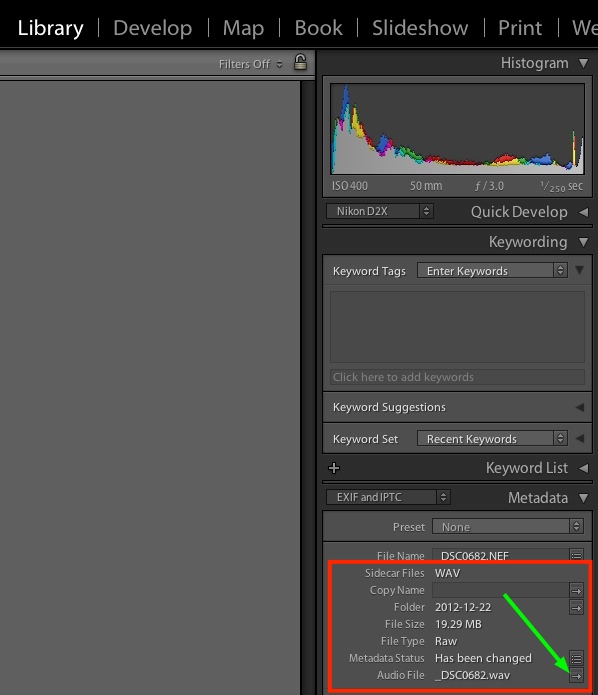
When it comes to processing, Lightroom fully accommodates this function. The WAV file recording has the same frame number as the image but with a ‘.wav’ file extension and is imported along with the image into LR 2, 3 and 4.

You can see the sound file in the Library module of Lightroom and you can play it back by clicking the arrowed icon:


LR’s Develop module and the playback icon.

A like feature is also available on some Canon DSLR bodies.

File sizes? A 10 second recording averages 75MB – not enough to worry about when it comes to consuming precious space on your camera’s CF or SD card. The D2 and D4 use one CF card, the D3 one or two CF cards.

The Crown Graphic

A well thought out design.

Watching Brian dePalma’s splendid Prohibition Era movie The Untouchables the other evening I was struck by just how skilled reportage photographers were in that period. In one early scene, the Treasury Agent Elliot Ness orchestrates a raid on a suspected illegal liquor warehouse and as he prepares to smash open one of the wooden crates he believes contains the hooch, an aspiring press photographer, armed with a Speed Graphic and that enoromous flashgun with the almost as large one-use bulb, bursts in and takes a snap. His men want the reporter removed but Ness, sensing a ‘photo op’ lets him stay. As he picks up the axe to smash the crate, it’s what follows that leaves you lost in admiration. In a choreographed series of actions, the reporter realizes he has used one of the two exposures in his film slide. In the matter of a few seconds, you see him insert the dark slide, pull out the film holder, reinsert it reversed, pull out the second dark slide, change the flashbulb and snap Ness as he pulls out the contents of the crate …. a Japanese decorative umbrella. Ooops. But what the photographer had to go through to get his one chance at the front page is exceptional.

The camera was, amazingly, exceptionally well suited to hand-held use. It came with a decent rangefinder (I dismantled mine to clean the mirrors whereupon it became easy to use), an optical finder with interchangeable masks for different lenses, a wire frame finder easily extended from the body and ideal for reporters’ use and adjustable focus stops. You had a reasonable range of perspective controls thanks to the drop bed, and lens exchange was very simple and fast. Best of all the whole thing collapsed into a surprisingly compact rectangular box and the included carrying handle made for easy transport. It weighed less than the modern DSLR. A large chromed side plate accommodated the flashgun whose handle later did double duty in George Lucas’s ‘Star Wars’ movies as a light sabre!

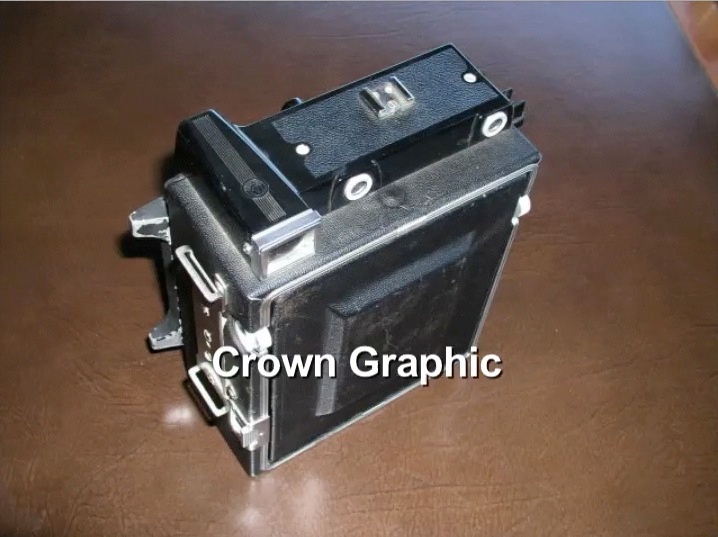
Until the roll film camera gained acceptance, the reporter’s tool of choice was the Graflex company’s Speed Graphic or later the Crown Graphic. I owned a Crown Graphic for a couple of years, interested in finding out just how it was to use a large format camera. I put together a slide show of my Crown Graphic – long sold – and you can download the 50MB file by clicking or touching the picture below:


Click the picture to download the slideshow.

Toward the end you can see where I made my own focusing cams for the wide and long focus lenses so as to ensure accurate coupling with the optical rangefinder for hand-held use. A fun project!

Tripod use was every bit as easy and the huge negative size meant that large prints of just about any size were easy to make with frightening resolution. Scanned at 4,000dpi the negative yielded no fewer than 320 megapixels! At 2,000 dpi, more than enough, it came in at 80 megapixels.

I eventually gave up on the Crown for a couple of simple reasons. First, it was impossible to find anyone to process my Kodak Vericolor originals without adding scratches, boot marks and hair lines. This meant endless retouching just as in the bad old film days. Second, getting a good scan of the originals at a reasonable price was also impossible. Drum scans, which would disclose every last detail in every last leaf on that giant sequoia were prohibitively expensive and the scanned files would average over 200MB. Guaranteed to disclose my iMac’s dual purpose design when processed – a computer and a toaster, all in one. But the Crown Graphic was an absolute blast to use. Both color and monochrome film stock remains available if you want to give it a shot. You will not lose any money when it comes time to sell your hardware, but you will need a good changing bag to load those film holders. Just about any lens will do, the large negative making the latest and greatest in optics overkill.

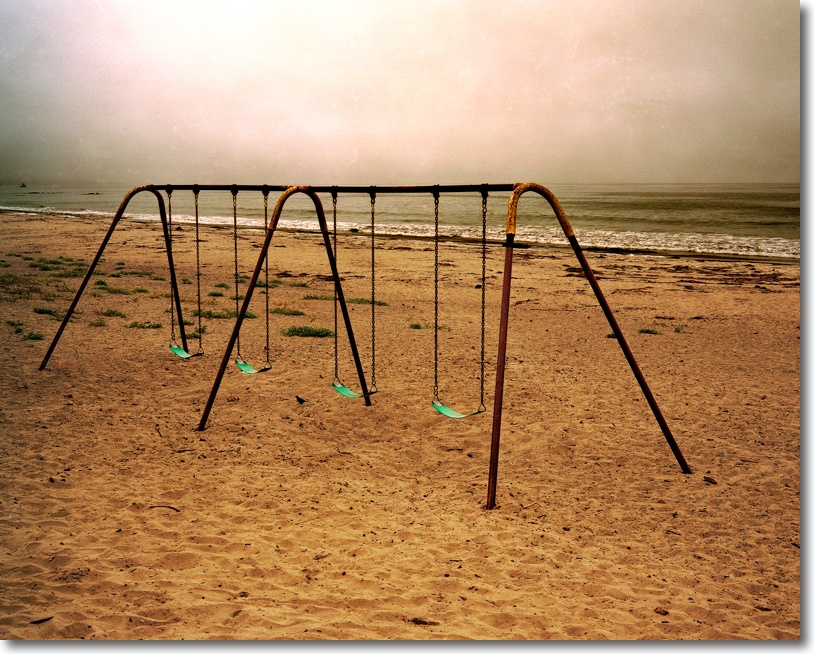
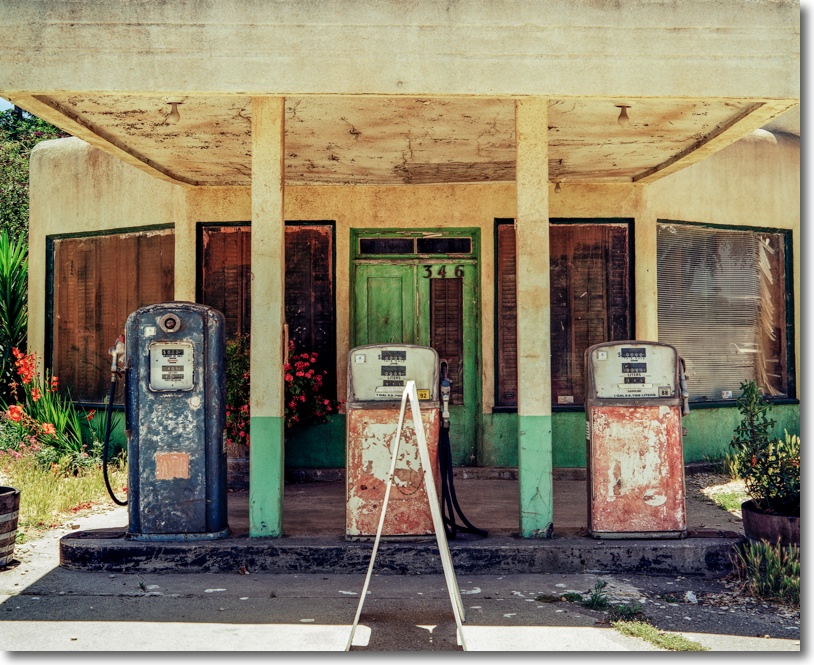
Here are a few snaps:


Cayucos beach.


Abandoned gas pumps, Los Alamos, CA.


General Store, Los Alamos, CA.


Rust.

Favorite gear of 2012

Old can still be good.

It would be wrong to caption this column ‘Camera of the Year’ or something similarly pretentious. After all, I’m an amateur snapper, not a journalist reviewing free hardware who gives the award to the maker paying the biggest kickback/free gear gift/trip to Osaka or the Black Forest. This is my money and my preferences we are talking about, not other people’s money and advertising dollars.

That said, I do give careful consideration to where my money goes and that is rarely to the latest and greatest. Obsolete means nothing to me, except maybe a good entry price and low depreciation, and buying new tends to be anathema to my psyche. Plus I like the gestation and discovery period that something a few years old has undergone.

So if I tell you that my favorite camera body was last made 7 years ago – aeons in DSLR terms – and the lens is no less than 4 decades old, I would be quite understanding were you to write me off as some sort of nutty eccentric, like the guys still doing wet collodion in 8″x 10″ view cameras.

However I have long known that a change of gear acts like a kick in the pants for yours truly, if nothing else to justify the outlay by making some decent pictures. And if the use experience confers tactile and mechanical pleasure, both keenly developed senses in my case, then all the better.
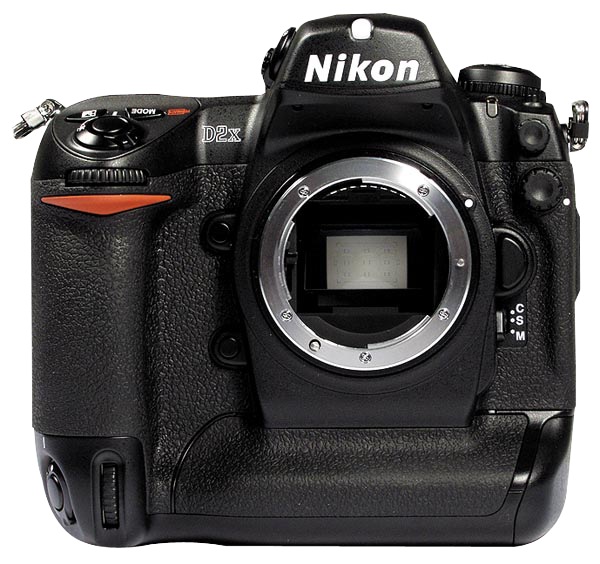

Click the picture.

My favorite gear of 2012 is the 2005 Nikon D2x with what I can only describe as a thrilling lens, the 50mm Nikkor-S f/1.4 pre-Ai MF lens. That’s like a 75mm portrait lens on the APS-C sensor in the D2x body and the handling, balance and ease of use of the combination are really special. The trade-off is more time in the gym to carry this far from svelte outfit around but, surprisingly, as a street snapper I have not experienced any of the ‘it’s intimidating to your subject’ syndrome that many ascribe to these big bodies. Quite the opposite. Maybe the loudly emblazoned ‘Nikon’, married of course to my massive build and no less threatening physical presence, does the trick, but I rather fancy I may be fooling myself here. Sylvester Stallone I am not.
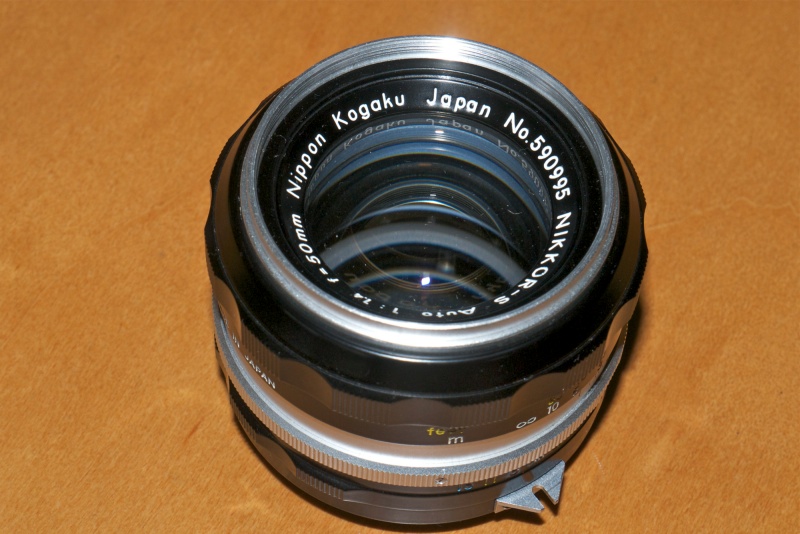

The 50mm Nikkor-S f/1.4. One of the most beautiful optical masterpieces yet conceived.
Click the picture.

Why pay $700 for an obsolete digital body? That money gets you a competent, current DSLR body, certainly less robust, but with a sensor sporting better high ISO performance. Maybe even a decent kit lens for that price will come with it. It will not get you much in FF DSLRs, with the original and superb Canon 5D being the best bargain in that price range. It also gets you an exceptionally well sealed body which, though it has no dust removal shaker, has no need of one. My FF D700 has such a mechanism yet I am regularly cleaning the sensor with brush and blower. There’s nothing wrong with the D700. It has far better performance above ISO800 and when fitted with the MB-D10 battery pack mimics the well designed vertical shutter release on the D2x. Plus it’s FF, so wide lenses remain wide. And neither body has a reputation for problems. Older D2x bodies can exhibit the ‘blank first frame’ symptom but that’s about all I have read of. Either body will last the average amateur longer than his stay on this mortal coil.

So why did I buy it? Because it is a far greater pleasure to use than the consumer grade alternative. It will not, however, take better pictures. Those are solely a function of the person pressing the button.

The lens is another story. Click the above picture and you will see how adding a $29 CPU confers proper EXIF data recording, automatic invocation of the appropriate lens correction profile, matrix metering and transfer of aperture control back to the lens, away from the control dials on the body. That works for me as I support the lens with my left hand in any case and, as an old fart, that’s how I have been changing aperture for several decades now, and I am strictly an ‘aperture priority’ guy when it comes to auto exposure. Manual Focus? No biggie, especially with the focus confirmation LED in the Nikon’s finder, the latter made so much the better by fitting Nikon’s magnifying eyepiece. The 50mm f/1.4 delivers performance indistinguishable from the 50mm f/2 of that era, offers one stop more speed and the bulk and weight balance with the heavy body far better. Focus and aperture clicks are simply a dream to use. Compared to modern multicoated optics you maybe trade off a little contrast in strongly backlit situations, but that’s what Lightroom is for.

The whole use experience is a tactile, aural and sensual thrill. That is never lost on me. This outfit makes for an integrated whole of quite exceptional utility and ease of use.

Highly recommended – the kit will run you under $800 if you shop around and there’s no way you are ever going to wear it out. And the only people who will point and say ‘Ugh, how dated’ are not ones you want to know in any case. They are called equipment freaks and photography is anathema to them.