Category Archives: Technique

A break in the storm

More than just a rainbow

Name any of the world’s great democracies and the chances are that you will find its happy residents indulging in the cocktail hour before dinner. America, Britain, France, German, Australia, Brazil – all favor this pastime which many regard, myself included, as the very touchstone of civilization.

Then look at those dour nations who struggle with the very idea of ‘one man, one vote’; God forbid ‘one woman, one vote’ for many do not even allow women the freedom of the ballot box. The Saudis? They don’t drink. The Russians? They do nothing but drink. The North Koreans? Please….

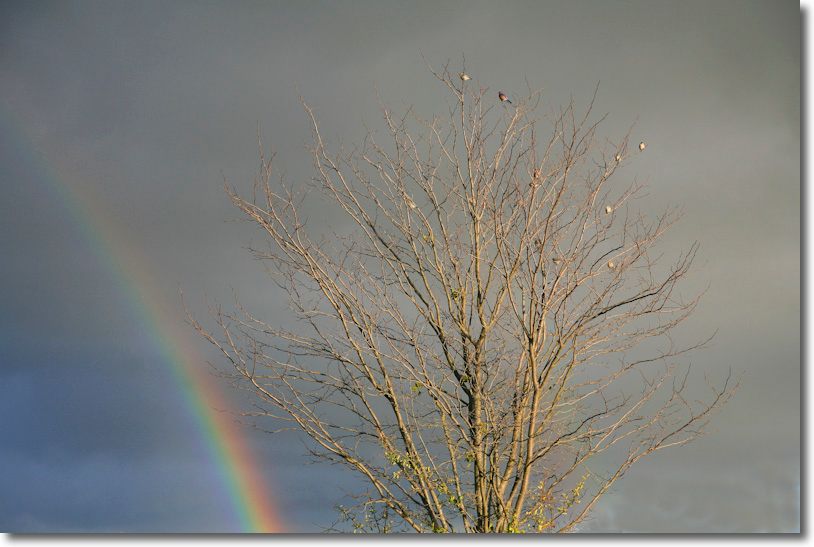
So after a day of truly wretched weather which saw thunder showers every few minutes interspersed with brief rays of sunshine, the thought of the daily libation was very much on my mind as I made my way to the freezer with its gin every bit as cold as the glass next to the bottle. Just before opening the refrigerator I glanced to my left and there it was. A superb rainbow gracing the old estate – clear sky to its left and threatening clouds on the right. Now you should know I’m pretty much blind without my glasses but that didn’t stop me from rushing to the office to grab the 5D, nearly damaging myself on that insouciant boulevardier Bertie the Border Terrier en route, and exiting stage left at a rate of knots that would have given pause to the staunchest of Olympic competitors.

Forget the old wives’ tale that landscapes are a stationary subject. Not a bit of it. Give the elements five seconds and, likely as not, the effect is gone. So throwing caution to the winds I banged off a couple of snaps even though what I saw through the viewfinder was mostly a ghastly blur, trusting to the gods and the Canon’s automation to get things more or less right.

I rushed back in at scarcely lower a pace and placed the card in the reader. Locating my glasses gave confirmation that all was right with the technology from Canon HQ, but when I loaded the picture into Photoshop and snapped it up to 100% original size (that’s some 30″ x 45″ on a print with the 5D’s full frame sensor) it became clear that the otherwise denuded tree on the right was replete with more birds than you could shake a stick at. The small picture here scarcely does it justice but a few moments later as I sipped the soothing elixir, the magic lighting long gone, I could not but help reflect on this wonderful bit of serendipity.

Fixing distortions

A tweak in Photoshop CS2

I’m finding the definition of the Canon 24-105mm IS L lens to be equal to anything on medium format or from Leica on 35mm. What is not so good, however, is that at 24mm you get noticeable barrel distortion (the sides bow outwards) and darkening in the corners.

Sometimes these aberrations do not matter but if you have strong horizontals or verticals or large smooth tone areas, they can be irritating to put it mildly.

I had thought that the only way to correct these was to take RAW images and make the adjustments in the very nice Adobe Camera Raw (ACR) interface. As I have written earlier, proper exposure technique results in little added benefit with the EOS 5D’s full frame sensor using RAW compared with JPG Fine, at least for this user. Plus I’m getting comfortable with the in-camera processing of JPGs offered through the Picture Styles option. JPGs have the great benefit that file duplication is avoided and, of course, file sizes are smaller meaning import to your computer and loading in image processing software are both much faster.

Stated differently, I’m of the growing opinion that RAW is overrated. I do not see better definition or tonal range in any large prints I care to make. I have no need for an unprocessed original. Once I have processed it I like it as it is and cannot see changing it again. And the thought of having to catalog two images of each picture is complexity in search of confusion.

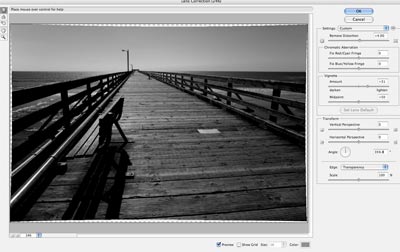
Well, looking through the myriad menus of Photoshop CS2 the other day, I chanced upon Filter->Distort->Lens Correction which offers the same ability to correct lens aberrations in JPGs as ACR does in RAW.

Here’s how it looks corrected on a screen shot:

Both barrel distrortion and vignetting are quickly corrected.

I’ll experiment some more with RAW but JPG Fine is just, well, fine for me.

Monochrome flashback

Still taking the occasional black and white picture

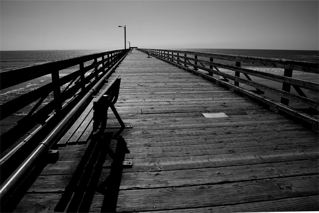
While I may have largely given up on black and white pictures, sometimes things just look better without color.

This was taken almost directly into the sun and the color original is already pretty desaturated. One click using the TLR Black and White Conversion action for Photoshop and a satisfying monochrome rendition results. I find the TLR plug-in gives a better monochrome tonal range than Photoshop’s native ‘Desaturate’ command. There are lots of other interesting actions on that site, too.

Note the slight vignetting in the sky from the Canon 24-105mm L lens at 24mm. I left it in as it heightens the mood.

Delegate the drudge of routine printing

American ingenuity never ceases to amaze.

Every year about this time our family – my wife, our son, the dog, the cat and I – engage in a nerve trying ritual.

The annual Christmas postcard picture.

For years now we have been taking this picture on the nearest point and shoot digital camera which falls to hand as the probability of catching all five cast members with bright smiles, good expressions and open eyes is …. well about as likely as that of finding a politician with integrity. Not impossible, but difficult, to say the least. So we place the camera on a tripod, gather together and bang away. Twenty tries usually does it. This year it was twenty one. Digital, of course, with its instant feedback, ensures we get something useable without having to wait for the film to come back from processing and going through the whole ordeal again.

Now, the picture taking part of the process, I must admit, is far from the most trying. The tough work begins when it comes to printing forty or fifty hard copies to mail to all and sundry. As I ordinarily use my wide carriage Epson printer for large prints which end up mounted and framed, making 4” x 6” postcard-sized ones is sheer agony. You can bet that the print nozzles will be clogged, rendering all and sundry in shades of purest magenta on the first pass. Then, after wasting much time and ink using the self-cleaning cycle (only a marketer could have thought up that misnomer), I try to recover that template I made for Photoshop years ago which places four prints on one sheet. Well, of course, it’s either missing in action or the annual software upgrade has rendered it useless again. Then when I get that bit sorted, I invariably run out of ink.

But then what would you expect? Take one of the very worst designed applications, a study in user torture named Photoshop, and pair it with the least friendly consumer gadget since the VCR – the home printer – and you have a recipe for frustration and failure.

So, this year, I said No More. I had come across an advertisement by one of the large drug stores in the West, Walgreens, which said you could upload your snaps and then elect to have them printed and ready in sixty minutes at a store of your choice. So we uploaded the annual snap (number 21 of 21!) to the local Walgreens, after first downloading their software which, believe it or not, even came in a version that works with computers preferred by human beings rather than geeks. I mean, of course, Apples. And not sixty minutes later, an email arrived asking that we drop by to pick up the prints. No, they don’t deliver. Not yet, anyway.

So we took the boy and the dog for a stroll down the road and there they were. Fifty beautiful 4” x 6” prints, perfectly exposed with those wonderful skin tones the home printer only dreams about, processed in a Fuji Frontier machine right there in the store. Total cost? $8. Yes, 16 cents apiece. Now had they been using a Kodak machine I would have gone elsewhere, as the second worst run American corporation (the prize goes to GM by a considerable margin) is not even capable of making a reliable machine or supporting after market service in a timely manner. So unreliable are the Kodak machines, and so poorly supported, that even the Wall Street Journal noticed after the large Target store chain threatened to return all its machines and going with Fuji if service did not improve. At my local Target, the Kodak machine is typically down 40% of the time.

The point of this piece is that while film may indeed be dead, the commercially made print is alive and kicking.

When I originally wrote the Film is Dead piece, I posted it on Photo.net to gauge reactions. Some fifty emails later, many laced with obscenities and personal attacks, I had in fact confirmed that Film must be Dead, otherwise why would so many deny the facts in ghetto language? It is troubling, though, that these purported aesthetes never graduated from grammar school.

Since that time, America’s second worst run corporation has restated earnings (they don’t even know how much they are losing), laid off thousands more employees (if all else fails, blame the worker – right out of the GM play book), has discontinued monochrome printing paper (excuse me, silver gelatin to those who still use it for cheap effect or is that marketing again?) and obsoleted (‘rationalized’ in MBA speak) most of its color film offerings. And that was just in one fiscal quarter.

So while film, which I still use for serious work, is on the way out, shortly joining the wax cylinder and the LP record as an avocation of the lunatic fringe, the genius of American capitalism, that prime mover of this great nation of hustlers, remains alive and kicking by making easy printing from digital originals a trivial matter.

I for one, while Walgreens and Fuji did their thing, got on with other more fun things this year rather than wasting time with the execrable Photoshop interface and the ink jet printer.

So go ahead and send your casual digital snaps to the local drug store – just make sure it does not use a Kodak machine if you want your prints back any time soon.
There’s nothing quite like mounting.

Years ago when I was serious about monochrome photography (and unable to afford being serious about color), I used to mount my best prints on thick card and matte them for display in frames. The difference between a loose, flimsy print and the finished, framed one was night and day. The mounting press I used was straight out of the tool box favored by the enforcers of the Spanish Inquisition. A massive acme screw on a cantilever placed immense pressure on the print while the hot platen helped melt the adhesive. Heat setting was, well, basic, as in “On” or “Off”. The same press was used to confer high gloss on prints, before the days of RC papers which came with their own, not very good, bluish sheen built in. You squeegeed the print onto a high gloss metal plate, hoping all the air was out, and heated it in the press. The nauseating smell of the formaldehyde which conveyed the gloss is with me to this day. I forget where I got this obscure instrument of torture, but I do recall it cost me all of five British Pounds back in the days before devaluation. That meant $14 in 1973 money, or $67 in today’s (2005) money. Not a lot, in other words, though I had to rewire the thing and generally mess with the wonky switch. But it worked.

This was, by the way, well before the days of Acid Free Boards and Archival Prints. Strange how those ancient monochrome 16″x 20″prints look fine to this day….

The Spanish Press moved on to its eleventh owner when I left the United Kingdom, as the former Colonies neither recognized 220 volts mains power or looked too kindly on a poor immigrant lugging Torquemada’s 50 pound favorite to the shores of the New World. And so it was relegated to the dusty recesses of memory, that foul press and its revolting formaldehyde odor.

Now my default print size, 8″x 10″ was not too bad when it came to handing prints around and asking “Do you like this one?”. But when I got serious about once more showing my work, or at least giving it away to others in a presentable format, memories of the Torquemada Special came flooding back. (See Really Large Prints where the author standardized on 13″ x 19″ prints for his best efforts, below). So I did a bit of shopping and discovered that the heated press situation is even worse than that for gasoline. The latter provides the consumer with an oligopoly, a few vendors pretending to compete but, realistically, fixing the price in a smoke filled room. By contrast, the photographic heated press world, an altogether smaller economy, has no competition whatsoever. In the United States you buy a press from Seal, aka Bienfang, or you do without. When you come down to it, a heated press is nothing more than a couple of slabs of cast iron, one of which contains a heater element, a foam pad, and yes, you guessed it, a massive lever (the acme thread has finally moved on), a couple of springs, two light bulbs – “On” and “Heating” – a thermostat and a cord and plug. So why does this nineteenth century piece of engineering crudity come with a price tag of $1,100 and up, you ask?

Tried to buy a cheap ladder recently? Same deal. It’s called liability lawyers. The members (a suitable description if ever there was one) of the tort bar have made sure that the finished product sells for four times its intrinsic value. Every time some twit falls off the ladder or burns himself using the mounting press, there go the legal – and product – costs. Add greedy home grown labor which spends its “sick leave” watching aforesaid members of the bar advertising their wares on television, and you have a prescription for an overpriced product.

So I did a bit more research. Seems that the Seal presses made back in the first 80 years of the twentieth century came with asbestos wiring. Now, bad memories of Torquemada’s Special dancing in my mind, I realized I did not particularly want to rewire a Genuine Seal original, attractive as it may be, for lack of full body armor and breathing equipment. So I sniffed around on ePrey, that home from home for liars, cheats and thieves, and determined that the current (as in 30 years old) line of Seal presses, distinguished by the suffix “M” in the model number (don’t ask, it stands for Masterpiece. Can you believe that?) as in 160M, 210M, etc. can be found now and then for under $500. That’s still eight times in today’s money compared to the cost of the Torquemada Original, but it beats paying $1,100 for the original cardboard packaging. So I waited patiently and a 160M joined the household, safely stored out of the way in the workshop some fifty yards from the main home. Cast iron being what it is, the UPS man used a dolly rather than risk a premature hernia. No use in tempting fate. Another $50 saw me as the proud owner of a used Seal tacking iron for attaching the mounting tissue to the print and mount.

So now I’m into this dry mounting exercise for some $450.

So now I’m stuck with mounting the prints and have absolutely no clue or recollection how to do it. I run to the Internet, read fifteen conflicting accounts, only to find definitive instructions in the packet of mounting tissue by …. you guessed it …. Seal/Bienfang. Don’t say I didn’t warn you about the lack of competition. Phew! You would think that the guys who make the press and the tissue know their stuff. And indeed they do. Things go without a hitch and three lovely 8″x 10″ prints are even now winging their way to him in time for his exhibition. No question he will win. Two identical prints, one held up with thumb tacks, the other nicely mounted, is no competition.

The moral of this tale? Well there are two. The first is that a properly dry mounted print with a decent mat is THE way to showcase your work. No, not one of those poncy things where you stick one edge to the back of the mat to let it “breathe and expand” only to cockle in two weeks, using the excuse that the “Art” world accepts no less – mainly because the Art world is broke. We are talking heat sealed here.

The second is that you should copy this piece to anyone you know involved in Chinese manufacture of basic equipment and get the price down from $1,100 to $99.99.

All photographers will be in your debt.