The LG 34UM95C ultrawide display

Supersize me.

For an index of all my Mac Pro articles, click here.
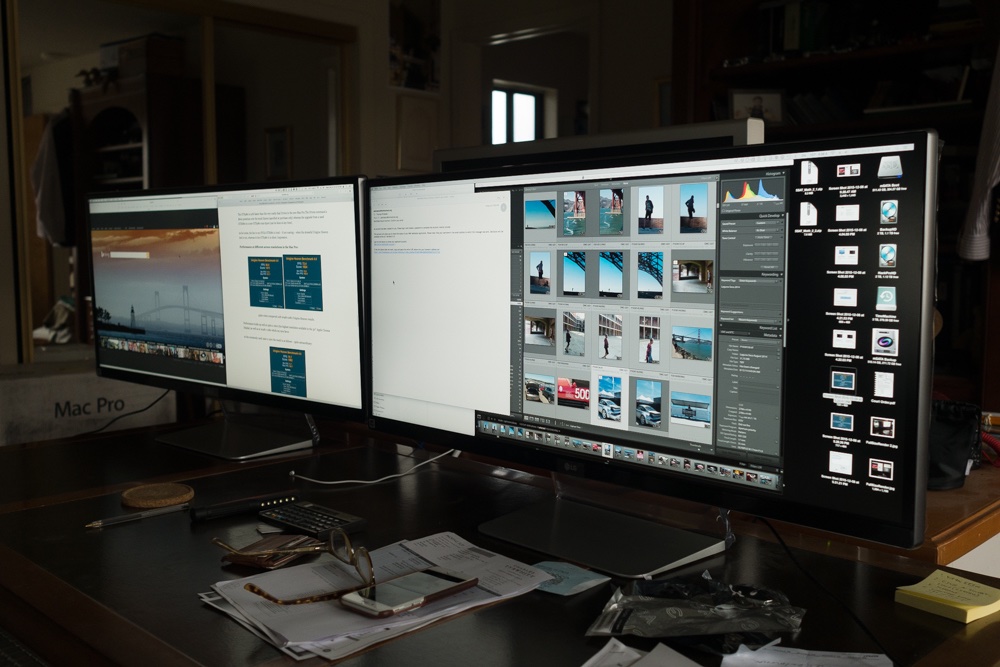

Dual LG displays, each running at 3440 x 1440 pixels. 30″ Apple Cinema Display in back.

A custom Mac Pro build for a customer saw him requesting tests with two LG 34UM95C displays, which run $600 or so each at the time of writing. These are ultrawide IPS panels with definition just shy of 4K. The user is a video production professional and needs all the screen real estate he can get. The Mac Pro is a 2009 heavily modified by me, running dual X5690 3.46GHz 12-core CPUs, 64GB of 1333MHz registered server RAM, 4TB of mSATA SATA3 SSD drives on one PCIe card and 4 x 4TB WD Caviar Black 7200rpm HDD. The total investment of some $6,000 compares with an all in cost of $15,000 for like performance with the new (trash can) Mac Pro.

The displays are driven by an EVGA Nvidia GTX970 4GB card, model 04G-P4-3975-KR, which runs some $300 at Amazon. This card is distinguished by having no fewer than three DisplayPort sockets, in addition to DVI and HDMI. The GTX970 has the same performance capabilities as the earlier GTX680, but the latter comes with dual DVI, one DP and one HDMI sockets and while it will drive one of the LGs at maximum definition it will not drive two, both the HDMI and the DVI (using a DVI to HDMI cable) being limited to half a screen at 1720 x 720 pixels – useless. The GTX970 uses 25% less power than the GTX680 – 145 watts vs. 195 watts at full chat. That’s a non-trivial difference. If you can live with the issues in the next paragraph, this card is highly recommended.
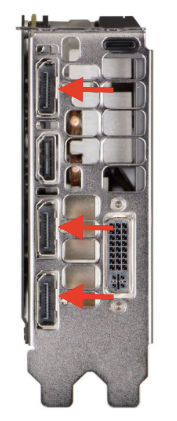

The ports on the GTX970 – the three DisplayPort sockets are arrowed.

The stock GTX970 has two issues – there is no splash screen at start with the Mac Pro (no big deal unless you want to switch in and out of Boot Camp) and requires the use of Nvidia’s drivers which must first be installed (as a SysPrefs pane) or you will get a black screen. Further, as Apple does not include these drivers with OS X, any update to OS X may require the update of the driver first. Nvidia is very good about keeping these current as it helps them sell cards for the 9xx cards. By contrast, the 6xx and 7xx cards work with the native OS X drivers.
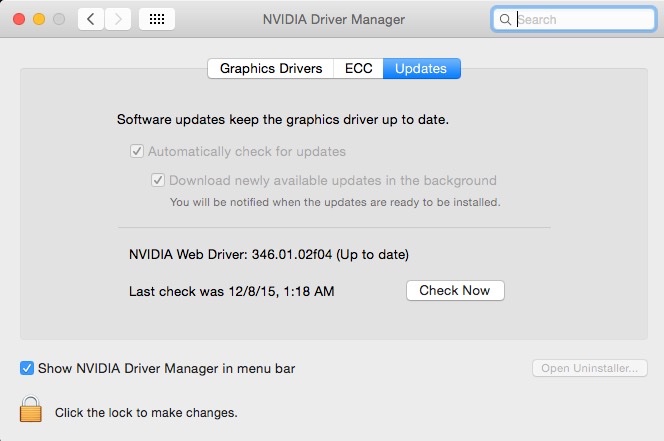

Nvidia driver loaded in the System Preferences pane.

If you need truly vast screen area, the LGs are recommended. There’s a costlier version with Thunderbolt sockets for the trash can Mac Pro, useless for classic Mac Pro users. The center base of the display sports a joystick which makes one-off tuning adjustments easy. The foot, a nice alloy match for the Mac Pro, is retained with two screws at one of two heights and limited tilt is provided. The displays have a very narrow frame and are both elegant and beautifully made. I would prefer the foot to be one inch taller, but that’s a personal preference.
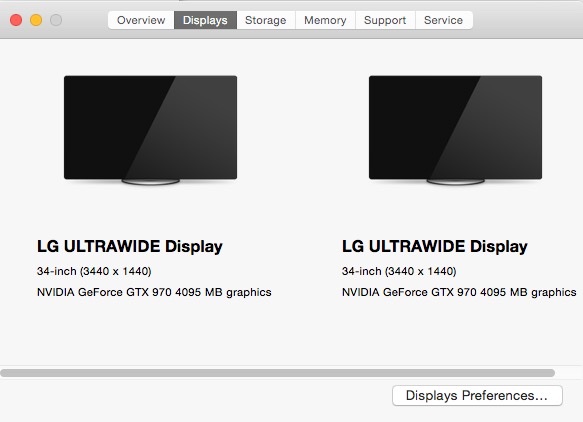

Full definition on both, each running at 60Hz.

My copy of Unigine Heaven maxes out at 2560 x 1440, so the adjusted framing rate shown in the (stretched) screenshot below figures to 38fps – excellent performance especially when the number of pixels is taken into account.
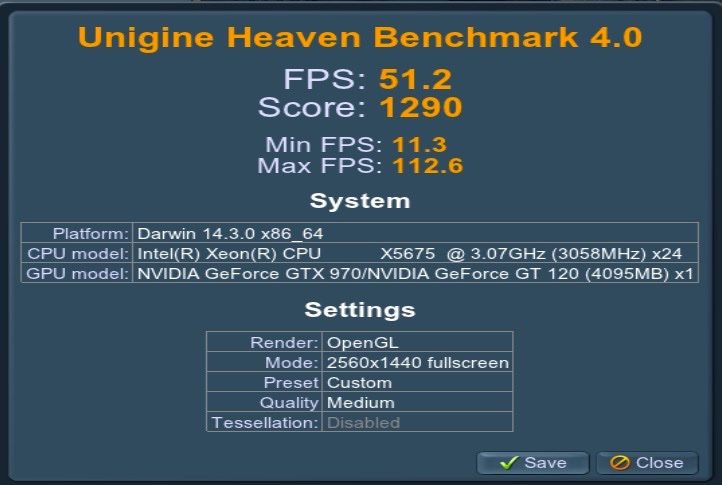

Tested on a 12-core 3.06GHz 2009 Mac Pro which also sports an ancient GT120 card.

Performance of the displays is exemplary. There is absolutely no backlight bleed and the displays are easily tuned, being shipped far too bright for photo processing – as is the case with just about every display out there. If you need vast screen real estate – 23% more than on a 30″ Apple Cinema Display – these are a bargain, and involve none of the issues encountered with 4K displays (flickering, incompatibility, minuscule font sizes, etc.). The back is drilled for a standard 100mm VESA wall or arm mount plate. Surprisingly light for their size, each comes with a DP and an HDMI cable, and those are the only two graphics sockets on the display. A provided stick on clear sheet of plastic adds ‘slideability’ on your desktop of choice. I left it off. Unlike the current ghastly and horribly overpriced Apple 27″ Thunderbolt displays with their awful glossy screens, the LGs sport pleasantly matte screens and suffer no reflection issues. Ideal for professional use all day long.

Prices on all flat panel LED/LCD displays continue to fall rapidly – I would hate to be in that business. Here’s the trend for the LG:

Louis Stettner

NY street photographer.

Louis Stettner, still going strong in his 90s, is a Brooklyn born street photographer. Click the image for an evocative slide show of the old New York Penn Station, sadly torn down in the 60s. Yes, there were vulgarians around long before Donald Trump:


Click the image.

William Wegman

Weimaraner guy.

The Weimaraner is a doleful looking fellow, occasionally used by police forces when they are out of German Shepherds. German, of course.

William Wegman has made a living out of snapping his Weimaraners and he just did a splendid layout for Bloomberg Business on Xmas gifts. The images are hilarious and outrageous, and any dog lover will enjoy them. Click the image.


Click the image.

The Freedom Trail

American history.

My son’s trip to Boston to check out prep schools coincided nicely with his history studies in intermediate school where he is in the middle of colonial and revolutionary American times, so at his teacher’s suggestion we took the Freedom Trail tour over the weekend to better soak up the history abundantly on display in downtown Boston.

The Trail covers over a dozen historical sites and is led by a guide dressed in period costume.


The Trail map.

Here is Winston, suitably bundled up, on Boston Common, ready to start the tour:


Bundled up and ready to go.

A goodly amount of time is spent at the Granary Burying Ground, named for the 12,000-bushel grain storage building that was once next door, which is the last resting place of Peter Faneuil, Paul Revere, John Hancock and Samuel Adams amongst others.


Wealthy individuals like Peter Faneuil enjoy large tombs.
Our tour guide is dressed in period slave costume.


Paul Revere’s tomb.


Sam Adams not only signed the Declaration of Independence, he also brewed beer, made to this day.
The picture on the beer bottle label is of Paul Revere.


The Boston Latin School. There is no spire as funds ran out!
Dating from 1635, it’s the oldest public school in America.
Five signers of the Declaration of Independence attended Boston Latin:
Benjamin Franklin, Samuel Adams, John Hancock, Robert Treat Paine, and William Hooper.


The old State House. Built in 1713 to house the colony’s government,
the Old State House was at the center of civic events that sparked the American Revolution.
The Boston Massacre took place right outside.


Another tour guide in period costume.
We enjoyed beautiful weather on the tour.


Built in 1729, Old South Meeting House was not a church,
but rather a meeting house for the Puritans to worship.
It was in this House that the momentous decision was
made to dump British tea in the harbor, rather than pay taxes.


A poster advertising the Trail.


The trail wends through many small alleyways.
This old bookshop typifies the setting.


Sign designating the original location of the Old Meeting House.


Faneuil Hall. Often referred to as “the home of free speech” and
the “Cradle of Liberty,” Faneuil Hall hosted America’s first Town Meeting.

All snapped by Winston and dad on iPhone6 cameras.

HBS

The best of the best.

For an alphabetical index of the New England College series of pieces, click here.

Calvin Coolidge reminded Americans that “The business of America is Business” and nowhere is this better shown than in the most famous of business schools, Harvard Business School. While HBS no longer dominates the ranks of CEOs of America’s largest companies – an affinity with dropping out and unkempt looks dominated by ‘hoodies’ being the thing today – a graduate of HBS has a meal ticket every bit as valuable as one from Harvard Law or even Harvard itself. Those who deny that ‘it’s who you know, not what you know’ never got admitted to any of these.

So no surprise, then, that in further capitalizing on my son’s Unfair Advantage, our week long visit to check out New England prep schools for him saw us dropping in on HBS. To say we left overawed hardly does the visit justice.


Winston on the steps of the Baker Library.

From the library’s site: “The Baker Library holds comprehensive special collections that record the evolution of industry from the 1400s to the present. The HBS Archives, manuscripts and rare books document the individuals, organizations and theories that shaped, and continue to influence, the global business world. ”


The main study room inside the Baker Library – a palpable sense of purpose.

You can see a brief video made by my son below:

In the great liberal tradition of American education, all the buildings are open and no one asks for ID or access rights.

Aldrich Hall is special – each level is replete with bay windows which form discrete, compact study areas for a handful of students. The atmosphere is hushed-respectful, as is the whole campus. No ra-ra-ra knuckle-headed sportsmen here.


Winston dressed for the occasion, inside Aldrich Hall, a Rockefeller donation.

From the Hall’s site: “Rockefeller suggested that the building be named for his father-in-law, Nelson W. Aldrich, who represented Rhode Island in the US House of Representatives from 1879 to 1881, then in the US Senate from 1881 to 1911. Aldrich, a notable financier and leader of the Republican Party, was chairman of the National Monetary Commission and the Federal Reserve. A driving force in international trade and monetary policies, he was sometimes called the “authentic voice of J.P. Morgan.” ”


The Dean’s House.

As befits the master of the world’s most storied business school, the Dean’s residence yields nothing in splendor to the rest of the HBS campus. From the site: “The Dean’s House was designed by Coolidge Shepley Bulfinch and Abbott. Construction was completed in 1929, two years after the dedication of the first 12 HBS buildings and just two years before the death of George F. Baker, the prominent banker who funded the construction of Harvard Business School’s original campus. The brick, 10,978-square-foot Georgian Revival-style building includes a gracious entry hall, study, living room, dining room, kitchen, and pantry on the main floor, with a circular staircase leading to a sitting room, bedrooms, and baths on the second and third floors. The surrounding garden was part of Frederick Law Olmsted’s original landscape design. ”

Any visit to Boston should see the tourist at HBS, for there are few more splendid experiences to be had.

All snapped on the iPhone 6.