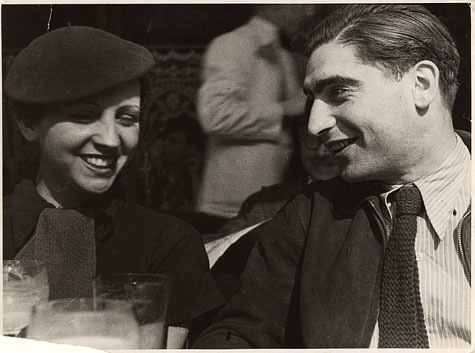
Zeiss Ikon’s finest.
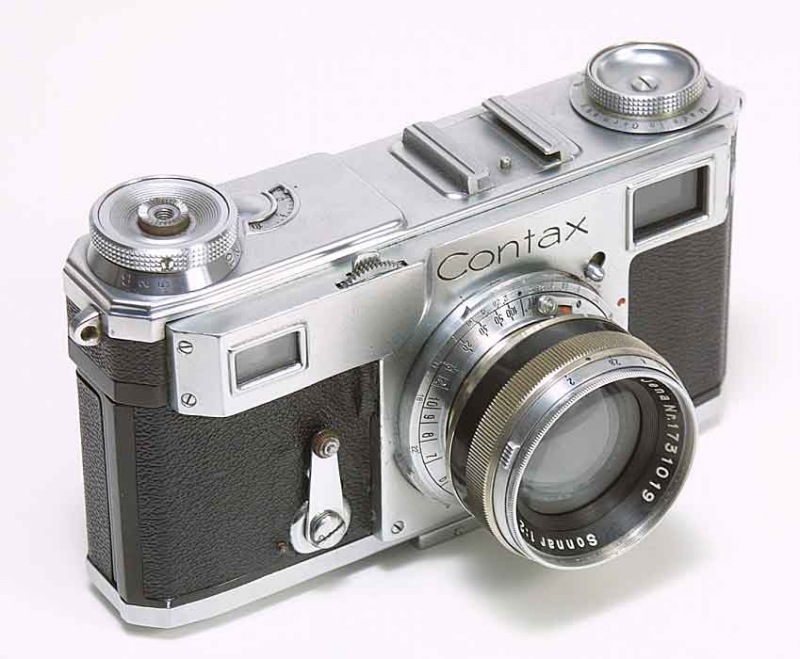
Zeiss’s finest rangefinder 35mm film camera, the Contax II, was manufactured in Germany between 1936 and 1941. I was lucky to borrow a used one from a camera store I worked in during my student days, along with the contemporary Leica IIIc, the Contax with the 50mm Sonnar, the Leica with the 50mm Summar. The Sonnar was far the better lens at f/2 and f/2.8.
The cameras were night and day. One version has it that Zeiss was determined to best the Leica with a more modern design. Another maintains that they had to change the design dramatically to avoid patent infringement. One thing is certain. The Zeiss business dwarfed that of Ernst Leitz, Wetzlar in wealth and breadth, so starting with a blank sheet of paper on the drawing board was no big deal, given Zeiss’s resources.
What emerged was a camera of quite exceptional elegance. Compare with the Leica IIIC:
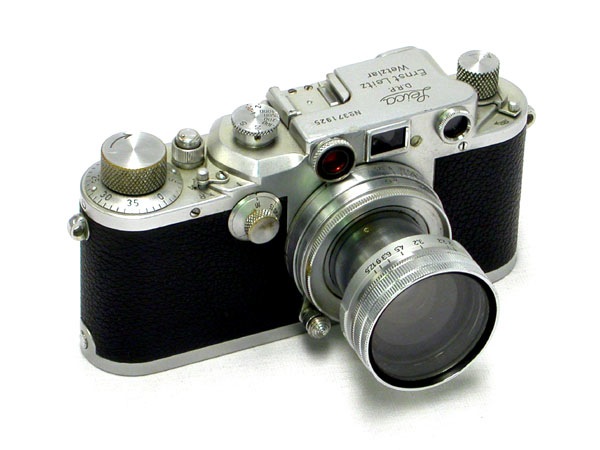
Where the Leica is all knobs and dials and busyness, the Contax is an integrated whole. The Leica is an unfinished engineer’s design, the Contax a Bauhaus aetheticist’s dream. Not until 1954, when Leitz released the greatest 35mm rangefinder design in history, the Leica M3, was anything comparable to the Contax made.
What prompts this piece is my recent article on The Mexican Suitcase and mention therein of the great war photographer Robert Capa. For when Capa landed on Omaha Beach on D Day in 1944, he was armed with two Contax II cameras and a Rolleiflex. The few images which survived from that reportage are among the most famous war pictures made:

Robert Capa’s unforgettable image of the American
Normandy landing on D Day.
The Leica user of that time had to focus through a rangefinder eyepiece, then change his view to the (awful) viewfinder, using a separate eyepiece. Slow shutter speeds had to be set on the small front dial, after setting the upper dial to a specific index. When the Leica’s shutter was released the upper dial rotated – interfere with it and your exposure would be off. The Leica’s lens had to be screwed in. You had no choice but to rewind the film when your 36 exposures were made.
The Contax changed all that. The rangefinder was brilliantly integrated as a central patch in the viewfinder, one eyepiece for both. All the shutter speeds from 1/2 to 1/1250th (!) of a second were on one large click-stopped dial concentric with the wind-on knob, with the release button elegantly integrated into the center. The clunky ‘lift-turn-drop’ miniscule main shutter speed dial of the Leica with its irregularly spaced settings, which could only be set accurately with the film advanced, was history. Interchangeable film cassettes could be loaded in both the feed and receiving bays, requiring no rewinding. Where the Leica used a horizontally running shutter made of rubberized cloth, the Contax ingeniously opted for a vertically running assembly of interlocking metal slats which permitted faster flash synchronization speeds, though factory flash synch was not added until the post-war Contax IIa/IIIa were released. Copal of Japan were to adapt the design to many Japanese cameras much later.
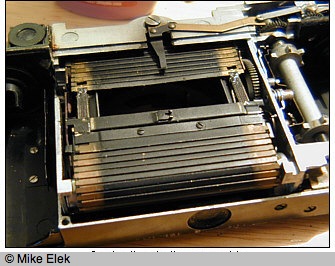
The Contax II shutter. Click the image for
Mike Elek’s excellent Contax repair site.
You can get a good sense of the quality of the camera’s engineering from Mike Elek’s site.
The lens used a bayonet mount – actually a dual bayonet mount. Shorter lenses fit in the inner mount focused with the small geared wheel in front of the wind-on knob, whereas longer, bulkier ones used the external bayonet claws you can see above, focused with a regular focus collar on the lens. Canon later used the same idea in its post-war Canon 7, where the external mount was used exclusively for its extraordinary f/0.95 50mm optic. The inner Leica screw thread mount used by Canon was too small to accommodate the huge f/0.95 lens.
A modern analogy is apposite. When the iPhone was released in July, 2007 it was a Contax II to every predecessor’s Leica IIIc. Function and form were one.
Only when the Leica M3 came along were all these modern features (save the dual bayonet mount – one bayonet sufficed) incorporated by Wetzlar, who also greatly improved the rangefinder by adding sharply defined edges to the rangefinder patch, suspended finder frames for three focal lengths, and an ingenious parallax compensation mechanism. That was 18 years and a world war later.
While some aver that the shutter in the Contax was more fragile, as the horizontal slats were connected with thin silk tapes which age poorly, contemporary users had no complaints, nor did I when I used this wonderful camera.
Contax simultaneously released the Contax III which added a non-coupled selenium cell exposure meter on the top plate, deemed revolutionary at the time, but in practice it ruined the lovely lines of the model II’s body.
After the war Zeiss released the IIa/IIIa pairing, much the same but maybe even better made. The basic body design was retained through the Contarex SLR range whose complexity and high manufacturing cost did a lot to bankrupt the Zeiss Ikon of old. Those Contarexes retained the dual reloadable cassette chambers, and updated the advance knob with a lever, but the design heritage was obvious for all to see. When the greatest film SLR of all time, the Nikon F, was released many years later that same dual locking/removable baseplate design was retained. It was not ideal – you sometimes wanted a third hand to change film – but it was solid, simple and robust. Compare that to the film baseplate slot-loading mechanism in every film Leica through the last model, the M7, and you will be in no doubt which is the superior system.
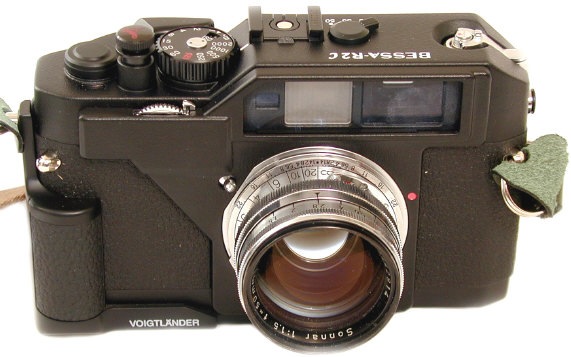
Amazingly, Cosina released the Voigtländer R2C in recent years sporting a Contax lens mount along with TTL metering, even if the body was an ugly duckling. The Zeiss aficionado could find new use for his classic Zeiss Ikon lenses:
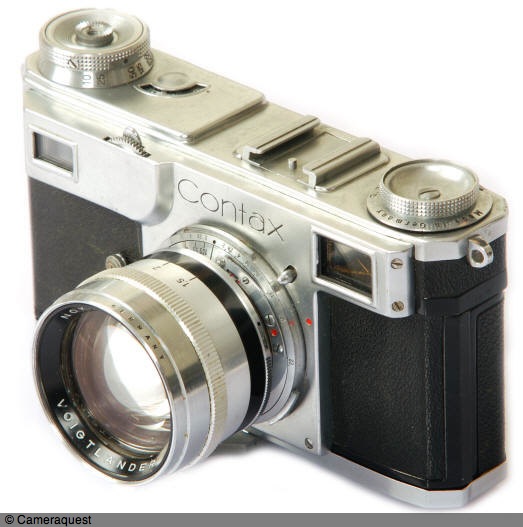
A handful of modern lenses was also released in the classic Contax mount and adapters are available to use old Voigtländer Prominent lenses – here’s the Prominent’s 50mm f/1.5 Nokton in a handsome semi-matte chrome finish on a Contax II body:
The Contax worked fine for Capa and no one reading this can lay claim to being a better photographer – or a more courageous one. The Contax II is one of the great classics of the 35mm rangefinder camera world.
Update July 203: I just added a Contax IIa, the post-war version, to my home theater display.