Lower and lower.
I wrote about my WalMart Superbowl special, the 42″ LCD TV I bought in March 2008, here. I had opted for the then little know Vizio brand, now a household name and very much the price leader to this day. The cost was $900 ex-tax.
That TV is 42″ and 720p/1080i. 1080p was just becoming affordable at that time but still cost $200-300 more at that size and after checking them in the Paso Robes WalMart I simply could not tell the difference at that size.
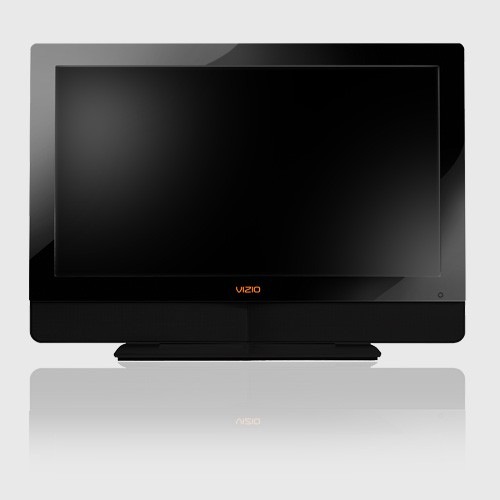
Vizio VW42L, 720p and $900 in 2008.
Five happy years of service at $15/month.
Well, prices have continued dropping and as with disk drive makers, the manufacture of large display panels has consolidated so that there are maybe three makers left – Samsung and LG of Korea and Sharp in Japan. Sharp has been flirting with bankruptcy for some two years now and Sony’s pride saw it loses tens of billions of dollars on their LCDs before they finally threw up their hands and gave up. Pretty expensive loss of face for a business which cannot forget its pioneering Trinitron cathode ray tube designs.
The value proposition saw me looking for a larger screen over the past few months, though it was not remotely sourced from dismay with the 42″ Vizio. Superb in every way it has never missed a beat. The only change I made was to add a pair of truly ancient (and truly excellent) B+W bookshelf speakers in lieu of the smallish ones built into the set. The latter are not bad as the TV’s design was before the current Jobsian obsession with all that is slim and trim in electronics, meaning that the internal speakers are actually a decent size with sound to match.
A friend counselled a local purchase owing to the ease of return if something went wrong, and pointed me to Costco as they double the standard warranty to 2 years and as with most things, TVs tend to fail when very young or very old. Amazon is not remotely competitive on price, selling the same set for 20% more. So I toddled off to the local Costco warehouse store to compare picture quality, having determined that 55″ – 72% more screen area than with a 42″ – was the most my viewing area could handle. Some dozen large screen sets were on display, all fed from the same high quality BluRay DVD source, making critical A-B comparisons easy. Matters were further helped by a knowledgeable salesman who candidly told me that return rates for LG, Samsung and Vizio are the same and that LED adds nothing to image quality, as I could see for myself.
Comparing the two very costly Samsungs with the two far cheaper Vizios I could tell no material difference absent the usual color mismatches which are easily cured through proper tuning. As the 42″ Vizio has proved as reliable as a brick, it came down to a $700 LCD model and an $800 LED model. LED sets are a relatively new development, replacing the backlit LCD panel with a myriad of light emitting diodes. All sets on display were 1080p, and the four I compared all sported 120Hz refresh rates, adequate to avoid motion blur on all but the fastest moving content. Given that the image quality on the two Vizios was identical, the only difference was one of weight – the LED being 5 lbs lighter, an irrelevancy – and thickness. Now why anyone should care whether their large screen TV is 6″ thick or 2″ thick beats me, so I went for the older $700 LCD model, whose bezel is also a tad wider. No biggie. The LED version uses $6 more power annually, something it would take over a decade to recover based on the $100 higher asking price.
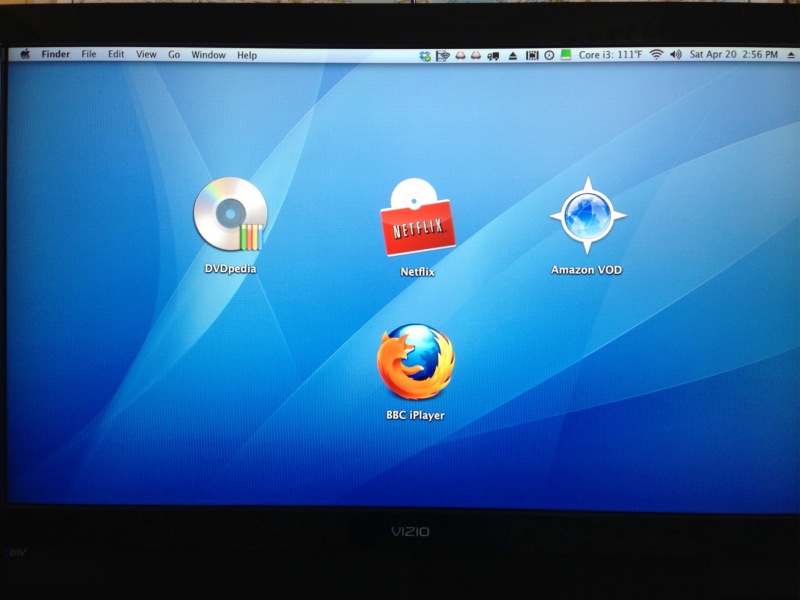
The 42″ Vizio’s home screen driven by the HackMini running OS Lion 10.7.4.
DVDpedia allows one click access to movies stored on large capacity HDD boxes.
The Vizios also had one feature missing from the Samsungs – an old fashioned VGA socket for a PC. My TV uses three input sources – the cable company’s feed/DVR, an AppleTV and the HackMini for stored movies/BBC iPlayer/Netflix/Amazon VOD. The last uses a VGA cable and while it would be easy to adapt that to HDMI, it means one less thing to worry about, given the availability of the VGA socket.
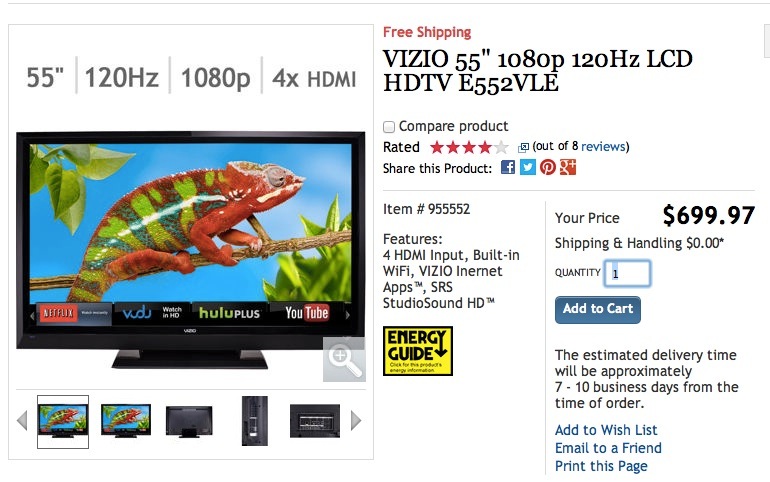
Vizio’s web site says this model is discontinued and I would expect the price to drop further as inventory is remaindered. Note the inclusion of web apps for Hulu, Netflix, etc.
Free delivery is scheduled for next week at which time I have updated this piece with my first impressions. Whether a BluRay player makes sense remains to be seen. On the 42″ model I could not tell the difference between BR and standard DVDs. The speakers in the 55″ one appear to be smaller than those in the 42″, suggesting poorer sound quality, but I will again bypass these in favor of the external bookshelf speakers, driven by an old Sony amplifier.
Bottom line? 72% more screen area for 22% less cost in nominal dollars – call it 35% after inflation – and with 2.3 times the number of pixels per unit area (1920 x 1080 compared with 1280 x 720) speaks to the continuing spiralling down of selling prices over the past five years. So even though making a 100″ screen is more than twice as difficult as making a 50″ one, owing to higher rejection rates as size increases, I do rather think that a 100″ screen for under $5,000 in five years is a realistic expectation. Read on.
Bigger and bigger:
About the time I wrote the piece linked above, Pioneer released a 104″ plasma set at some $100,000 a pop. You see these in TV studios and corporate settings now and then, and the price has now come down to some $75,000. Not realistic for home use at that price. Further, plasma screens use far more power and sport a glossy glass front, just like the ghastly displays in iMacs. The last thing you want in a TV is a reflective surface.
However, looking at that same Costco site, you can now get something almost as large for a very affordable price with a matte LCD panel:
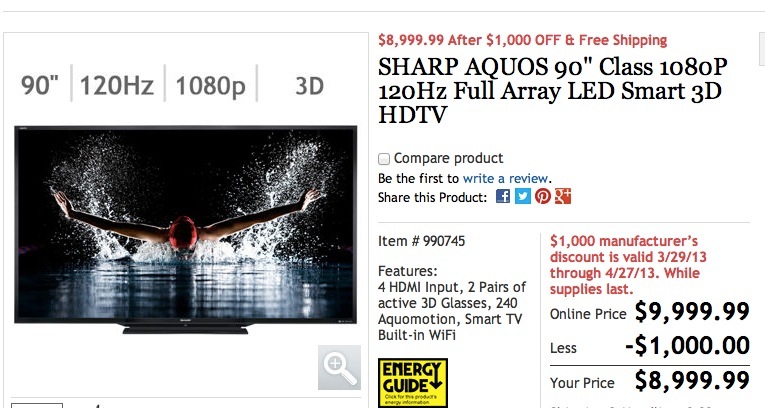
While that’s a lot of money, it argues strongly as a preferred alternative to the projector/screen approach. The latter is damned by the need for a darkened room, as projectors are not that bright, and involves extensive installation intricacies. I rather doubt that my landlady will take well to a chassis suspended from the ceiling along with holes for all the cables! Reckon on $4,000 for a quality projector and $5-6,000 when all is said and done. A high quality screen will run you some $1,000, a retractable one even more. So that 90″ Sharp LCD is not only competitive, you can bet prices will fall. Further, you can view the Sharp comfortably in broad daylight.
All these devices are a wonderful way of displaying photographs as well as movies. Because the normal viewing distance for 42″ to 55″ displays is 7-11 feet or so, even a 2 megapixel original will look wonderful as the inclination to pixel peep a large TV screen is generally missing for all but the certifiably insane. I would not be surprised if my next TV, five years hence, was a $5,000 100″ LCD model, but first I will have to buy a house to accommodate it!
Calibration? Easy. I will simply use the EyeOne colorimeter via the HackMini to tune the colors just so.
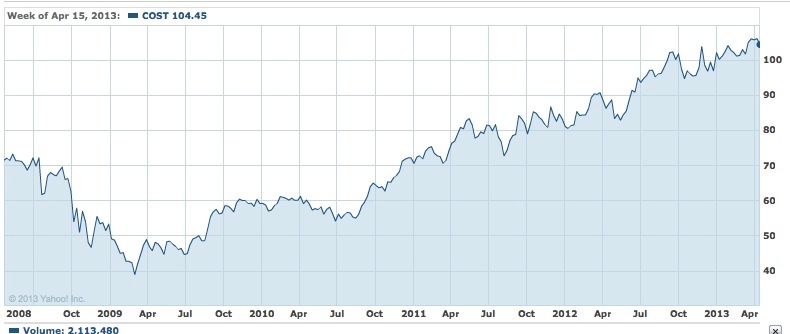
That old 42″ Vizio? Still in perfect order, it was given to that same friend who so smartly pointed me to Costco, though I did have to pay the $55 annual ‘membership’ fee, a sunk cost for one who does not propose to buy his beef by the cow, which seems to be the most common package size for meat at the Costco warehouse. And as for Costco, clearly they are doing most things right:
4K TV panels:
4K panels are now coming to market, boasting 2160p definition, twice that of 1080p. They are still expensive and use upscaling to make use of that definition, which is comparable to Retina Displays on MacBook Pros. Whether this is a solution looking for a problem is unclear, but they may pose an affordable alternative to large computer displays for use with desktop OS X or Windows machines. Prices will only come down – Amazon lists a Seiki 50″ set for under $1,400.