Category Archives: Hardware

Stuff

Panasonic FF mirrorless imminent

A new FF entrant.

DP Review has an interesting interview with a Panasonic representative, talking about the forthcoming full frame S1 (24mp) and S1R (47mp) bodies.

While Panny is coy about the maker of the sensors, meaning it’s not Panny, that hardly matters. Panny and Nikon no more make all the parts in their hardware than Mercedes and BMW do in their cars, where everything from shocks, wheel, electronics, brakes, windows, seats, etc. is sub-contracted. That does not stop them from making good products.
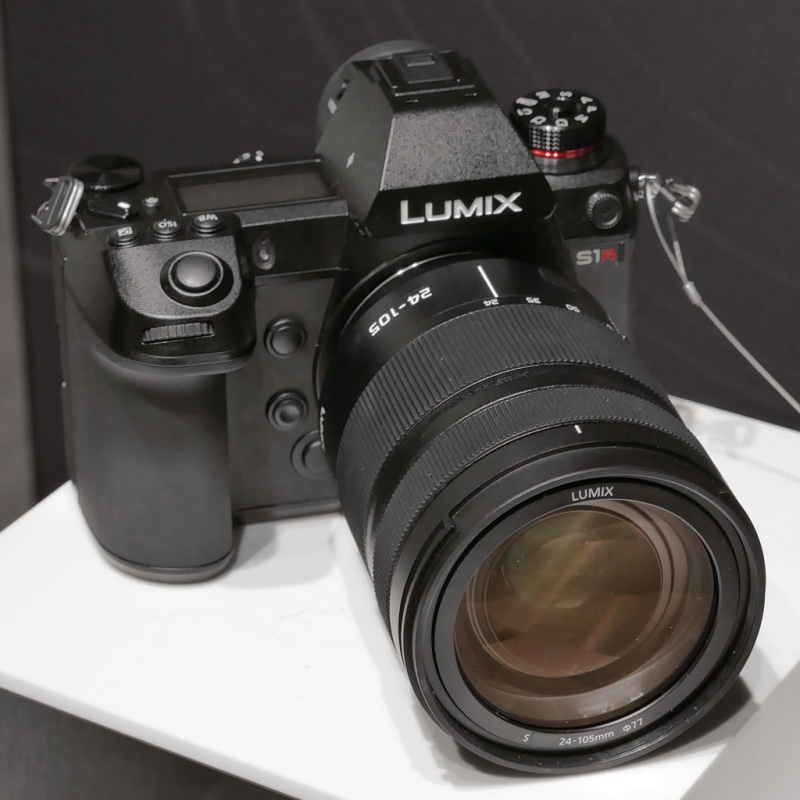

The Panasonic S1R.

Panny’s timing is perfect. With Nikon having just introduced the mirrorless Z6/Z7, bodies which really dictate a move to the new compact lens line, Panny will be identically priced. The new user will have to pay for a body and lens and you can bet that if Panny wants decent market share that prices will be identical to Nikon’s. Best of all the bodies will hit the market with a large range of lenses from Panny (the MFT optics are excellent), Leica ($$$) and Sigma, the latter for those who do not care about bulk, weight and poor auto focusing. The target market is stated as being the working pro. I would wager that the bodies will take adapted MFT lenses with full functionality, restricting the sensor size to that of MFT. Not nuclear physics and nice to have, the 47mp sensor becoming 12mp, perfectly adequate for all but mural sized prints.

It is heartwarming to read of Panny’s experiments with ergonomics described in the article, something very reminiscent of Leica’s approach in designing the landmark M3 in the early 1950s, the best handling camera of the time. Panny also puts significant stress on the quality of the EVF and the camera’s durability, both required if they are to compete with Nikon. Further, given the high quality video implementation in Panny’s high end MFT bodies it seems the video maker has much to look forward to here. Panny really knows video.

From a hardware perspective there has never been a better time to be a photographer, even if the cell phone revolution has saturated the world with execrable photography.
Nikon – a magnificent legacy

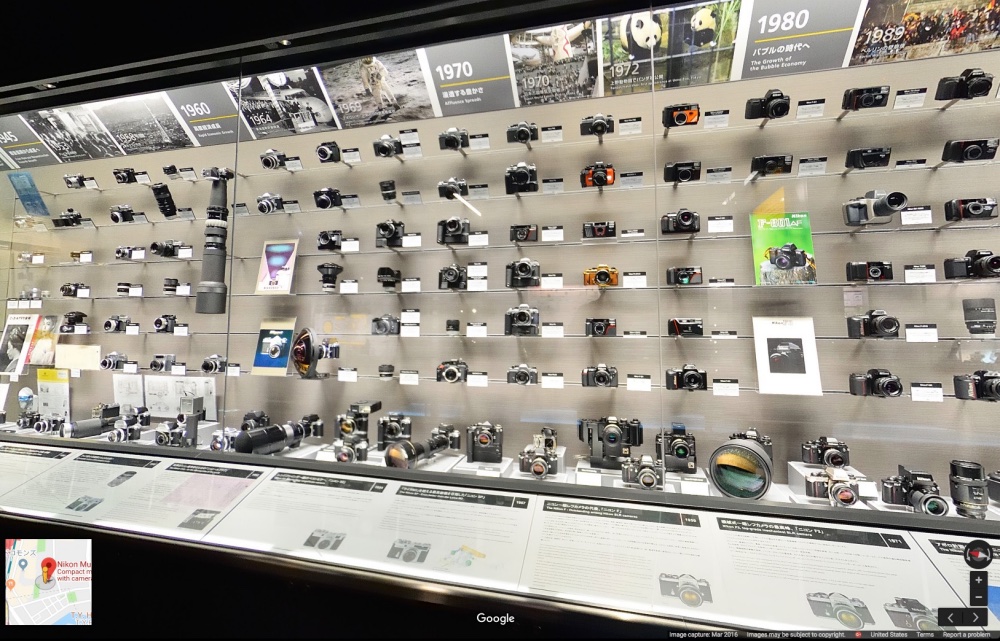
The Nikon Museum in Tokyo.


Click the image to go to the interactive Google view.

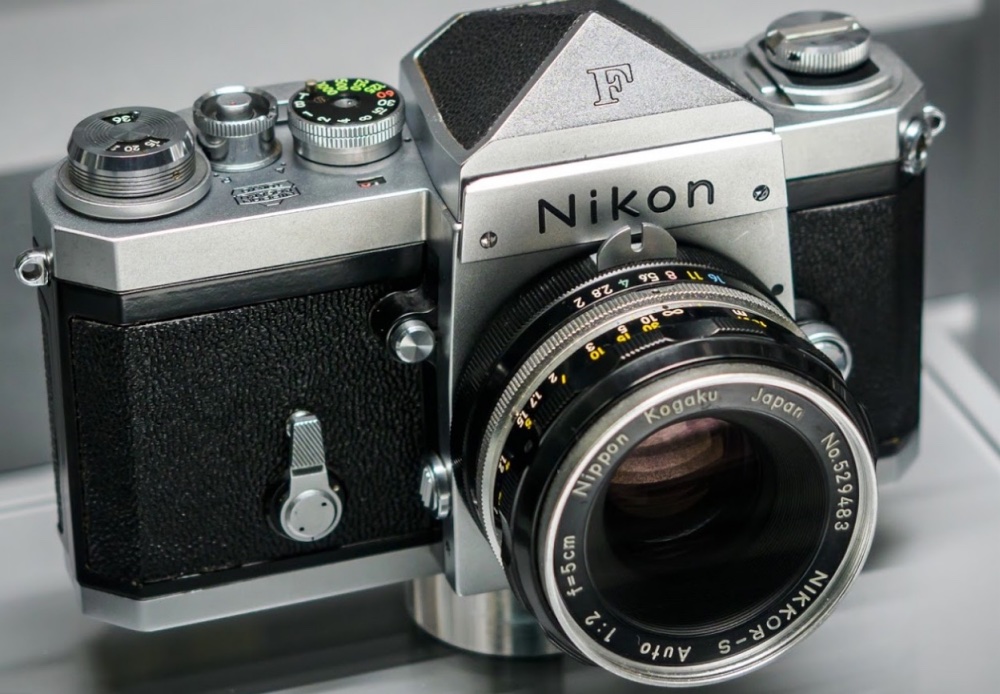
Nikon honors its legacy in the extensive displays in the Nikon Museum. When Nikon abandoned the Zeiss Contax lens mount replacing it with the F mount in its first – and best – SLR, the peerless Nikon F, it was as much a statement of intent as it was an act of courage. The wisdom of that decision persists to this day when even the earliest F mount lenses can be mounted on the latest Nikon D850 DSLR.

Now with a new, wider mount in the Z6/Z7 mirrorless offerings, Nikon has finally begun to abandon the flapping mirror in favor of what is already acknowledged as the best EVF in the business, the one found in the new Z bodies.


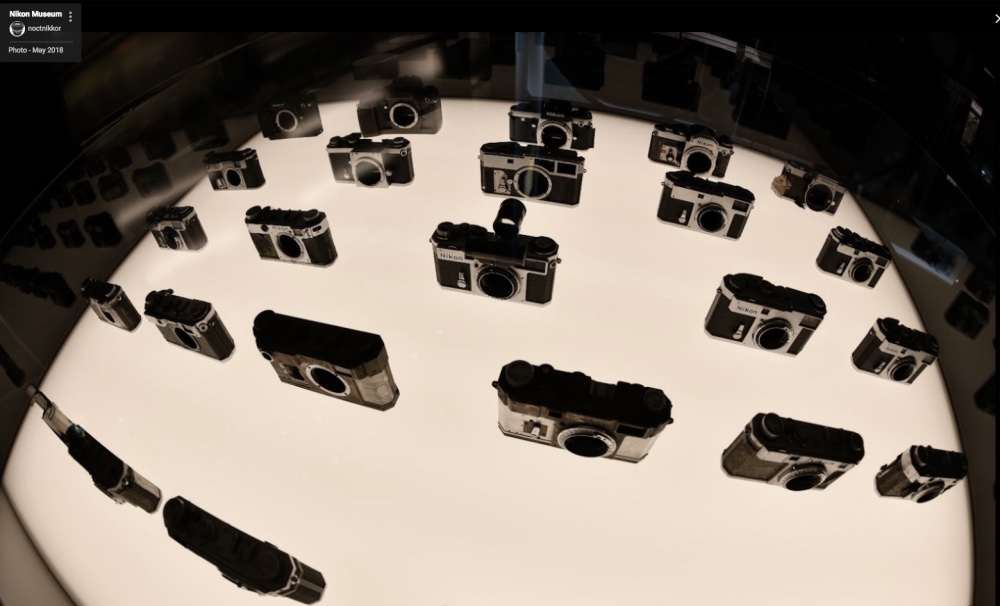
A display of rangefinder bodies which preceded the Nikon F. The related lenses put Nikon on the map.

Leitz, Wetzlar used to be the owner of the legacy crown, snatched from it by Nikon with the Nikon F which saw the rangefinder Leica M bodies migrate from being workhorses to becoming silly Veblen goods. The working pro gives these not even a passing thought, no more than an enthusiastic driver thinks about Rolls Royces.


The Nikon F. The camera which changed everything. This camera did to the German
camera industry what Honda did to British motorcycles.

Nikkor 28-105mm f/3.5-4.5D AF lens

A decent walkabout optic.

The heart warming facts about Nikon’s AFD zoom optics is not only that many choices exist but also that many are insanely inexpensive in mint, used condition.

My mint copy of the 28-105mm f/3.5-4.5 ran me but $78 plus $7 to Amazon for a 62mm UV protective filter. I did not bother getting a lens hood as the one for this lens is huge and mostly useless.

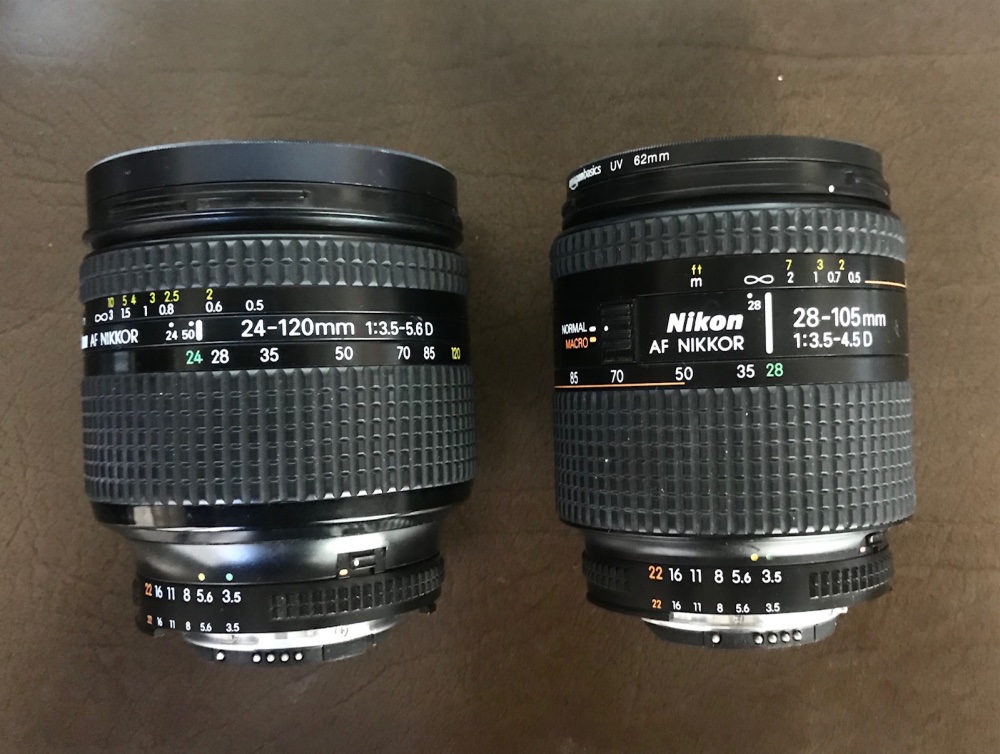
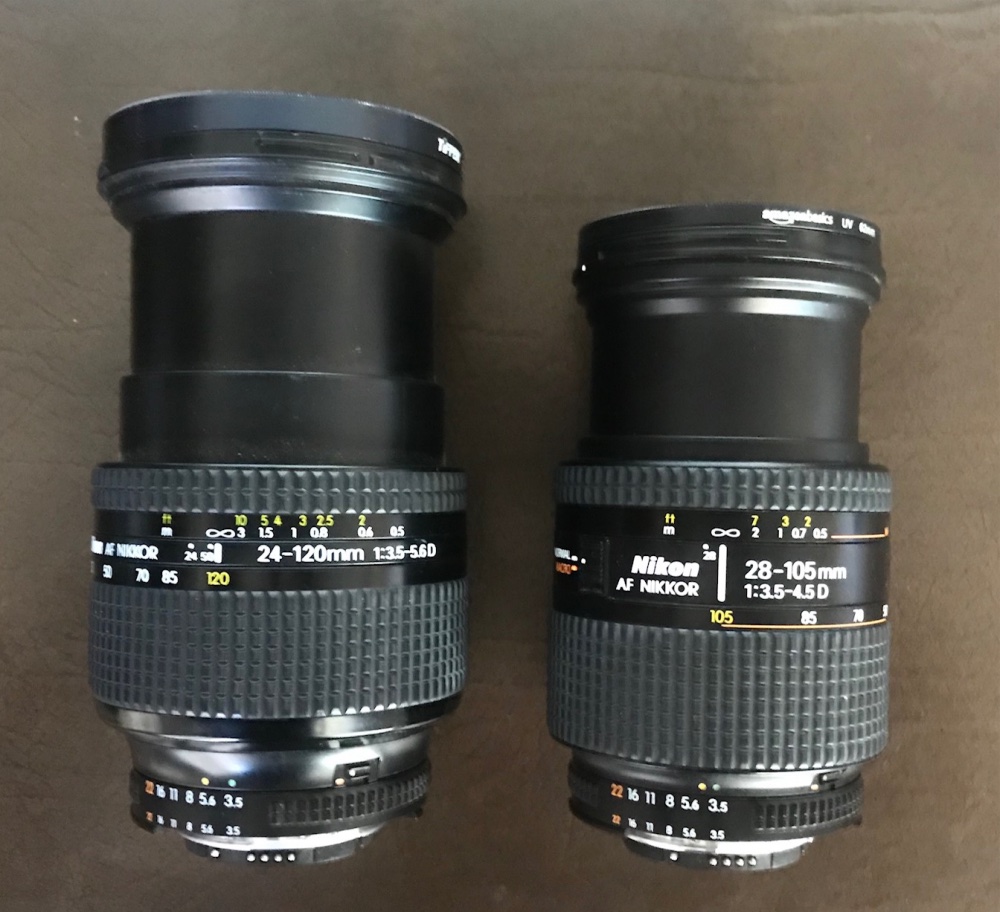
The rational ‘walkabout’ comparison is the 24-120mm f/3.5-5.6 IF lens which adds internal focusing for a smoother feel and extends more at both ends. I have been using the 24-120mm on my Nikon F100 with Ektar film with considerable success. If there’s a complaint it’s the generous dollops of distortion, barrel at the wide end and pincushion at the long. This needs correcting in LR with architectural subjects, a pain but not hard to do.


At their widest settings. Note that the zoom rings work in opposite directions.


At the longest focal lengths.


So how does the 28-105mm differ? Bulk and weight are much the same, the zoom rings displays a tad more stiction owing to the traditional design, the optic is faster at the long end by one stop and adds a handy macro feature.

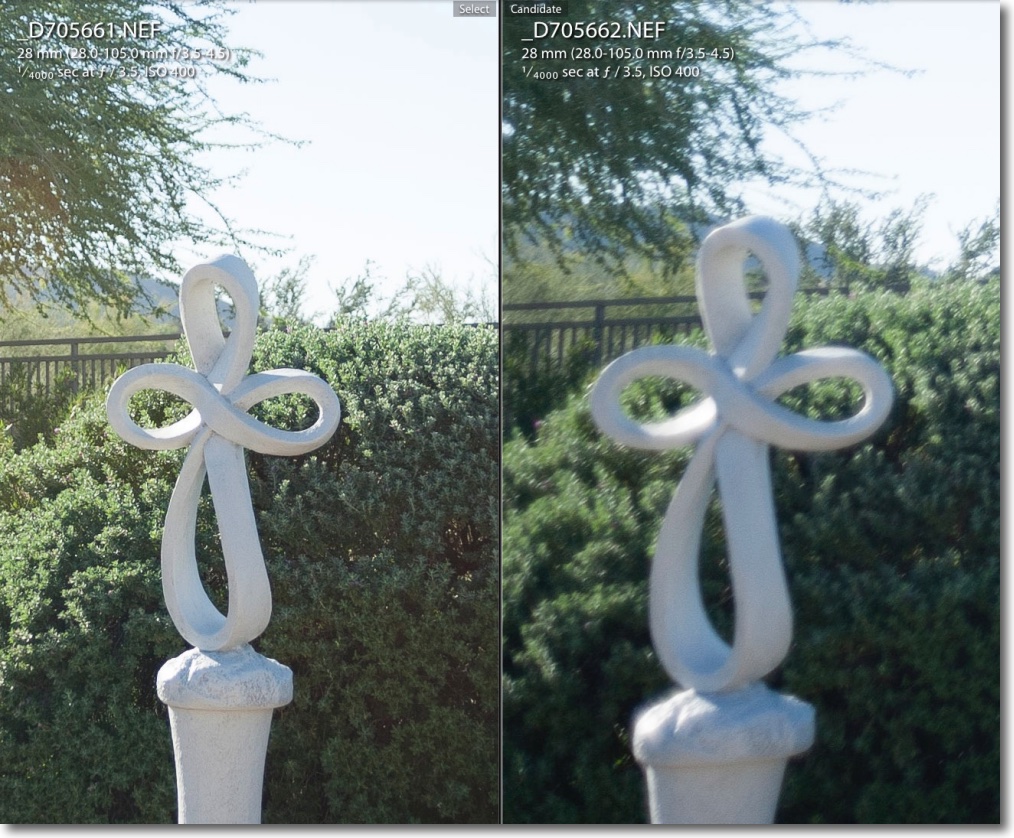
Here are test images – you can compare with those from the 24-120mm f/3.5-5.6 by clicking here.


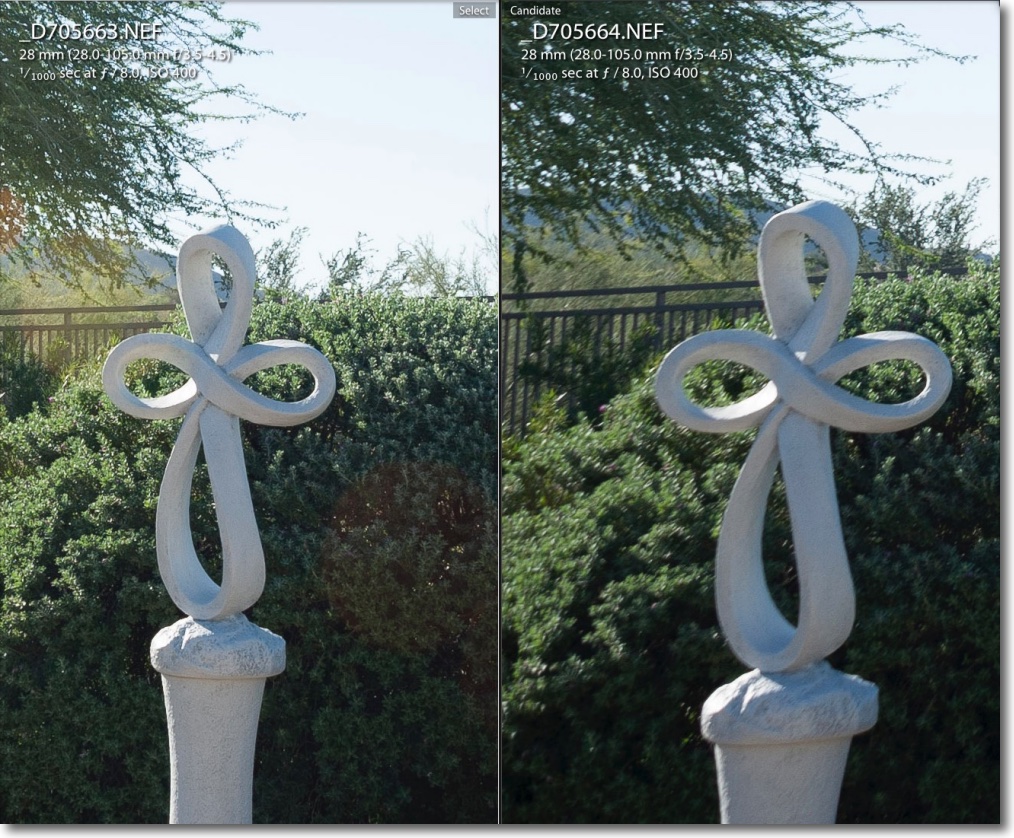
At 28mm, f/3.5, center and edge.


At 28mm, f/8, center and edge.


At 50mm, f/4, center and edge.


At 50mm, f/8, center and edge.


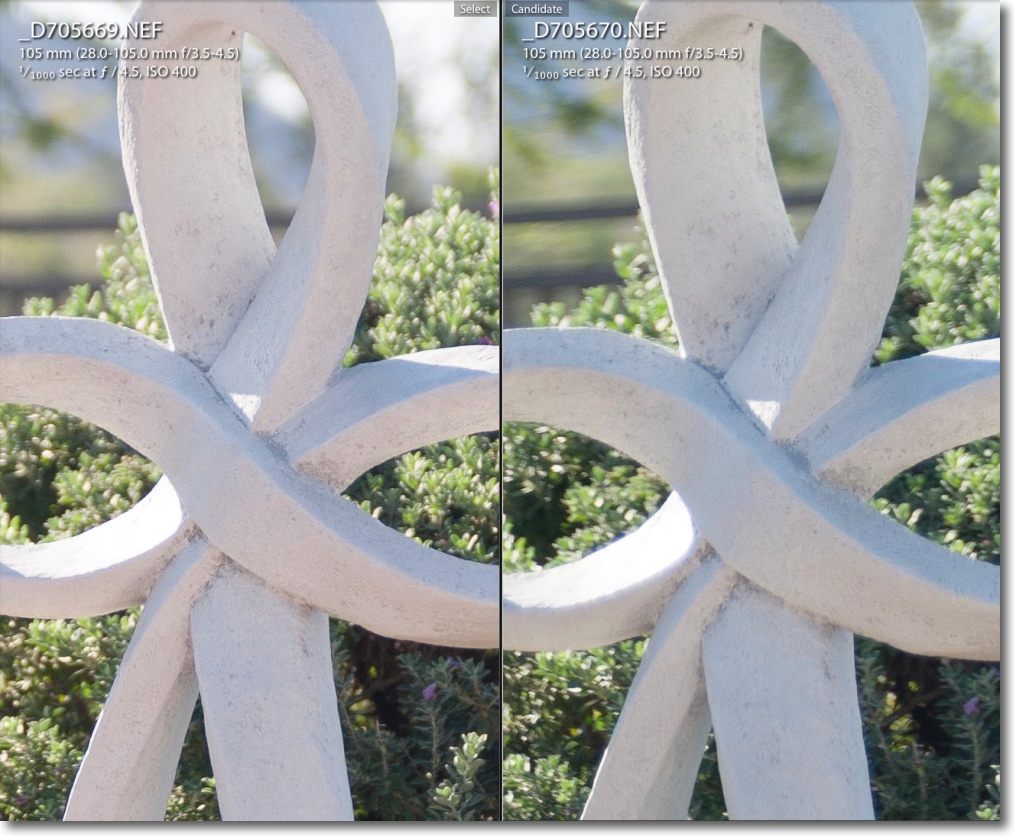
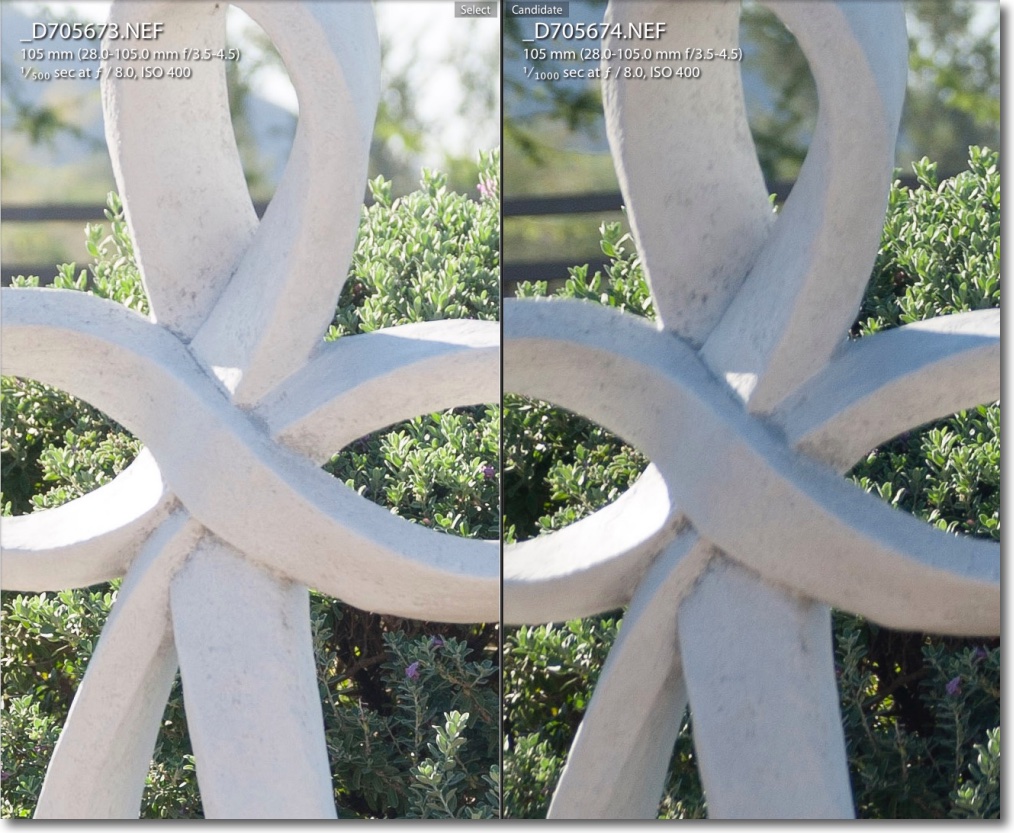
At 105mm, f/4.5, center and edge.


At 105mm, f/8, center and edge.


In summary edge performance at the wide end is ghastly at full aperture; you need to stop down to f/8 to make it useable. The 24-120mm optic is far better in this regard. The edges from the 28-105mm get progressively better as the focal length increases. Whereas the 24-120mm lens shows chromatic aberration (easily fixed in LR) the 28-105mm has none. Not published here, distortion characteristics disclose that the 28-105 shows mild barrel distortion at 28mm, disappearing at 50mm or longer. That is much better than the 24-120 which barrels greatly at 24mm and pincushions north of 50mm. Neither optic does a particularly good job of rendering out-of-focus areas, both yielding results that are too ‘busy’ for my taste. The 28-105mm lens shows no light fall off at the edges at any aperture or focal length. I have found that the later lens correction profile in LR for the 28-105mm f/3.5-4.5 G VR optic (the one with no aperture ring) works well with this earlier AF D lens.

Handling of both optics on the D700 DSLR and F100 film SLR is excellent. They balance well, zoom rings lack any gritty feel, AF is as fast as you need for all but sports subjects and as I always use aperture priority with aperture control transferred to the lens, the aperture ring on the 28-105mm is easier to access as the lens is less steeply pyramided at that location, making the ring more accessible. Not a big deal in practice.

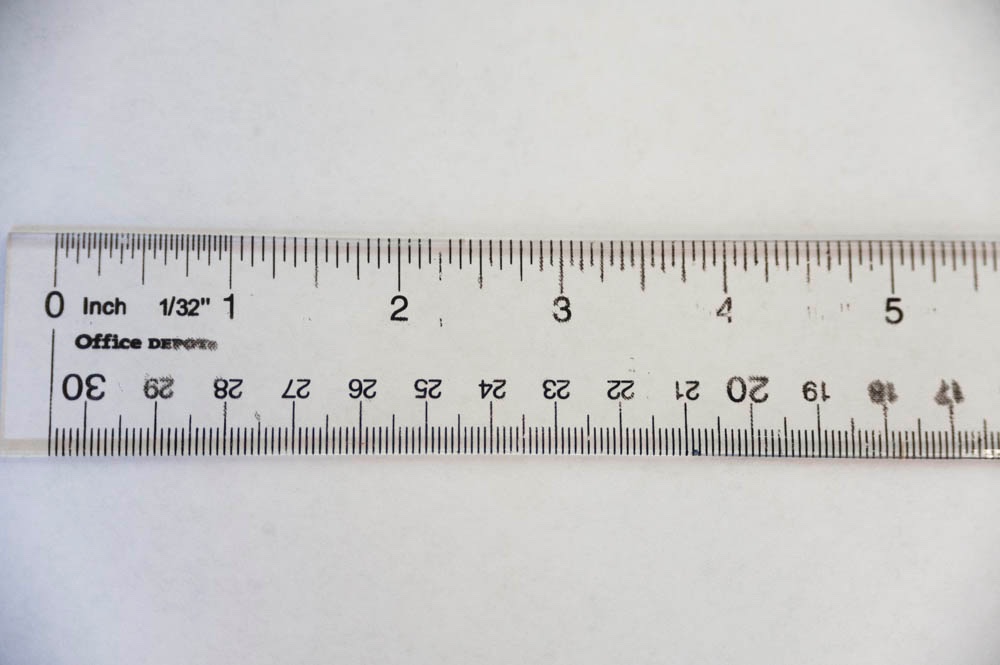
The macro range on the 28-105mm is accessed by setting the focal length between 50 and 105mm and focus between infinity and 0.5 feet. The switch on the barrel is flipped and you get a very handy macro lens with a focal length range of 50-105mm. The long focal length setting is especially handy as it allows better clearance between the front of the lens and the subject. This is the closest I could get at 105mm:


The magnification ratio computes to 1/4 life size.

Sharpness, even at f/4.5 in the macro range, is excellent – fully useable.

Conclusion: If you need 24mm (which is much wider than 28mm) and useable edge performance near full aperture at the wide end, the 24-120mm is the better choice. If you prefer a minimum of post-processing to remove distortion the 28-105mm is to be preferred. The construction quality and material choices (more plastic) of the 28-105mm are lower but hardly a deal breaker and the macro feature is both useable and the optics excellent. Weights of the two lenses with filters are 16oz for the 28-105mm and 20 oz for the 24-120mm.

It’s a nice choice to have to make with each lens selling for well under $100. I have both!

Apple discards the college business

Silly-priced new MacBook Air.

Apple just announced the new MacBook Air and it’s priced at an over-the-top $1200 for the base model with a 13.3″ display.

You will not be seeing this much more:

Yes, this silly-priced MacBook Air confirms that Apple is strictly in the Veblen Goods market, where a premium price is seen as attractive, a low one as a disincentive to conspicuous consumption.

Consider: Wireless ear bud speakers at $120. Cellphones starting at $800 + tax + annual service contracts. The Apple Pencil to draw on your iPad at $100. All commanding 50% profit margins because someone has to pay for that ridiculous over-the-top flying saucer HQ:


Hubris. The Apple HQ building in Cupertino.

I’m writing this on a 2010 Mac Pro tower. In its faultless 365/24/7 life it has had one upgrade of GPU, CPU, RAM and SSD storage. I expect it to continue to deliver fault free daily performance for another decade, at 70% of the speed of the latest throwaway machines. When parts fail – and they seldom do – they are easily replaced with a screwdriver or two and readily available. The chassis design dates from 2006.

My MacBook Air is the last 11″ 2015 model made. I would upgrade this $800 machine annually as, with associated tax benefits, the upgrades were free. Then the 11″ was discontinued never to appear again. It weighs just 2.38lbs and is a handy portable companion. At 11″ a costly ‘Retina Display’ would be money wasted. It’s the perfect traveling machine whether for college student or businessman. But you can no longer buy it new. So now the aspiring student will buy a Chromebook with comparable specs to the new MacBook Air for, what, $450?

In a decade Apple has abandoned its core constituency, the pro A/V market. It has abandoned college students and the impecunious. And now it sells ridiculously overpriced, glass-backed, fragile cell phones for $1000 and up.

Strange business model for the coming recession.

Strategy? Given that technology changes at the margin for desktops, laptops, tablets and cellphones are very slow, I’m increasingly focused on upgrading to 2-3 year old tech, as I did in moving from an iPhone6 to an iPhone7 for a modest $300 net a few weeks back. No $1000 cellphones for me. I get 80% of current performance for 30% of the cost. That solves.

Panasonic S1R FF SLR

Aimed solidly at the pro.

Panasonic announced the 47mp FF S1R mirrorless camera today along with the 24mp S1. As the inventor of the mirrorless, interchangeable lens camera with the G1 a decade ago Panny knows what it’s doing and the long line of successors to that revolutionary body has captured both the video and stills markets with aplomb.

An early partnership with Leica saw to it that some of the finest MFT lenses came with Panny mounts and the S1R continues that tradition using the Leica ‘L’ bayonet, shared with the very costly S2/S3 Leica bodies. While Leica FF lenses run $5,000 a pop, it’s always good having Leica on your side when it comes to optics for no one does it better than the magicians in Wetzlar, Germany.

Those great designs invariably migrate to cheaper Panny versions and, indeed, Panny has announced that there will be some 20 lenses available 24 months hence, both Leica and Panny designs. I have used both the amateur and pro grade Panny optics on their MFT bodies and can testify to the quality of the optics. As for modern Panny MFT bodies – I use two GX7s – nothing comes closer to the Leica M2 experience of my film days when it comes to a compact street snapper, and the total silence of the electronic shutter option makes the modern Panny MFT body the stealthiest camera made.

As for the feature set of the new full frame S1R/S1, Panny appears to have nailed it, including:

  • In body IBIS (missing from Canon’s new FF offering)
  • In lens IBIS
  • Dual storage card slots (missing from both the new Canon and Nikons)
  • 4K/60fps video – a first (only a crippled cropped mode available in the new Canon)
  • Top plate LED display – like in every other FF SLR with ‘pro’ aspirations
  • Three axis touchscreen rear LCD
  • Extensive weather sealing

It’s interesting to compare the feature set with those from Canon and Nikon. Both those powerhouses have offered variously crippled iterations on their top end DSLRs, reluctant to lose the cash flow from their cash cows. Yet only the meanest observer would deny that the flapping mirror DSLR is done and dusted, the greater simplicity of the mirrorless body and greater optical design flexibility owing to the much shorter flange-to-sensor distance being the future. By contrast, while Canon and Nikon must pay fealty to owners of current costly optics by ensuring compatibility, Panny has no such oath of loyalty to maintain as they have never had an FF offering. So they can start afresh, and doing so with Leica’s ‘L’ mount is a perfect way of hitting the ground running.

In addition to pairing with Leica on the lens front, Sigma has also got its nose in the picture, promising to offer lenses. Take that with a bushel of salt for Sigma has no design chops worth mentioning, always taking the easy way out with their gargantuan designs which destroy the very idea of a small camera/large picture. As for quality control, Sigma’s corridors have yet to be darkened by that concept as my truly miserable experience with their 35mm f/1.4 ‘Art’ lens disclosed. Sigma’s optical quality reputation is well deserved. Sure, you can get crackerjack Sigma lenses, but what is your time worth while you sift through all those returns? In fact, so bad is Sigma’s QC that they remain the only lens maker that offers an aftermarket gadget to allow you to program optimal AF because, sure as heck, the factory seems incapable of doing that. That dongle should come free with every Sigma optic.

Pricing? Well, the Nikon Z6/Z7 are priced at $2,000 and $3,400 so I would expect the S1/S1R to come in a few dollars higher, given the enhanced feature set. Availability is set for early 2019. Meanwhile, I would imagine that the $6,000 mirrorless Leica SL ‘L’ mount body with its modest 24mp sensor will henceforth only sell to those who like paying up an additional $4,000 for a two cent red paper dot which states ‘Leica’ in the middle.