Not much going on.
[column width=45% padding=5%]
As one who is disciplined about spending money, I always try to set a tech budget for the coming year. Only something truly unexpected and exceptional – like the iPad in 2010 – is allowed to blow the budget.
So here are my thoughts on the 2012 tech budget around here.
Photo hardware: It seems to me that camera hardware has three sectors. The full frame sensor cameras from Sony, Nikon and Canon when the very highest image quality is demanded. (We can disregard medium format digital here as the gear has very limited use and is impossible to justify on cost for nearly all users). The APS-C/MFT sensor offerings for ‘serious’ amateurs, though APS-C is in increasing trouble, offering the bulk and weight of full frame but the image quality of MFT. And cell phones, with the latest offerings from Nokia and Apple sporting outstanding lenses, so much so that a full length professional movie was recently shot using a Nokia cell phone – Olive. I regard the low end point-and-shoot sector as dying, ceding its market share to smartphones.[/column]
[column width=45% padding=5%]
I have never been happier with my very simple MFT kit, comprised of a Panny G3 body (whose sensor is noticeably better than the one in the G1 I used before), a 9-18mm Olympus MFT wide zoom, the 14-45mm kit zoom and the 45-200mm MFT Panny tele zoom. I really should sell the latter as I hardly ever use it. The sensor quality meshes nicely with my preferred print size of 18″ x 24″; were I to consistently need larger prints I would look at a used Canon 5D or the like at a bargain price – like the one I used before moving to MFT. If you can make a sharp 18″ x 24″ print you can display the related image on a TV screen of any size.
The iPhone 4S brought a fine Sony lens to Apple’s cell phone and a divinely simple user interface with a responsive shutter button. It will render prints up to 13″ x 19″ at a pinch and two years hence the iPhone6 will be even better.
[/column]
[end_columns]

Mobility and capability combined. iPhone 4S with wifi hotspot, iPad, G3 with kit lens and obligatory spare battery.
[column width=45% padding=5%]
At this time, the only thing that would tempt me to get another camera would be if Apple were to release one, competing head on with the likes of Sony/Panny/Nikon/Canon in the crowded prosumer field. This is a heaven sent huge revenue opportunity for Apple, which exactly matches their business model. Take an existing, chaotic field filled with inept designs, make a better mousetrap and clean up. Plus the replacement cycle, unlike with TVs, is 2-3 years, which is what Apple needs. The Apple camera would dispense with the idiocy of complex controls and hard to read on screen menus, offer Siri voice control and have one button. To take the snap. So that’s a $500 potential budget item.
I like to make large prints and have no reason to upgrade the HP DesignJet 90 dye ink printer. It has a small footprint, delivers outstanding image quality using fade free inks, and is easy to fix when it breaks, which is rarely. It’s also a lot cheaper than current wide carriage offerings from HP, Epson and Canon, and spare parts are easily obtainable. A ten year device on its sixth year here. The only complaint is that a fresh print smells like the locker room of Chelsea Football club but, unlike with that motley crew, the HP is a winner and the stink dissipates after an hour or so.
Tripods have seen the advent of light materials like carbon fiber in recent years, but as I never trek with one my old alloy Linhof fits the bill and, at last count, had three legs just like the competition. In 2011 I added a Glif tripod holder for the iPhone 4S for a few dollars, so now my 50 year old tripod can hold my new iPhone for movies and the like. Our son loves to insert the 4S in the Glif and attach the assembly to the old Linhof.
The back end of photo hardware, the computer to process and disseminate snaps, has never looked better and while it’s all fast and reliable Hackintosh gear here, realistically any Mac or PC made in the past 3 years or so will fit the bill, if not as robustly. The newest CPUs from Intel – SandyBridge – add speed to the earlier Core2 line and use less power, but it’s not like they are essential. The 2012 upgrade from Intel – IvyBridge – offers small increases in performance. Intel’s high speed data interface – Thunderbolt as Apple calls it – will come to PCs in 2012, [/column] [column width=45% padding=5%]
which means that Hackintoshes will benefit through the simple insertion of an inexpensive aftermarket card; right now, however, there are so few peripherals out there using the interface that it remains a solution that has yet to find its time. Unless you like to shell out $1,000 for silly priced glossy screen Apple monitors, that is. But Thunderbolt technology is exciting, offering data throughput rates an order of magnitude faster than USB, so a couple of years from now we will be able to copy a 5gB movie file in a few seconds. But the technology has yet to hit prime time.
The MacBook Air remains the best laptop on the market, is very light and competitively priced, and works well with Lightroom and Photoshop on the road. It will continue to get faster, the SSD will get larger and the battery life will improve further, but these are slow changes which suggest no reason to upgrade my 11″ 2010 model. Maybe a couple of years hence, and it’s the first Apple laptop I have owned which does not fry the user’s lap. The DVD and traditional spinning disk drives are not missed.
The most exciting hardware coming to market in 2012 is the iPad, version 3. This will likely sport a Retina Display with four times as many pixels as the displays in versions 1 and 2 and a far better camera. The one in iPad 2 is poor. Best of all, the likely inclusion of the A6 four core CPU will enhance the ability to smoothly redirect images and movies wirelessly, as I described here. The iPhone 4S does this well, but the battery life is too short, an area where the iPad excels. Budget $600 for the 32gB model.
Processing software:
My ‘go to’ app for storage, cataloging, keywording and printing is Lightroom3. For more demanding processing, generally the blurring of backgrounds or the straightening of leaning verticals, I round trip files from LR3 to Photoshop CS5. When odd shapes need outlining for processing I have not found an application from anyone which holds a candle to CS5’s ‘Magic Lasso’ and ‘Refine Edges’ tools. It would be great if Adobe was to add these tools to LR3 whose selective editing tools are crude by comparison, but that’s unlikely to happen as they risk cannibalizing their cash cow, Photoshop.
[/column]
[end_columns]
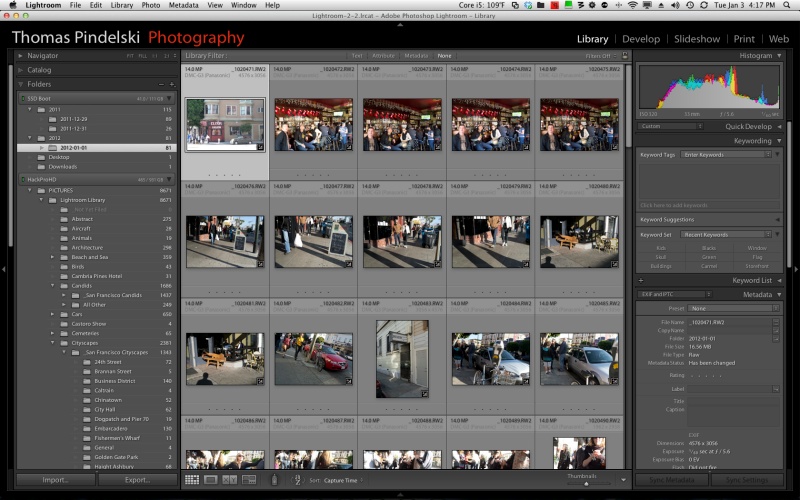
Everything in one place. Lightroom 3.
[column width=45% padding=5%]
I no longer do HDR or deep focus work, but the apps I like there, and both permit roundtrips from LR3, are Photomatix HDR and Helicon Focus. When it comes to correcting lens distortion I use either the canned profiles within LR3 or make my own using Adobe’s Lens Profile Creator, free software which integrates nicely into LR3.
Right now I don’t see any immediate desktop app breakthroughs on the horizon. iPhoto remains the standby for family snaps, though I do wish Apple would cease messing it up with silly features like face recognition.[/column]
[column width=45% padding=5%]Things are different on the iPad, where some great photo processing apps are beginning to appear. Snapseed does an excellent job with the touch interface and Big Aperture has made a first pass at providing selective focus tools, though the outliner is crude compared to the Magic Lasso in CS5. Still, it’s a start. The cost of these is so low that they are impulse purchases which need no budget.
So right now the 2012 budget appears to be $500 for an Apple iCamera, if it even appears, and $600 for iPad3. As in 2011, more will be spent on travel to photo locations and on making and mounting prints than on hardware or software. That’s how it should be.
[/column]
[end_columns]