The next step.
The other day I wrote of how analog photography – film and chemical based – reached its technological zenith under the auspices of Edwin Land. His instant color prints were the culmination of the process of making a permanent, paper image. Thereafter, digital technology took center stage.
One of the major drawbacks of images, be they film or digital, is the depth of field problem. Getting just the things you want sharp continues to be a major issue. Cameras have gone from large film formats, with accordingly long focal length lenses and limited depth of field, to the other extreme of minuscule sensors and very short lenses, where almost everything is sharp all the time.
I have written about this depth of field problem often in these pages. Because I favor a small sensor camera, the Panasonic G1, and because my favorite genre is street snapping, I am always bedeviled by DOF issues. Mostly, because of the short focal length lenses dictated by the small MFT sensor in the G1, that means too much depth of field. When background clutter intrudes, I use Auto Blurâ„¢ to blur the background. It doesn’t take long, though it is, frankly, a pain in the nether regions to have to do this. While your level of blurring is binary – blurred or sharp – the effect is fine as long as you do not overdo it. This following street snap is a typical example of where blurring the distracting car in the foreground improves a picture. Sure you can do progressively increased blurring if you take it in steps but life’s too short and I don’t take snaps for the equipment or technique obsessed.
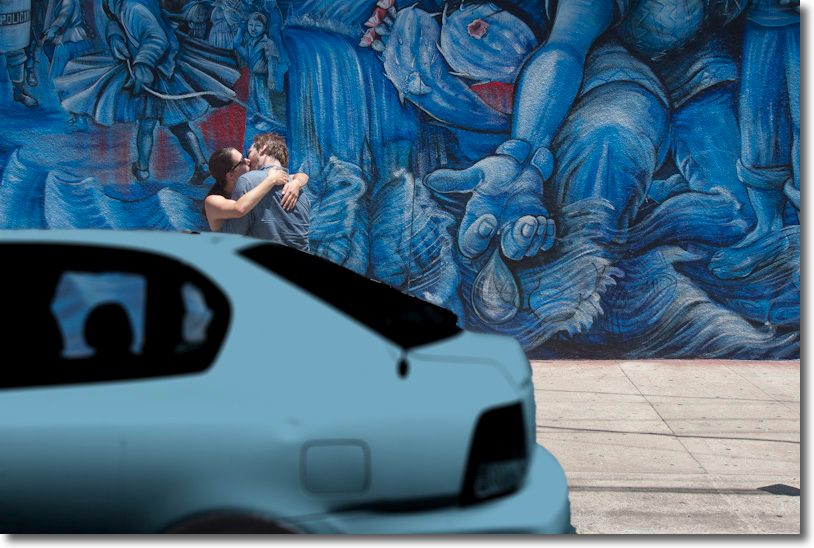
The Kiss. 24th and York Streets, San Francisco. Panasonic G1, Olympus 9-18 MFT @ 18mm, 1/1000, f/7.1, ISO 320
At the other end of the spectrum – close-ups and macros – there’s never enough DOF and an elegant solution dictating the use of many selectively focused images exists in the guise of the wonderful Helicon software. But forget about using Helicon if your subject is moving.
Some digital camera makers are beginning to address the issue of enhancing background blur – Sony has a software based version in some of its point-and-shoots and I believe there’s something in the new Panasonic G3 which I have on order. I haven’t delved into the details yet as my primary drivers in getting this body are a less noisy sensor and a faster autofocus speed. Both are desirable for street snapping, the former because sometimes you have to crop an image, the latter for obvious reasons.
The purpose of this preamble is to look at the exciting next step in selective focus photography, which is coming soon from Lytro. The start-up, founded by Stanford graduate student Ren Ng, and well funded with $50 million in capital, is promising to release a consumer version of its Lytro Light Field camera soon. One of the best uses to date of variable focus photography has been in the medical field of Computer Axial Tomography to make CAT scans of a patient’s body. Moving the patient through an X Ray beam, multiple images are recorded allowing the diagnostician to look at the body as if it was sliced open, the location of the slice being whatever is needed. Light Field photography is different, and considerably more elegant.
Ren Ng’s PhD disseration is remarkably clear and well written. Even if the math may leave you cold the issues are clearly addressed. You can download the thesis by clicking below:

Click to download Ren Ng’s PhD dissertation
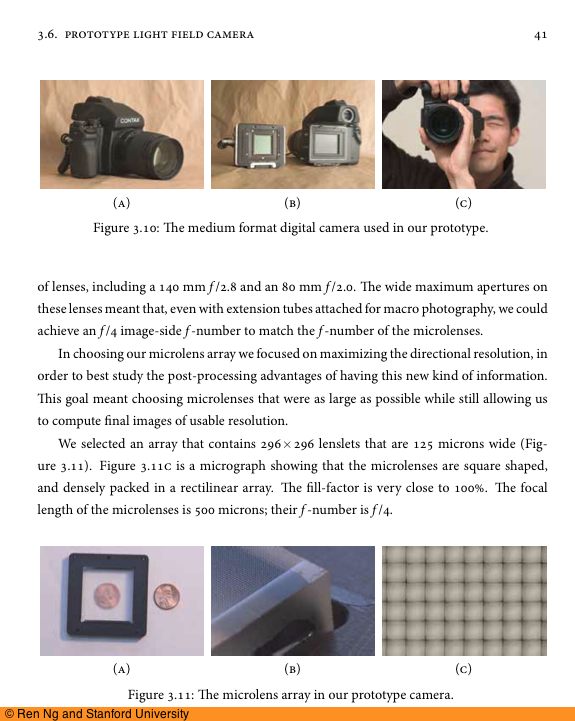
An additional set of microlenses is installed in front of the regular digital sensor, to record the position of light rays at the aperture and on the sensor. This positional data makes it possible to record depth information with an image, information which traditional film and digital photography discards. While Ng is in no sense the ‘discoverer’ of this technology, which has been in academic journals since the time of Leonardo as he relates in his thesis, it looks like he may be the first to realize it in a consumer camera.
This is not idle theorizing. Ng’s thesis (2006) includes illustrations of a Contax 645 modified to include the light field receptors:
The results are simply stunning. Your first click on the images will, I guarantee, make your jaw drop – click the picture to go there (does not work with an iPad):
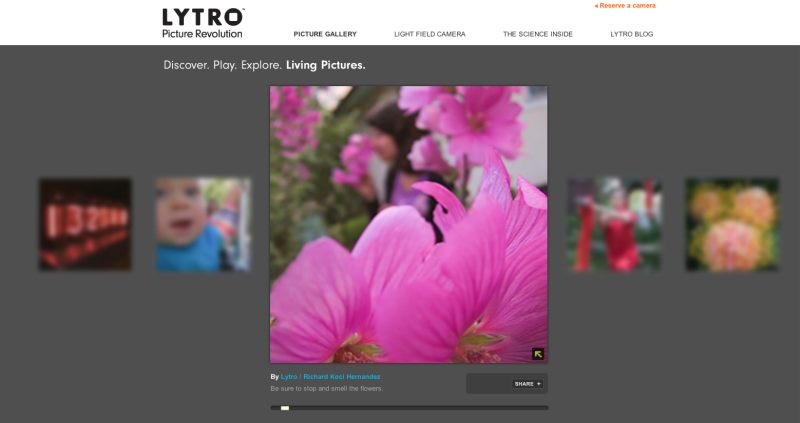
Click the picture for the interactive Lytro gallery.
To me that’s comparable to the excitement I experienced when first seeing a black and white picture show itself in the developer tray under the red light in the darkroom, or to seeing that first Polaroid print develop in my hand. I just tried it on our 9 year old and his reaction was the same.
In the gallery, take a look at the picture of the four models posed in the studio. You can select which one you want to be sharp. So, if you can do that, the next rational step is to select a range of sharpness and rates of focus drop off. Because the recorded image has information relating to depth and position, it follows that this is possible.
The implications for photography and camera design are earth shaking. As all image depth data is stored with each image courtesy of the micro lens array adjacent to the digital sensor there is no need to focus your image when you take the picture. Focus delay is literally zero. So once that high quality f/1.0 lens comes along at a decent price, and is used in conjunction with a small sensor, it can be very compact indeed. You will simply bang away at f/1 for every image and then select what you want sharp at the processing stage. Camera shake will be a thing of the past, given the sort of short shutter speeds which result. No focus mount, no focus rack, no focus motor, no focus battery drain, no clunky extending lens. Think about it.
You can sign-up to reserve a camera:
Needless to add, I have already done so.
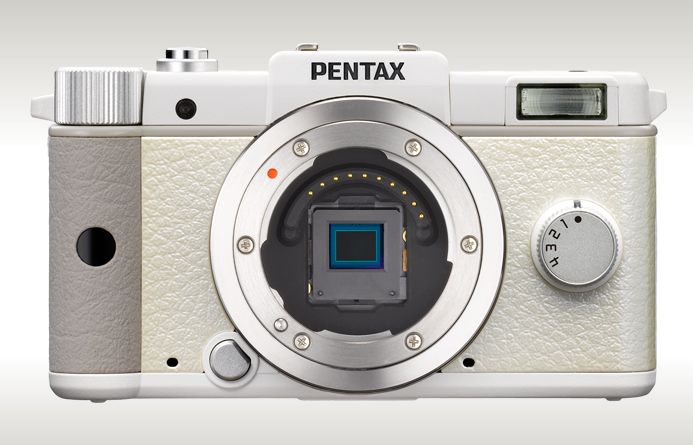
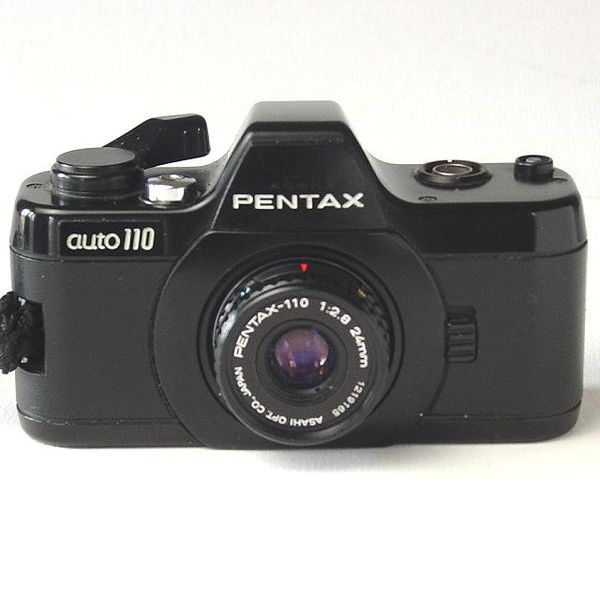
So why didn’t Nikon or Canon do this when the idea has been around for ages? Well, can you name one significant photography innovation from the Japanese? Look where innovation has come from – roll film (George Eastman/Kodak), 35mm (Oscar Barnack/Leitz), anti-reflection coatings (Carl Zeiss), Honeywell (the Correfot which became autofocus), polarizing lenses (Edwin Land/Polaroid), instant photography (Edwin Land/Polaroid), the SLR pentaprism (Zeiss Ikon), digital sensors (Bell labs) – not a Japanese in sight. And now Lytro – Chinese/American. OK, we can credit Pentax with the first instant return mirror in an SLR. Hardly earth shattering.