Two new features of note. And one great loss.
Like many, I use Macs not for the hardware – which my many years of use have shown to be generally poorly designed and unreliable – but for the operating system which is robust and largely trouble free. Indeed, my home brew Hackpro has shown that not only are PC hardware components dead reliable, they are also far cheaper and more easily replaced than anything in a Mac. The last major upgrade to OS X was Snow Leopard (June, 2009) and while it introduced no exciting new features the reliability improved on its already excellent predecessors Leopard and Tiger. Snow Leopard is so solid that the only time I reboot any Mac running it is when a software upgrade dictates that process.
Now that the next release of the Mac OS X operating system is out in beta test, details are beginning to leak. Snow Leopard will soon be replaced by Lion and here are a couple of substantive features that have caught my eye:
Recovery partition support: Lion will place a separate partition on your start-up drive with a complete installable copy of the Mac OS in it. This means that if the regular boot partition gets corrupted in some way, you will simply be able to restart your Mac while holding down the Option key and will be presented with a choice of boot drive. You elect the Recovery partition and are up and running in no time. Of course, if your whole drive is hosed, that will not help, but the increasing incidence of Solid State Drives (SSDs), as used in the MacBook Air and some MacBook Pros, makes this much more useful as the chances of ‘mechanical’ failure in an SSD are low. I suppose a massive blow would do it but the SSD would be the least of your worries in that case.
I hope that the version of the OS in the Recovery Partition is updated at the time the user updates the OS in the boot partition down the road. I can’t determine if that is the case
TRIM support for SSDs: Because an SSD can sustain fewer read/write cycles to any one internal location the OS has to move data around to maximize life. It’s not that big a deal as it’s likely your Mac will be obsolete before you exceed the number of permitted cycles, but it’s still a fact of life which may affect a very small percentage of users. Further, one dirty little secret of SSDs is that they do a poor job of managing garbage like deleted files (hitting ‘Delete’ does not delete the file, just the file name which appears in Finder, removing the total file size from the ‘space remaining’ statistic only), so they tend to lose storage capacity over time in the absence of TRIM technology.
Here’s a System Profiler snap from my 11″, 2010 MBA running Snow Leopard:
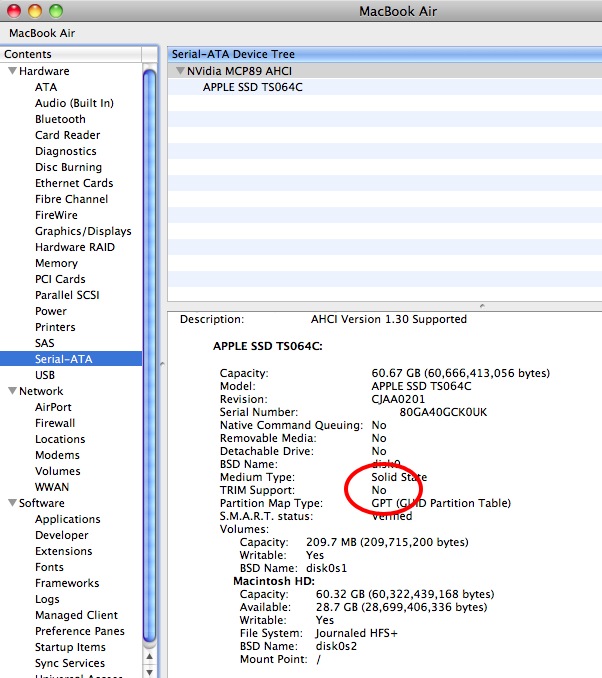
As you can see, it does not support TRIM, which is a technology which cleverly manages garbage to keep storage capacity at a maximum.
OS Lion, SSD + Recovery Partition + TRIM: Put those together and you get three benefits:
- Fast SSD read and write speeds
- Ability to restart even with a blown boot drive OS
- Efficient management of dead space on a costly SSD
This leads to a couple of thoughts. If I can get Lion to run on the local workhorse here, my HackPro, then the next logical step is to add a small SSD to become the start-up drive with OS Lion on it and to store the Applications and Library directories on that SSD. Data files will continue to reside on traditional spinning disk drives until SSDs become larger and much cheaper. MacPro users could do this also given the machine’s ability to contain multiple disk drives. MacBook Pro users whose disk drive is of the spinning traditional type can get a kit to replace the increasingly useless optical disk drive with an SSD – Mac Sales has them – thus running two drives inside their laptop. I’m not sure about iMacs; there’s an option to buy these with an HDD plus an SSD but whether it’s possible to retrofit machines with an additional SSD which came without one is not something I have researched. Nor will I, given the poor heat design of the iMac which saw two die prematurely here, and the ghastly glossy screen.
I added up the size of those directories and here is what I got:
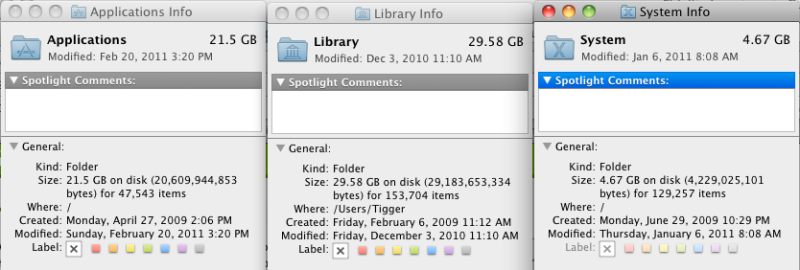
So that little lot totals less than half the capacity of a 120gB SSD. Here’s the current pricing of SSDs at MacSales – these come in a 2.5″ drive size so add $20 for the cradle to adapt the SSD to a full size machine which takes 3.5″ drives:

So the 120gB is in the gB/$ sweet spot and just the right size for my purposes.
MacSales’s web site makes the point that applications like Photoshop still do a lot of disk swapping when processing, so doing this using an SSD is going to result in far faster performance when doing complex processing. And my experience with the SSD in my MacBook Air tells me that PS and LR3 work super fast, especially when it comes to start-up times. Typically these applications start in half the time on the MBA compared with the HackPro with its 8gB of RAM and 1tB Samsung 7200rpm traditional HDD boot drive.
Today even the MacBook Pro laptop computer reports faster benchmark results than the HackPro despite the latter’s four core CPU, fast Nvidia 9800+ GPU and 8gB of RAM. But, then again, I can get faster to the grocery store on my push bike than you can in your Ferrari. Raw speed tests are not everything. Constraining factors like a slow internet connection can make all that speed of little use in many real world uses. The SSD addresses one of those bottlenecks, the slow read/write times of conventional hard disk drives, so for a modest investment of $270 + OS Lion I expect that the HackPro will once again jump to the forefront of effective speed in practical use which, for me, means less time spent processing photographs. That’s always a good thing as I much prefer pressing the button to messing about with a mouse.
Thunderbolt: Never missing an opportunity for hype, Apple has just added Intel’s Light Peak technology to the newest MacBook Pros fancifully naming it Thunderbolt. Please. This has nothing to do with OS Lion but is a wire or optical connector which permits far higher data transfer rates than USB2 or the nascent USB3, as well as supporting many peripherals like external drives, displays, etc. on one connector. The MBP version does not use optical fibers but you can bet those will be coming soon. There has been some confusing press stating that Thunderbolt will be exclusive to Macs for a year but I think that cannot be correct. It makes no sense for Intel to destroy its market for this exciting technology by limiting sales to a vendor who commands 5-10% of the non-tablet computer market. Accordingly, I expect that we will see aftermarket PCIe plug-in Light Peak cards for PCs and MacPros soon. It will be interesting to see how this works out but hopefully all those sockets on computers will disappear in favor on one, two or three Light Peak connectors. Light Peak supports serial connections (simply string your peripherals together end-to-end) and offers mainframe communication speeds to the PC market and I wouldn’t be making any investment in USB3 peripherals if I were you. USB3 is DOA.
No more Rosetta: Now here’s the bad news. Lion will not include Rosetta so PowerPC apps, like my Photoshop CS2, will no longer run. That’s a shame and I fail to see why Apple would delete this feature. Still, for the first time in ages, Apple has made Adobe happy given how many people will have to upgrade to the outrageously overpriced CS5.
The more troubling implication is for EyeOne Match which is the application used with the Eye One colorimeter to profile displays. Even though PPC hardware has been discontinued for years, x-rite has yet to update EyeOne Match to work on Intel machines; it needs Rosetta to work.
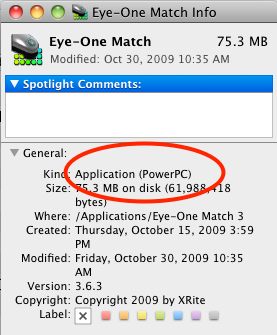
I have written to xrite and will publish their reply if I get one. Here’s what I wrote:
Gentlemen – I use your EyeOne colorimeter with your EyeOne Match software on my Macs for photo processing. I use v. 3.6.3 which is the current version of EyeOne Match, I believe. This application requires Rosetta to run in OS Snow Leopard as it is a PowerPC app and appears not to have been updated to run natively on Intel Macs. As you know PPC Macs have not been made for many years. EyeOne Match runs fine on my Macs using Rosetta.
However, the next version of Mac OS X, Lion, which will be introduced shortly, will no longer support Rosetta/PPC apps. So my question is:
“When can we expect an Intel version of Eye One Match which will work on the latest Macs running Lion?”
Not upgrading the Mac OS is not an option as all new Macs will come with Lion only; unless you upgrade your EyeOne Match software your device will cease to function on new Macs and your sales to Mac users will cease.
Thank you.
Until I get a positive response with a committed date from xrite I no longer recommend the Eye One for photographers and have updated my review to that effect. Indeed, the Mac user contemplating purchase of any xrite colorimeter should first address this issue and, if the software runs in Rosetta/PPC emulation mode only, buy something else.
xrite follow up: Correspondence with fellow photographer Roy Hammans has disclosed that others are onto this issue. It seems that Monaco Optix has the same problem and I wouldn’t be surprised if ColorMunki has it also – all three colorimeters are sold by xrite.
Meanwhile, assuming xrite is lazy/slow/dumb (which history suggests) it occurs to me that there is a workaround. The Mac user would keep a working installation of Snow Leopard in a separate partition on his boot drive and start from that, perform a profile update then simply copy the profiles created over to the Lion partition. Then reboot from Lion. Even easier, create a bootable version of Snow Leopard (with Rosetta) on an SDHC card or an inexpensive USB thumb drive, and install the EyeOne Rosetta software there. An 8gB drive should be ample as OS X uses under 5gB.
Your display profiles reside here on your Mac:
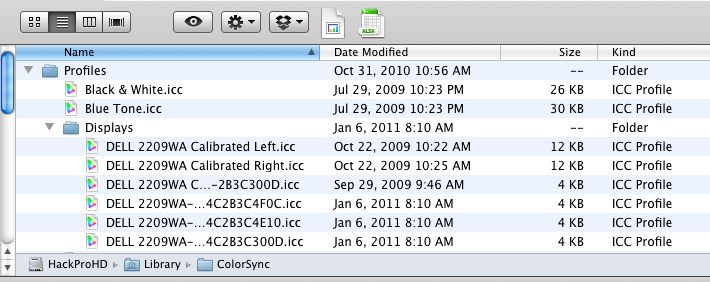
If it comes to this, as I suspect it will, then I will post a piece here explaining how to accomplish the workaround, allowing users to update to Lion and still retain the ability to use the EyeOne to profile their displays.
TurboTax: While not germane to photography, US users of TurboTax should also think before moving to Lion. Through and including tax year 2005, TurboTax for Macs was a PPC application and needs Rosetta to run. So if you need to access tax returns prepared using TurboTax for tax years 2005 or earlier on your Mac, make sure to keep a Mac running nothing later than Snow Leopard handy for that purpose.