Regina Relang

A fine German fashion photographer.

The words “wit” and “photography” are rare companions when the photographer in question is German, but Regina Relang is an honorable exception to the rule that has it that humor has yet to be discovered in Germany.
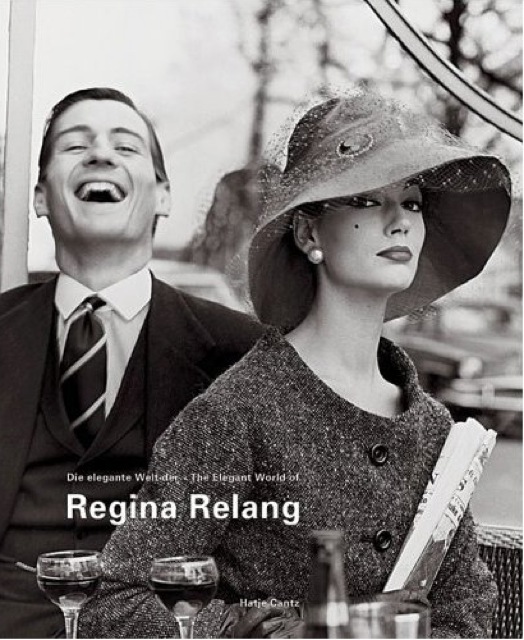

The Elegant World of Regina Relang, by Esther Ruelfs

Relang’s career spans the immediately pre- and post-WW2 periods, the latter perhaps the greatest outpouring of great fashion and photography we have yet seen.

Her oeuvre is both light hearted and witty and never less than totally sophisticated. And while many of her German models look as if someone took a floor brush to them to reveal a new layer of perfect, unblemished epidermis – what else to expect of the Master Race? – that detracts little from the charm and beauty of her photography.

The book is frustratingly written in both German and (stodgy) English, with the English version in very light print on a light background (conspiracy theorists can have at it here) but as it’s the only monograph out there on Relang, I’m going to button my lip. No book on photography should have a ‘must read’ text and this one certainly more than espouses that dictum. The writing, or maybe it’s the translation, is beyond pedantic.
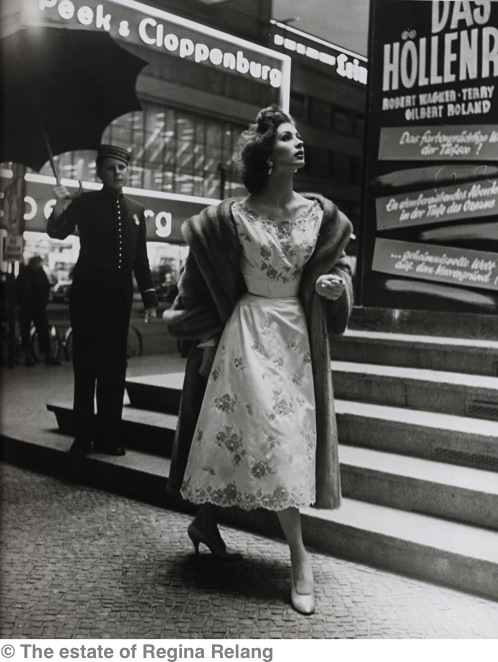

Wit, class and sophistication. Suzy Parker photographed by Regina Relang, Berlin, 1954.

Relang was also a fine photographer in the more general sense and a selection of her non-fashion work is also on display here. Some of her later work is in color and she has as fine a sense for a simple color palette as she does for monochrome.

A few points of technical interest. Reading between the lines I conclude that Relang was mostly a Rollei twin lens reflex user. What makes this remarkable is that while the small size and low weight of the Rollei liberated the camera from the studio, nothing could suit a waist level Rollei less well than Relang’s style. Relang, you see, was all about motion and action, movement blur and so on. If you have ever tried using a TLR Rollei to follow action (in her time the eye level frame finder was not yet available, being introduced on later models) you will know why I say this. It’s near impossible as the image in the viewfinder is reversed.

Unlike her contemporaries Avedon and Penn, who typically adopt an “everything must be sharp” style, it is rare to find a Relang picture which does not use selective focus. The varied use of this technique in the many pictures in this book speaks to a very high level of technical skill on the part of the photographer. With the depth of field equivalent to a 75 or 80mm lens on a 35mm camera, (but with the field of view of a standard lens), selective focus is easily available at larger apertures, of course.

I highly recommend this book for anyone interested in beautiful photography, gorgeous women, haute couture or great technique.

In my case that’s all of the above.

Don’t waste your money at Amazon – get a remaindered copy. Mine ran $20 from Edward G. Hamilton.
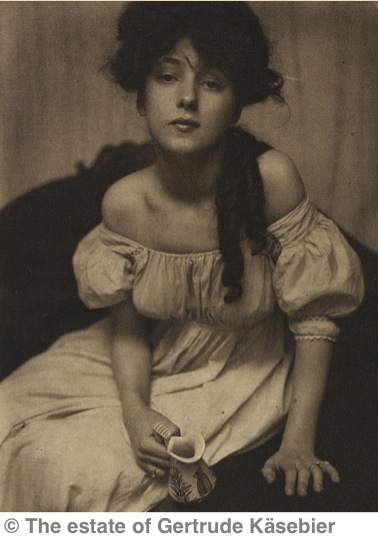
Gertrude Käsebier

A great American photographer.

I’m certainly no fan of filmy, soft focus, photography on the whole, but that’s not to say I don’t like it when it’s well done.

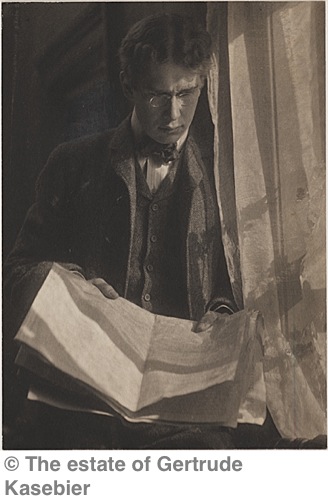
Gertrude Käsebier (1852 – 1934) was an American photographer who did most of her best work around the beginning of the twentieth century. Her work is distinguished by soft light and great warmth and charm.


Portrait Miss N. 1903


Portrait by window light. Date unknown

It’s unclear whether the general fuzziness of her work is the result of poor technique, deliberate manipulation or simply caused by the technical limitations of the time. No matter, the results work.

While the standard writing on Käsebier is that she was a member of the Photo Secession movement headed by Stieglitz, stylistically she was very much her own person.

A timely reminder that not all that is sharp is good, and that not all that is blurred is bad.

1929 Redux

“Those who deny history are doomed to repeat it”. Santayana

In 1907, the crash immediately preceding the one prior to the 1929 Depression, John Pierpont Morgan is credited with personally saving the financial system when he led a band of capitalists in infusing private capital into a doddering stock market. The loans were repaid and America went about its business in due course. Since then, various US governments have repeated his actions but, sadly, using your money and mine to bail out crooks both on Wall and Main Streets.

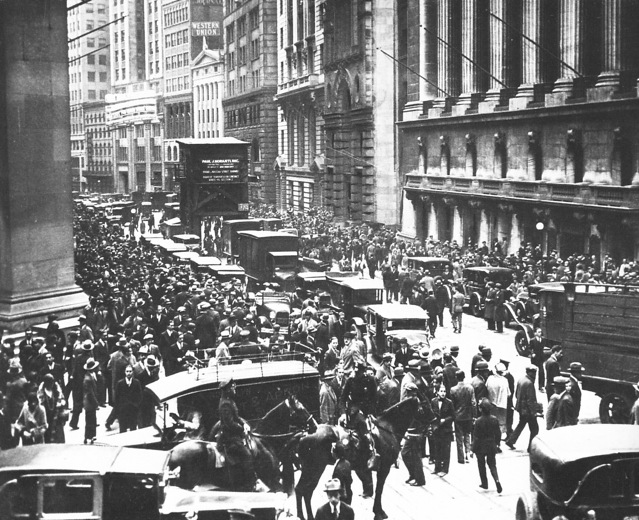
So after yesterday’s greatest ever one day percentage decline in the Dow index, it seems only appropriate to recall how Wall Street (or, more correctly, Broad Street) looked back then.


A magnificent picture of the limits of greed. Photographer unknown.

The building at left – 23 Wall Street – served as J. P.Morgan’s headquarters until the 1990s when it was sold and converted to residential housing. It’s at the corner of Broad (where you can see the Stock Exchange) and Wall (not visible, Wall is behind you). Morgan purposely limited its height to two stories as the ultimate statement of WASP wealth and power.

I was lucky that the Morgan Bank was my client in the 1981-1983 period but less lucky with my assigned seating in the Board Room, which has to have had one of the longest tables ever made. For some reason the usher always insisted on seating me right opposite the glowering, mutton chopped oil of JP himself, staring down on me from Protean heights. To this day all I can remember of those tedious and boring meetings is Morgan’s censorious glare. We could use him today.

If you continue west a few yards on Wall Street you come to Trinity Church, burial place of America’s first and greatest Treasury Secretary, Alexander Hamilton. I used to visit it often. Each time I would pass the shoeshine boy outside the Church and was always reminded of the (perhaps apochryphal) tale attributed to financier Bernard Baruch who, upon receiving a stock tip from the boy in early 1929, promptly went out and sold all his shares. He survived the Depression and prospered mightily. When asked his secret, Baruch honestly responded “I made my money by selling too soon”.

In January 2008 I followed Baruch’s advice.

Schadenfreude? No. Santayana. “Those who deny history are doomed to repeat it”.

Strange that many years later I would end up working for America’s other great Treasury Secretary, Bill Simon, but that’s a story for another time.

Grain is dead

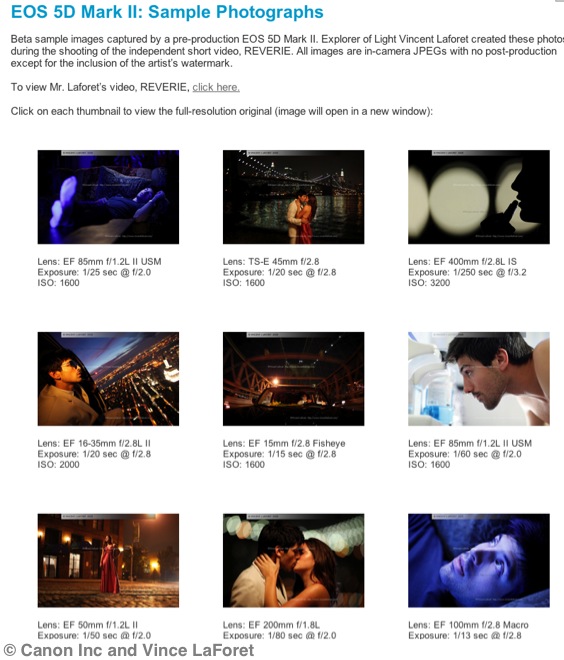
From the Canon 5D Mark II.

Vince LaForet’s work with the new Canon 5D Mark II at 1600 and 3200 ISO confirms that, for all practical purposes, grain is dead.

Click the picture for large JPGs at high ISO speeds from the new Canon body. In many you will see color fringing near the corners suggesting Canon has some way to go to better Leica in its optics, albeit even L lenses are mostly chump change compared to those from Germany. The fringing (correctable in post processing in Lightroom or Aperture) is especially noticeable in the snaps taken with the 45mm TS-E and the 15mm Fisheye (which I own and love). High time Canon started adding in-camera processing to fix this sort of thing. Obviously, the body ‘knows’ which lens is mounted and it’s not like Canon is ignorant of the aberration patterns in their optics. Adding a lens ‘map’ for each lens doesn’t sound like nuclear physics.

What you will not see is grain.

It would seem that the resolving power of Canon’s latest sensor significantly exceeds that of many of its lenses. I would suggest that use of any of the consumer zooms on this body is a complete waste of time – the proverbial Coke bottle lens on a Hasselblad. The cheaper non-L primes are fine (I love the fisheye, the 50/1.4 and the 85/1.8) but ‘kit’ lenses are a no-no. Garbage in, garbage out.

So, if you want grain, you are going to have to add it at the processing stage!

Mother Russia

Nothing changes.

What on earth can one make of Russia? For centuries it has stumbled from one brutal murderous dictator to another seemingly yet more heinous. Democracy, simply stated, is a concept they are incapable of embracing, preferring the cold clutches of the state and cheap booze. The current Russian poll to seek out the greatest Russian has Stalin in a healthy lead. Runner-up? Tzar Nicholas II. This from a nation that has given us Tolstoy, Tchaikovsky, Solzhenitsyn, Sakharov, Horowitz, Nureyev and on and on. You figure it out. I cannot.

So how is it that so cruel a system has given us much of what we think of as great art today, whether in music, painting, ballet, opera, architecture, you name it? Maybe it’s simply that the Slav creative gene only works well when depressed.

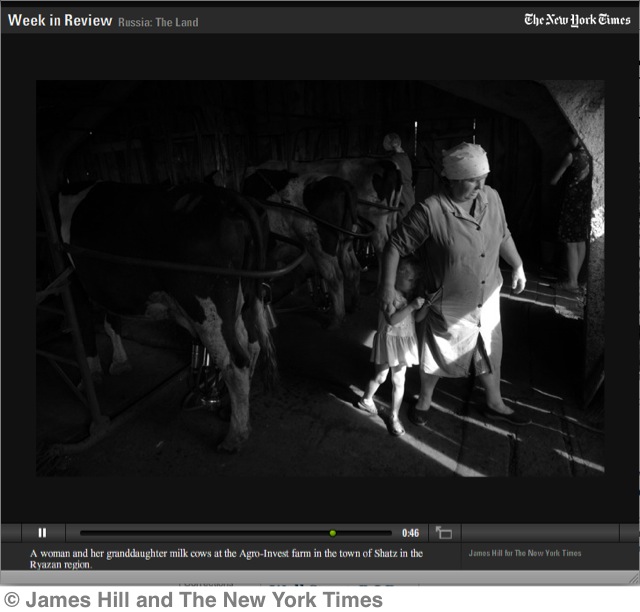
Click the picture for a beautiful monochrome photo essay by James Hill on the remains of agrarian Russia, appropriately published in that most socialist of US papers, The New York Times: