Just add lightness

Lotus was not the first.

Ask any graduate of UC London’s School of Mechanical Engineering which alumnus they are most proud of and the answer is likely to be Colin Chapman of Lotus Cars fame. Chapman’s pioneering designs resulted in many victories in all forms of motor racing but most notably in the most demanding of all, Formula One.

When asked about his key design tenets, Chapman would answer “Just add lightness”.


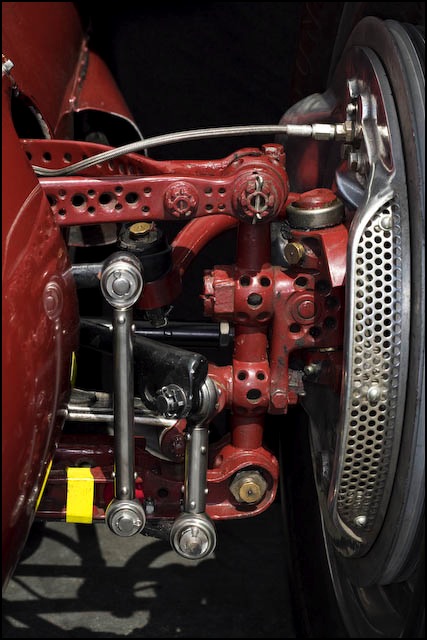
1930s Alfa racer at the Laguna Seca Historics, 2008

As this pre-war Alfa Romeo grand prix racer’s suspension shows, he was not the first to have that idea.

What makes our former adulation of great engineers and designers so poignant today is that the US, desperately in need of engineering talent, makes it increasingly difficult to enter the profession. Domestic production of engineering graduates is stymied by the childlike attention spans and instant gratification generated by TV, populism and computer games. We prefer to encourage our kids to become pop stars, actors or sportsmen – all fields of endeavor with miniscule prospects for success. Or worse – we make fine brains into the mush that passes for lawyers, a business (it’s no more a profession than prostitution) that has done more to hurt US productivity and destroy wealth than even the government could. At the same time we place foolish cartels on immigration because we (rightly) fear that we cannot compete with Ivan, Lee or Yamamoto. Capitalism is truly hanging itself with its own rope.

Beauty

From the 2008 Monterey Historic Races.

Back from the days when drivers were fat and tires were thin.

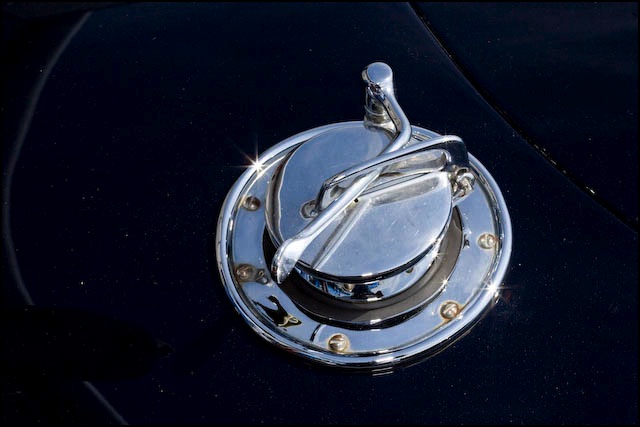
Late 1930s Talbot-Lago filler cap

The annual Historic races held at the Laguna Seca track in Monterey County, California, provide an orgy of viewing of some of the finest cars made. Insiders know that the race track is lousy for viewing and that all the real action is in the paddock. Further, go on the Thursday before the race weekend and you will not only get in free, you will also avoid the polyester set with its foul clothing and even worse taste. (N.B. For the best parking spot tell the fellow at the entrance that your are “pit crew”. Works every time.)

Instead, in a friendly and unrushed setting, you can chat with the drivers and mechanics and exult in the beauty of what once was.

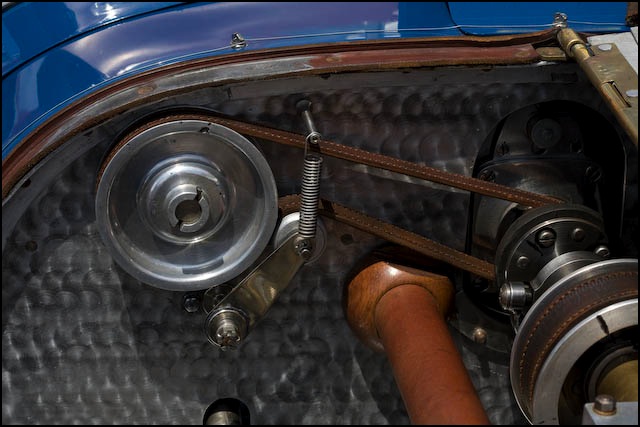
Leather belt drive for the tachometer on a late 1920s Bugatti. Note the simple tensioner.

The charming owner of this Bugatti explained that the leather belt is actually a sandwich of leather with a Teflon ‘filler’. It looks fine and, unlike the original, lasts. Note the beautifully executed, diamond machined, firewall.

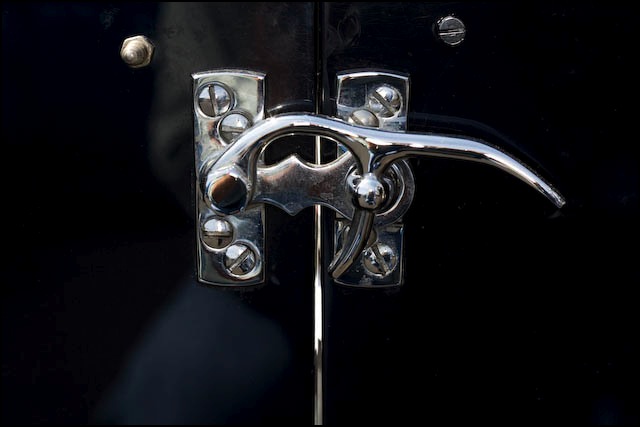
Door handle on a pre-war Delage. Pure, unabashed sensuality.

And forget all that rot about beauty being in the eye of the beholder. It’s absolute. You either get it or not.

I used the 5D with the 100mm macro for these, with a shadowless ring flash, which preserves the original shadows cast by the sun while dampening down the otherwise excessive dynamic range. If there is a better hand-held macro outfit with the certainty of sharp, large prints, I do not know of one.

Wealth

A fabulous photograph.

For an index of articles on art illustrators, click here.

I blew by this one on my first glance through this month’s pile of fashion magazines and am awfully glad to have revisited it.
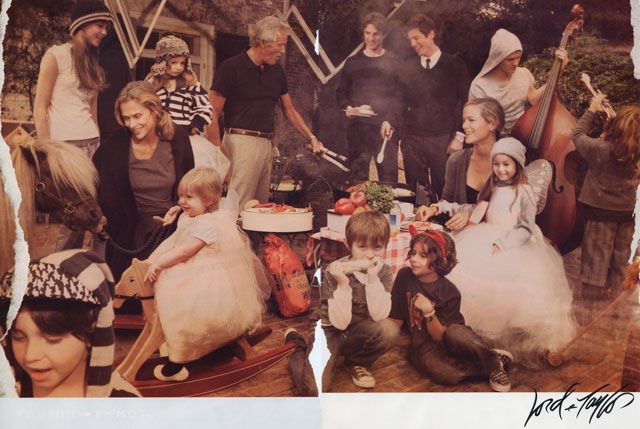
Lord & Taylor is a clothing and knick knack store for the wealthy. If you want to see the best Christmas windows in New York you need go no farther than Cartier, Saks or Lord & Taylor, all conveniently close by on Fifth Avenue. By the way, when it comes to Christmas windows, we west coast recluses marvel at Saks’s in Union Square in San Francisco, a city with much of New York’s charm and diversity but little of its nastiness.

First and foremost, this complex composition, worthy of Rembrandt’s Night Watch, speaks of success. A large, well dressed family, preparing for a barbeque. Obviously this is the weekend place.

The silver haired paterfamilias, fit and tanned, is very much in charge, strengthening his position of control by taking on the menial cooking chores. He’s old world, of course, so no stainless steel multi-knobbed built in barbie for this man. So gauche. No. It’s charcoal and an old Weber grill, and who could argue? It’s the ultimate condescension of the wealthy – use what the working man does. It’s real – look at the smoke trails in front of the preppie boys.

The massive cantilevered arms must support a very large awning. The affluent have large patios which need large awnings.

He seems to have three sons, the two who finished prep school and are now at Yale and Princeton, the eldest very aware of his film star looks, and then the third, in the hoodie. He went to UC Santa Cruz, did too much surfing and too many drugs, started a rock band and is the real success of his generation. He’s making music on the bass with his niece on the trumpet. Rich people play instruments.

The mother (Lauren Hutton) is messing about with the pony (doesn’t everyone have a pony?) and the animal is the focus of attention for her daughter and grandchild on the right. Rich people have animals. Big animals.

The number of kids is hard to fathom. I’m reckoning the girl at top left was a surprise fourth child for the old couple. Rich people can afford it. That still leaves seven kids to account for, so either the last generation was Catholic, or someone else’s kids got into the party. It just adds to the fascination of the picture.

Finally, the almost too precious arrangement of vegetables by the Weber makes another subtle reference to wealth. Clearly these are for show, not consumption. The rich love show pieces, be they veggies or china.

Note also the Degas-like cut off of the child at the lower left and that insanely mischievous look of the little boy front center. What a piece of choreography! All told there are fourteen people in the picture …. and one pony. Mercifully, the art director and photographer left out the obligatory dumb-as-a-brick golden retriever. A Border Terrier would have been nice, but I suppose that’s too much to ask. The rich own Border Terriers.

The inspired choreography, the subtle and oft repeated message (if you have to ask you cannot afford it), the warm colors reminiscent of the great party scenes of Renoir, the rustic setting, the simple classy clothes worn with grace.

Advertising does not get more subliminal than this. Not only does the viewer get gently invited to the world of wealth, he gets an object lesson in deportment and behavior just by gazing at the guests. Would I change anything? Well, I would likely give the old boy a stiff G&T in a nice L&T crystal tumbler. Easy on the ice. When it dawns on the old boy how much of his inherited capital he has just blown on nice clothing, he will need a restorer.

What a photograph! Bravo!

Boy, do I wish I could speak to the photographer who took this.

P.S. The edge tears are in the original; the center ones are mine as I had to rip out the two page spread to scan and join the images.
Leni Riefenstahl

To know her work is to understand.

Few would dispute that the greatest movie about the Olympics is Olympia, Leni Riefenstahl’s 1936 masterpiece chronicling the Aryan master race in the 1936 Olympics. It shows perfect specimens of the nordic man-god ideal variously chucking the discus, running like a gazelle (albeit slower than the schwartzer untermensch Jesse Owens), and generally being, well, white and superior. Sure it’s dated (whitey is unlikely to win much of anything in the modern sham known as the Olympic Games) but the photography is superb.

The movie follows on from one far greater, perhaps the most evil film ever made, Triumph of the Will. Watch it with an open mind and you, too, will be swept up in the cleverly managed tension which builds throughout the movie until her slightly less than Aryan leader finally makes his appearance for the 1934 Nazi Party rally in Nuremberg. The style is one of a succession of still images rather than that of a movie. Between Riefenstahl’s adulation of this bad man and the Propaganda Ministry’s financing, she produced the greatest fake documentary yet made. I was forcibly struck by just how plagiarized her work has become in watching the old version of Spartacus with Kirk Douglas and just about any of the tedious Star Wars epics from Geroge Lucas (a man who has never met an actor he can direct). Look at any of the crowd scenes of the armies of bad guys from either director and you have a shameless rip off of the best/worst in Riefenstahl’s propaganda masterpiece. Look at the post war The Third Man and you have all her camera angles writ large by director Carol Reed. She left an indelible mark on the documentary genre.


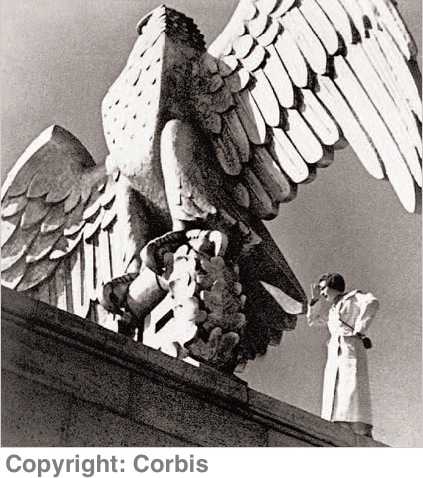
Hitler’s favorite film maker supervises filming

Sure.

She was just following orders.


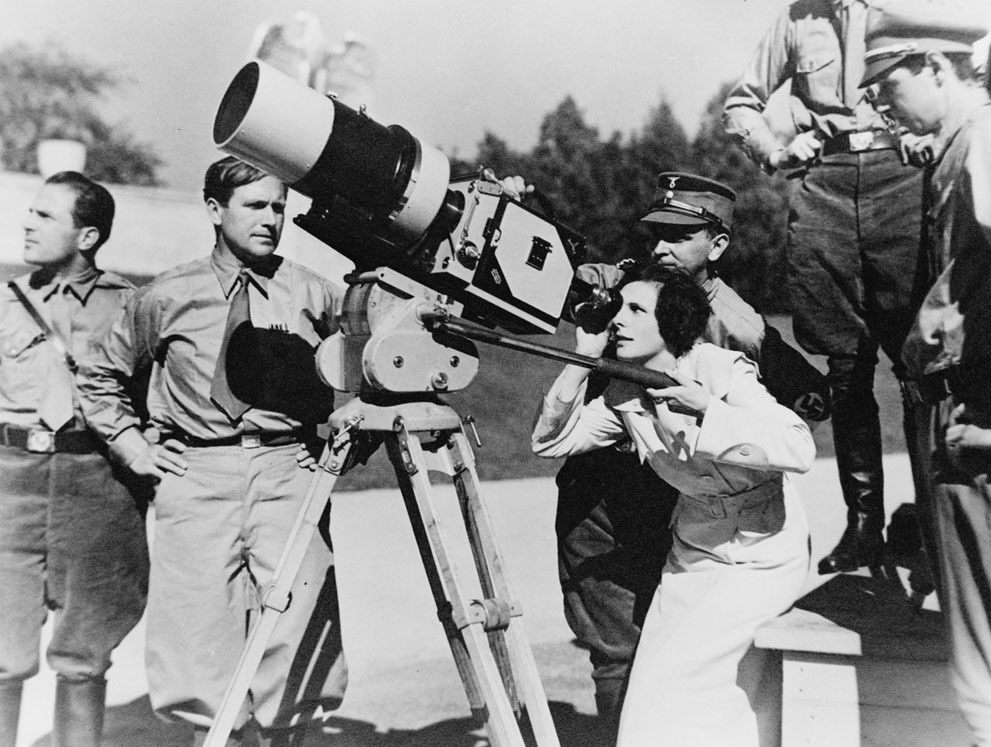
A big lens and no moral compass, Riefenstahl participates enthusiastically in the 1934 Nuremberg Nazi party rally.

They should have whacked her at Nuremberg – where could have been more appropriate? – along with all the others in 1946, and have saved the world another 50 plus years of her denials and apologia. Her total absence of shame rightly confines her to this journal’s Hall of Shame.

Update August 30, 2024:

This Guardian review of a new documentary about this evil woman confirms what I wrote back in 2008, above. They should have whacked her at Nuremberg.