About the snap: Balloon seller

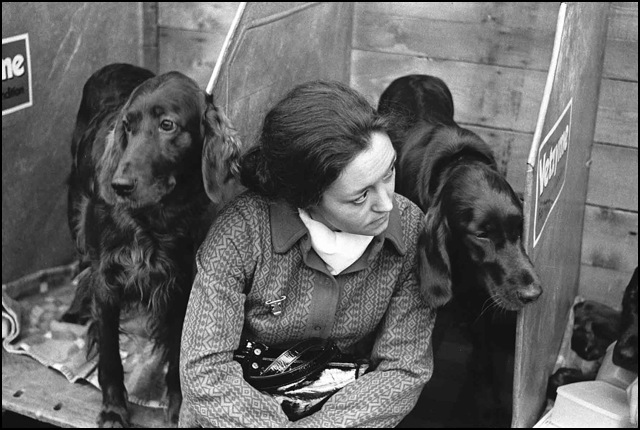
Balloon seller


Date: Easter Day, 1974
Place: Battersea Park, London
Modus operandi: Enjoying the Easter Parade
Weather: Lovely
Time: 2 pm
Gear: Leica M3, 35mm Summaron
Medium: Kodak TriX/D76
Me: Glad the balloons were helium filled
My age: 23

The Easter Parade at Battersea Park, then a fun, working class area in London (now doubtless replete with overpriced, cardboard condominiums), was always a good source of street snaps. This macho-attired balloon seller gave me a mouthful of the best four letter words seconds later but, then again, what could he do? Give chase and lose his balloons? Anyway, with the 35mm lens I was pretty close, it’s true, and this was one of those rare occasions where I simply stuck the camera in an unsuspecting stranger’s face.

I have always enjoyed the comic contrast between the seller’s attire and his product offering, and hope you like it too; God help anyone trying to sell balloons decorated with golliwogs today in our uptight, bigoted world.

Early Penn

A special technique makes for special pictures

I may have grumbled about Irving Penn’s love of darkroom technique before, but there’s no denying the originality of the results. So it’s no surprise that some early pictures of his, taken with a Leica, and published in Leica Fotografie 2/1955, have stuck in my mind. Penn was mostly using large format and 6×6 film in those days, but he was not past messing about with 35mm film on his vacation.

But he did not stop at just taking snaps. These were made on color film with the originals cropped and rephotographed in monochrome and printed with a point light source condenser enlarger. It’s worth adding that most 35mm and 6×6 film users enlarged their negatives using diffuser enlargers, meaning that the light source was a coated neon bulb which naturally softened the image, obviating the worst of the grain. They were also inexpensive, thanks to the simple optical design. By contrast, the high intensity, uncoated, focused, point light source Penn used in his costly professional enlarger (complete with an exhaust fan to stop things melting) magnified every detail and line in the print, an effect Penn used to startlingly good effect in these pictures from the Arabian desert.

Note the etched appearance and the startling effect of the stripes on the running boys’ clothing. No less striking is the composition here, with everything but the main subject sharp – shades of Parkinson’s red hat picture. Or was it the other way around? Yes, I rather think Penn got there first.

I have never seen these reproduced elsewhere and hope you share my excitement on seeing these images. The original magazine is now over fifty years old, so please pardon the yellowing and fading.

Leitz Trinovid binoculars

A useful accessory for outdoorsmen

A good pair of binoculars is a useful tool to have along in the countryside – a fine discovery tool for those photographers enamored of long lenses.

I struggled along with any number of numbingly awful ones as a kid until, some twenty years ago, I finally acquired the ne plus ultra of binoculars, the Leitz Trinovid 7 x 42B. These remain the only piece of Leitz equipment in the family unless you count the lens on the Lumix LX1, allegedly made by Leica (their involvement was probably limited to design only).

These are distinguished in several aspects of their design. First, as is always the case with products of Leitz Wetzlar (those made through 1965 or so, that is), are the optics. Raise these to your eyes and Wow! You will never look through another binocular again. Second, the large inlet glass, 42mm in diameter, is a boon in poor light. Third, the field of view is exceptionally wide making finding subjects that much easier. Fourth, the 7x magnification is just right – not too high (shakes!) not too low (useless). And finally the construction is like they used to make them. Leatherette covers a light alloy chassis, special prisms constrain the bulk and the feel is like nothing since that 1960 Leica M2 I used for many years in film days of yore. A sensual delight. The ‘B’ designation means that the exit pupil is very large. Stated in English, if you wear glasses, as I do, you will be delighted.

Leica makes binoculars to this day. For all I know they even focus automatically – yeccch! They are ugly to look at, with all that fake machismo effect created by ridiculous rubber casings serving only to cheapen the aesthetics. I haven’t tried a pair nor will I. I already have the best. If you are in the market for a pair of binoculars, try and search out a good used set of these. Mine are not for sale!

Edward Quinn: Photographer

A man of grace and beauty

Mention Edward Quinn’s name today in photography circles and you will get puzzled looks. Partly that’s because he was a quintessentially European photographer, meaning that maybe the US saw less of his work. Part is that his work is just too refined to appeal to modern tastes.


Grace Kelly by Edward Quinn

Yet Quinn (1920 – 1997) was the first among those who plied their trade on the Côte d’Azur, where his subjects were the rich and famous, much of his work gracing the pages of Paris Match or Life magazines.

I first came across his work in the English Edition of Leica Fotografie issue 4/1966 (I was published there in 1974, by the way, back when I cared about such things). His picture shows a rather formal, slightly over-dressed tweedy individual, holding an M3 with the 35mm Summaron I knew and loved so well. He looks to have come from central casting for a movie on the British Raj. While his subjects are invariably famous they are clearly at ease with this ‘Master of the Leica’ as LF styled him.

Take a look at his web site which, while a bit of a mess organizationally, shows his work well.

His book Riviera Cocktail is available from Amazon. Sadly the text seems to be in German, but the pictures are timeless.

A welcome winter visitor

A dash of beauty during the most miserable time of the year


Click the right arrow above for a recorded sound version of this piece.

There is very little good that can be said about the winter, even in lovely California. The days are short, the lighting drab, the vines lonely, denuded and miserable.

So at this time of the year that house guardian and all around good egg, Bertram the Border Terrier, adopts a winter routine. After hopping off the bed he makes a quick trip to the outdoor toilet, then spreads himself out on the big sofa in the living room. How a small terrier manages to claim all of a three seat sofa beats me, but I know my place.

Anyway, aforesaid Border was seen to raise a questioning eyebrow this morning as his guide and master, doing his best Rambo imitation, crawled along the carpet with camera and honker lens attached. I had replaced the obligatory head strap with a pair of woolen pajamas, you know, the ones with the classy paisley design, but the whole ensemble attracted little more than a sigh of disgust from the four legged one who wrote the whole episode off as just so much more eccentricity on the part of his guide and master.

The family manse is some 22 miles east of the Pacific and is guest to many fine animals. A couple of rabbit families have burrows in the vineyard, much to Bertram’s dismay, and the bird boxes see swallows, finches, bluebirds and other relatives at various times of the year. Hummingbirds do a number on the star jasmine on the north patio, with their high pitched chirps and wonderful flying. Red tail hawks provide an unceasing vigil, with ground squirrels being a particular delicacy while the turkey vultures, with faces only a mother could love, teach one and all what effortless flying is about. Once the grapes ripen, the flocks of starling feast on our crop with no intent of payment (just like Bubba on my taxes), accounting for no less than a ton of grapes last year. Greedy buggers!

But back to the Rambo bit. The object of my attention was a rare visitor indeed. A magnificent egret was perched on the little bridge over the pond. He had been dropping in for a couple of days now and any sign of movement in the home would immediately spook him. Hence the all fours bit. The moment I spotted him early this morning I did my best commando imitation and high tailed it (OK, grovelled on the carpet), to the office to slap the 400mm honker on the camera.

Gradually sliding open the sliding glass wall on the south side of Chez Pindelski, I had time for just two snaps before the Great White Egret made off. I was all of seventy feet away. What brings him so far inland I have no idea, as you usually see him and his kin hanging out along the coast in marshland. The little pond used to contain magnificent carp which I had raised over a couple of years, but the sushi-loving racoons put paid to that. Maybe he just liked the clear well water that feeds the pond?

Anyway, here he is in all his splendor. I had to really crank up the contrast when processing the picture, owing to the horribly flat light. No matter. A visitor of this distinction is always welcome at the estate. Check out those legs!


Great White Egret. 5D, 400mm Canon EF ‘L’, 1/500, f/5.6, ISO 500. Processed in Aperture.

Ordinarily these fellows are to be found at the coast in reedy surroundings, like here:


Great White Egret. 5D, 400mm Leitz Telyt, 1/500, f/6.8, ISO 800. Processed in Aperture.

This was snapped just off Highway One a couple of years back.