The modern professional photographer is at a huge disdvantage
A recent email from a reader, a professional photographer, bemoaned the growing difficulty of making money in the profession.
Now while the Renaisasance is a period of great interest to me and I have oft exhorted photographers to study the great works of that greatest period of western art, it doesn’t merit extensive mention here simply because the subject is too far removed from the world of photography.
But the book I am reading, Michelangelo and the Pope’s Ceiling, is not just compelling reading, maybe the finest art book I have yet read, but it also goes to the heart of the pro’s complaint.
Look at the skill set Michelangelo had to bring to the equation. When Pope Julius II retained him to paint the vault of the Sistine Chapel (Julius was busy tearing down old St. Peter’s at the time – we are talking c.1508 here) Michelangelo had several problems.
First was the small matter of several tons of Carrara marble he had procured to sculpt the Pope’s tomb. They were sitting in a square around the corner from St. Peter’s when Julius decided to pour capital into the new cathedral, and hang the tomb. And hang paying Michelangelo for the useless marble. So Michelangelo was broke.
Second was the problem that Michelangelo was a sculptor, not a painter. He had created the two greatest sculptures ever, the Pietà , (though adherents of Donatello’s Mercury might differ) and followed up with the David, also not too shabby.
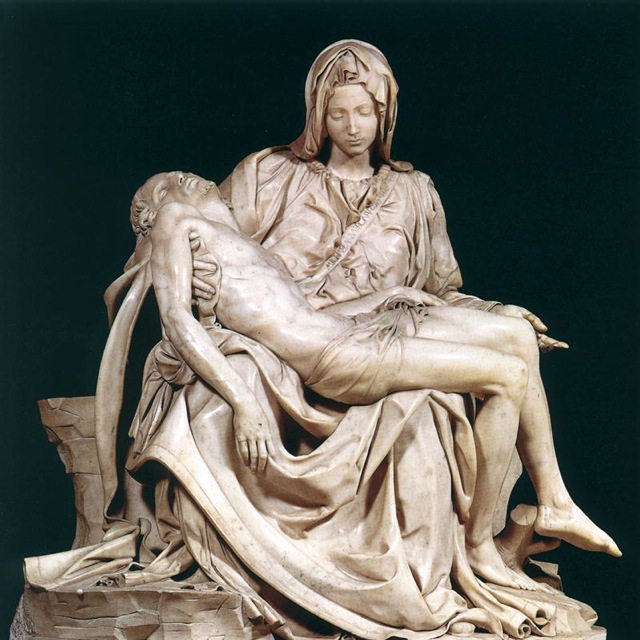
Michelangelo’s Pietà , St. Peter’s Basilica, Rome. 1499
Third, the Pope was a true believer in having only the best – Bramante was retained to design the cathedral, Raphael to do the walls in the papal apartments and when it came to the ceiling, it had to be on fresco, meaning a layer of wet cement that had to be painted within 12 hours if the pigments were to be absorbed by the cement. Michelangelo had never painted on fresco.
Now the painters and sculptors of the day, the same we now adulate, were regarded as little more than tradesmen at that time. Sure, highly paid tradesmen (just like the public school educated plumber today who, when he deigns to show up, does so in a brand new SUV), but they took their orders from their employers. If the Pope said I want the Virgin Mary right here, that’s what you did.
Unlike the more politically astute Raphael – I consider him the greatest painter of his age – Michelangelo cared not one whit for his employer’s preferences and proceeded to craft a large canvas sheet (the invoice still exists!) to screen his work from visitors to the chapel. My way or no way. Indeed, so confident was he of his skill that the book relates how he got in a physical fight with his patron who had tried to sneak in to look at the work. Luckily for posterity, Julius repented and the threatened death sentence for his painter was soon forgotten.
Michelangelo’s contract provided for a payment up front, one half way through, then a final payment on completion. ‘Half way through’ meant two years, after many false starts as the sculptor learned just how hard fresco painting was. In other words, he had serious technical problems with the composition of the concrete, its absorption rate, etc., etc. Like photo processing in the dark ages of the darkroom. But the artisan in him triumphed and two years later he and his team unveiled the first half of the ceiling, to universal approval. God alone knows what Julius would have done had it gone down poorly. Mercifully his syphilis was not playing up at the time.
So look at the skills Michelangelo had to bring to the equation. Negotiation, procurement, relearning how to paint, mastering a new medium, man management (it takes lots of people to build scaffolds and make concrete), a psychotic, driven employer, mastery of the latest in pigments and colors, composition, cartooning, transfer of the cartoons to the wet fresco. The list is endless. And the one essential skill, which cannot be learned, was the fact that he was a great artist.
Now think of the modern photographer. Let’s assume he knows how to take good pictures. Unlike Michelangelo and Rapahel and Bramante, he has enormous competition. After all, is it not true that anyone can take a photograph? The barriers to entry are non-existent. There is no trade school or years of apprenticeship to foster development of technical skills. Why bother when it’s largely done for you by the people at Nikon or Epson or whatever? Sure he has to have marketing skill to find a client but unfortunately for him his client can get most of what he wants at very low cost on the web. His art, in other words, has been commoditized. The premium for skill has been drastically discounted.
Step back and look what has happened to western hemisphere people. Maybe it’s best illustrated in the story of the two American tourists (one imagines they must have been Texans) who, presented with yet another priceless Renaissance church on their trip to Italy, yet keenly aware that their flight back home is but two hours away, are posed with a quandary. How to take it all in during the time available? “Simpleâ€, says the hubby. “You take the outside honey, and I’ll do the insideâ€. Cameras clicking, videos whirring.
So in a world increasingly suffering from short attention spans who has the time, let alone the interest, to absorb a beautifully composed, perfectly lit, artistically printed photograph? Who cares when you can see something even better in video on the truly ghastly YouTube?
So the professional photographer’s lament of how it’s getting harder to make a living at his art is not hard to understand. Anyone can push a button. Few can paint a fresco ceiling.