A simple amusement.
I was reading Vanity Fair, a must-read for photographers everywhere, when I came across one of those questionnaire interviews with a famous person. At least he must be famous, because he is in Vanity Fair, right?
What on earth would I answer if asked these amazing questions? Ah! I know. You have to rig it. Betcha that’s how they do it. The subjects get to ask their own questions.
So that’s what decided me to do my own Q&A as a photographer (mostly):
Who Inspires You: Cartier-Bresson, Erwitt, Penn, Parkinson
Favorite discovery: Digital imaging
Best gadget ever: Those clip on eyes for the old Leica M mount 50mm DR Summicron
Best camera you ever used: Leica M2
Best lens ever used: A tie. 90mm Leica Apo-Summicron-M Asph/Canon 85mm f/1.8
Best picture ever taken: Darling, there are so many it’s impossible to say.
Most capable camera you ever used: Canon 5D which I use to this day. A jack of all trades and master of most.
Favorite photo venue: The streets of Mayfair, London, preferably on a sunny day
Favorite watch: Any Patek Philippe; an Audemars Piguet Royal Oak for sports wear
Favorite champagne: Bollinger NV
Jeans: Levi 501 button fly. The classic.
Favorite writing instrument: The Bic Cristal ball pen. Another classic.
Shirts: Brooks Brothers and L L Bean
Suits: Paul Stuart, Madison Avenue
Favorite restaurant in the whole world: La Grenouille in Manhattan, but only if I have a gorgeous brunette to accompany me. On my own it would be any McDonald’s whose stock and food I adore.
Most exciting location you have ever dined in: Windows of the World, 107th floor, World Trade Center, north tower.
Favorite car: Ferrari. It has avoided me so far and somehow continues to do so.
Photographic ambition: A biography of the best of the best in photography, made as a movie documentary, with a highly opinionated voice-over by yours truly, of course.
Greatest fear: That soon 51% of US voters will be working for the government
Favorite leaders: Churchill for his courage, Reagan for his optimism, Thatcher for her determination, Golda Meir for her guts.
Favorite actresses: Rachel Ward, Claudia Cardinale, Eva Green.
Favorite actors: Who cares?
Favorite city: Beverly Hills. A focus of vapidity in a sea of pollution.
Least favorite thing to do: Commercial air flight.
What you do to relax: Read women’s fashion magazines – Vogue, VF, Bazaar, Elle. Walk my dog. Watch Formula One. Read philosophy.
Person who irritates you most: Anyone in, or running for, public office.
The greatest crime in a free society: The Income Tax.
The greatest influence on you as a photographer: Caravaggio
Painters who mean most to you: Caravaggio, Giorgione, Mantegna, Ucello, El Greco, Gericault, Corot, Manet, Degas, Seurat, Rothko
Favorite music: Chopin when I’m depressed. Mahler when I’m really depressed. The Rolling Stones when I’m recovering.
Favorite dog: Any Border Terrier, but especially mine.
Favorite musician: Horowitz
Favorite composer: Chopin
Favorite woman: The one I wake up next to.
Favorite cat: I hate cats.
Favorite photo: The one I haven’t seen or taken yet.
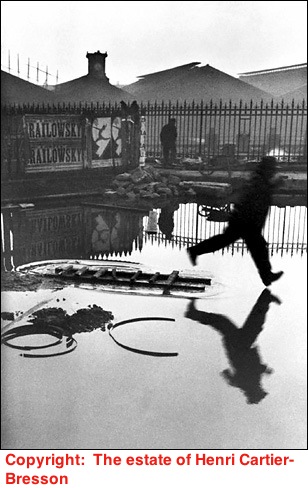
Favorite photo you have seen: I suppose it has to be The Great Brailowsky. HCB at his luminous, spontaneous best.
Phew! That was fun!