Yearly Archives: 2006

Gary Winogrand

Book review

The old dictum has it that “If you having nothing good to say, say nothing, so I will earnestly struggle to say something good about Garry Winogrand’s street photography. I purchased my copy of this book in June, 1992 and, amazingly it remains in print. I return to it earnestly every year or two trying to see what the famed critics who all gush over Winogrand’s work are going on about.

True, some of the early work here is not bad, capturing the feel of 1950s and ‘60s America. Where a set piece is involved, such as a night club or an event or a zoo, in other words somewhere where Winogrand could actually be bothered to make the slightest effort at framing the picture, then indeed there is some good photography. The many pictures from the night club El Morocco are exemplars of their kind and the zoo pictures are poignant and thoughtful.

But the overall feeling I always come away with from my repeated occasional marathons through this book, is that, well, the photographs are, for the most part, surpassingly ugly. In his gushing essay on the photographer’s work John Szarkowski nonetheless pulls no punches between the lines. Take a look at the contact sheet of Winogrand’s street shots in 1961 (vital, involved, he actually bothered to raise his camera to eye level in a few) with the one from 1982. Sorry, the latter is pure garbage. The other way in which Szarkowski takes a side swipe at Winogrand’s work is in reciting some mind numbing statistics about Winogrand’s prodigious use of film during his Los Angeles period, 1979-1981. In that time, Winogrand processed 8,522 rolls of 35mm film with another 5,000 or so rolls taken but not proofed. Half a million pictures in 2 years. That’s 20 rolls a day. Can you wonder his contact sheet from this period is rubbish? Judging from the 1982 contacts he just walked the streets frantically pressing the button all the time without looking for or at a subject. Well, I suppose Kodak loved him.

By all means get the book to see the work of an American icon. Just don’t expect too much.

Update May, 2019: Sad to report but Winogrand also wasted money on color film stock.

Long thoughts

200mm and 400mm are great focal lengths for landscapes

I have always enjoyed using a lens around 200mm for landscape photography. On the one hand, it’s relatively easy to hold steady hand held or with the aid of a monopod. On the other, it affords the easy opportunity of focusing on the essentials, cutting clutter.

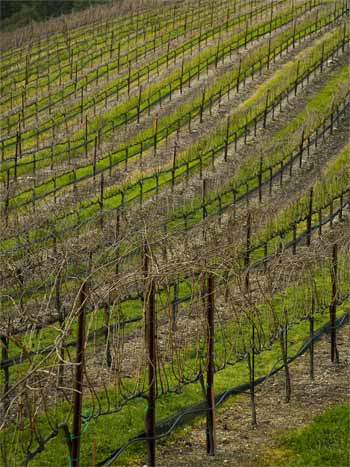
I often find that selecting an elevated viewpoint and then composing to cut out the sky works well. This approach heightens the sense of drama and ‘stacking’ inherent in a lens of this length, such as in this picture taken the other day of some local vines just before spring pruning:

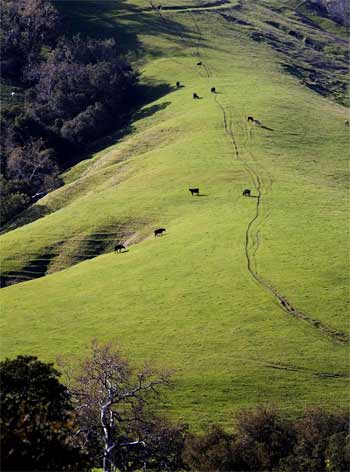
Another example of an elevated viewpoint, looking down into the valley in afternoon light is this one:

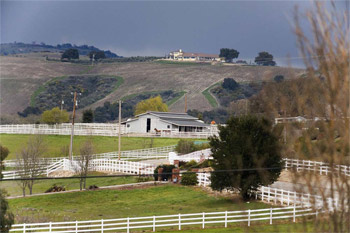
And finally, a strongly receding subject like this is only made bolder by the long lens:

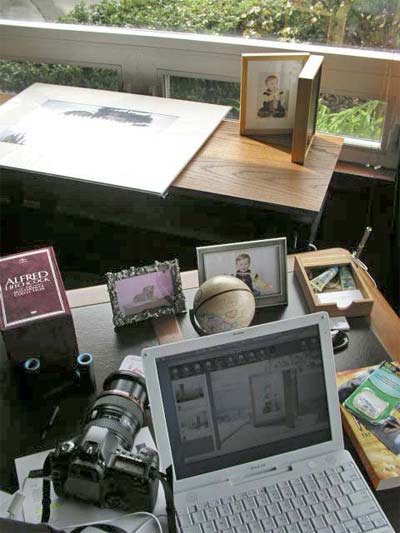
Go longer, meaning 400mm in my case, and things get shakier. Literally. There’s more bulk to manhandle and more lens length for the wind to bear upon. It’s not that my 400mm lens is bad – it is not – but I have very rarely managed sharp large prints from it using film as they were nearly always plagued by definition-robbing camera shake. 400mm is long! The new ‘film speed’ opportunities offered by the full frame sensor in the Canon EOS 5D, even at 1600 ISO it’s near noise free, have literally brought my old Leitz 400mm f/6.8 Telyt back to life, once it was suitably adapted for use on the Canon body. This was taken at 1600 ISO and I think the shutter speed the camera selected was 1/1000th. Hand held with no support, the original is wonderfully detailed:

Now while there may be an ‘auto everything’ Canon 200mm L lens in my future, it’s really a pleasure to see these old Leitz 200mm and 400mm warhorses getting a new lease of life.

Canon’s EOS Capture

Instant digital gratification?

I messed about some more with the software Canon provides with its 5D camera, Digital Photo Professional (DPP). You know the application with all those comedic spelling errors.

Well, I found more spelling errors, true, but I got to wondering about the little USB cable Canon provides with the camera that plugs into a receptacle under that silly flap on the side.

After installing DPP on my iBook, I plugged the camera in and switched the ‘Communications’ option on the Tools menu on the LCD from ‘Print/PTP’ (the default) to ‘PC Connect’. That really should read ‘iMac Connect’ but I’ll let it go. With the camera switched on, go to DPP->Tools->Start EOS Capture on the iBook and you are ready.

Take a snap in RAW format and, hey presto!, the picture appears on the iBook’s screen. It works as well in Jpg mode. You see the snap on a full screen where you can actually gauge sharpness, focus, exposure and so on, as opposed to the small LCD screen on the back of the camera where you mostly see your nose in the reflection.

For a studio photographer, whether taking product pictures or using live models, this strikes me as the bee’s knees in functionality. The pictures are automatically transferred from the camera’s card to the computer while all this is going on. Thus a smart pro could have his studio assistant view the screen shots and provide instant feedback allowing corrections to be made. After all, said assistant no longer has anything else to do as he’s not loading film any more. And you thought Polaroid invented instant gratification?

With the camera set to the lowest quality Jpg setting, a sharp picture pops on the screen in 3 seconds; with RAW it pops up blurred in 5 seconds and takes another 10 seconds to sharpen. There’s quite a bit of processinbg going on in this case and, let’s face it, my iBook’s 1.42 gHz processor isn’t the fastest on the planet. The timing with RAW + low quality Jpg is similar.

A separate panel on the iBook’s screen also appears allowing you to set many of the cameras settings using the keyboard, such as aperture, shutter, ISO, image quality. Most intriguingly, you can also enable a timer automating shots with stated intervals. Maybe astronomers will like this sort of thing?

The cable provided is ridiculously short – some eighteen inches – as to be unusable, but that’s nothing an extension cable cannot fix.

Postscript: I tried this set-up with a 15 foot long USB extension cable using my iMac G5 which has a 2 gHz Power PC processor, 2 gB of memory and very fast video processing. A sharp RAW image is displayed in 5 seconds, highest quality Jpg takes 3 seconds and lowest quality Jpg is around 1.5 seconds. These times suggest this would be an extremely capable studio installation as, by the time you have set the camera down to look at the monitor, the image will be there.

Robert Capa

Blood and Champagne – book review

I recall approaching this book with the thought that Capa was not really a very good photographer. I came away thinking otherwise, realizing that what makes a war photograph ‘good’ is not beautiful composition or perfect lighting or wonderful technique. No, the act of being there and recording the moment is what makes a war photograph good and no one bested Capa at that.

This book does not include any of Capa’s pictures, being an unauthorized biography. No problem. Just go to the Magnum Photos web site to see hundreds of examples of his work. Alex Kershaw does a fine job of writing a gripping narrative which at the same time is well researched. While the book could do with fewer asterisked footnotes, the quality of research is never in doubt and the writing never dry or academic.

Capa, the man, clearly suffered from what we would now call an addictive personality. His determination to be at the latest war front speaks to his addiction to adrenaline. In between, there was the incessant gambling, the boozing and the women. The gambling nearly bankrupted the agency he founded with Cartier-Bresson, Chim Seymour and George Rodger, Magnum Photos. The boozing was tediously incessant. The women ranged from Ingrid Bergman to Parisian streetwalkers.

Yet what a life the man lead. From the Spanish revolution, where he was in the thick of the action on the Republican side, to the D-Day landings on murderous Omaha Beach, to Viet Nam which took his life, he swallowed his fear and waded into the front lines of action. Kershaw forthrightly addresses the question of whether the famous picture of the Spanish Republican soldier at the moment of death was faked, coming away uncertain. I think it was, having seen some purported contacts of the film roll years ago in a reputable British photography magazine which showed the soldier ‘dying’ half a dozen times in succession, but it’s hardly likely that Magnum, or whoever owns the negatives, is going to release them if that is the case. No matter. One or two fakes in a life as prolific as Capa’s can be forgiven.

He also recounts at considerable length the D-Day story, where Capa went in with the first wave on June 6, 1944, carrying two Contax cameras and a Rolleiflex, taking but 79 pictures. Not surprising he took so few. Capa was a studied photographer who knew not to waste film and knew even better that the goriest images would never pass muster with the censor at Life, whose audience was Middle Americans who wanted their war sanitized. Kershaw relates how a darkroom technician fried the films when drying them, leaving but 11 frames useable, 9 of which were published. To Life’s eternal discredit, the magazine blamed Capa in print, saying the majority of pictures were too blurred to reproduce.

Later, having taken the required five training jumps, Capa parachuted in, yes parachuted in, with the 17th Airborne over Wesel on the Dutch border, in March 1945. Stunning courage. He was armed with his cameras and a spare pair of underpants into which he admitted having to change upon landing!

That his life ended in 1954 at the age of 41 is hardly surprising. First, he was feeling pressure from up-and-comers David Douglas Duncan and Larry Burrows. That meant just one more war. Second, he was, as ever, broke and in need of money. Third, his unwavering dedication to being in the front lines meant that sooner or later the inevitable would happen. So Capa, his best work done, trod on that fatal land mine.

“It’s not enough to have talent”, Kershaw quotes Capa as saying, “You also have to be Hungarian”.

This is a gripping story. The book is available from Amazon.

Noise

Shutters are all over the board

Over the years I have owned cameras from across the noise spectrum, by which I mean the noise the shutter makes when it’s tripped has varied from near silence to cacophonous. From a gentle whisper to a metalllic explosion.

For the most part, it’s fair to assume most photographers would agree that noise is not a good thing. Not only does it distract and cause vibration, there’s something just wrong about it. It’s in our genetic make-up. Why do you think the costliest real estate is invariably in the quietest locations, be it Fifth Avenue mansions with one foot thick stone walls or the sweeping estates of the Bel Air with the nearest neighbor hundreds of yards distant?

Silence, then, is a premium priced attribute, yet that fact seems to have escaped many camera manufacturers. Thinking back, the large Pentax 6×7 I owned years ago had the most wonderful lenses, yet the only truly sharp results I obtained from it were when it was used with a studio flash, with which it unfortunately synchronized at very low speeds. The problem was that tripping the shutter set off an explosion so loud, that people a hundred yards distant would duck for cover wondering which cowboy had come to town, guns blazing. So nice as that big negative was, and it fit 16″ x 20″ paper near perfectly, the camera had to go. The ten explosions a roll plus the onset of carpal tunnel from trying to hold this beast to eye level, not to mention hearing problems, were simply too much.

My large format gear is at the other end of the noise spectrum. In fact the lens shutters are so nearly totally silent, an illusion enhanced by the distance of the shutter from the operator and the huge space between lens and film which acts as a baffle, that sometimes I wish the shutters were a tad louder. Take the time I was photographing by a waterfall. Did that shutter trip or not? In other words, a crucial element essential in the design of all machines, feedback to the operator, is missing. It’s the same problem that makes using a silent keyboard so difficult.

Engineers will point out that noise is not just sound. Rather, it’s a collection of sounds of varying frequency, volume and duration all mixed together. So while I have no idea what the optimal mix is, I do know that higher frequencies are not a good thing as they tend to amplify the apparent noise too much. On the other hand, too much low frequency sound, is just as bad. As it takes far more energy to generate a loud low frequency sound than a loud one of high pitch – compare a cello or double bass to a violin – too much of the low stuff means something is moving hard and fast. Like a mirror thudding into a frame, protected only by a strip of neoprene. That spells vibration.

The second noisiest camera I ever owned was the Rollei 6003 medium format single lens reflex. What with the large instant return mirror, the electrical diaphragm and the motor yanking the film to the next frame, you could not be inconspicuous using one of these beasts. Rollei must have done something right with damping and vibration control, however, as even images at 1/15th or 1/8th second on a solid tripod showed no blurring from camera movement. And as a studio camera par excellence there’s an argument to be made in favor of noise as the subject knows that the picture has been taken. There’s that feedback thing again.

The Nikon F wasn’t bad. Like everything else about the camera, the noise was purposeful. No nonsense. “Built to last” was the thought that came to mind when operating this brute of a camera. The Leicaflex SL that succeeded it in my tool kit gave the exact opposite impression. Tinny, limp-wristed, you always wondered how long things would last before the next trip to the repair shop. Quite a contrast to the magnificent solidity of the lenses.

The screw thread Leicas rangefinder were always far noisier than you expected. While their “clack” was not that obtrusive, it hardly meshed with the Leica’s reputation as a stealth camera. The M3 and its successors were superior, though I always wished they were quieter, especially with that irritating shutter bounce on 1/15th and 1/30th, which every mechanical shutter M has had. The best in this regard was the M6 I used for several years which had a zinc top plate replacing the brass in the M2 and M3. Brass is ideal for chrome plating, but my M6 was black, so zinc was used as a cost saving. That camera had a beautiful shutter sound, sadly not matched by its build quality which was dramatically inferior to the M2 and M3. Plus the quick jam loading system was an absolute catastrophe – you had to crimp the film end to ensure it did not slip out of the stines meant to grasp it. So the M6 moved on, but not on account of its shutter sound. With any mechanical Leica M (I have not used the electronic M7) you get wonderful tactile feedback from the shutter release, to the extent that you know exactly how much pressure is needed to trip the shutter. Worth its weight in gold, whether on the street or in the studio.

The Canon EOS 5D is nothing to get excited about either way. The timbre of the noise is not objectionable, the volume is middle of the road, but you are going to be noticed when you press the button. For an electrical release, feedback is not bad. The first pressure to lock in focus and exposure is easily distinguished from the second which releases the shutter. There’s not that progressive feel of the Leica M’s shutter release, but it’s a worthy effort.

Setting aside the minority audience for large format cameras, the two quietest shutters I have used were from opposite camps. The one on the Rollei 3.5F was purely mechanical and wonderfully quiet. Feedback was not the greatest, not helped by the awkward location of the button, but it was a joy to use and hear.

The other was in the Mamiya 6, also a medium format camera. This one is purely electronic, the shutter release is actually an electrical switch, with all the challenges that poses for feedback design. Owing to an absence of a flapping mirror and the use of between the lens shutters, the camera was simply wonderfully quiet and what you did hear was just right.
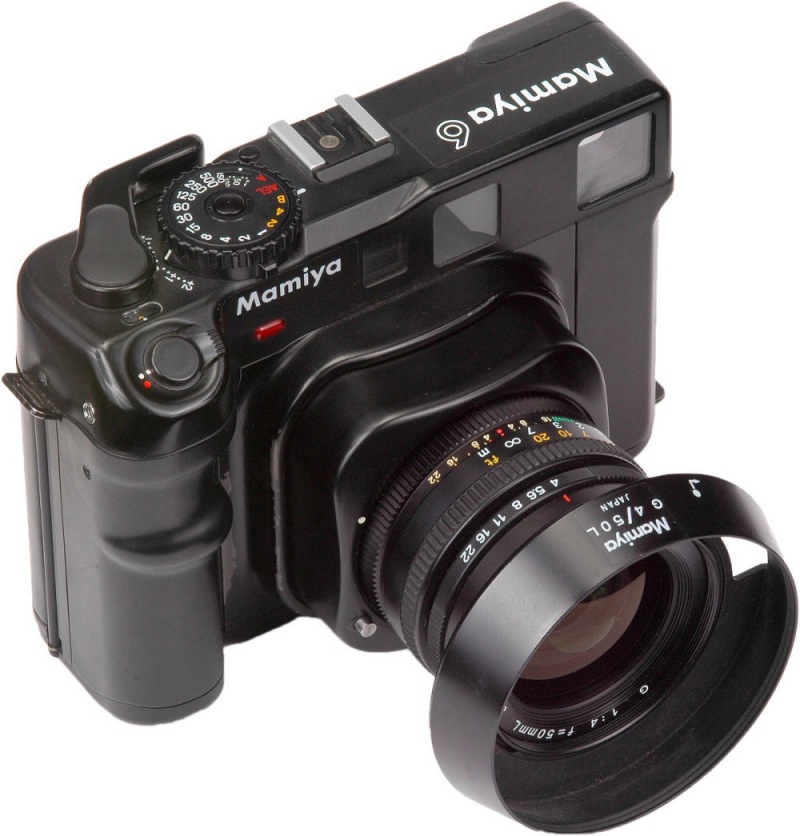

Mamiya 6. Noise? Just right.

Before closing, I have to say a word about the shutter in my Olympus 5050Z point and shoot. Near silent, Olympus felt obliged to add an option of an electronically generated shutter sound. This emanates from the camera’s speaker after the shutter is pressed. Unfortnately, it comes so late that it’s tomorrow by the time you hear it. Add the huge shutter lag and you have an example of how to get it dead wrong. Needless to add, the shutter release button has such poor resistance design that accidental exposures become the order of the day. At least you can switch off the electronic shutter noise.

So, camera designers, in my next camera I would like the sound of the Mamiya 6 with the tactile feedback of a Leica M2 or M3, with some of the overtones from the M6 for reassurance. The gun makers can use the Pentax 6×7 and Rollei 6003 as reference for their latest efforts. And the people at Olympus have some learning to do.