Yearly Archives: 2011

Tattoo you

Ugh!

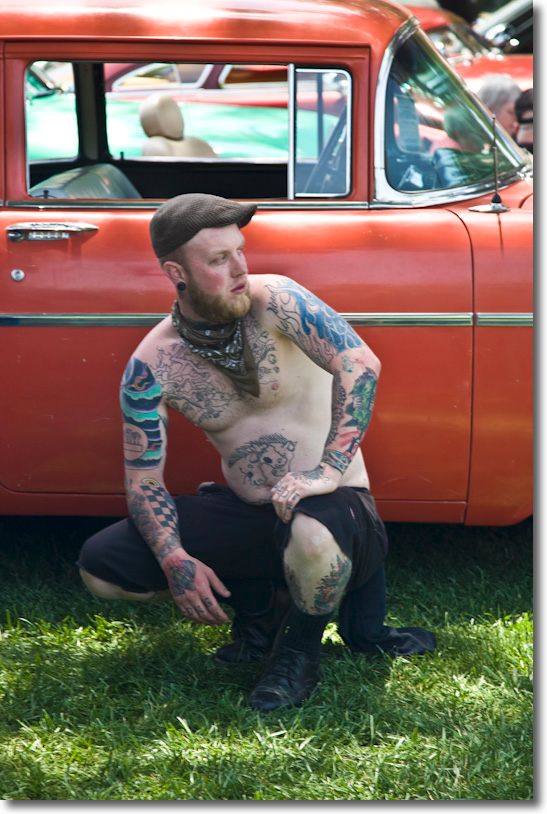
I used to think that tattoos were the province of the dregs of society. You know, white trash. (They tend to show poorly on non-white skin ….) Then many years ago I learned that Kind Edward VII of England sported one on the royal behind and realized that poor taste was classless and universal.

The problem for those making a commitment to being voluntarily scarred for life is that the things are very hard to remove. Further, you had better be sure about your loved ones because that tribute to ‘Violet – ’til death do us part’ tends to get a bit old when you find her in bed with your best friend, and the heart on your chest lovingly pierced with an arrow proclaiming ‘Mother’ takes on a new meaning when you find that when the old lady croaked, she left her not inconsiderable pile to the local humane shelter, dashing your visions of that new sports car.

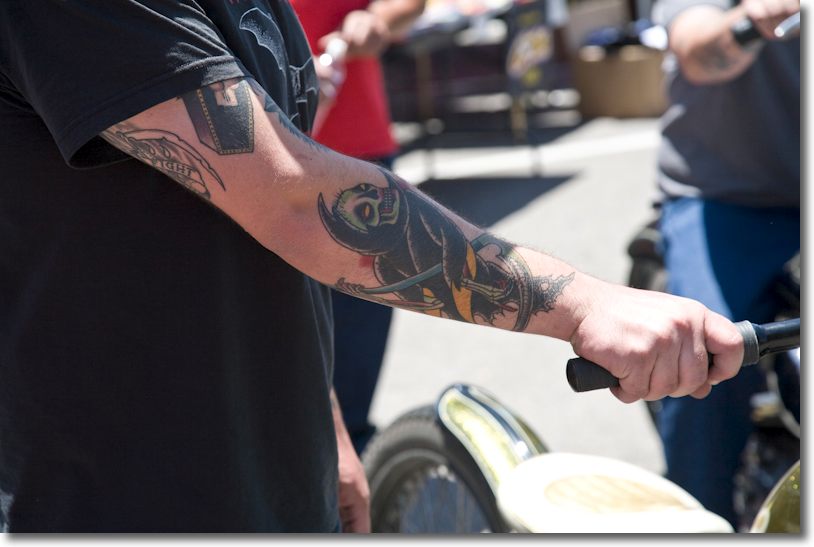
Here are a few of the more colorful irreversible indiscretions I have chanced on in recent times:

Bikers. G1, kit lens @ 28mm, 1/640, f/7.1, ISO320

The car painter. 5D, 24-105mm @ 90mm, 1/90, f/4.5, ISO 125.

Full throttle death’s head. 5D, 24-105mm @ 100mm, 1/500, f/5.6, ISO250

Weddings by Buissink

A true master of the genre.

While I have never wanted to make so much as one penny from taking pictures, I greatly respect those who do.

It’s a very tough way of making a living, made tougher in the digital age of “anyone can take a picture”, whereas in reality the percentage of camera owners who can do so has never been lower. Aunt Nellie with her POS point-and-shoot will make sure that the bride’s dress is eyeball searing white, not an iota of detail left in the trashed highlights and the groom’s tails will be every bit as lacking when it comes to detail in that expanse of black. Of course, there’s a good chance that everyone’s eyes will be closed and there will be a tree growing out of the bride’s head. There’s a reason Nellie’s pix are free and an equally good one why a real pro charges a great deal for his services.

Other than fashion photography where only a handful make a real living, surely one of the toughest fields has to be wedding photography. Except perhaps in Hollywood, there’s no repeat business for the most part. The stress is enormous. The photographer has to be a master orchestrator of diverse personalities on what is, for at least two of the participants, one of the most stressful days of their lives. The one trying to look her best and weak from all the fasting and exercise, the other trying to disregard the hangover. And the pictures must come out. Failure of equipment or technique is simply not an excuse. Further, everyone now expects to see the proofs at the reception after the wedding, so the photographer is running on fumes for the best part of a day. And did I mention the videos? Not my idea of fun, so when I see work of this nature done at an exceptional standard, my respect for the photographer is immense.

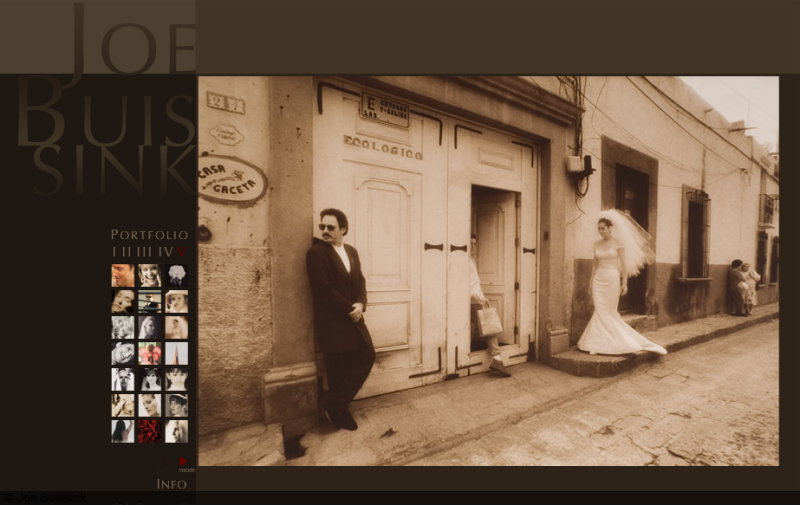
While it’s not a genre I’m especially into – it’s not like you search out wedding snaps to enjoy good photography – I know great work when I see it and none is better than that of Joe Buissink, a high-end wedding photographer in southern California. His work transcends the mere record which is most wedding photography and becomes art. The pictures are great despite the subject.

Here’s an example of the man’s art, taken from his web site. Cartier-Bresson would be proud of this one:

Click the picture for Joe Buissink’s superb web site.

No, you will not find ugly or fat (or ugly fat) people on his site, and for that we should all be truly grateful. His women are gorgeous, the way they should be on this most special of days in their life. His men are handsome. And the children properly dressed and simply divine.

The StackShot

Stepper for macros.

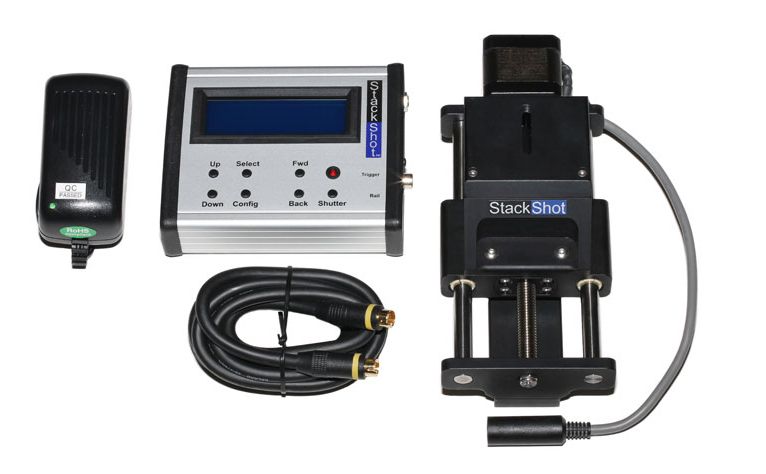
It’s a little strange to be writing a column about macro photography when I just sold my Canon 5D and 100mm Canon Macro to a good home. Still, I found myself sharing some details about Helicon Focus with the new owner and notice that Helicon’s web site now refers to a device named the StackShot. This is a focus rail with a built in stepper motor which allows movement of the camera toward the subject in predetermined steps, all set on a small LCD controller.

I have not used the StackShot so cannot comment but what little there is from users on the web it seems to be a solid device. The value of such a device is with very small subjects – bugs say – where the camera movement between snaps has to be extremely small, owing to the high magnification and small size of the subject. The StackShot’s inter-photo interval can also be varied to permit proper recycling of a flash tube if you use one. The resulting images are then stitched together using HF in the usual way – a process rendered trivially simple by this superb application.

You can see an excellent video of the device in action, made by the manufacturer, by clicking here.

The StackShot kit.

The maker says that steps can be as small as 0.01mm and while it’s not cheap at $475, it does look like just the thing for those special subjects. For another $50 there’s a version with a USB port allowing control from your laptop, but I cannot figure out from the operating manual on their web site whether the software runs on OS X on a Mac.

Oooh! Balenciaga

What a show!

One hundred and twenty examples of anything in a show tend to cause overload in the viewer. How many Chinese urns, Renaissance oils or vintage cars can anyone take, after all?

So if I tell you that the Balenciaga show at the de Young museum in San Francisco was too small, that will give you some sense of just how riveting the output of the Basque haute couture master really is. The appeal of the oeuvre of this master designer to any photographer is clear. There is a special combination of art and craft, as seen in the best photographs. It’s not enough to make it. You have to make it fresh and new and original and breathtaking. You have to know how to use color and line and cut. And you have to make it well. It’s a skill which tests many disciplines. And the best of the best attracts the best photographers to record his work for posterity. Irving Penn, John Rawlings, Richard Avedon – a who’s who of fashion photographers did Balenciaga’s miraculous creations justice.

The show was simply thrilling. What was really so extraordinary was to realize just how quintessentially Spanish his designs are. If you know your Goya, El Greco and Zurbaràn, you will see them in the gowns time and again. The absolute show stoppers are the two bolero sequined jackets which are masterpieces of form and design. One is on the right in the first snap, below. And anyone who tells you there is nothing new to be had in the black cocktail dress has not seen the Basque master’s myriad renditions. Just beyond perfection, and made with an unsurpassable commitment to quality. The snaps are not great as the lighting was low and even at ISO 1600 I was struggling to keep the camera steady, plus they had a million guards waiting with arrest warrants if you were caught. What kind of BS is this “no photography” rubbish? Well, in true Spanish tradition, that was simply a red rag to this bull.

Look at the raincoat far right in the second picture – worn by Mona Guinness. Take something old and make it completely new. Stunning. Or the red shawl number in the last picture. (There was a black shrouded version but I couldn’t get a picture – it was like nothing I have ever seen). Can you wonder he kept his designs secret until the last moment to stop the Diors of the world ripping him off?

Severity of line and architectural construction and attention to detail were everywhere. One of the guards, catching me shaking my head in sheer disbelief, even engaged me in conversation and allowed as how he too thought the bolero jackets were the best thing there. The appeal of Balenciaga is universal.

The show was also a reminder of what it took to be a Balenciaga woman:

  • 5′ 6″ minimum
  • Size 6 maximum
  • 110 lbs or less
  • Wasp waisted
  • …. and married to great wealth

It runs through July 4. See it if you can.
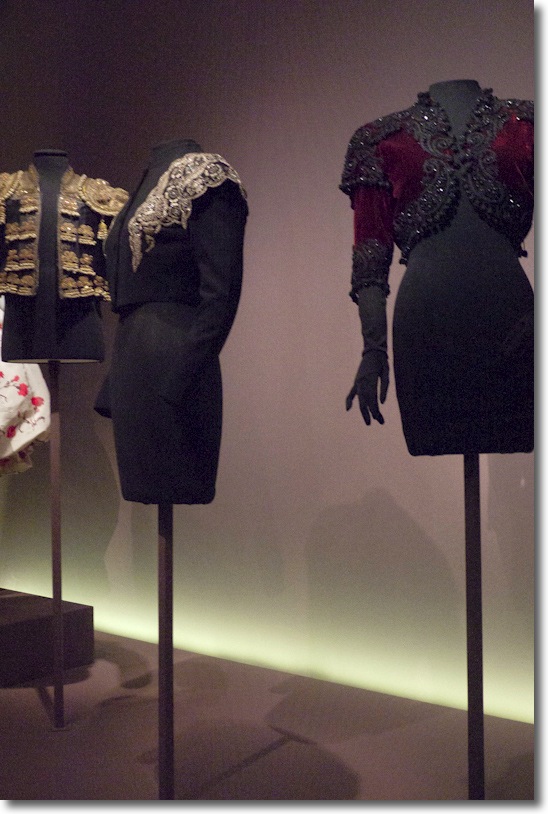
1/6th, f/4.4

1/8th, f/4
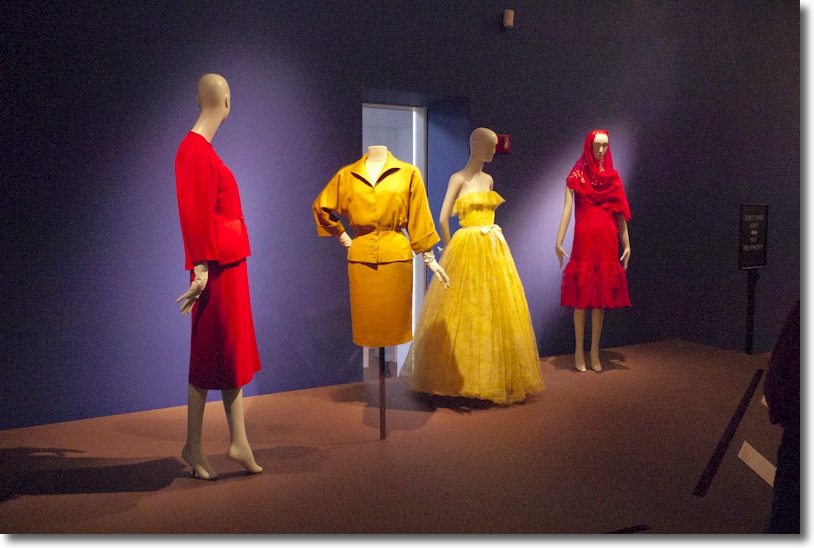
1/10th, f/3.5

All snapped on the Panny G1, ISO 1600 at 14mm on the kit lens. This is the first time I have rued not having an M9 with a Summilux …. after all, it’s a mere fraction of a Balenciaga original.

If you want a fine book with many pictures taken by Penn, Avedon, Horst, Beaton, Hoyningen-Heune, Rawlings and Cartier-Bresson (!), check here. Or just get the show catalog which is a bargain at some $45.

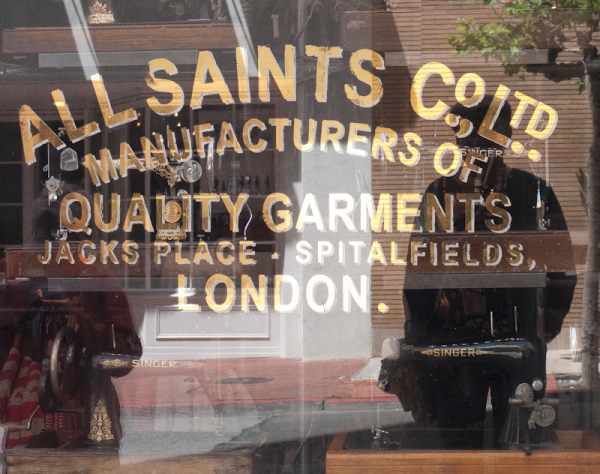
Sew me

Beautiful relics.

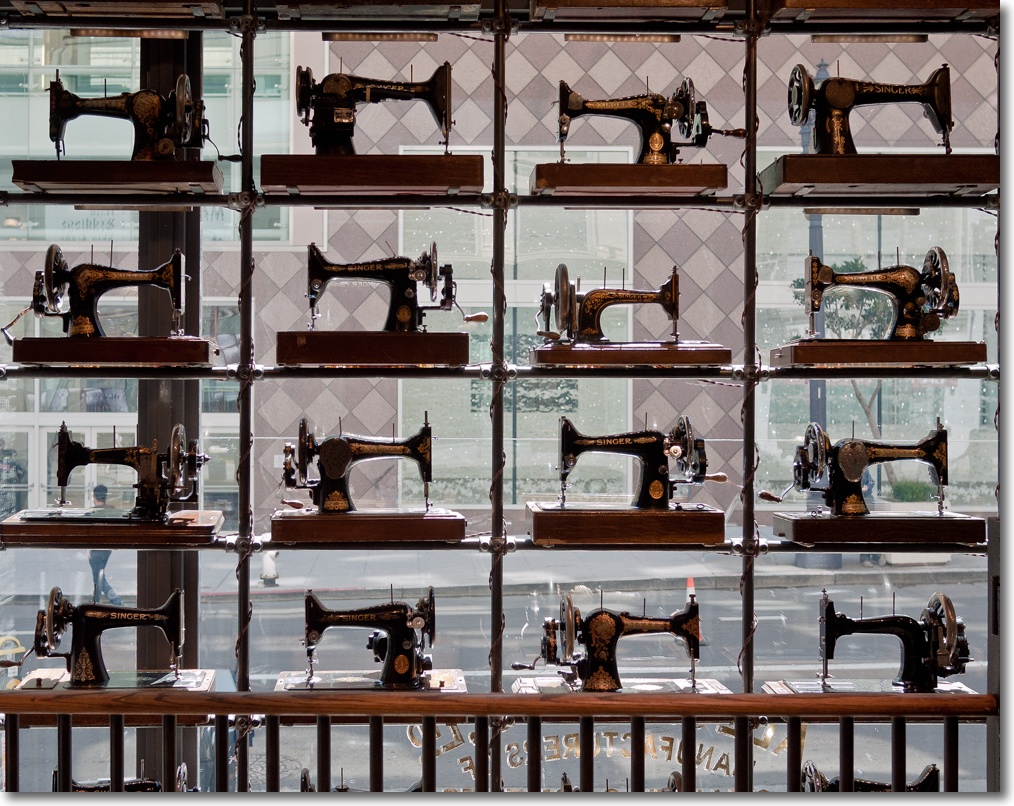
This store on Geary Street in San Francisco affects a ‘bespoke English tradition of tailoring’ image; in reality, the stuff inside is trashy clothing for teenagers. But who could fail to be drawn in by this exhibit of classic Singer sewing machines?


G1, kit lens @ 20mm, 1/320, f/2.8 ISO320.

It’s hard to imagine the size of the fortune made by Isaac Singer (1811-1875) with his great invention, which saw standardized parts used to make manufacturing as efficient as possible. Add the availability of installment payment plans and the business went ballistic. In the book “The Wealthy 100“, which computes American fortunes as a fraction of Gross National Product, thus rendering comparison between then and now meaningful, Singer ranks as the 52 wealthiest American ever; his partner, Edward Clark, who came up with the installment sale idea is at #33. Even then the world treated banksters favorably. $5 down and payments for ever on the remaining $95. By comparison, Bill Gates is at #31. Unlike Gates, Singer gave the world something that worked and worked well.

The store clerk told me they have 600 (six hundred!) machines all told and, looking around, I have no reason to doubt that. They were nice enough to let me take a snap from inside which shows the machines, each individually illuminated, at their best. These are objects of great mechanical beauty, as usable today as the day they were created.

The store is named All Saints and is at 140 Geary Street, San Francisco.