Yearly Archives: 2011

An excellent Photoshop CS5 book

Videos seal the deal.

I’m finding the help files in my recent upgrade to Photoshop CS5 frustrating to use. Often the chronology of steps to get to the point at which the Help file is invoked is missing, so you don’t know how to first get to where you are. So that got me searching for a better guide and, of course, there are so many books out there that it’s hard to know where to start.

So I resorted to looking at on line video tutorials among the many Photoshop podcasts on AppleTV. That was an even worse experience. Many podcasts do not cover CS5 and of those that do you are often stuck with someone who thinks he’s funny and spends endless time sharing his sense of humor with you at the start of the video. Frustrating. Then I chanced upon a teacher named Richard Harrington and found his narrative professional, correctly paced and on point. So I bought his book for some $35.
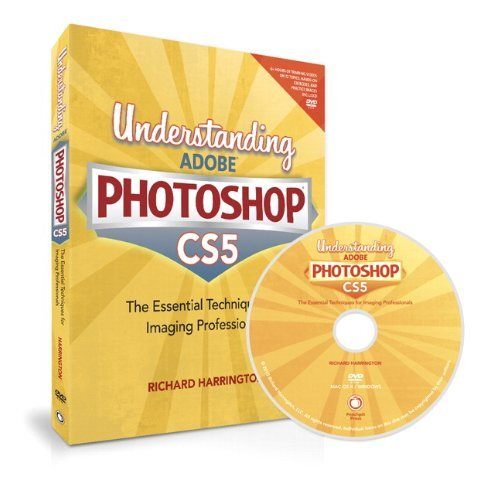
Click to see the book at Amazon.

The book itself is slim as these things go, at 300 pages, but the included DVD contains no fewer than 72 videos illustrating key techniques. These could be higher definition but they are well done otherwise. Additionally, there are quizzes on each of the sixteen chapters, reflecting the serious, academically-oriented thrust of this production. Further, there are many TIF files to allow the in book examples to be replicated hands-on. This is an excellent method of learning the essentials of this massively complex application.

I’m adopting the Pareto Principle, reckoning that I can get 80% of the power of CS5 by learning 20% of its content. Right now I’m at something like 10/2!

Harrington’s book and tutorials are recommended if you value your time and prefer professional tuition; you can get a sense of his teaching style by looking up his video podcasts online using iTunes. The definition of these is the same as that of the ones on the DVD, which is to say not great, but you can make things out.


The Balenciaga show

The pulse rises.

Update: My review of the show appears here.

How could anyone be less than thrilled at the prospect of seeing so many Balenciaga gowns in one place?

Watches have Patek Philippe. Cameras have Leica. Cars have Ferrari. And the most perfect clothes ever created have Basque designer Cristóbal Balenciaga. All marques in a Class of One and not a one remotely practical in the modern world. I confess to serious affairs with the first two, lust for the third and have come to the sad realization that a wearer of the fourth will not cross my path.

The photo for the exhibition at the DeYoung Museum in San Francisco, which showcases no fewer than one hundred and twenty Baleniciaga creations, is by the great American Vogue photographer John Rawlings, and if you don’t have the book of his work I suggest you rush out and get it right now.

Here’s how I saw it the other day in America’s finest city:

Poster for the Balenciaga show, Clay Street, downtown San Francisco.

More when I have visited the show.

Not for what?

Not for profit, my rear.

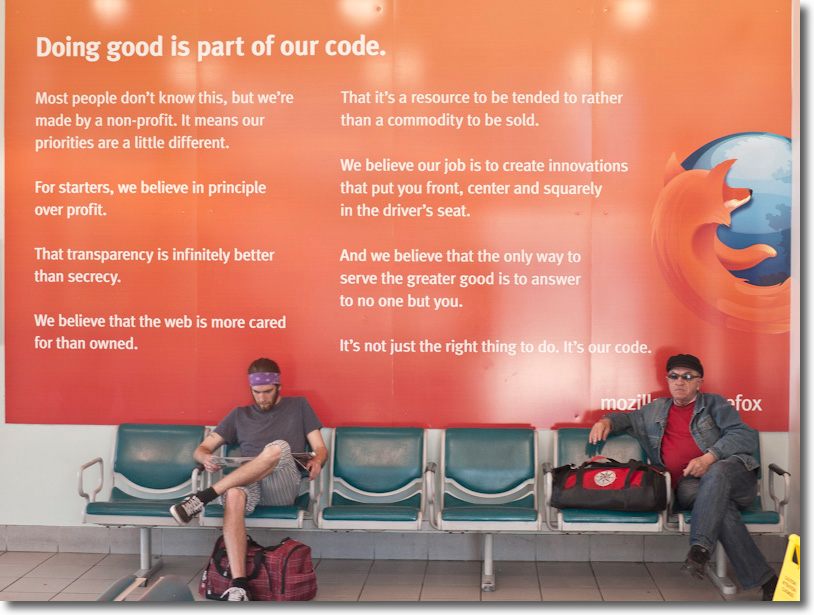
Get a load of this:

Mozilla at the Caltrain terminus in San Francisco – this tripe is everywhere in the station.
G1, kit lens @25mm, 1/25, f/5, ISO320.

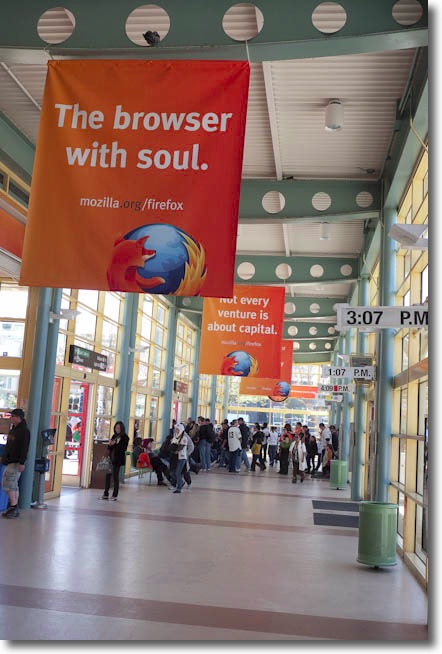
Why, I am asking myself, does a web browser software maker obliterate nearly every square inch of the Caltrain terminus at Townsend and 4th in San Francisco – I mean walls, floors and hanging flags so that you can no longer see the station clock – with the most tasteless ads proclaiming its genius and decency, never missing an opportunity to scream at you in foul orange that they are a ‘not for profit’. This is just about as credible were the US Defense Department proclaiming it exists for the greater good of the future of mankind. (Hint: It exists because of oil).

The reality must be that Mozilla is onto such a good thing that it has decided to blow tons of its profits on costly advertising to grow its net income further because, hey, you and I are paying for it. Here’s how it works. The Mozilla Foundation owns the Firefox product and has the not-for-profit status. The Mozilla Corporation makes a lot of money on the back of this stance. I’m not privy to their financials but would not be surprised to find that there are hefty ‘administrative’ or ‘management’ fees or some such tripe being paid by the Foundation to the Corporation, making sure the Foundation makes no net income. Hey, it’s a not for profit suddenly, both as organized (under section 501(c)(3) of the Internal Revenue Code) and as reflected in its financial statements. Likely the Corporation then pays out all net income as compensation to its senior people, the CEO of which sits on both Boards …. so you get to say you are ‘not for profit’ while living like Riley. And pay zero corporation tax into the bargain. Meanwhile you can proclaim to the whole world that the code monkeys writing the software are paid peanuts, and that’s true.

More about their structure here. By making Google the default browser in Firefox, Google ponies up likely north of $100mm a year to Mozilla – details here. Why bother with this money shuffling when you could simply overpay your executives from one corporate entity? Because excess compensation in a not-for-profit attracts far greater scrutiny from the tax authorities than any corporation’s pay check does. Have you seen the pay of US banksters’ recently? Has the IRS required a return of any of that egregious pay? No. And because there are millions naïve enough to buy the ‘not-for-profit’ claim, they use Firefox for that reason – meaning they are unwittingly suckered into using Google for search – and allow Mozilla to get more money from Google for directing you to Google’s advertising.

Meanwhile, by all means use Firefox if it works for you (the latest Version 4 has almost caught up to Safari as regards speed, having been in the slow lane for ever, and its use of fonts still needs work). But don’t use it in the mistaken belief that related advertising dollars are making their way to feed the world’s poor.

Moral of the story? Wherever Google is involved, get your BS meter out. Google’s culture of theft is deeply ingrained and spreads its tentacles to those who do business with it, like Mozilla.

This nonsense is everywhere in the Caltrain station.
“We believe in principle over profit”. Excuse me while I vomit.

….you can’t even see the station clock.

So if you find one of your favorite train stations suddenly obliterated in puke orange, sanctimonious, self-serving advertising, smell the rat, and don’t buy the message. Your city and nation is being robbed of millions of tax dollars and you and I pay the shortfall. Welcome to the Hall of Shame, Mozilla.

And as the next picture shows, they make a Freudian slip and admit it!

Posters on the floor!

Nob Hill

Phew!

Take my advice. If you really must make your way uphill from North Beach in San Francisco, up Powell Street to Nob Hill, take the cable car. I pushed my bike all the way up and if you see camera shake in this image, it is on account of my heart rate which was ticking along at some 200 per. None of this was helped by the parking garage behind me which boldly stated that parking was $12 for the first hour and $52 a day maximum.

Still, I managed to get my wits about me, wiped the perspiration off the brow, leaned on the old two wheeled steed and snapped a picture of one of the costliest residences on the west coast. No one said Nob Hill was cheap.

Nob Hill home. G1, kit lens @38mm, 1/100, f/6.3, ISO320.

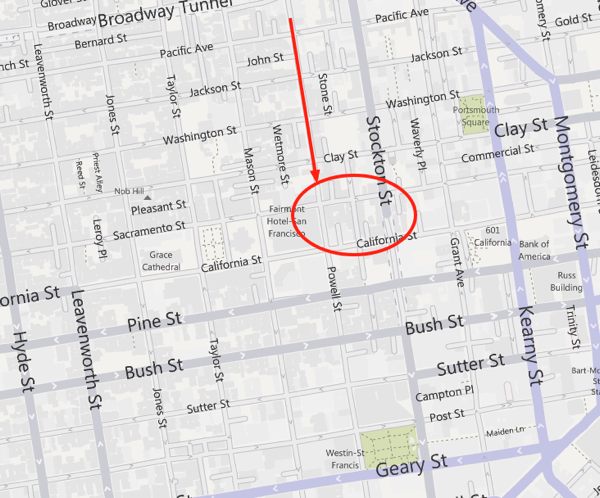
Here is the location and the direction along which I suffered my coronary: