Category Archives: Photographs

Redrum

A memory of a tour de force.

I suspect many might agree that the scariest film ever made is Kubrick’s ‘The Shining’ with a manic Jack Nicholson generally waging mayhem in an off-season holiday hotel.

For fans of Diane Arbus’s work there’s an image of the two little girls side by side, just like in her photograph. Right before the room fills with blood, that is.

The opening scene, where the camera seems to go off a cliff while the car it’s following proceeds straight on, is one of the first uses of the Steadicam in motion pictures. Right at the beginning, it will have you gripping your seat for the next 2 hours. I saw ‘The Shining’ in 1980 when it came out and am still too scared to risk it again. But the many images in the movie have stuck in my unconscious, not least the child on the tricycle mouthing “Redrum, redrum”. Check it in the mirror ….

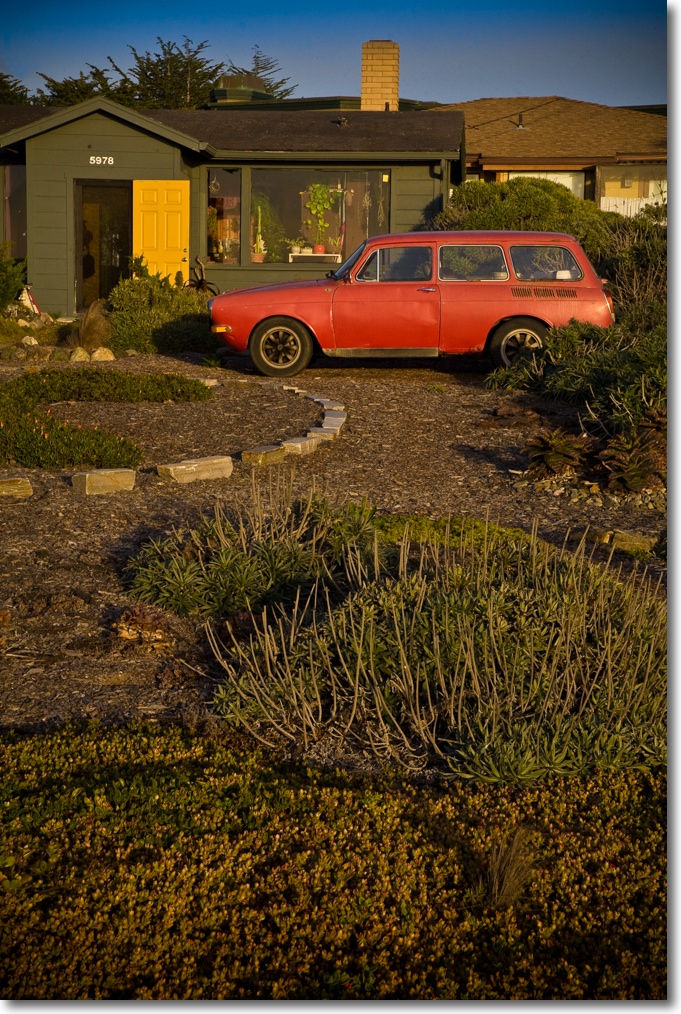
Well, I still have Redrum Moments of flashback to the movie and the latest happened the other day in late sun.

5D, 24-105mm at 73mm, 1/180, f/16, ISO 400

Quite what this bizarrely colored VeeDub was doing in someone’s garden beats me, but you cannot beat the scary contrast of colors, pretty much unretouched. And that open door does little to calm the tension.

More Helicon macros

Make your macros sing.

I wrote about Helicon Focus recently and for this new inductee to the macro world it’s fair to say that the software opens up new realms in macro photography. This application requires that you take several pictures of your subject, each focused slightly differently, after which it applies some serious processing to stitching together the sharp zones of each into one sharp whole. Magic!

Now your subject must be still and you need to use a tripod (unless you are very lucky doing this handheld, which I think is a long shot) to permit proper stitching of the sharp zones from your constituent images.

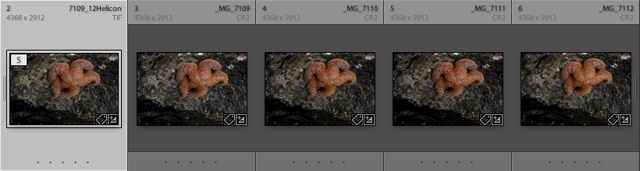
I import the originals into Lightroom in the normal way and stack them using the ‘time between pictures’ slider, which allows automatic stacking of pictures taken close together. I then export the stack in TIFF, making sure there are no export size constraints in the Image Sizing section of the export panel. The exported images are then dropped into Helicon Focus, I hit ‘Run’ and ‘Save’, then import the composite image back into Lightroom where it is added to the top of the stack, like so:
The deeper the required depth of focus the more images you need. For reasonably square on subjects with some depth I find 3-5 images works fine. For more drastically sloped ones, more may be needed. Digital film is cheap! Take too many rather than too few. The processing times in Helicon on my MacBook (C2D) are short – four uncompressed 72 mB TIFFs are combined into one new one in the space of thirty seconds. These are full frame TIFFs generated by Lightroom from the RAW originals taken on my Canon 5D.

Even though these images were taken at f/22, the close focus distance and the 100mm focal length of the Canon macro lens make for very shallow depth of field, so I simply set the lens to manual focus, focus on the nearest part of the image and take a picture, repeating with a small adjustment of the focus ring every 8 seconds, the time it takes for my ring flash to recycle to full power. That’s important – you really want your images identically exposed.

And here is the result – taken yesterday after more time spent wading in the tide pools at my top secret Highway One location on the Pacific coast, 22 miles west of home. This chap was hanging out on the underside of a big boulder waiting for high tide. If you do this sort of work, check the tide tables before you go – the best being revealed at low tide. He is maybe 3″ in diameter.
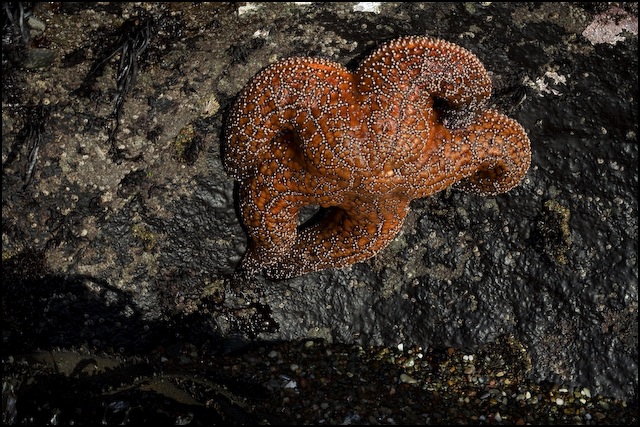

Starfish. 5D, 100mm macro and ring flash, 1/60, f/22, ISO 400, tripod. Four constituent images.

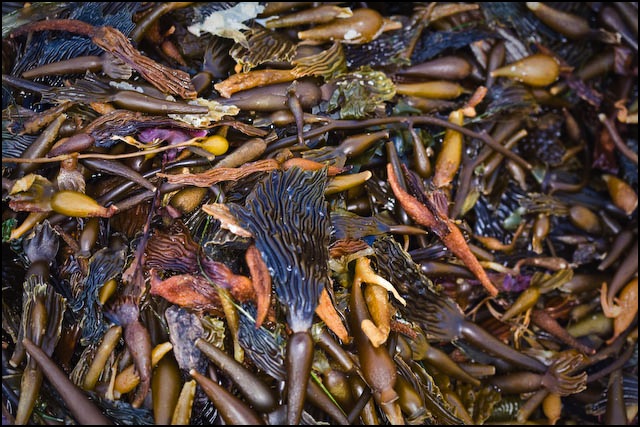
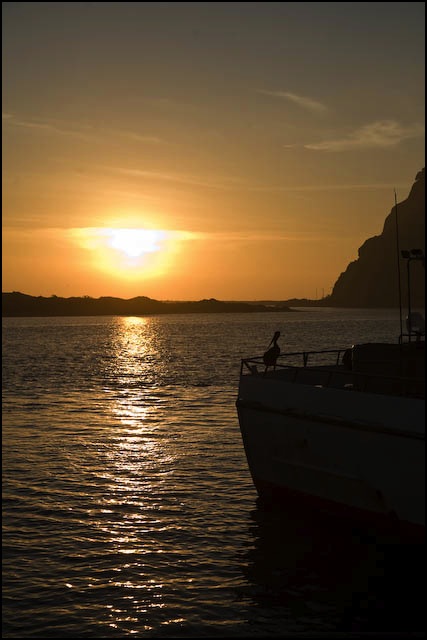
Do this sort of thing at sunset with glancing rays from the sun and add a touch of ring flash to reduce the contrast range and make all tones easily visible (much easier than doing HDR), and you get something like this:
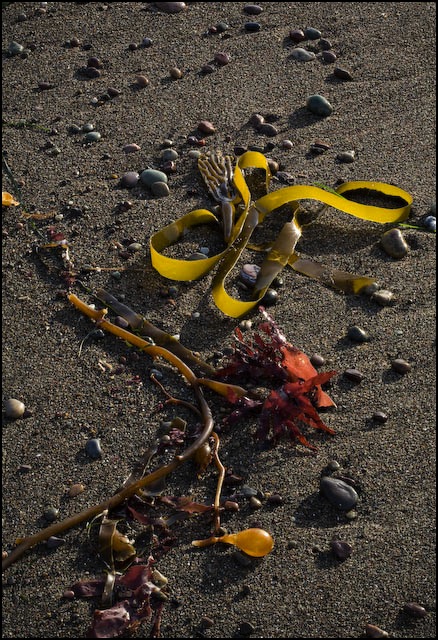

Kelp at sunset. 5D, 100mm macro and ring flash, 1/45, f/22, ISO 400, tripod. Five constituent images.

It’s no surprise if I tell you that the Canon Macro plus Helicon Focus are in the running for my Best Gear of 2008 award.

If you want to see Helicon Focus applied in the more traditional area of photomicrography, take a look at the beautiful images crafted by Charles Krebs.
One more step

America makes another huge step forward.

So much of the world so desperately wants America to be good and great again, that it bears recalling one of the ugliest times in the nation’s history, best characterized by this Dorothea Lange depression era picture.


Mississippi, June 1937

Some seventy years after Lange snapped this picture, bigotry and racism remain nascent in much of our nation, but we rise above this, moving on joyfully.

The bursting blood vessels, the guns, the bibles, the braying of hounds and the clinking of manacles become ever more distant as America once more has the opportunity of being a beacon of light and progress. The senescent purported ‘hero’ (when Americans say ‘hero’ they usually mean ‘victim’) and his boastful ignoramus of a running mate will now return to the cesspool whence they came, hopefully never to be heard from again. An America whose leaders denigrate education, intelligence and thoughtful reflection is not one I want anything to do with. Judging by yesterday’s polling, I am not alone.

It’s been a long time since January 20, 1980, the last time Americans proudly held their heads high and thought “This is what we stand for. This is the example we will set”. Since that time we have seen an America guilty of unilateral military aggression, the abolition of many rights granted us in the Constitution, and crimes of greed unparalleled in our short history. I, along with many of my fellow Americans, hope that the new administration will once more make America an example, not the pariah it has become.

Those who appreciate Lange’s iconic photograph understand.

Color abstraction

The mind’s eye

I can never resist this sort of thing – a tight collection of shapes, reflections, textures and a little color.


Panasonic LX1, 1/250, f/8, ISO 100. 16:9 Widescreen format.

The car’s price tag, visible in the original, states $28,888, so you can guess this was taken in the San Francisco Bay Area with its large Chinese population, the number ‘8’ being a symbol of good luck in that culture.