What America needs now.
It seems oddly fitting that this past Friday, the culmination of Wall Street’s (and America’s) worst week ever, that a friend should have sent me In the Shadow of the Moon, a NASA documentary about the twelve men who have walked on the surface of the moon.
In these digital days it’s hard to recall that the still photography gear used by these brave men was nothing more than a Hasselblad 500EL or two fitted with a long roll film magazine and upgraded with some low temperature lubricants to make sure nothing froze up. Americans, as cavalier with the environment as ever, concluded that it would be cheaper to dump the bodies on the moon than to bring them back to earth. Indeed, in the 1970s, the Victor Hasselblad company ran a classic advertising campaign pointing out that Hasselblads, lightly used, were to be had free. All you needed was a round trip to the lunar surface to get yours.
In this documentary you can see various moon walkers banging away with their 500ELs, a large digital counter clearly visible on the right side of the film magazine to remind them how many of their 200 shots they had used.
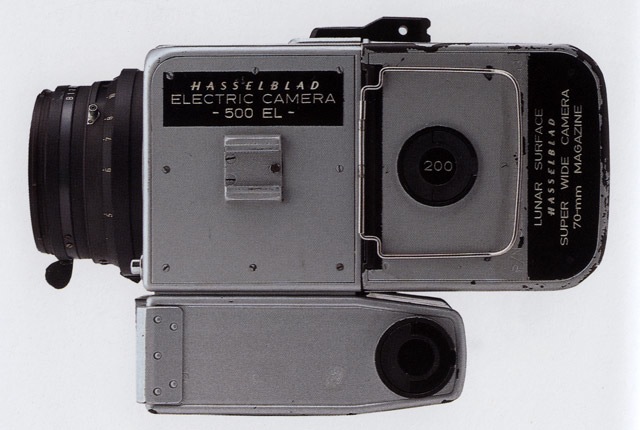
The Hasselblad 500EL model used by the moon walkers
This film has some so-so movie pictures (the technology of small movie cameras really was pretty mediocre back in 1969) and some tremendous still pictures. These astrophysicists, mechanical engineers and scientists, passing for astronauts, were so elevated by a shared spirit of ecstasy in their journey that their photographic skills rose magically to a new plane as the whole world rooted for America to pull off the Apollo 11 landing.
While most know of the great snap Armstong took of Aldrin, Armstong’s figure reflected in Aldrin’s face mask, there are two special moments that caught my attention. One is a movie frame showing the blast off of the lunar lander on its way to dock with the orbital module before returning to earth. I had never seen this and remember well the feeling of dread that there was only one chance to get this right. As the lander blasts off, the American flag in the lunar surface rocks mightily on its pole. Buzz Aldrin later reported that he glanced up briefly from his instrument checks and saw the flag fall over from the blast, something not visible in the video.
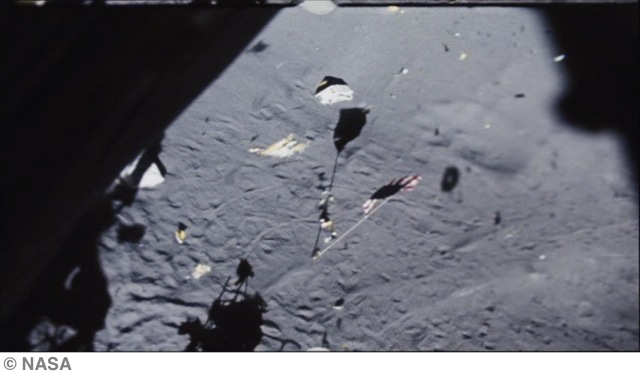
The Apollo lunar lander blasts off from the lunar surface, Old Glory in the blast
The other, also a movie picture, is easily the most beautiful and heart warming in the whole movie. For all their protestations about the beauty of the lunar surface, there is no disguising that the orb of earth from space is a very special thing, and the moment the parachutes deploy in a superb aerial shot, we are all united as one race sharing our adulation of this most perfect of places. This still frame does not begin to do that magical moment justice.
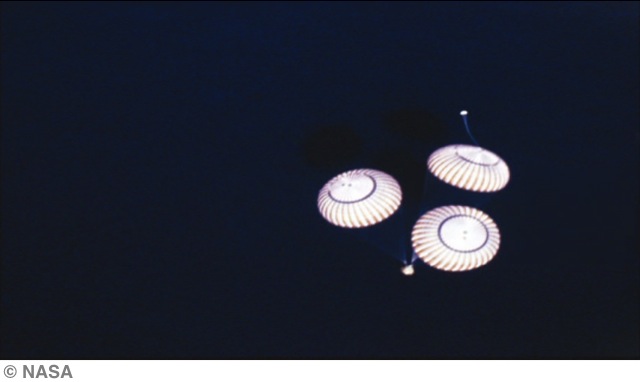
Apollo 11 returns to earth
On a broader scale, the Apollo program reminds us how strong leadership can inspire a nation and the world. The astronauts speak eloquently of their reception worldwide pointing out that, wherever they go, they are greeted with the words “We did it”. That sounds right. The greatest, most generous nation on earth did not seek to keep this to itself but wanted to share its joy and wide eyed spirit of discovery with the world.
Another point to note is the life changing effect the moon trips had on all concerned. Most speak eloquently and mystically of the experience and while logical thinkers will continue extolling Darwinian evolution over creationism, when you see that orb of blue and white approaching, well, you do tend to think of some sort of Supreme Being because it seems too perfect to maybe just have happened.
This is a special piece of film and photography and a recommended antidote to a period in which America’s bleeding is infecting the whole world. American hegemony may be fading, who knows?, but I have yet to encounter anyone, no matter how anti-American, who would argue that a world with Chinese leaders would be a better place.